Nombre total de pages vues

07/03/2019

Science et Technologie - Astronomy picture of the day : "Sharpless 249 and the Jellyfish Nebula"

2019 March 7
See Explanation.  Clicking on the picture will download
 the highest resolution version available.
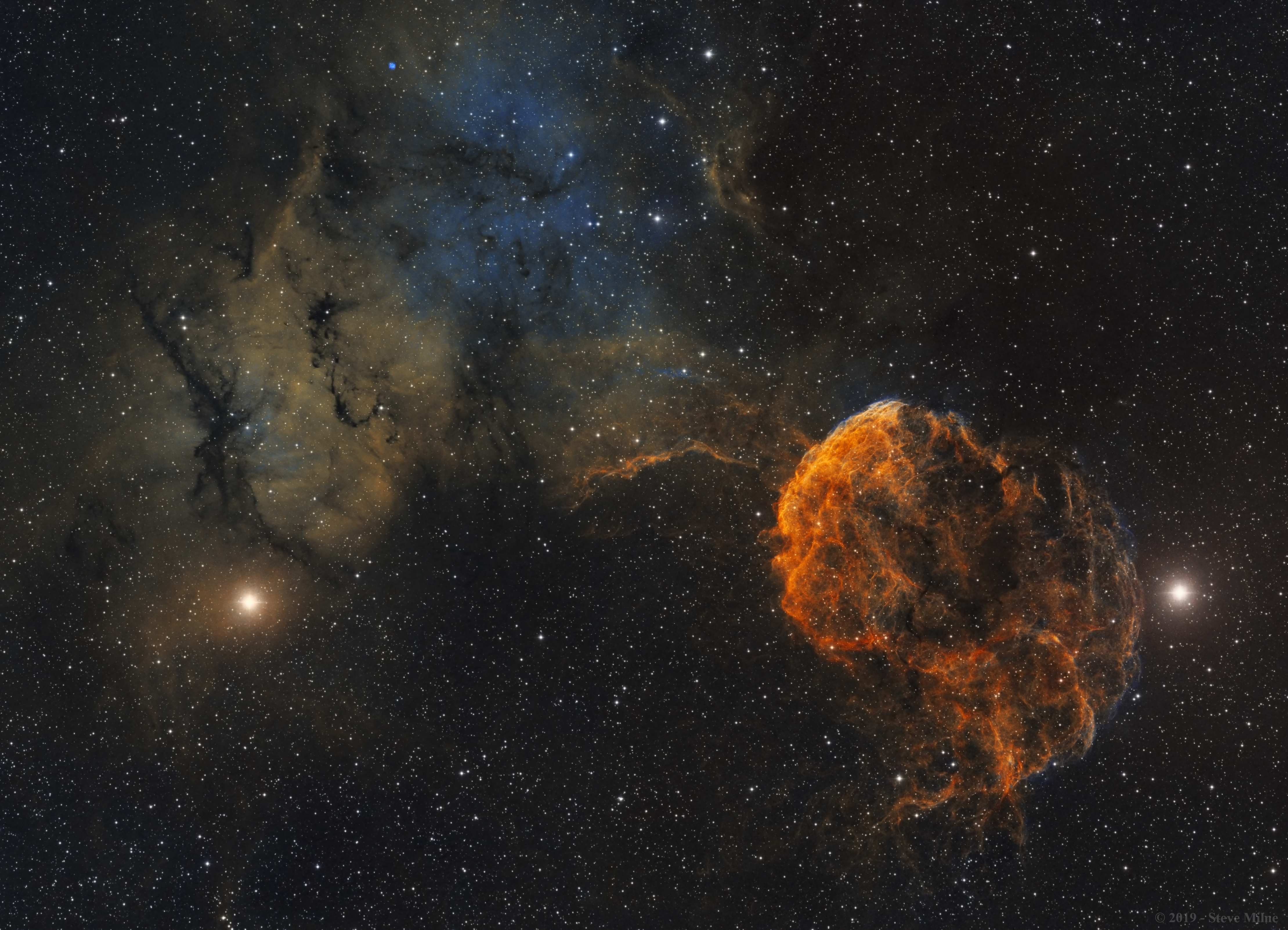
"Sharpless 249 and the Jellyfish Nebula" Image Credit & CopyrightData - Steve Milne & Barry Wilson, Processing - Steve Milne

Explanation: Normally faint and elusive, the Jellyfish Nebula is caught in this alluring telescopic field of view. The entire scene is a two panel mosaic constructed using narrowband image data, with emission from sulfur, hydrogen and oxygen atoms shown in red, green and blue hues. It's anchored right and left by two bright stars, Mu and Eta Geminorum, at the foot of the celestial twin. The Jellyfish Nebula itself is right of center, the brighter arcing ridge of emission with dangling tentacles. In fact, the cosmic jellyfish is part of bubble-shaped supernova remnant IC 443, the expanding debris cloud from a massive star that exploded. Light from the explosion first reached planet Earth over 30,000 years ago. Like its cousin in astrophysical waters the Crab Nebula supernova remnant, the Jellyfish Nebula is known to harbor a neutron star, the remnant of the collapsed stellar core. An emission nebula cataloged as Sharpless 249 fills the field at the upper left. The Jellyfish Nebula is about 5,000 light-years away. At that distance, this image would be about 300 light-years across.

Science et Technologie - Le monde minéral et ses trésors cachés : "Stromatolite de la mine de Corsica, Minnesota"

Stromatolite de la mine de Corsica, Minnesota
"Stromatolite de la mine de Corsica, Minnesota"
Certains stromatolites datent de près de 3,5 milliards d'années. Elles étaient présentes dans des eaux peu profondes. Il s'agit de la première manifestation de vie dont la trace nous soit parvenue.

06/03/2019

Ciência e Tecnologia - Saude e Medecina - Adeus mamografia : testes ao sangue para detetar o cancro da mama


Nos últimos tempos, vários centros de investigação estão na corrida para criar testes ao sangue para detetar marcadores de cancro da mama antes de este ser visível na mamografia. A Universidade de Heidelberg anuncia ter um teste pronto para entrar no mercado ainda em 2019.

Sarah Schott, do Hospital Universitário de Heidelberg, na Alemanha, está convicta de que o teste que a sua equipa desenvolveu estará disponível no mercado ainda este ano e poderá com grande vantagem substituir a mamografia na deteção do cancro da mama, pelo menos nas mulheres com menos de 50 anos.


Descrito pelos investigadores como "uma biopsia líquida" e "não invasiva", o teste, intitulado HeiScreen, já detetou 15 tipos diferentes de células de cancro da mama e tem ainda a vantagem de identificar o cancro antes de este ser visível através das técnicas de raios X ou ecografia. É também mais económico, requerendo apenas alguns mililitros de sangue e podendo ser feito em qualquer laboratório.

Diario de Noticias - Portugal

05/03/2019

Science & Technology - Astronomy picture of the day : "X-Ray Superbubbles in Galaxy NGC 3079"

2019 March 5
See Explanation.
Moving the cursor over the image will bring up an annotated version.
Clicking on the image will bring up the highest resolution version
available.
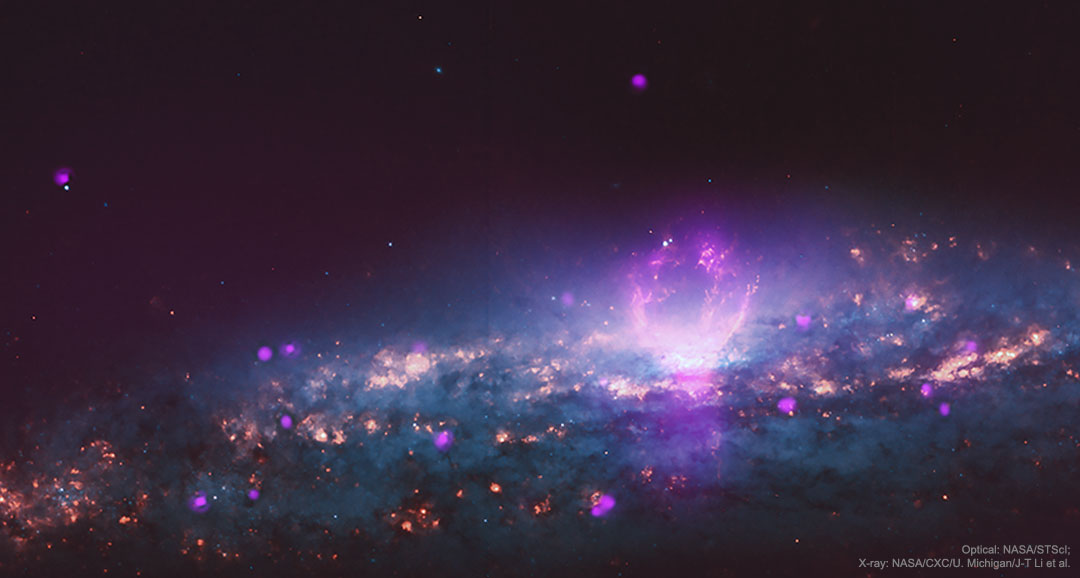
X-Ray Superbubbles in Galaxy NGC 3079 
Image Credit: X-ray: NASACXCU. MichiganJ-T Li et al.Optical: NASASTScI

Explanation: What created these huge galactic superbubbles? Two of these unusual bubbles, each spanning thousands of light-years, were recently discovered near the center of spiral galaxy NGC 3079The superbubbles, shown in purple on the image right, are so hot they emit X-rays detected by NASA's Earth-orbiting Chandra X-Ray Observatory. Since the bubbles straddle the center of NGC 3079, a leading hypothesis is that they were somehow created by the interaction of the central supermassive black hole with surrounding gas. Alternatively, the superbubbles might have been created primarily by the energetic winds from many young and hot stars near that galaxy's center. The only similar known phenomenon is the gamma-ray emitting Fermi bubbles emanating from the center of our Milky Way Galaxy, discovered 10 years ago in images taken by NASA's Fermi satellite. Research into the nature of the NGC 3079superbubbles will surely continue, as well as searches for high-energy superbubbles in other galaxies.

Science et Technologie - Le monde minéral et ses trésors cachés : Gypse et ses cristaux monocliniques

Gypse et ses cristaux monocliniques
Le gypse est un sulfate de calcium. Souvent enchâssé dans des marnes imperméables, il est alors préservé de la dissolution comme c'est le cas à Grozon, dans le Jura. Translucide, il présente ici, à la surface de ses parois, le contour de cristaux monocliniques.

Bruno Cupillard

04/03/2019

Science & Technology - Astronomy picture of the day : Celestial Alignment over Sicilian Shore

2019 March 4
See Explanation.
Moving the cursor over the image will bring up an annotated version.
Clicking on the image will bring up the highest resolution version
available.
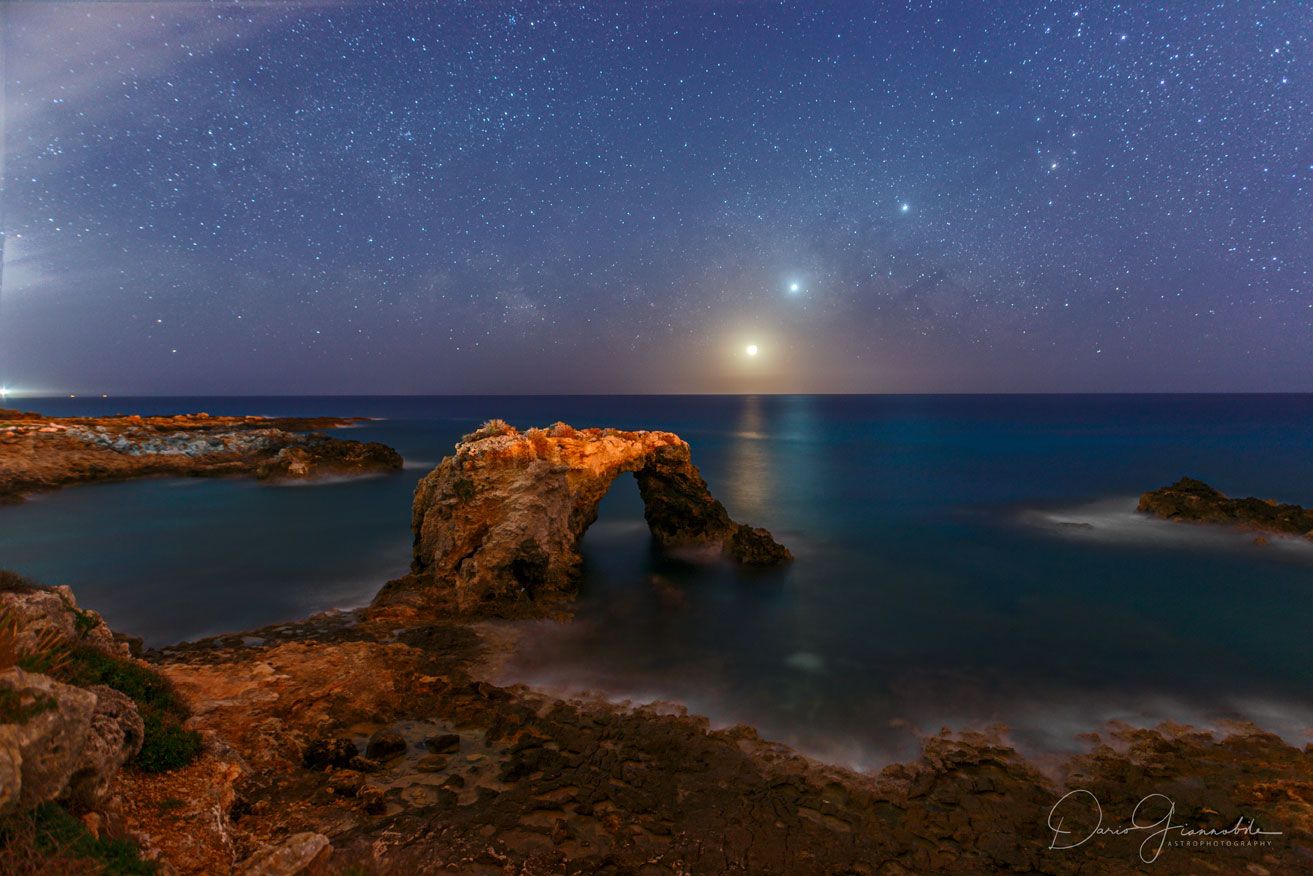
Celestial Alignment over Sicilian Shore
 
Image Credit & Copyright: Dario Giannobile
Explanation: This was a sunrise to remember. About a month ago, just before the dawn of the Sun, an impressive alignment of celestial objects was on display to the east. Pictured, brightest and closest to the horizon, is the Moon. The Moon's orange glow is caused by the scattering away of blue light by the intervening atmosphere. Next brightest and next closest to the horizon is the planet Venus. Compared to the Moon, Venus appears more blue -- as can (also) be seen in its reflection from the water. Next up is Jupiter, while the bright object above Jupiter is the star Antares. Although this display was visible from almost anywhere on planet Earth, the featured image was taken along a picturesque seashore near the city of Syracuse, on the island of Sicily, in the country of ItalyThis month Saturn appears between Venus and Jupiter before sunrise, while Mars is visible just after sunset.

Science et Technologie - Le monde minéral et ses trésors cachés : Gypse noir et blanc aux impuretés contrastées

Gypse noir et blanc aux impuretés contrastées

Le gypse est un minéral très fréquent des terrains sédimentaires. C'est un sulfate hydraté decalcium CaSO4 qui cristallise sous des formes très diverses : concrétions en forme de rose, flèches ou masses de cristaux aux parois accolées.

Les couleurs sont tout autant variées : incolore, blanc, jaune, rose à rouge, gris à noir, etc.

Bruno Cupillard

03/03/2019

Science & Technology - Astronomy picture of the day : The Orion Bullets

2019 March 3
See Explanation.  Clicking on the picture will download
the highest resolution version available.
The Orion Bullets 
Image Credit: GeMS/GSAOI Team, Gemini Observatory, AURA, NSF;
Processing: Rodrigo Carrasco (Gemini Obs.), Travis Rector (Univ. Alaska Anchorage)


Explanation: Why are bullets of gas shooting out of the Orion Nebula? Nobody is yet sure. First discovered in 1983, each bullet is actually about the size of our Solar System, and moving at about 400 km/sec from a central source dubbed IRc2. The age of the bullets, which can be found from their speed and distance from IRc2, is very young -- typically less than 1,000 years. As the bullets expand out the top of the Kleinmann-Low section of the Orion Nebula, a small percentage of iron gas causes the tip of each bullet to glow blue, while each bullet leaves a tubular pillar that glows by the light of heated hydrogen gas. The detailed image was created using the 8.1 meter Gemini South telescope inChile with an adaptive optics system (GeMS). GeMS uses five laser generated guide stars to help compensate for the blurring effects of planet Earth's atmosphere.

02/03/2019

Science & Technology - Astronomy picture of the day : NGC 6302: The Butterfly Nebula

2019 March 2
See Explanation.  Clicking on the picture will download
the highest resolution version available.
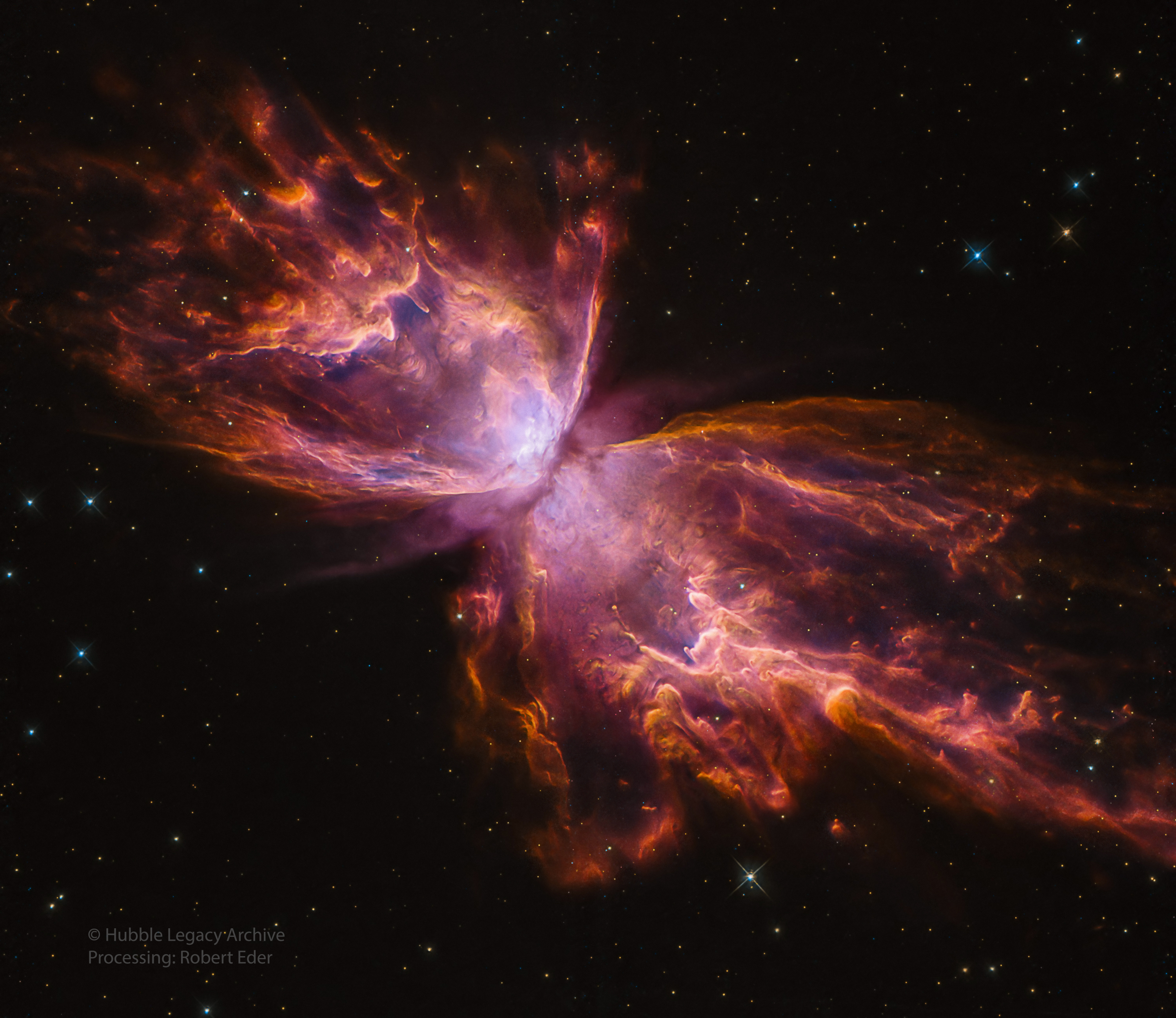
NGC 6302: The Butterfly Nebula 
Image Credit: NASAESAHubbleHLAReprocessing & Copyright: Robert Eder

Explanation: The bright clusters and nebulae of planet Earth's night sky are often named for flowers or insects. Though its wingspan covers over 3 light-years, NGC 6302 is no exception. With an estimated surface temperature of about 250,000 degrees C, the dying central star of this particular planetary nebula has become exceptionally hot, shining brightly in ultraviolet light but hidden from direct view by a dense torus of dust. This sharp close-up was recorded by the Hubble Space Telescope in 2009. The Hubble image data is reprocessed here, showing off the remarkable details of the complex planetary nebula. Cutting across a bright cavity of ionized gas, the dust torus surrounding the central star is near the center of this view, almost edge-on to the line-of-sight. Molecular hydrogen has been detected in the hot star's dusty cosmic shroud. NGC 6302 lies about 4,000 light-years away in the arachnologically correct constellation of the Scorpion (Scorpius).

Science et Technologie - Le monde minéral et ses trésors cachés : "Pietersite aux reflets chatoyants"

Pietersite aux reflets chatoyants
"Pietersite aux reflets chatoyants"

Sid Pieters a découvert cette forme de crocidolite en 1962 sur les terres de sa ferme, en Namibie. En 1964, cette matière a été nommée pietersite. Depuis 1993, une amphibole très fibreuse trouvée en Chine porte la même appellation car elle présente des couleurs et des chatoyances similaires.

Bruno Cupillard

ASTRONOMY - Red Sprites and Circular Elves Lightning over Italy

 2025 December 23 Red Sprites and Circular Elves Lightning over Italy Image Credit & Copyright:  Valter Binotto Explanation:  What's...