"La profondeur des océans"
18/04/2021

ASTRONOMY - Rainbow Airglow over the Azores
2021 April 18
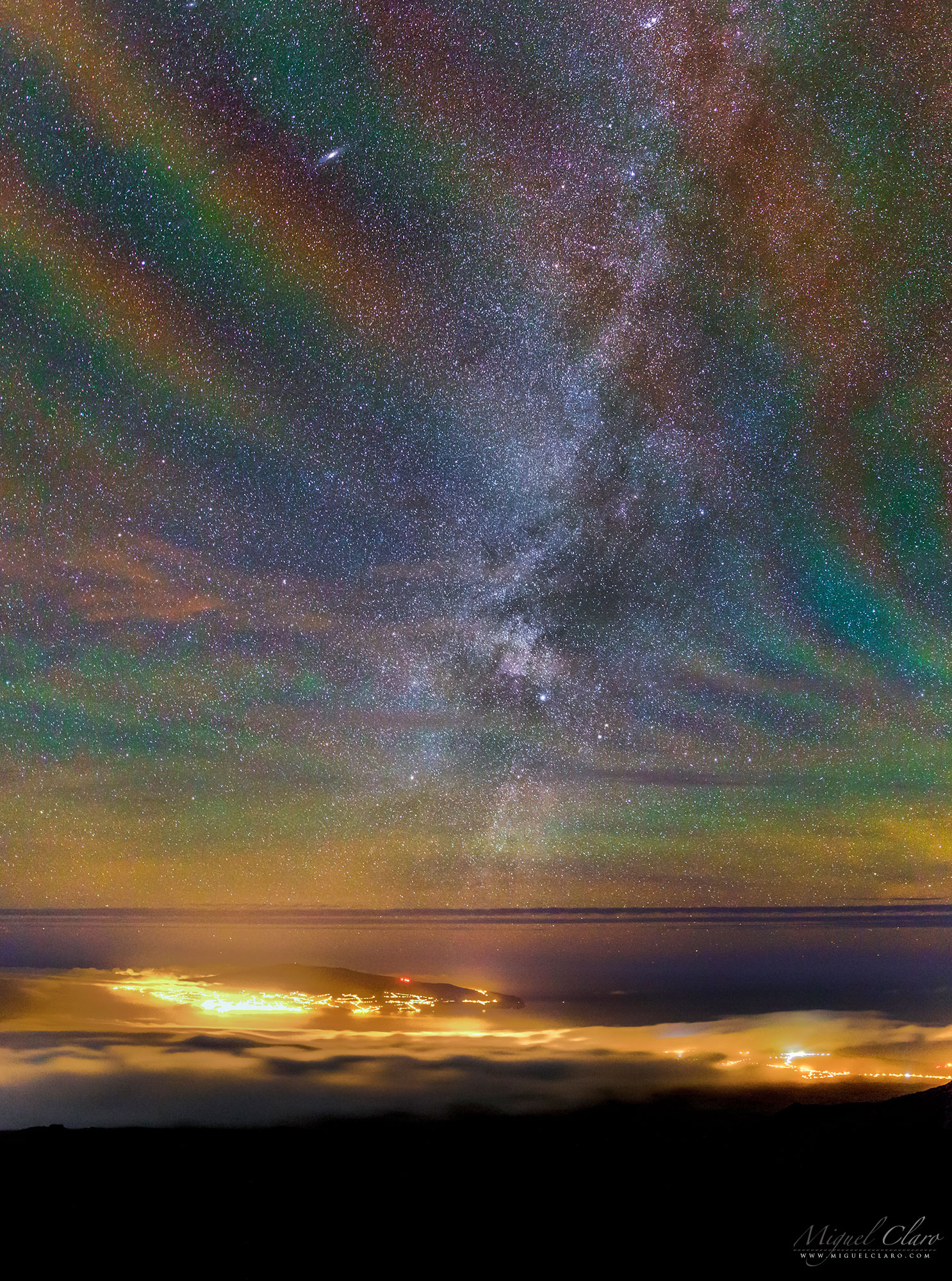
Image Credit & Copyright: Miguel Claro (TWAN); Rollover Annotation: Judy Schmidt
Explanation: Why would the sky glow like a giant repeating rainbow? Airglow. Now air glows all of the time, but it is usually hard to see. A disturbance however -- like an approaching storm -- may cause noticeable rippling in the Earth's atmosphere. These gravity waves are oscillations in air analogous to those created when a rock is thrown in calm water. The long-duration exposure nearly along the vertical walls of airglow likely made the undulating structure particularly visible. OK, but where do the colors originate? The deep red glow likely originates from OH molecules about 87-kilometers high, excited by ultraviolet light from the Sun. The orange and green airglow is likely caused by sodium and oxygen atoms slightly higher up. The featured image was captured during a climb up Mount Pico in the Azores of Portugal. Ground lights originate from the island of Faial in the Atlantic Ocean. A spectacular sky is visible through this banded airglow, with the central band of our Milky Way Galaxy running up the image center, and M31, the Andromeda Galaxy, visible near the top left.
17/04/2021
ASTRONOMY - Inside the Flame Nebula
2021 April 17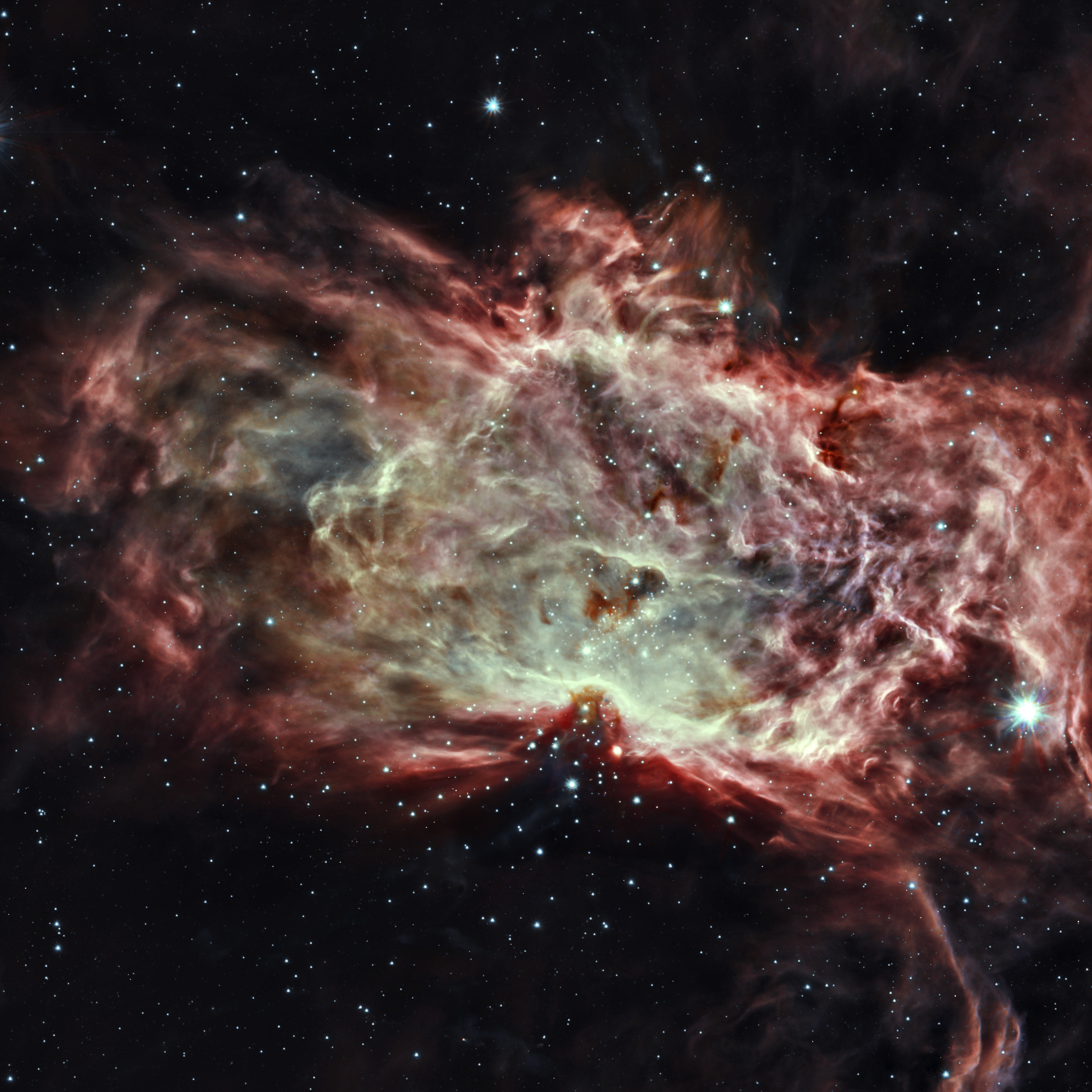
Image Credit: NASA, JPL-Caltech, IPAC Infrared Science Archive - Processing: Amal Biju
Explanation: The Flame Nebula is a stand out in optical images of the dusty, crowded star forming regions toward Orion's belt and the easternmost belt star Alnitak, a mere 1,400 light-years away. Alnitak is the bright star at the right edge of this infrared image from the Spitzer Space Telescope. About 15 light-years across, the infrared view takes you inside the nebula's glowing gas and obscuring dust clouds though. It reveals many stars of the recently formed, embedded cluster NGC 2024 concentrated near the center. The stars of NGC 2024 range in age from 200,000 years to 1.5 million years young. In fact, data indicate that the youngest stars are concentrated near the middle of the Flame Nebula cluster. That's the opposite of the simplest models of star formation for a stellar nursery that predict star formation begins in the denser center of a molecular cloud core. The result requires a more complex model for star formation inside the Flame Nebula. ...........................
15/04/2021
MINERAUX - Le béryl, un cristal d’eau de mer

Le béryl (Be3Al2Si6O18) est un minéral du groupe des silicates. Son nom vient du grec beryllos, qui signifie « cristal de la couleur de l'eau de mer ». Il en existe plusieurs variétés utilisées en joaillerie, comme l'aigue-marine et l'émeraude. Couleurs : variées. © Rob Lavinsky, Wikimedia Commons, CC by-sa 3.0
ASTRONOMY - The Galaxy, the Jet, and a Famous Black Hole
2021 April 15
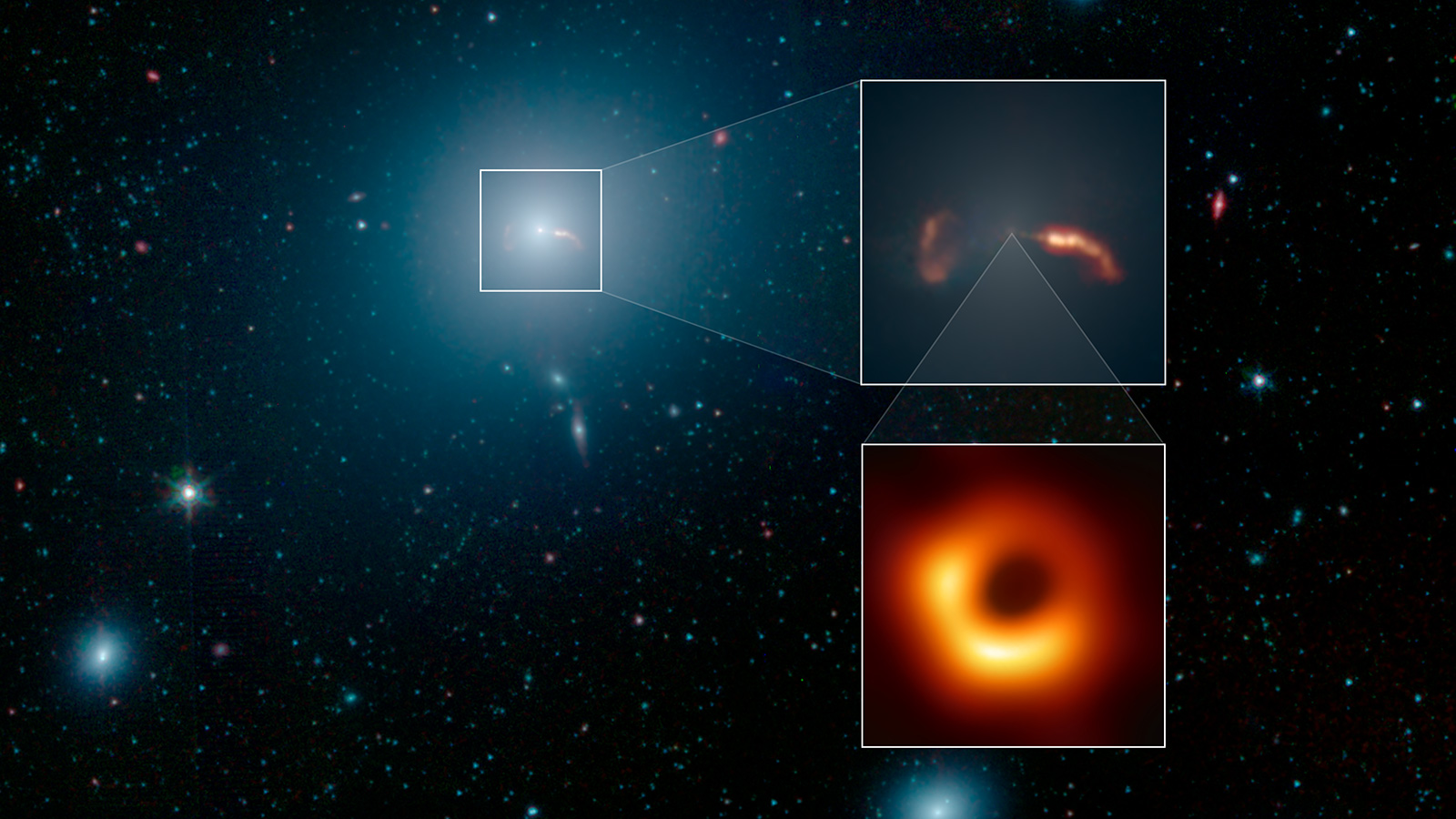
Image Credit: NASA, JPL-Caltech, Event Horizon Telescope Collaboration
Explanation: Bright elliptical galaxy Messier 87 (M87) is home to the supermassive black hole captured by planet Earth's Event Horizon Telescope in the first ever image of a black hole. Giant of the Virgo galaxy cluster about 55 million light-years away, M87 is the large galaxy rendered in blue hues in this infrared image from the Spitzer Space telescope. Though M87 appears mostly featureless and cloud-like, the Spitzer image does record details of relativistic jets blasting from the galaxy's central region. Shown in the inset at top right, the jets themselves span thousands of light-years. The brighter jet seen on the right is approaching and close to our line of sight. Opposite, the shock created by the otherwise unseen receding jet lights up a fainter arc of material. Inset at bottom right, the historic black hole image is shown in context, at the center of giant galaxy and relativistic jets. Completely unresolved in the Spitzer image, the supermassive black hole surrounded by infalling material is the source of enormous energy driving the relativistic jets from the center of active galaxy M87.
14/04/2021
ASTRONOMY - The Pencil Nebula Supernova Shock Wave
2021 April 14
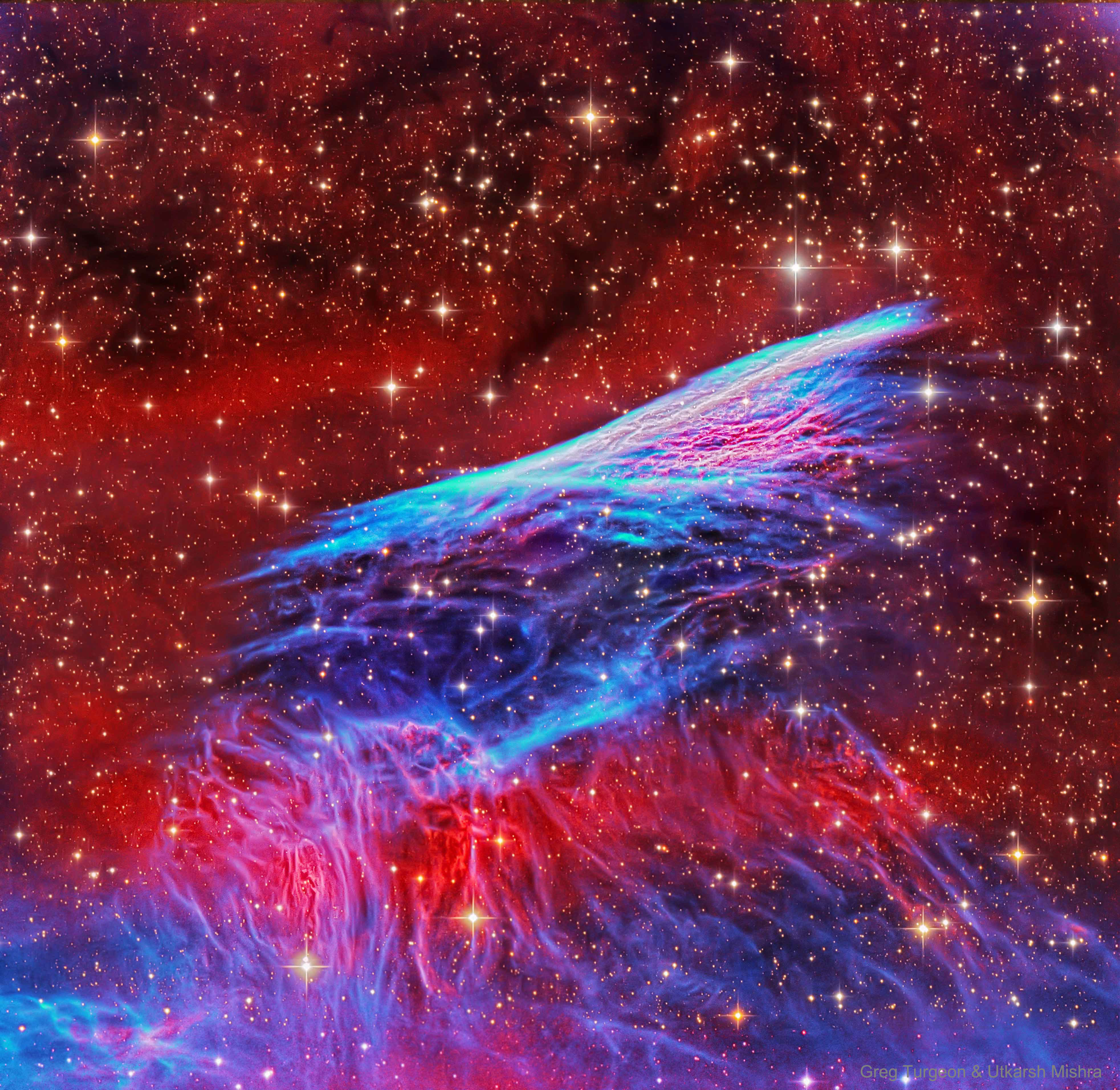
Image Credit & Copyright: Greg Turgeon & Utkarsh Mishra
Explanation: This supernova shock wave plows through interstellar space at over 500,000 kilometers per hour. Near the middle and moving up in this sharply detailed color composite, thin, bright, braided filaments are actually long ripples in a cosmic sheet of glowing gas seen almost edge-on. Cataloged as NGC 2736, its elongated appearance suggests its popular name, the Pencil Nebula. The Pencil Nebula is about 5 light-years long and 800 light-years away, but represents only a small part of the Vela supernova remnant. The Vela remnant itself is around 100 light-years in diameter, the expanding debris cloud of a star that was seen to explode about 11,000 years ago. Initially, the shock wave was moving at millions of kilometers per hour but has slowed considerably, sweeping up surrounding interstellar material. In the featured narrow-band, wide field image, red and blue colors track, primarily, the characteristic glows of ionized hydrogen and oxygen atoms, respectively.
13/04/2021
ASTRONOMY - Zodiacal Night
2021 April 13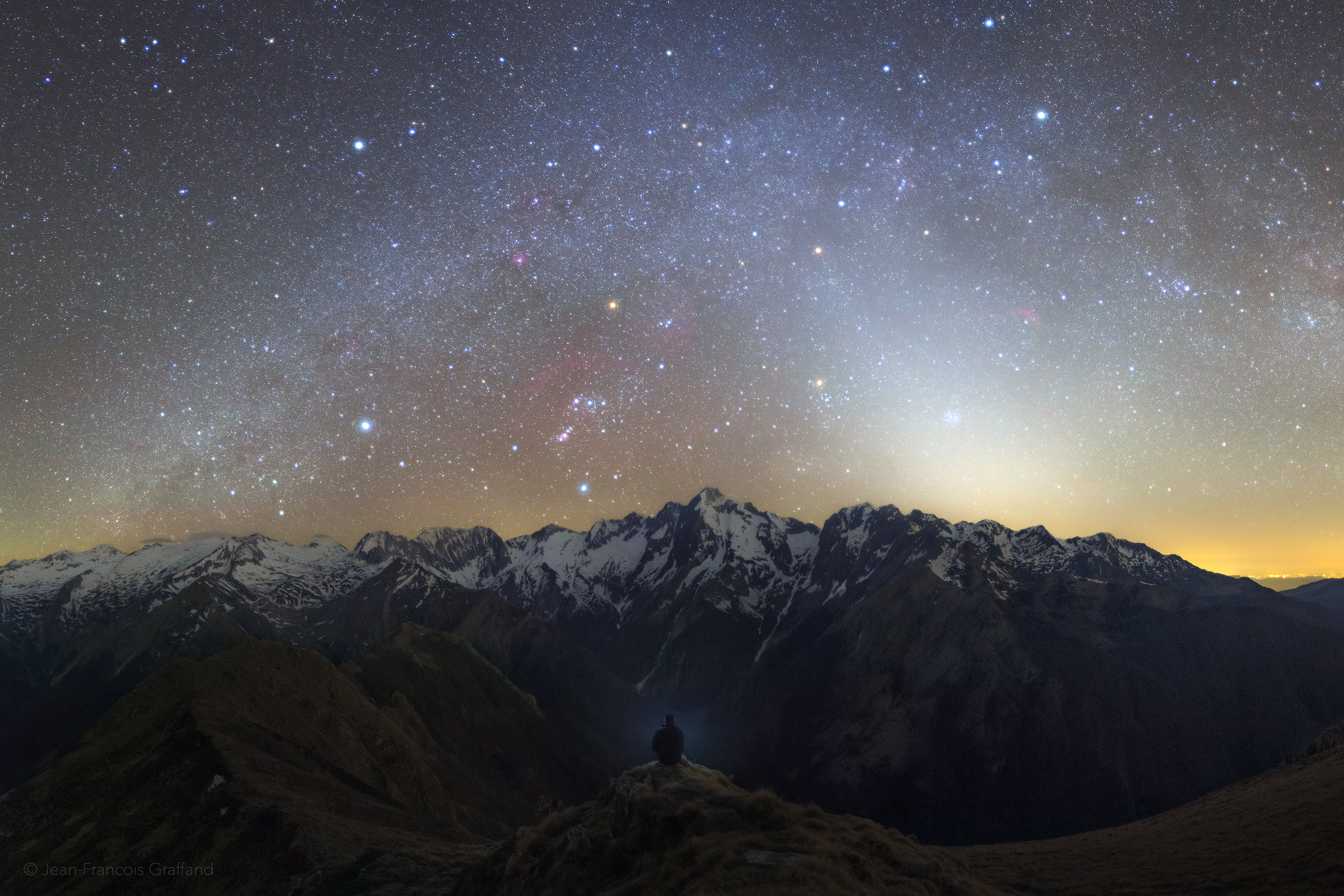
Image Credit & Copyright: Jean-Francois Graffand
Explanation: An intense band of zodiacal light is captured in this serene mountain and night skyscape from April 7. The panoramic view was recorded after three hours of hiking from a vantage looking west after sunset across the Pyrenees in southern France. At 2838 meters altitude, Mont Valier is the tallest peak near center. In the sky above, the familiar stars of Orion and the northern winter Milky Way are approaching the rugged western horizon. At the shoulder of Orion, Betelgeuse is one of three bright yellowish celestial beacons. It forms a triangle with fellow red giant star Aldebaran located below Betelgeuse and to the right, and the red planet Mars. Mars shines just under the band of the Milky Way, still immersed in the bright zodiacal light.
12/04/2021
ASTRONOMY - Alnitak and the Flame Nebula
2021 April 12
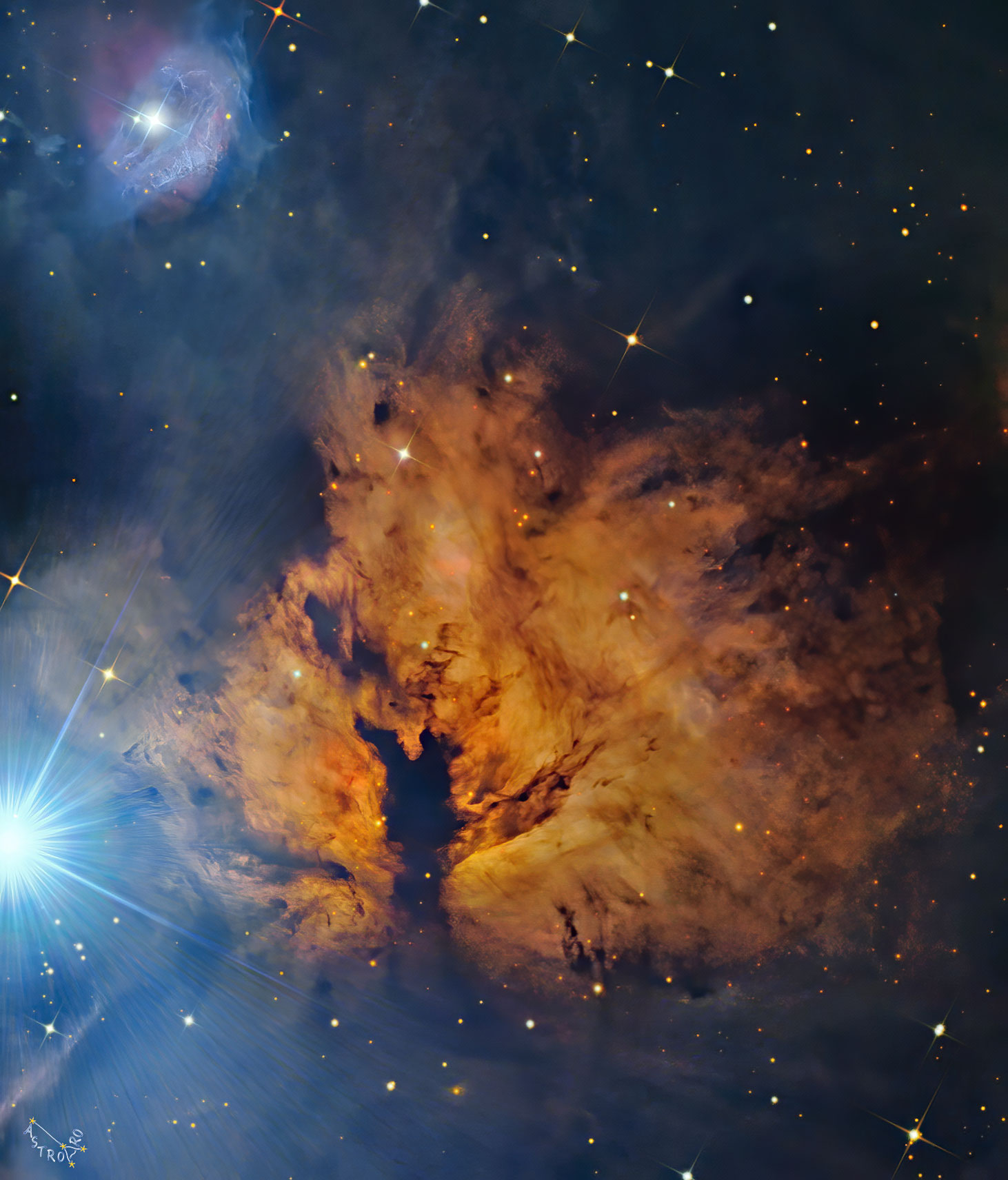
Image Credit & Copyright: Team ARO
Explanation: What lights up the Flame Nebula? Fifteen hundred light years away towards the constellation of Orion lies a nebula which, from its glow and dark dust lanes, appears, on the left, like a billowing fire. But fire, the rapid acquisition of oxygen, is not what makes this Flame glow. Rather the bright star Alnitak, the easternmost star in the Belt of Orion visible on the far left, shines energetic light into the Flame that knocks electrons away from the great clouds of hydrogen gas that reside there. Much of the glow results when the electrons and ionized hydrogen recombine. The featured picture of the Flame Nebula (NGC 2024) was taken across three visible color bands with detail added by a long duration exposure taken in light emitted only by hydrogen. The Flame Nebula is part of the Orion Molecular Cloud Complex, a star-forming region that includes the famous Horsehead Nebula.
09/04/2021
ASTRONOMY - Messier 106
2021 April 9
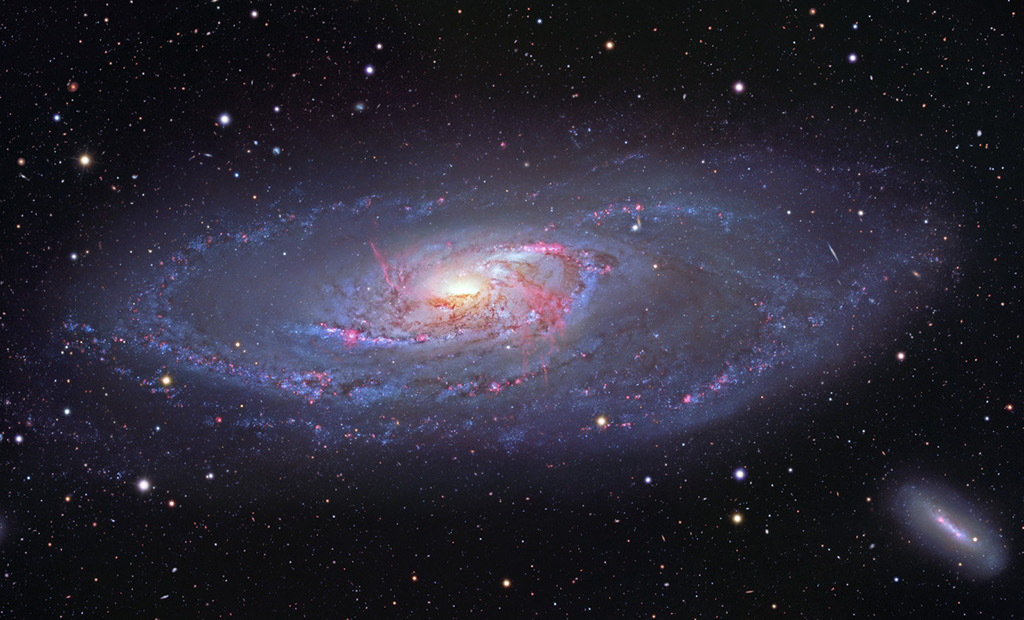
Image Credit: NASA, Hubble Legacy Archive, Kitt Peak National Observatory;
Amateur Data & Processing Copyright: Robert Gendler
Explanation: Close to the Great Bear (Ursa Major) and surrounded by the stars of the Hunting Dogs (Canes Venatici), this celestial wonder was discovered in 1781 by the metric French astronomer Pierre Mechain. Later, it was added to the catalog of his friend and colleague Charles Messier as M106. Modern deep telescopic views reveal it to be an island universe - a spiral galaxy around 30 thousand light-years across located only about 21 million light-years beyond the stars of the Milky Way. Along with a bright central core, this stunning galaxy portrait, a composite of image data from amateur and professional telescopes, highlights youthful blue star clusters and reddish stellar nurseries tracing the galaxy's spiral arms. It also shows off remarkable reddish jets of glowing hydrogen gas. In addition to small companion galaxy NGC 4248 at bottom right, background galaxies can be found scattered throughout the frame. M106, also known as NGC 4258, is a nearby example of the Seyfert class of active galaxies, seen across the spectrum from radio to X-rays. Active galaxies are powered by matter falling into a massive central black hole.
08/04/2021
ASTRONOMY - 3D Ingenuity
2021 April 8

Image Credit: NASA, JPL-Caltech, MSSS, ASU
Explanation: The multicolor, stereo imaging Mastcam-Z on the Perseverance rover zoomed in to captured this 3D close-up (get out your red/blue glasses) of the Mars Ingenuity helicopter on mission sol 45, April 5. That's only a few sols before the technology demonstrating Ingenuity will attempt to fly in the thin martian atmosphere, making the first powered flight on another planet. The historic test flight is planned for no earlier than Sunday, April 11. Casting its shadow on the martian surface, Ingenuity is standing alone on four landing legs next to the rover's wheel tracks. The experimental helicopter's solar panel, charging batteries that keep it warm through the cold martian nights and power its flight, sits above its two 1.2 meter (4 foot) long counter-rotating blades.
Inscription à :
Articles (Atom)
La vie et la mort - Y-A-T-IL UNE VIE APRèS LA MORT ? (3/5)
Sept jours de coma… et une expérience consciente Durant sept jours, le neurochirurgien reste plongé dans un état végétatif. Les examens neur...

-
2026 January 1 Auroral Corona Image Credit & Copyright : Roi Levi Explanation: Cycle 25 solar maximum made 2025 a great year for ...
-
Imaginez un monde où le cancer n’est plus une sentence, mais une simple étape à franchir. Grâce à une découverte révolutionnaire, ce rêve es...


