Nombre total de pages vues
01/05/2023
AERONAUTIQUE - Avions de légende -Le Spirit of St. Louis (l'avion de Charles Lindbergh) et la traversée de l’Atlantique
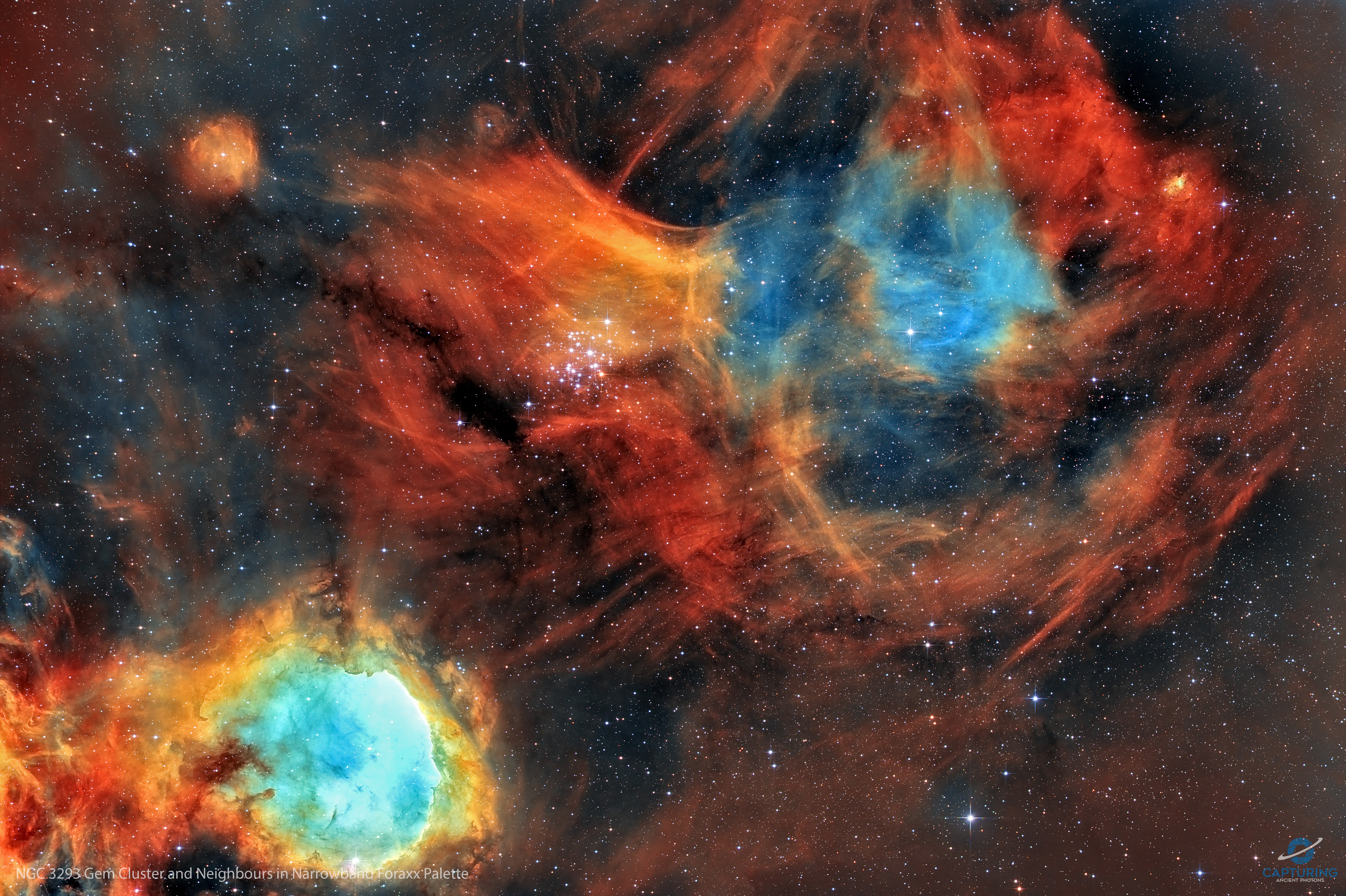
ASTRONOMY - Carina Nebula North
2023 May 1
Image Credit & Copyright: Carlos Taylor
Explanation: The Great Carina Nebula is home to strange stars and iconic nebulas. Named for its home constellation, the huge star-forming region is larger and brighter than the Great Orion Nebula but less well known because it is so far south -- and because so much of humanity lives so far north. The featured image shows in great detail the northernmost part of the Carina Nebula. On the bottom left is the Gabriela Mistral Nebula consisting of an emission nebula of glowing gas (IC 2599) surrounding the small open cluster of stars (NGC 3324). Above the image center is the larger star cluster NGC 3293, while to its right is the emission nebula Loden 153. The most famous occupant of the Carina Nebula, however, is not shown. Off the image to the lower right is the bright, erratic, and doomed star known as Eta Carinae -- a star once one of the brightest stars in the sky and now predicted to explode in a supernova sometime in the next few million years.
30/04/2023
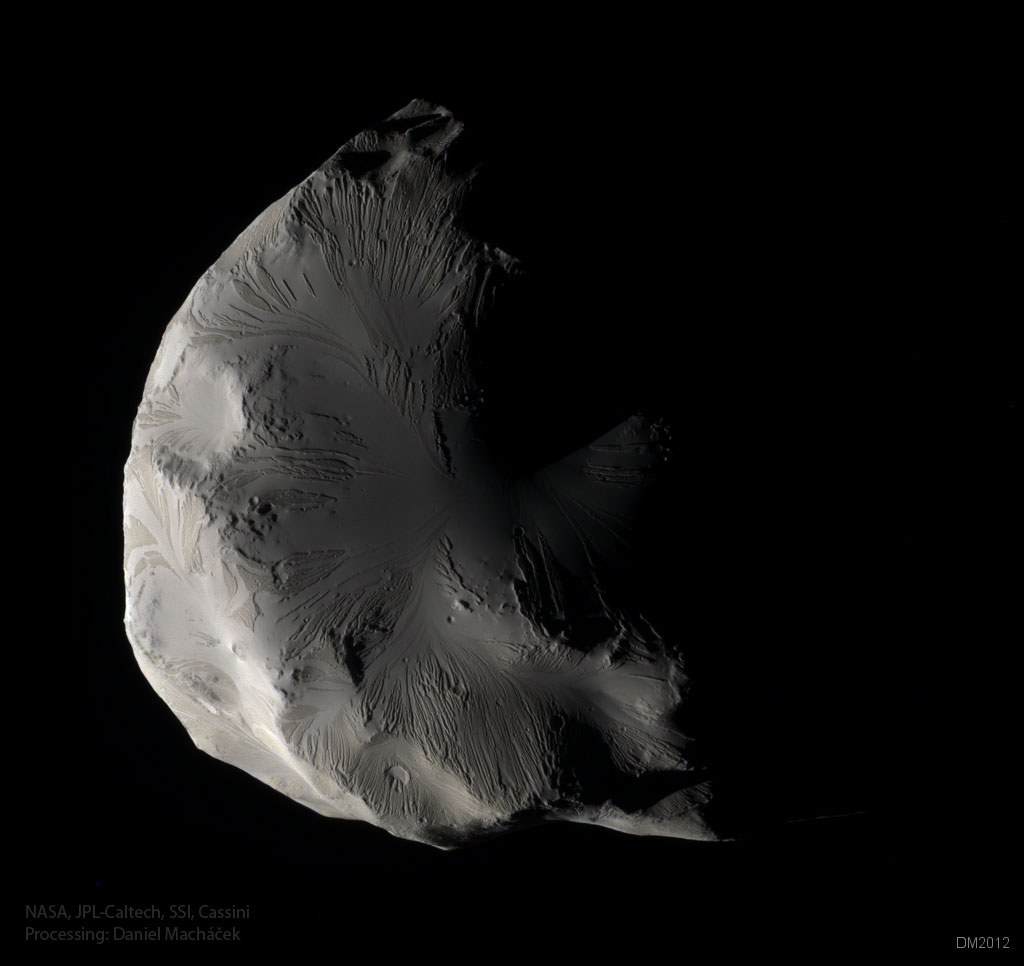
ASTRONOMY - Saturn's Moon Helene in Color
2023 April 30
Image Credit: NASA, JPL-Caltech, SSI; Processing: Daniel Macháček
Explanation: Although its colors may be subtle, Saturn's moon Helene is an enigma in any light. The moon was imaged in unprecedented detail in 2012 as the robotic Cassini spacecraft orbiting Saturn swooped to within a single Earth diameter of the diminutive moon. Although conventional craters and hills appear, the above image also shows terrain that appears unusually smooth and streaked. Planetary astronomers are inspecting these detailed images of Helene to glean clues about the origin and evolution of the 30-km across floating iceberg. Helene is also unusual because it circles Saturn just ahead of the large moon Dione, making it one of only four known Saturnian moons to occupy a gravitational well known as a stable Lagrange point.
29/04/2023
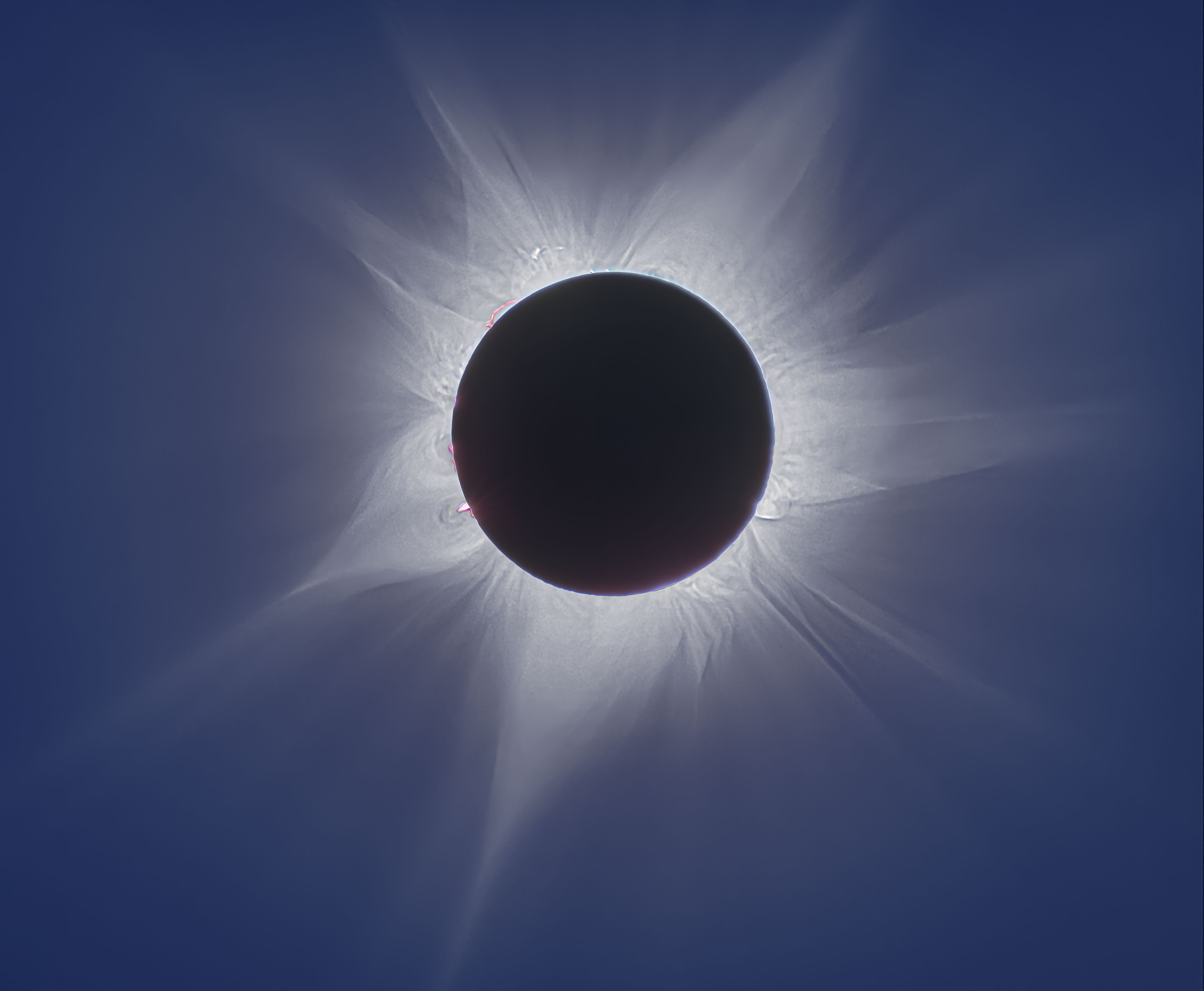
ASTRONOMY - Solar Eclipse from a Ship
2023 April 29
Image Credit: Fred Espenak
Explanation: Along a narrow path that mostly avoided landfall, the shadow of the New Moon raced across planet Earth's southern hemisphere on April 20 to create a rare annular-total or hybrid solar eclipse. From the Indian Ocean off the coast of western Australia, ship-borne eclipse chasers were able to witness 62 seconds of totality though while anchored near the centerline of the total eclipse track. This ship-borne image of the eclipse captures the active Sun's magnificent outer atmosphere or solar corona streaming into space. A composite of 11 exposures ranging from 1/2000 to 1/2 second, it records an extended range of brightness to follow details of the corona not quite visible to the eye during the total eclipse phase. Of course eclipses tend to come in pairs. On May 5, the next Full Moon will just miss the dark inner part of Earth's shadow in a penumbral lunar eclipse.
28/04/2023
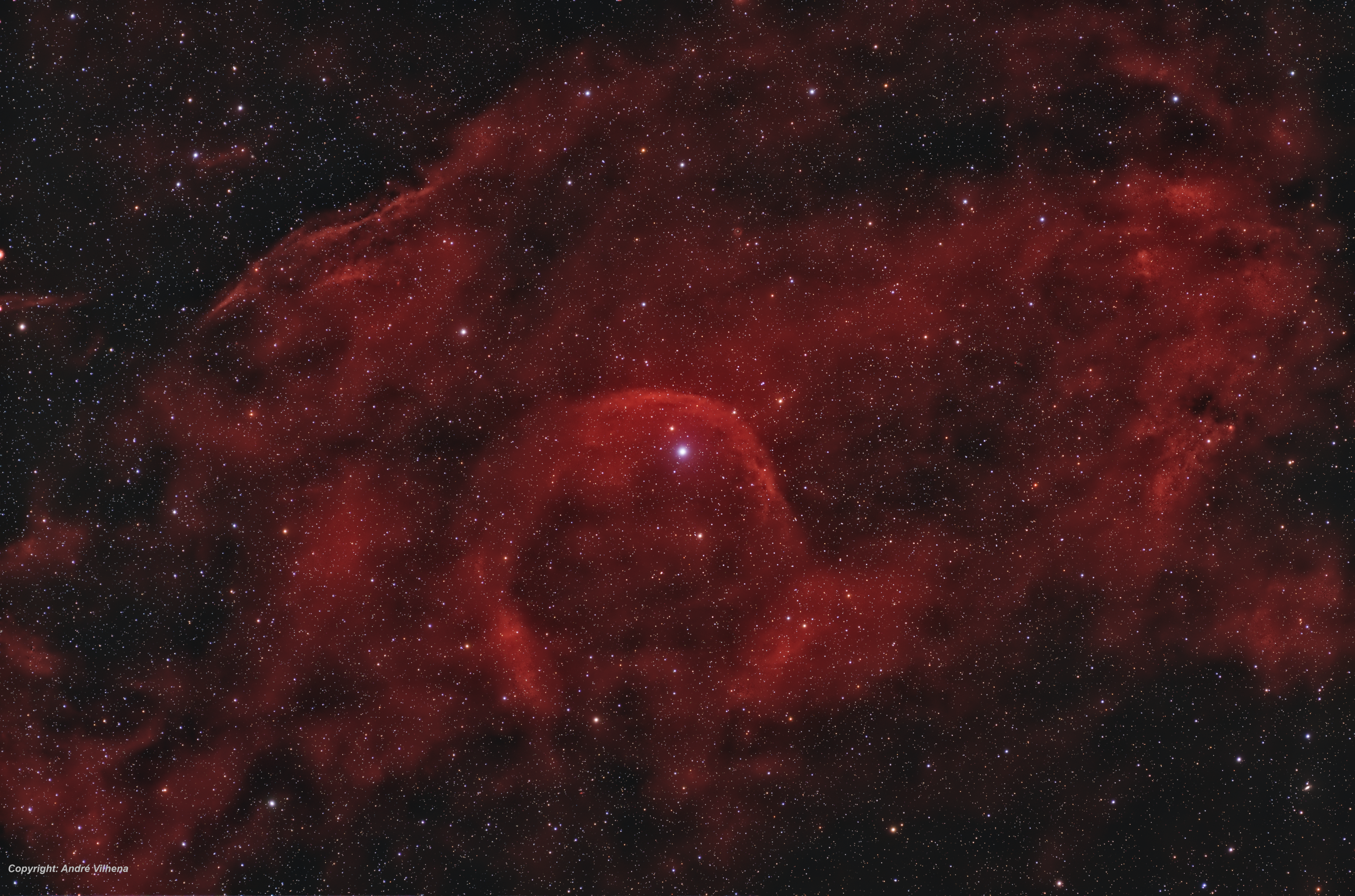
ASTRONONOMY - Runaway Star Alpha Camelopardalis
2023 April 28
Image Credit: André Vilhena
Explanation: Like a ship plowing through cosmic seas, runaway star Alpha Camelopardalis has produced this graceful arcing bow wave or bow shock. The massive supergiant star moves at over 60 kilometers per second through space, compressing the interstellar material in its path. At the center of this nearly 6 degree wide view, Alpha Cam is about 25-30 times as massive as the Sun, 5 times hotter (30,000 kelvins), and over 500,000 times brighter. About 4,000 light-years away in the long-necked constellation Camelopardalis, the star also produces a strong stellar wind. Alpha Cam's bow shock stands off about 10 light-years from the star itself. What set this star in motion? Astronomers have long thought that Alpha Cam was flung out of a nearby cluster of young hot stars due to gravitational interactions with other cluster members or perhaps by the supernova explosion of a massive companion star.
27/04/2023
ASTRONOMY -The Tarantula Nebula from SuperBIT
2023 April 27
Image Credit: SuperBIT, NASA
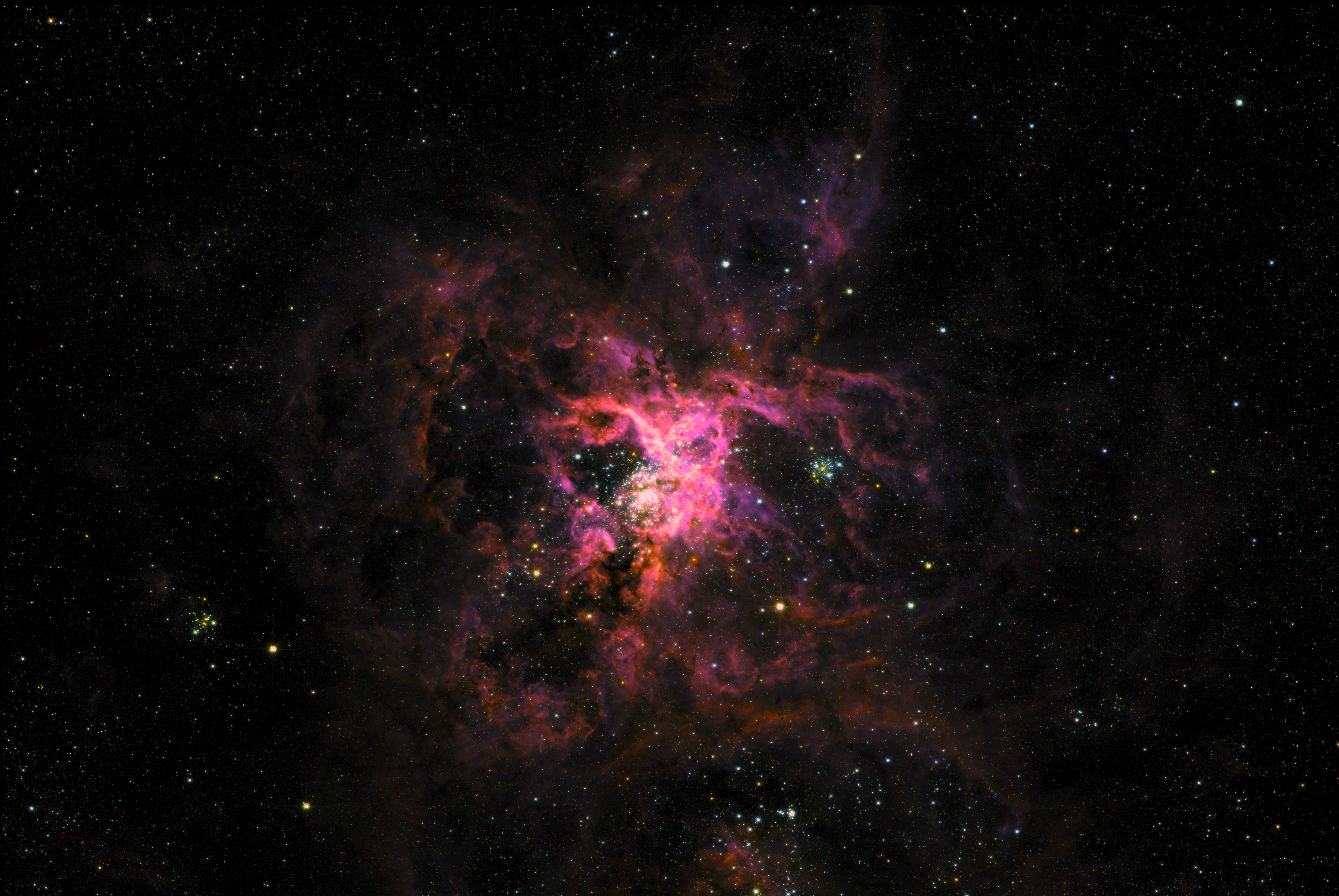
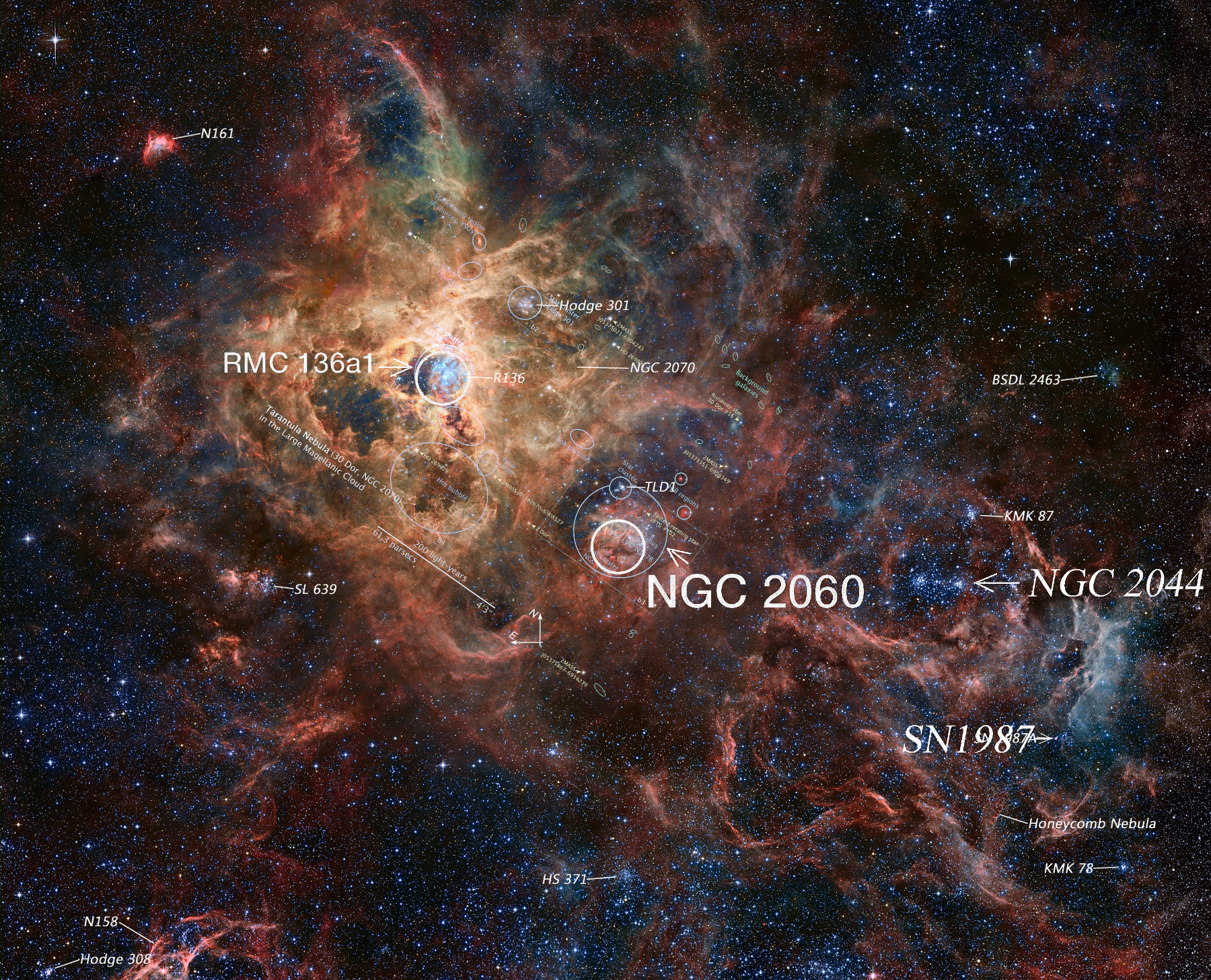
Explanation: The Tarantula Nebula, also known as 30 Doradus, is more than a thousand light-years in diameter, a giant star forming region within nearby satellite galaxy the Large Magellanic Cloud. About 160 thousand light-years away, it's the largest, most violent star forming region known in the whole Local Group of galaxies. The cosmic arachnid is near the center of this spectacular image taken during the flight of SuperBIT (Super Pressure Balloon Imaging Telescope), NASA's balloon-borne 0.5 meter telescope now floating near the edge of space. Within the well-studied Tarantula (NGC 2070), intense radiation, stellar winds and supernova shocks from the central young cluster of massive stars, cataloged as R136, energize the nebular glow and shape the spidery filaments. Around the Tarantula are other star forming regions with young star clusters, filaments, and blown-out bubble-shaped clouds. SuperBIT's wide field of view spans over 2 degrees or 4 full moons in the southern constellation Dorado.
26/04/2023
ART FRACTAL - Détail de l'ensemble de Mandelbrot
AERONAUTIQUE - Avions de légende - Le Messerschmitt Bf 109, un avion de chasse de référence
ASTRONOMY - The Moon through the Arc de Triomphe
2023 April 26
Image Credit & Copyright: Stefano Zanarello
Explanation: Was this a lucky shot? Although many amazing photographs are taken by someone who just happened to be in the right place at the right time, this image took skill and careful planning. First was the angular scale: if you shoot too close to the famous Arc de Triomphe in Paris, France, the full moon will appear too small. Conversely, if you shoot from too far away, the moon will appear too large and not fit inside the Arc. Second is timing: the Moon only appears centered inside the Arc for small periods of time -- from this distance less than a minute. Other planned features include lighting, relative brightness, height, capturing a good foreground, and digital processing. And yes, there is some luck involved -- for example, the sky must be clear. This time, the planning was successful, bringing two of humanity's most famous icons photographically together for all to enjoy.
25/04/2023
ASTRONOMY - Northern Lights over Southern Europe
2023 April 25
Image Credit & Copyright: Lorenzo Cordero
Explanation: Did you see an aurora over the past two nights? Many people who don't live in Earth's far north did. Reports of aurora came in not only from northern locales in the USA as Alaska, but as far south as Texas and Arizona. A huge auroral oval extended over Europe and Asia, too. Pictured, an impressively red aurora was captured last night near the town of Cáceres in central Spain. Auroras were also reported in parts of southern Spain. The auroras resulted from a strong Coronal Mass Event (CME) that occurred on the Sun a few days ago. Particles from the CME crossed the inner Solar System before colliding with the Earth's magnetosphere. From there, electrons and protons spiraled down the Earth's northern magnetic field lines and collided with oxygen and nitrogen in Earth's atmosphere, causing picturesque auroral glows. Our unusually active Sun may provide future opportunities to see the northern lights in southern skies.
ASTRONOMY - Sunset Solstice over Stonehenge
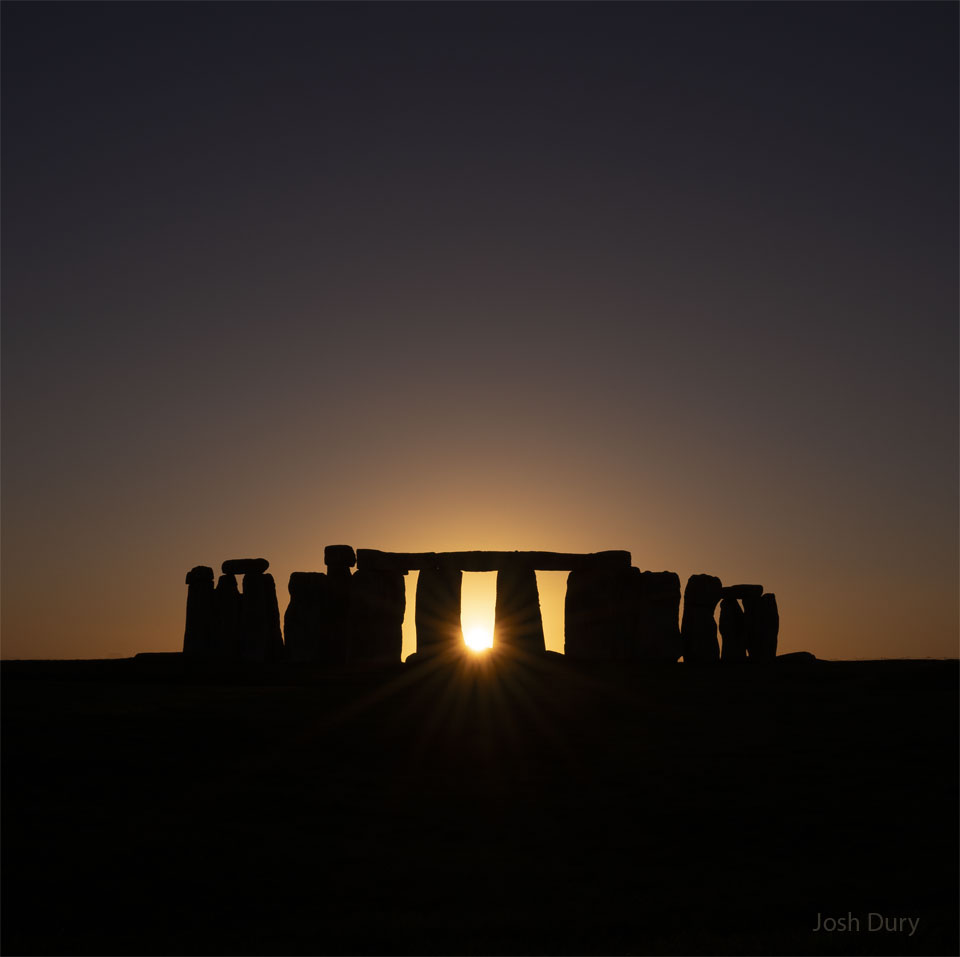
2025 December 22 Sunset Solstice over Stonehenge Image Credit & Copyright: English Heritage , Josh Dury Explanation: Yesterday the Su...
-
2022 September 26 All the Water on Planet Earth Illustration Credit: Jack Cook, Adam Nieman, Woods Hole Oceanographic Institution ; Data ...
-
2025 May 11 The Surface of Venus from Venera 14 Image Credit: Soviet Planetary Exploration Program , Venera 14 ; Processing & Copyri...