Nombre total de pages vues
01/06/2023
CLIMAT - Une invasion impressionnante de méduses sur les plages de la côte Atlantique
ASTRONOMY - Simulation: A Disk Galaxy Forms
2023 May 31
Video Credit: TNG Collaboration, MPCDF, FAS Harvard U.; Music: World's Sunrise (YouTube: Jimena Contreras)
Explanation: How did we get here? We know that we live on a planet orbiting a star orbiting a galaxy, but how did all of this form? Since our universe moves too slowly to watch, faster-moving computer simulations are created to help find out. Specifically, this featured video from the IllustrisTNG collaboration tracks gas from the early universe (redshift 12) until today (redshift 0). As the simulation begins, ambient gas falls into and accumulates in a region of relatively high gravity. After a few billion years, a well-defined center materializes from a strange and fascinating cosmic dance. Gas blobs -- some representing small satellite galaxies -- continue to fall into and become absorbed by the rotating galaxy as the present epoch is reached and the video ends. For the Milky Way Galaxy, however, big mergers may not be over -- recent evidence indicates that our large spiral disk Galaxy will collide and coalesce with the slightly larger Andromeda spiral disk galaxy in the next few billion years.
30/05/2023
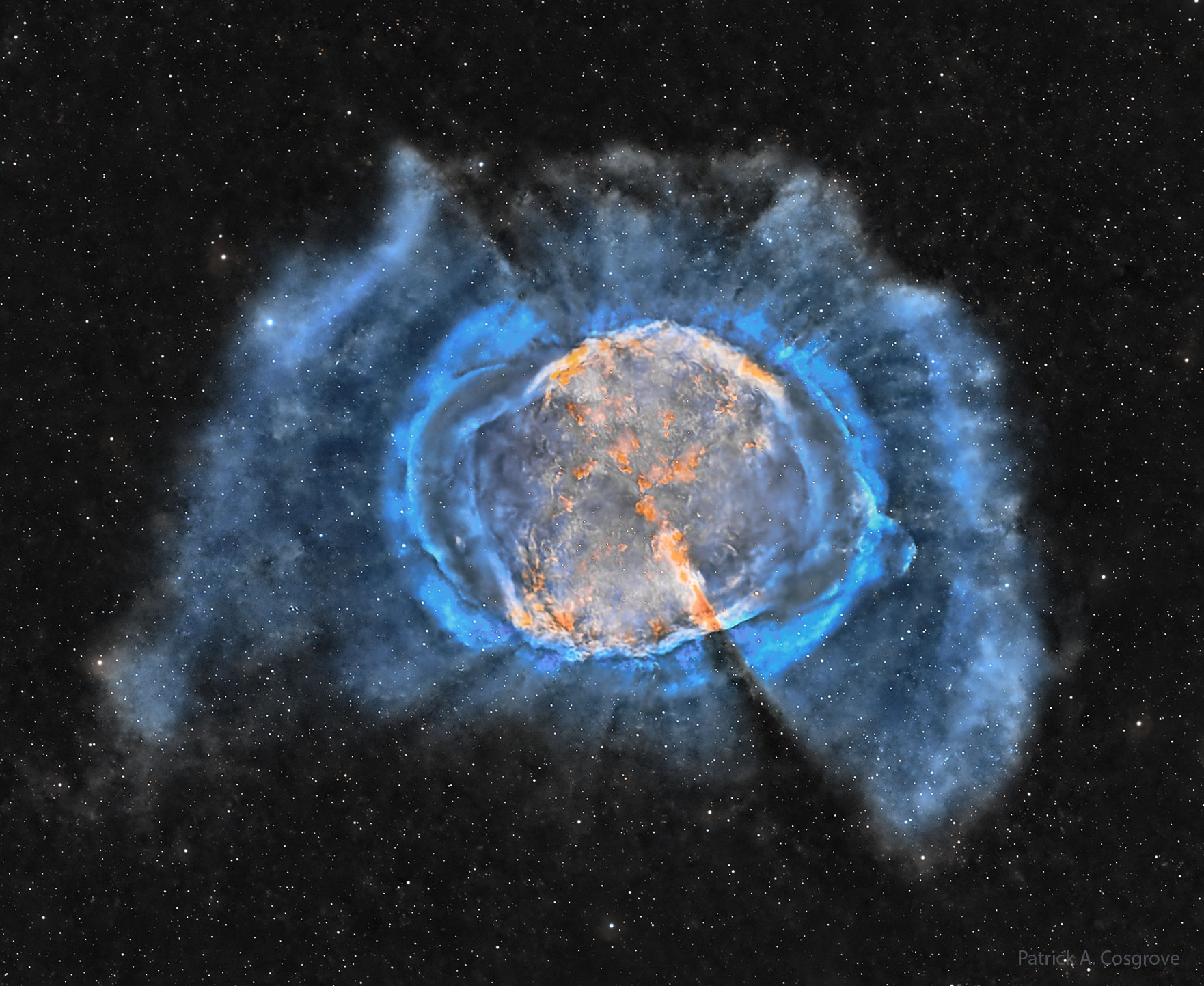
ASTRONOMY - M27: The Dumbbell Nebula
2023 May 30
Image Credit & Copyright: Patrick A. Cosgrove
Explanation: Is this what will become of our Sun? Quite possibly. The first hint of our Sun's future was discovered inadvertently in 1764. At that time, Charles Messier was compiling a list of diffuse objects not to be confused with comets. The 27th object on Messier's list, now known as M27 or the Dumbbell Nebula, is a planetary nebula, one of the brightest planetary nebulae on the sky and visible with binoculars toward the constellation of the Fox (Vulpecula). It takes light about 1000 years to reach us from M27, featured here in colors emitted by sulfur (red), hydrogen (green) and oxygen (blue). We now know that in about 6 billion years, our Sun will shed its outer gases into a planetary nebula like M27, while its remaining center will become an X-ray hot white dwarf star. Understanding the physics and significance of M27 was well beyond 18th century science, though. Even today, many things remain mysterious about planetary nebulas, including how their intricate shapes are created.
29/05/2023
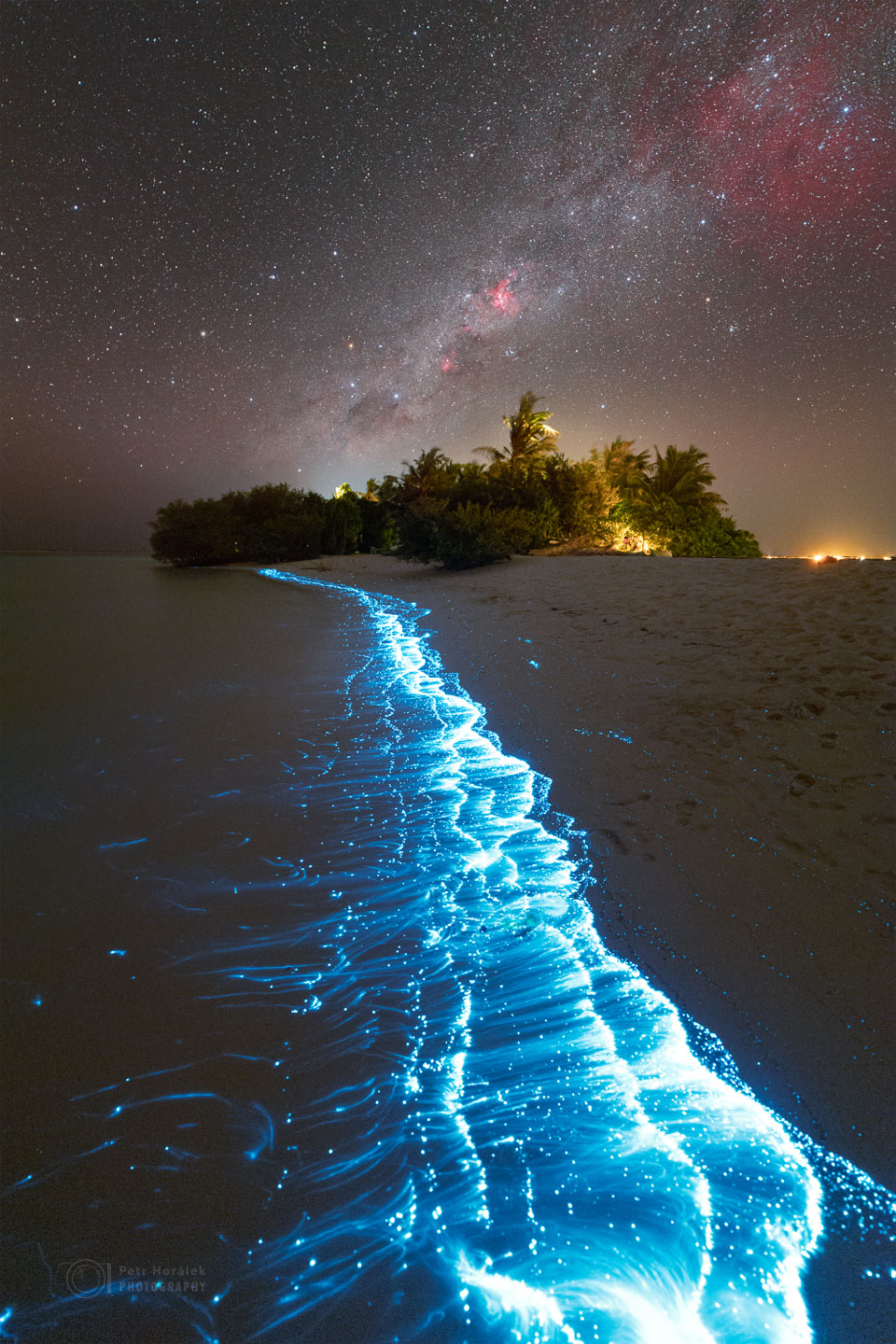
ASTRONOMY - Milky Way over a Turquoise Wonderland
2023 May 29
Image Credit & Copyright: Petr Horálek / Institute of Physics in Opava, Sovena Jani
Explanation: What glows there? The answer depends: sea or sky? In the sea, the unusual blue glow is bioluminescence. Specifically, the glimmer arises from Noctiluca scintillans, single-celled plankton stimulated by the lapping waves. The plankton use their glow to startle and illuminate predators. This mid-February display on an island in the Maldives was so intense that the astrophotographer described it as a turquoise wonderland. In the sky, by contrast, are the more familiar glows of stars and nebulas. The white band rising from the artificially-illuminated green plants is created by billions of stars in the central disk of our Milky Way Galaxy. Also visible in the sky is the star cluster Omega Centauri, toward the left, and the famous Southern Cross asterism in the center. Red-glowing nebulas include the bright Carina Nebula, just right of center, and the expansive Gum Nebula on the upper right.
25/05/2023
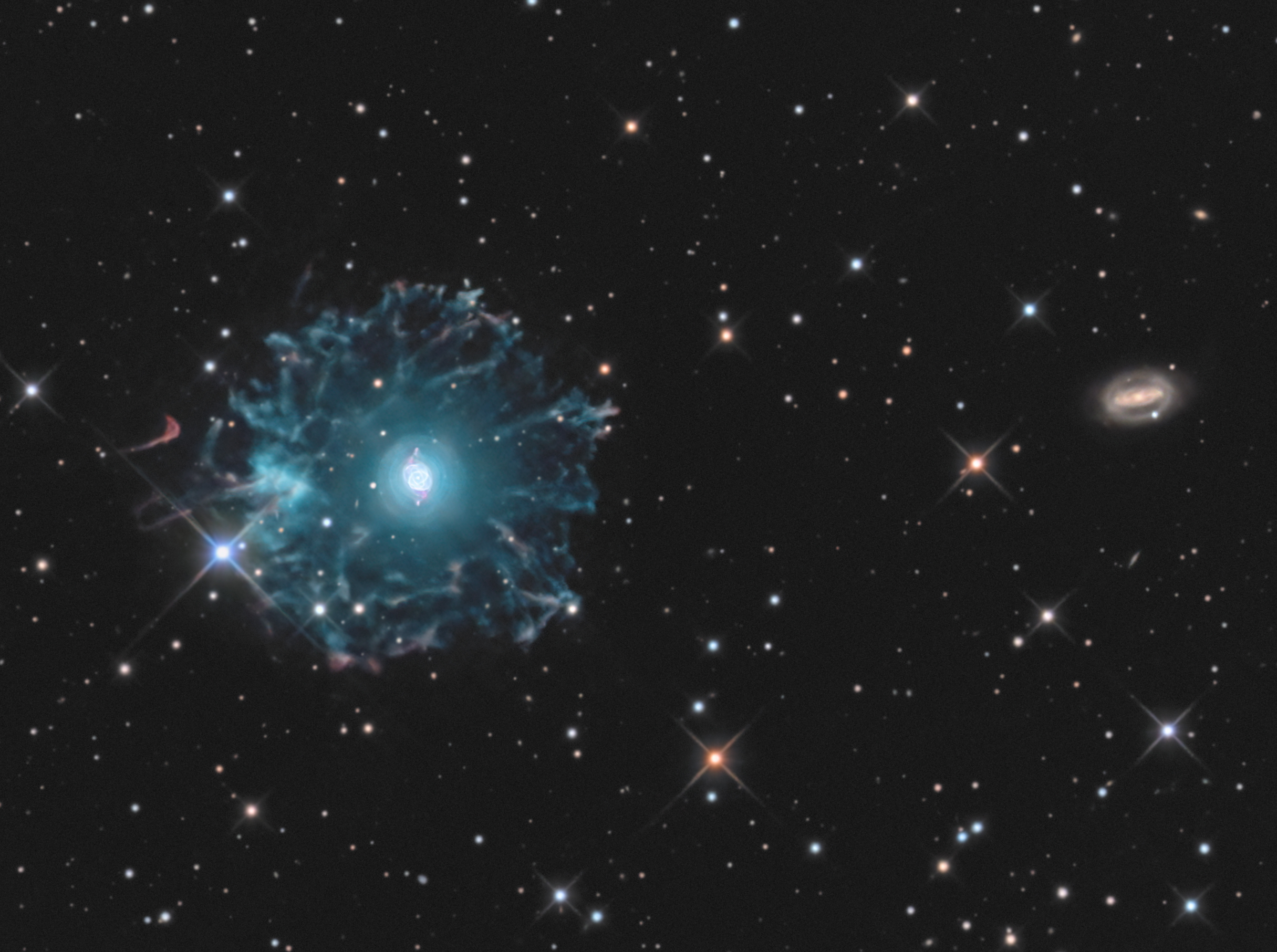
ASTRONOMY - Cat's Eye Wide and Deep
2023 May 25
Image Credit & Copyright: Jean-François Bax, Guillaume Gruntz
Explanation: The Cat's Eye Nebula (NGC 6543) is one of the best known planetary nebulae in the sky. Its more familiar outlines are seen in the brighter central region of the nebula in this impressive wide-angle view. But this wide and deep image combining data from two telescopes also reveals its extremely faint outer halo. At an estimated distance of 3,000 light-years, the faint outer halo is over 5 light-years across. Planetary nebulae have long been appreciated as a final phase in the life of a sun-like star. More recently, some planetary nebulae are found to have halos like this one, likely formed of material shrugged off during earlier episodes in the star's evolution. While the planetary nebula phase is thought to last for around 10,000 years, astronomers estimate the age of the outer filamentary portions of this halo to be 50,000 to 90,000 years. Visible on the right, some 50 million light-years beyond the watchful planetary nebula, lies spiral galaxy NGC 6552.
24/05/2023
ART FRACTAL - La fractale de Superman
ARCHEOLOGIE - Une étonnante épave d'un navire romain découvert en Méditerranée
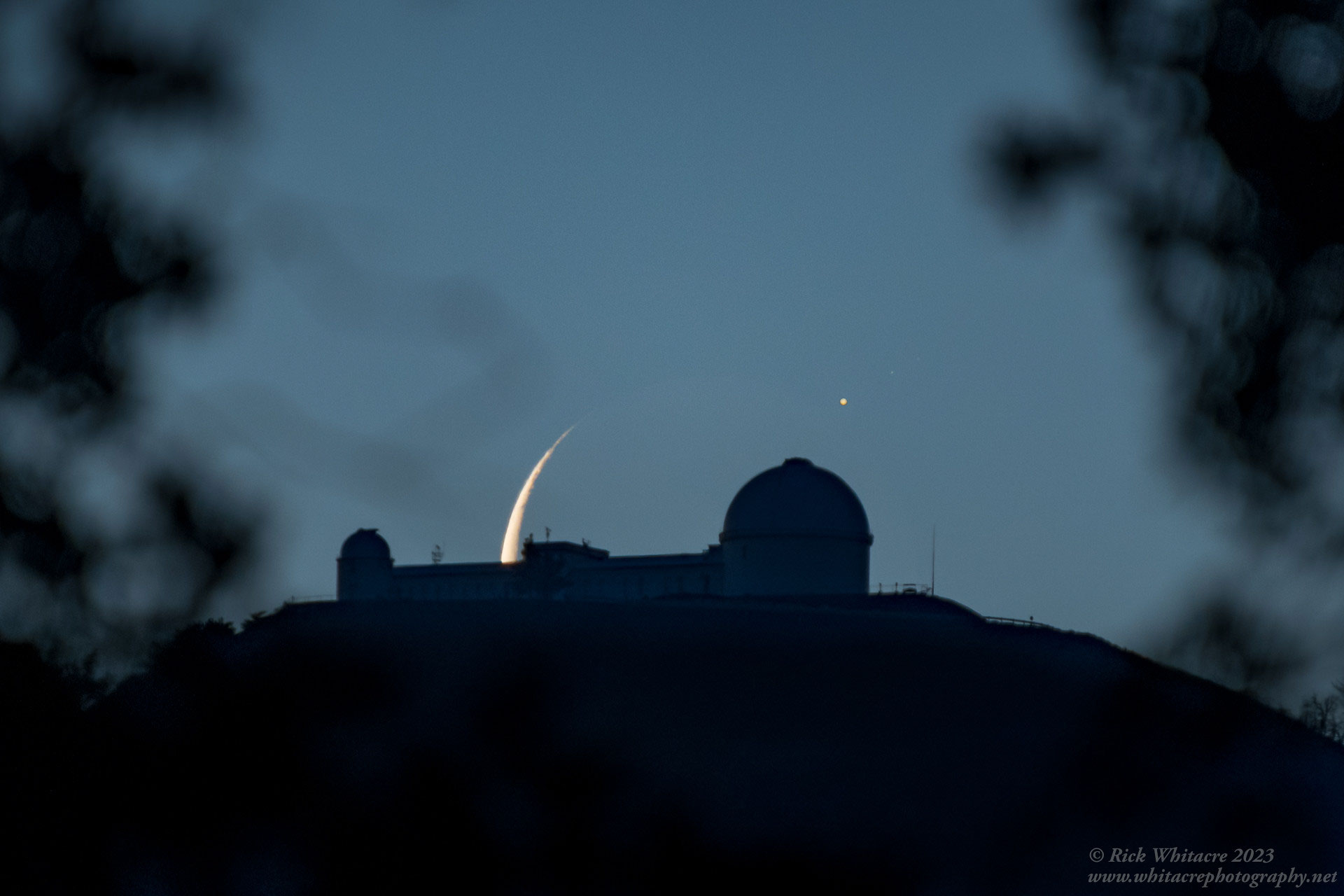
ASTRONOMY - Observatory Aligned with Moon Occulting Jupiter
2023 May 24
Image Credit & Copyright: Rick Whitacre; Text: Natalia Lewandowska (SUNY Oswego)
Explanation: Sometimes we witness the Moon moving directly in front of -- called occulting -- one of the planets in our Solar System. Earlier this month that planet was Jupiter. Captured here was the moment when Jupiter re-appeared from behind the surface of our Moon. The Moon was in its third quarter, two days before the dark New Moon. Now, our Moon is continuously half lit by the Sun, but when in its third quarter, relatively little of that half can be seen from the Earth. Pictured, the Moon itself was aligned behind the famous Lick Observatory in California, USA, on the summit of Mount Hamilton. Coincidentally, Lick enabled the discovery of a moon of Jupiter: Amalthea, the last visually detected moon of Jupiter after Galileo's observations.
23/05/2023
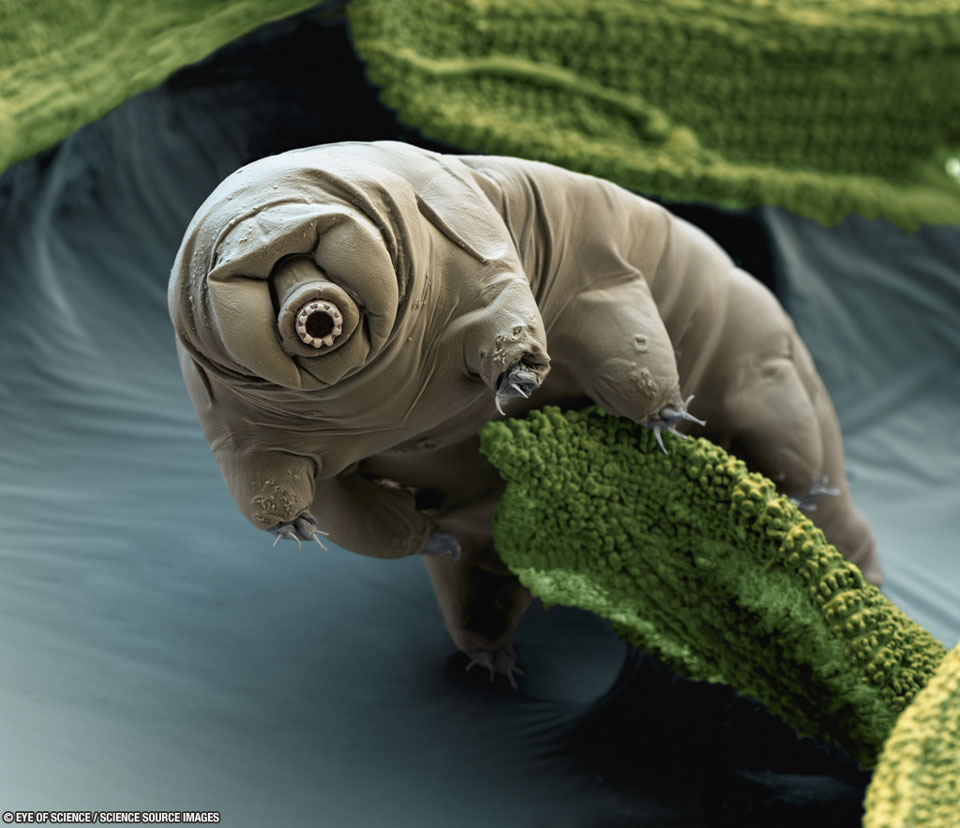
ASTRONOMY - Tardigrade in Moss
2023 May 21
Image Credit & Copyright: Nicole Ottawa & Oliver Meckes / Eye of Science / Science Source Images
Explanation: Is this an alien? Probably not, but of all the animals on Earth, the tardigrade might be the best candidate. That's because tardigrades are known to be able to go for decades without food or water, to survive temperatures from near absolute zero to well above the boiling point of water, to survive pressures from near zero to well above that on ocean floors, and to survive direct exposure to dangerous radiations. The far-ranging survivability of these extremophiles was tested in 2011 outside an orbiting space shuttle. Tardigrades are so durable partly because they can repair their own DNA and reduce their body water content to a few percent. Some of these miniature water-bears almost became extraterrestrials in 2011 when they were launched toward to the Martian moon Phobos, and again in 2021 when they were launched toward Earth's own moon, but the former launch failed, and the latter landing crashed. Tardigrades are more common than humans across most of the Earth. Pictured here in a color-enhanced electron micrograph, a millimeter-long tardigrade crawls on moss.
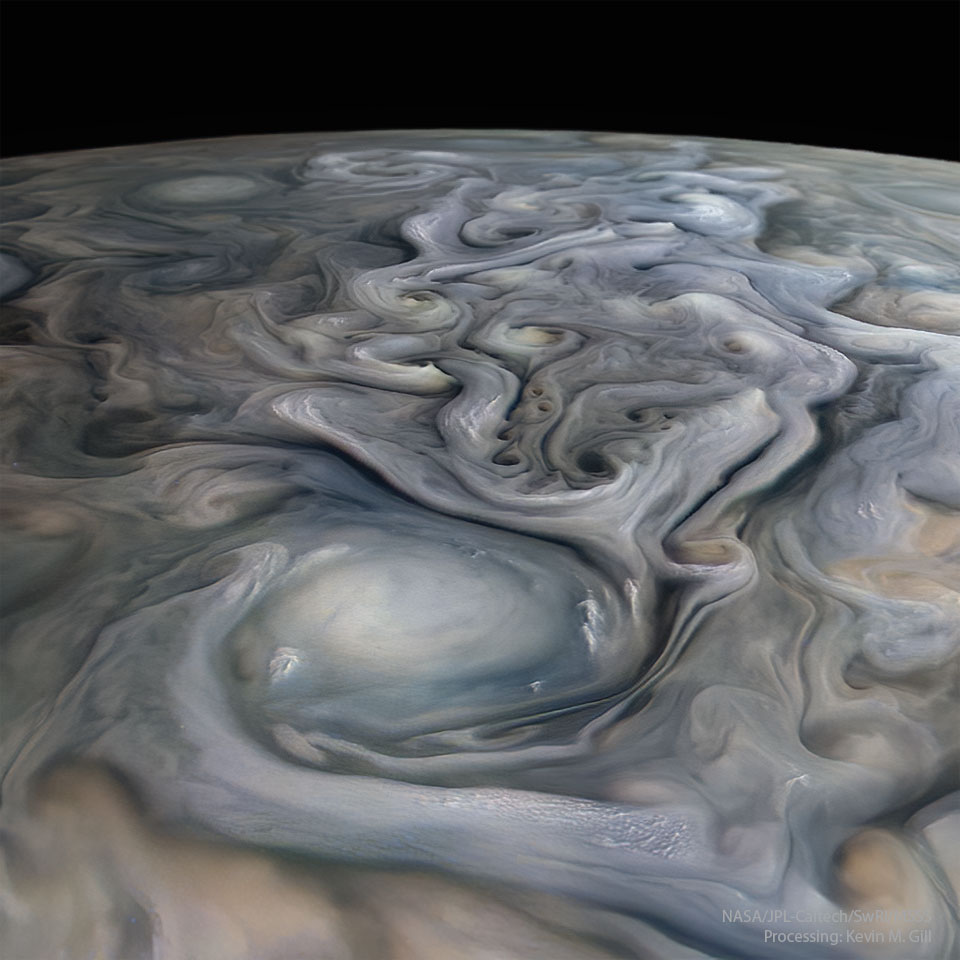
ASTRONOMY - Jupiter's Swirls from Juno
2023 May 23
Image Credit: NASA/JPL-Caltech/SwRI/MSSS; Processing & License: Kevin M. Gill
Explanation: Big storms are different on Jupiter. On Earth, huge hurricanes and colossal cyclones are centered on regions of low pressure, but on Jupiter, it is the high-pressure, anti-cyclone storms that are the largest. On Earth, large storms can last weeks, but on Jupiter they can last years. On Earth, large storms can be as large as a country, but on Jupiter, large storms can be as large as planet Earth. Both types of storms are known to exhibit lightning. The featured image of Jupiter's clouds was composed from images and data captured by the robotic Juno spacecraft as it swooped close to the massive planet in August 2020. A swirling white oval is visible nearby, while numerous smaller cloud swirls extend into the distance. On Jupiter, light-colored clouds are usually higher up than dark clouds. Despite their differences, studying storm clouds on distant Jupiter provides insights into storms and other weather patterns on
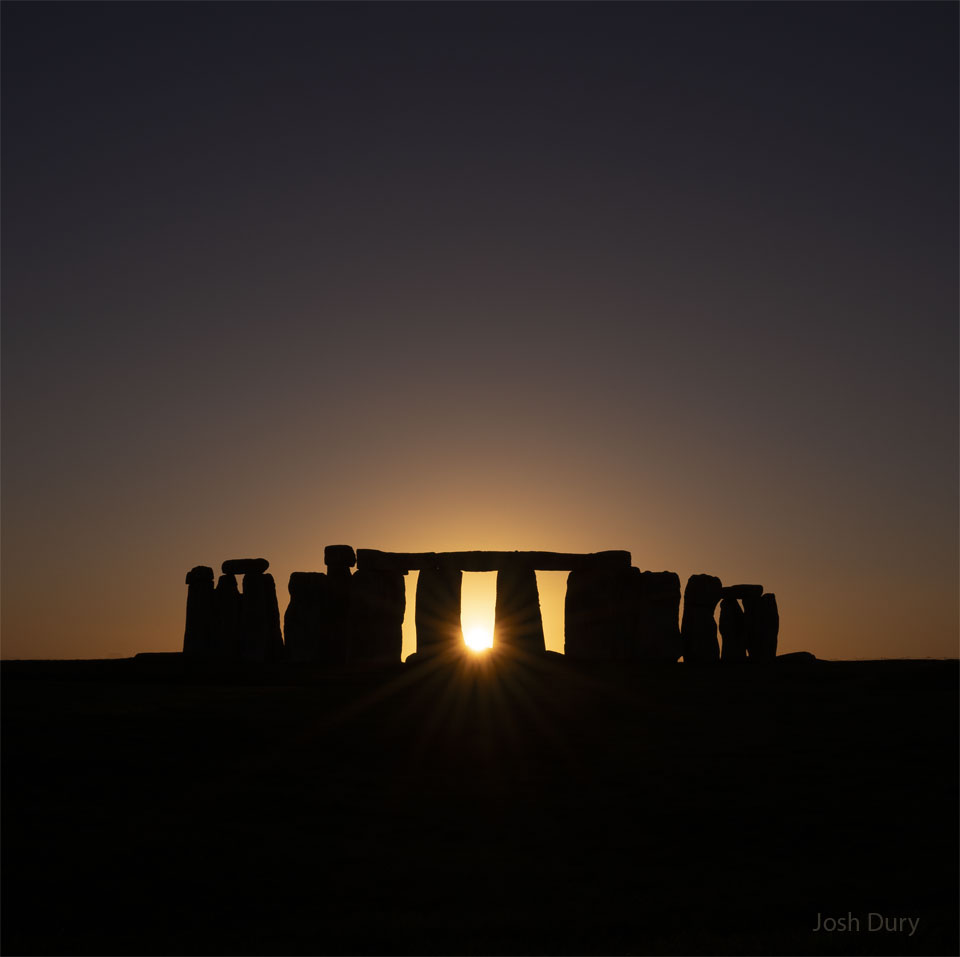
ASTRONOMY - Sunset Solstice over Stonehenge
2025 December 22 Sunset Solstice over Stonehenge Image Credit & Copyright: English Heritage , Josh Dury Explanation: Yesterday the Su...
-
2022 September 26 All the Water on Planet Earth Illustration Credit: Jack Cook, Adam Nieman, Woods Hole Oceanographic Institution ; Data ...
-
2025 May 11 The Surface of Venus from Venera 14 Image Credit: Soviet Planetary Exploration Program , Venera 14 ; Processing & Copyri...