Nombre total de pages vues
06/08/2023
MACRO PHOTOGRAPHIE - l’anémone en mouvement
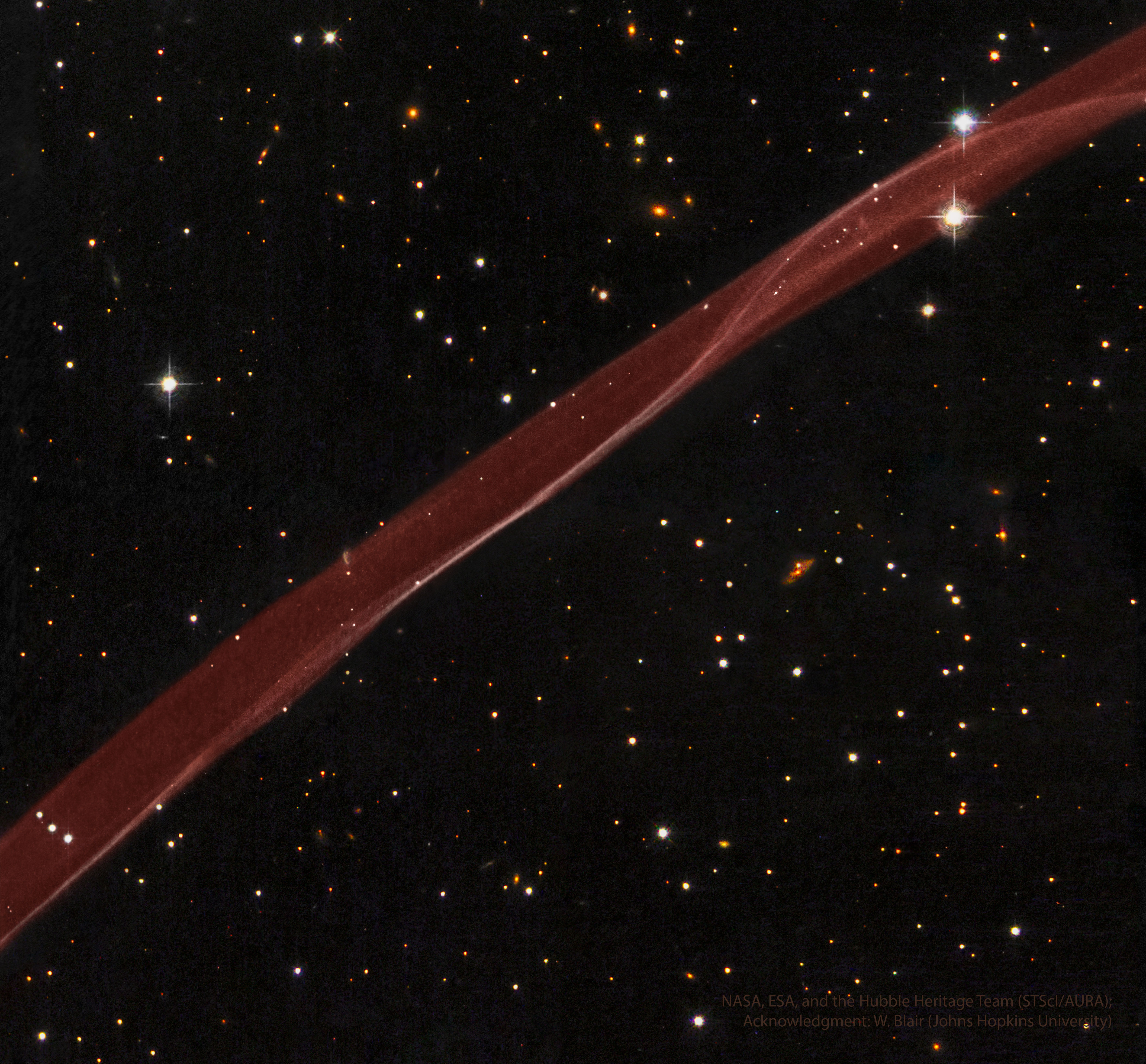
ASTRONOMY - SN 1006: A Supernova Ribbon from Hubble
2023 August 6
Credit: NASA, ESA, Hubble Heritage (STScI/AURA); Acknowledgement: W. Blair et al. (JHU)
Explanation: What created this unusual space ribbon? The answer: one of the most violent explosions ever witnessed by ancient humans. Back in the year 1006 AD, light reached Earth from a stellar explosion in the constellation of the Wolf (Lupus), creating a "guest star" in the sky that appeared brighter than Venus and lasted for over two years. The supernova, now cataloged at SN 1006, occurred about 7,000 light years away and has left a large remnant that continues to expand and fade today. Pictured here is a small part of that expanding supernova remnant dominated by a thin and outwardly moving shock front that heats and ionizes surrounding ambient gas. The supernova remnant SN 1006 now has a diameter of nearly 60 light years.
04/08/2023
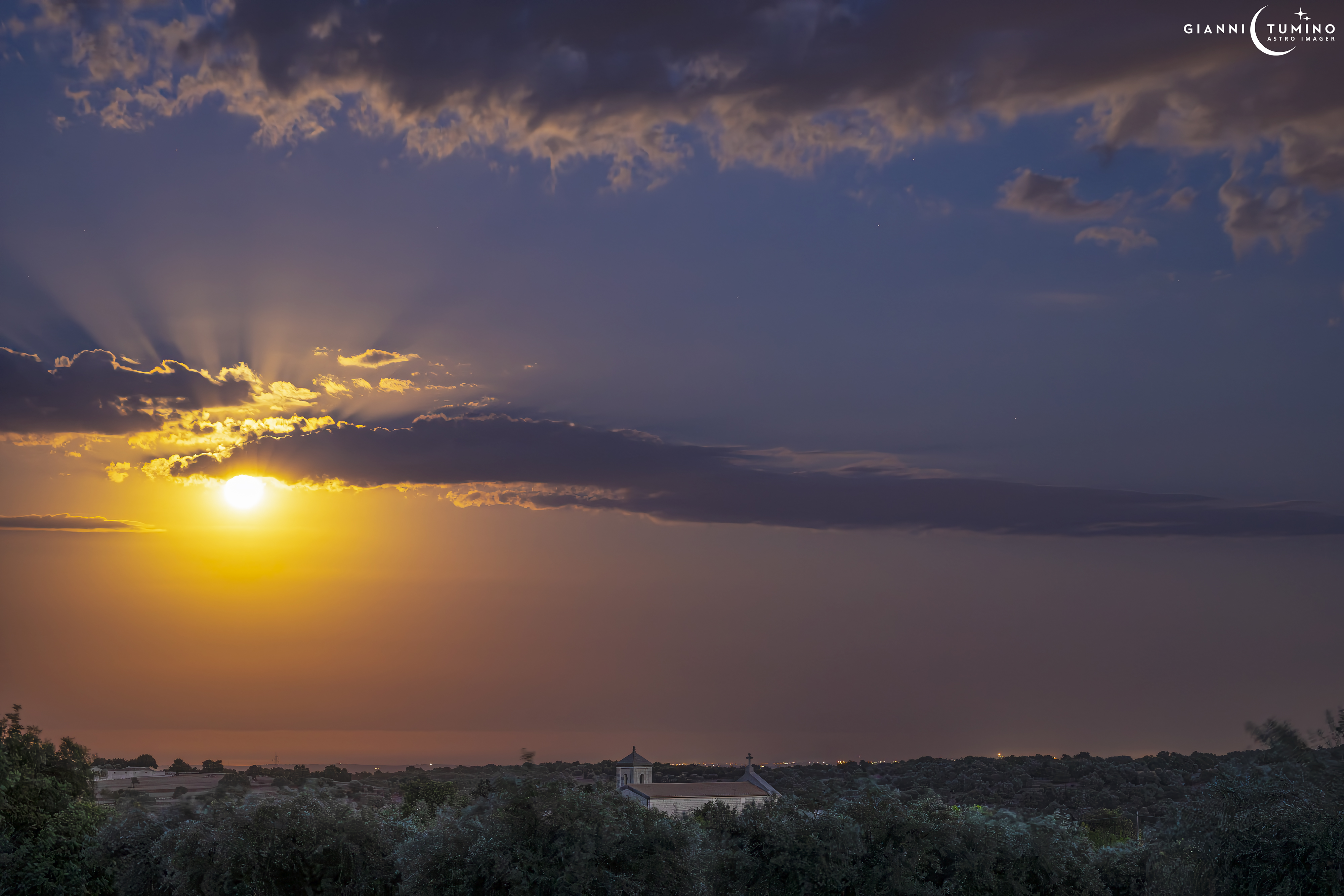
ASTRONOMY - Moonrays of August
2023 August 4
Image Credit & Copyright: Gianni Tumino
Explanation: A Full Moon rose as the Sun set on August 1. Near perigee, the closest point in its almost moonthly orbit, the brighter than average lunar disk illuminated night skies around planet Earth as the second supermoon of 2023. Seen here above Ragusa, Sicily, cloud banks cast diverging shadows through the supermoonlit skies, creating dramatic lunar crepuscular rays. The next Full Moon in 2023 will also shine on an August night. Rising as the Sun sets on August 30/31, this second Full Moon in a month is known as a Blue Moon. Blue moons occur only once every 2 or 3 years because lunar phases take almost a calendar month (29.5 days) to go through a complete cycle. But August's Blue Moon will also be near perigee, the third supermoon in 2023.
02/08/2023

ASTRONOMY - M82: Galaxy with a Supergalactic Wind
2023 August 2
NASA, ESA, Hubble; Processing & Copyright: Harshwardhan Pathak
Explanation: Why is the Cigar Galaxy billowing red smoke? M82, as this starburst galaxy is also known, was stirred up by a recent pass near large spiral galaxy M81. This doesn't fully explain the source of the red-glowing outwardly expanding gas and dust, however. Evidence indicates that this gas and dust is being driven out by the combined emerging particle winds of many stars, together creating a galactic superwind. The dust particles are thought to originate in M82's interstellar medium and are actually similar in size to particles in cigar smoke. The featured photographic mosaic highlights a specific color of red light strongly emitted by ionized hydrogen gas, showing detailed filaments of this gas and dust. The filaments extend for over 10,000 light years. The 12-million light-year distant Cigar Galaxy is the brightest galaxy in the sky in infrared light and can be seen in visible light with a small telescope towards the constellation of the Great Bear (Ursa Major).
26/07/2023
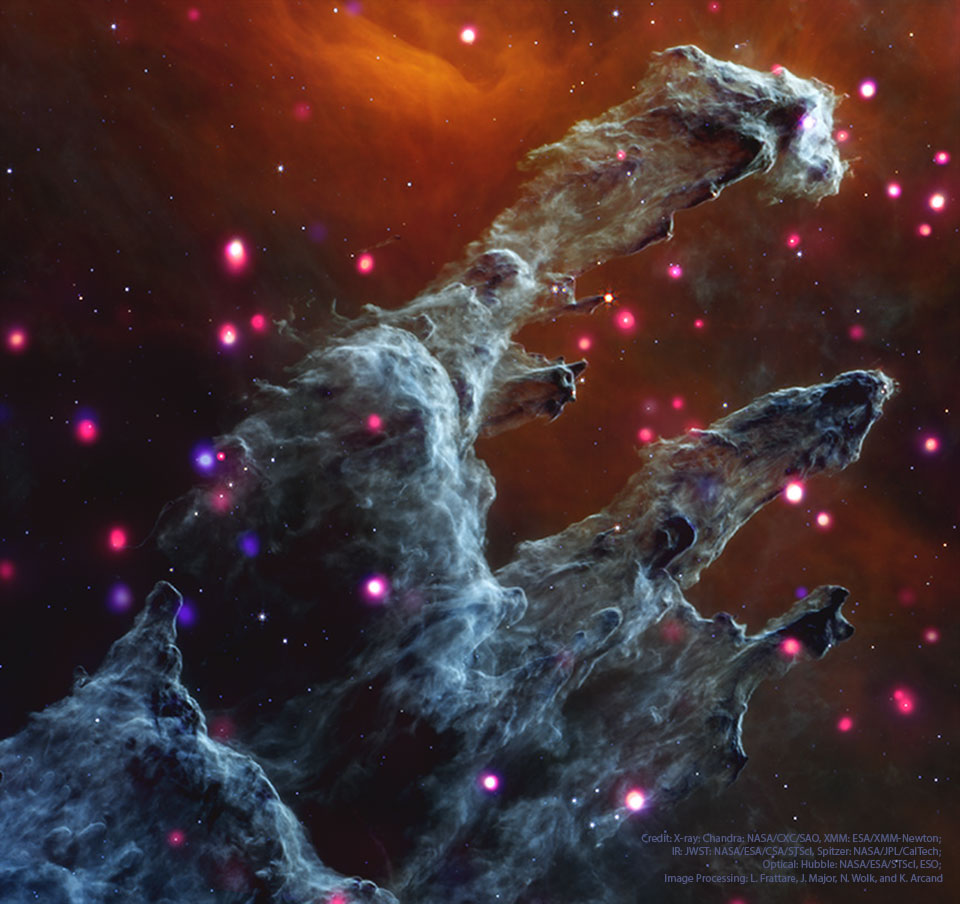
ASTRONOMY - The Eagle Nebula with X-ray Hot Stars
2023 July 25
Image Credit: X-ray: Chandra: NASA/CXC/SAO, XMM: ESA/XMM-Newton; IR: JWST: NASA/ESA/CSA/STScI, Spitzer: NASA/JPL/CalTech; Visible: Hubble: NASA/ESA/STScI, ESO; Image Processing: L. Frattare, J. Major, N. Wolk, and K. Arcand
Explanation: What do the famous Eagle Nebula star pillars look like in X-ray light? To find out, NASA's orbiting Chandra X-ray Observatory peered in and through these interstellar mountains of star formation. It was found that in M16 the dust pillars themselves do not emit many X-rays, but a lot of small-but-bright X-ray sources became evident. These sources are shown as bright dots on the featured image which is a composite of exposures from Chandra (X-rays), XMM (X-rays), JWST (infrared), Spitzer (infrared), Hubble (visible), and the VLT (visible). What stars produce these X-rays remains a topic of research, but some are hypothesized to be hot, recently-formed, low-mass stars, while others are thought to be hot, older, high-mass stars. These X-ray hot stars are scattered around the frame -- the previously identified Evaporating Gaseous Globules (EGGS) seen in visible light are not currently hot enough to emit X-rays.
23/07/2023
ASTRONOMY - The Antikythera Mechanism
2023 July 23
Image Credit & License: Marsyas, Wikipedia
Explanation: It does what? No one knew that 2,000 years ago, the technology existed to build such a device. The Antikythera mechanism, pictured, is now widely regarded as the first computer. Found at the bottom of the sea aboard a decaying Greek ship, its complexity prompted decades of study, and even today some of its functions likely remain unknown. X-ray images of the device, however, have confirmed that a main function of its numerous clock-like wheels and gears is to create a portable, hand-cranked, Earth-centered, orrery of the sky, predicting future star and planet locations as well as lunar and solar eclipses. The corroded core of the Antikythera mechanism's largest gear is featured, spanning about 13 centimeters, while the entire mechanism was 33 centimeters high, making it similar in size to a large book. Recently, modern computer modeling of missing components is allowing for the creation of a more complete replica of this surprising ancient machine.
22/07/2023
GEMMOLOGIE - La fluorine
ART FRACTAL - Inquiétante image fractale sur fond rouge
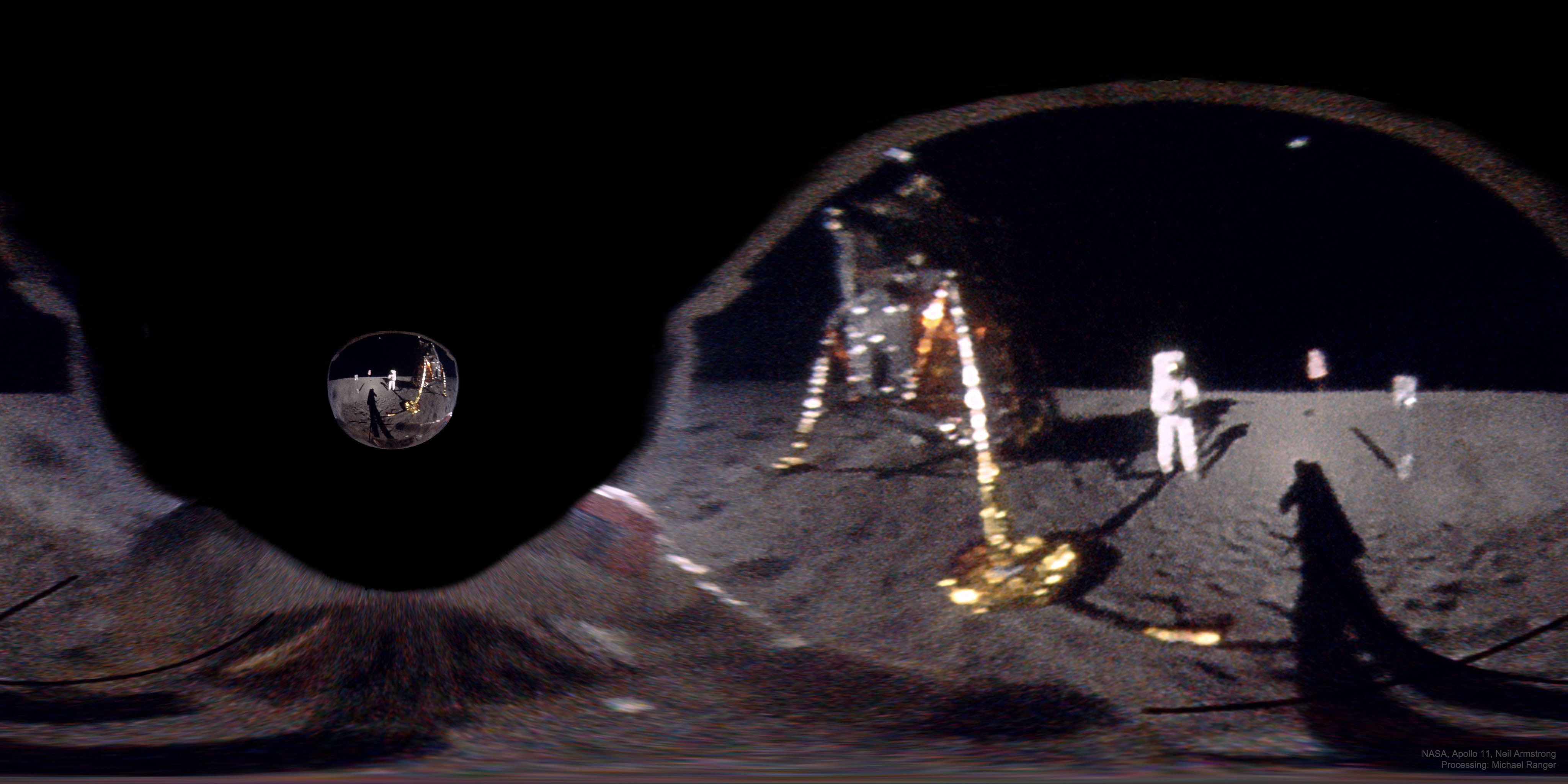
ASTRONOMY - Apollo 11: Armstrong's Lunar Selfie
2023 July 22
Image Credit: NASA, Apollo 11, Neil Armstrong; Processing: Michael Ranger
Explanation: A photograph of Buzz Aldrin standing on the Moon taken by Neil Armstrong, was digitally reversed to create this lunar selfie. Captured in July 1969 following the Apollo 11 moon landing, Armstrong's original photograph recorded not only the magnificent desolation of an unfamiliar world, but Armstrong himself reflected in Aldrin's curved visor. In the unwrapped image, the spherical distortion of the reflection in Aldrin's helmet has been reversed. The transformed view features Armstrong himself from Aldrin's perspective. Since Armstrong took the original picture, today the image represents a fifty-four year old lunar selfie. Aldrin's visor reflection in the original image appears here on the left. Bright (but distorted) planet Earth hangs in the lunar sky above Armstrong's figure, toward the upper right. A foil-wrapped leg of the Eagle lander and Aldrin's long shadow stretching across the lunar surface are prominently visible. In 2024 NASA's Artemis II mission will return humans to the Moon.
21/07/2023
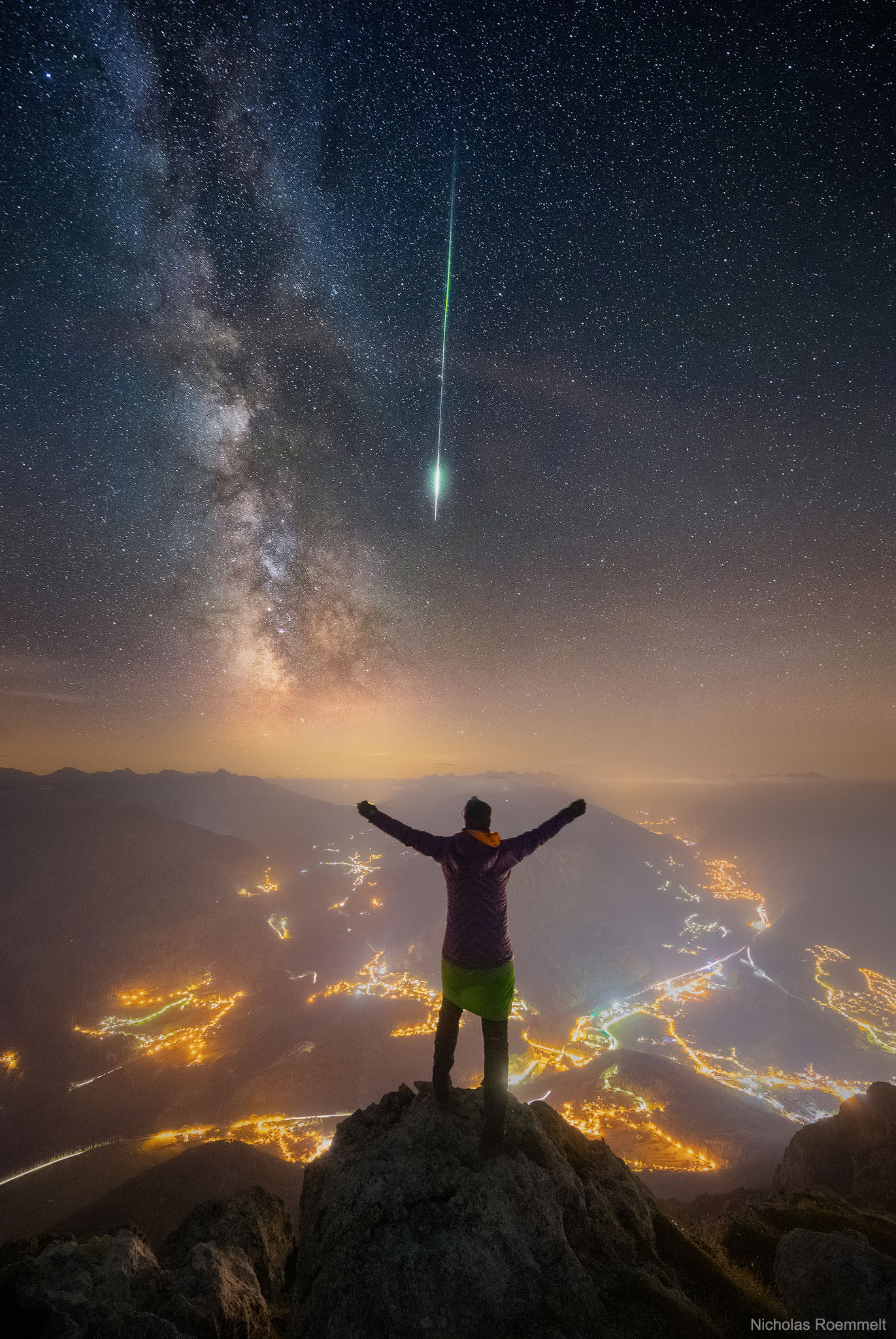
ASTRONOMY - Meteor and Milky Way over the Alps
2023 July 16
Image Credit & Copyright: Nicholas Roemmelt (Venture Photography)
Explanation: Now this was a view with a thrill. From Mount Tschirgant in the Alps, you can see not only nearby towns and distant Tyrolean peaks, but also, weather permitting, stars, nebulas, and the band of the Milky Way Galaxy. What made the arduous climb worthwhile this night, though, was another peak -- the peak of the 2018 Perseids Meteor Shower. As hoped, dispersing clouds allowed a picturesque sky-gazing session that included many faint meteors, all while a carefully positioned camera took a series of exposures. Suddenly, a thrilling meteor -- bright and colorful -- slashed down right next to the nearly vertical band of the Milky Way. As luck would have it, the camera caught it too. Therefore, a new image in the series was quickly taken with one of the sky-gazers posing on the nearby peak. Later, all of the images were digitally combined.
ASTRONOMY - Sunset Solstice over Stonehenge
2025 December 22 Sunset Solstice over Stonehenge Image Credit & Copyright: English Heritage , Josh Dury Explanation: Yesterday the Su...
-
2022 September 26 All the Water on Planet Earth Illustration Credit: Jack Cook, Adam Nieman, Woods Hole Oceanographic Institution ; Data ...
-
2025 May 11 The Surface of Venus from Venera 14 Image Credit: Soviet Planetary Exploration Program , Venera 14 ; Processing & Copyri...