FuturaSciences
Nombre total de pages vues
13/09/2023
AERONAUTIQUE - LES INVENTIONS QUI N'ONT JAMAIS VOLE - La vis aérienne de Léonard de Vinci
FuturaSciences
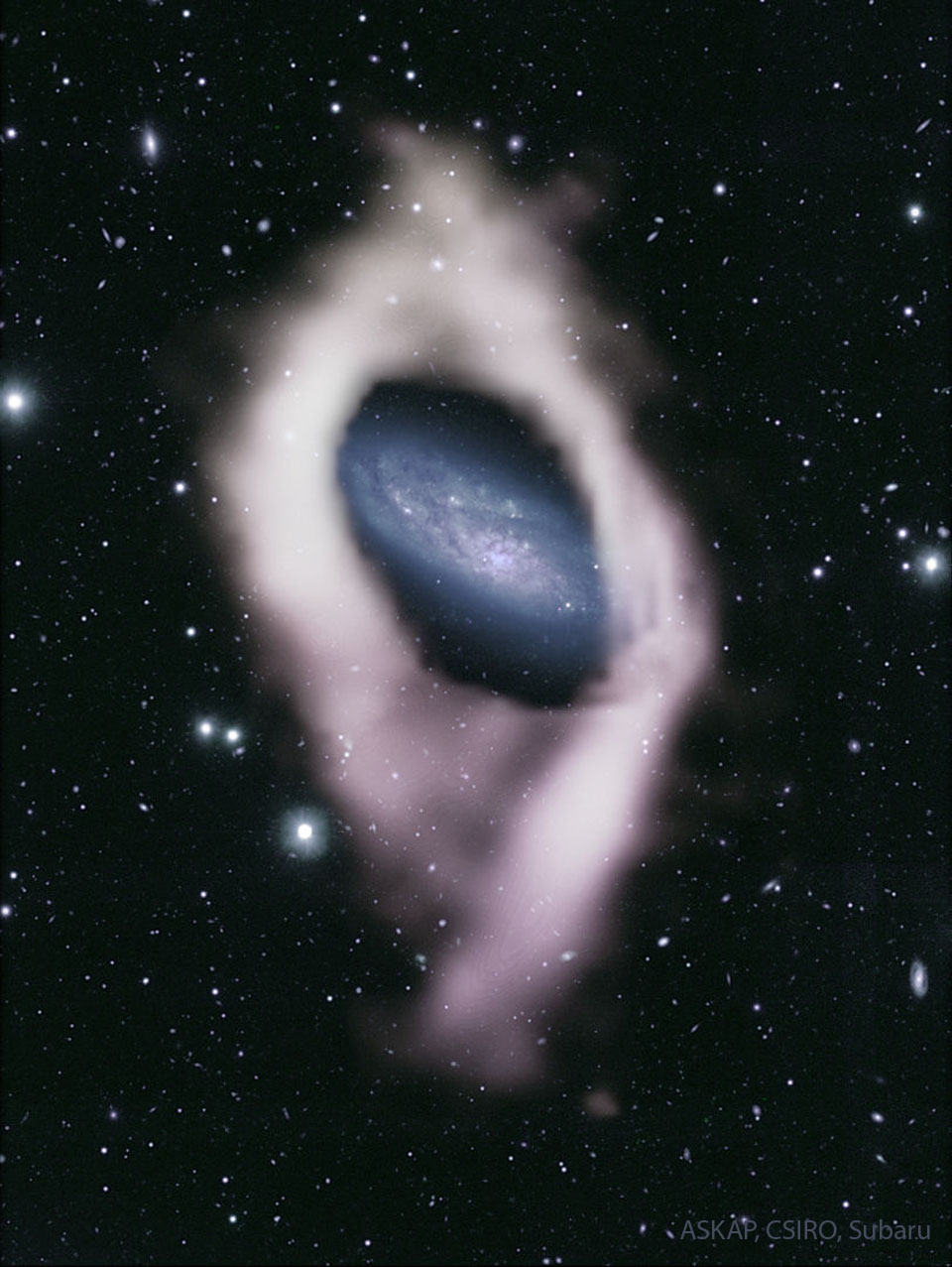
ASTRONOMY - NGC 4632: Galaxy with a Hidden Polar Ring
2023 September 13
Credit: Jayanne English (U. Manitoba), Nathan Deg (Queen's University) & WALLABY Survey, CSIRO/ASKAP, NAOJ/Subaru Telescope; Text: Jayanne English (U. Manitoba)
Explanation: Galaxy NGC 4632 hides a secret from optical telescopes. It is surrounded by a ring of cool hydrogen gas orbiting at 90 degrees to its spiral disk. Such polar ring galaxies have previously been discovered using starlight. However, NGC 4632 is among the first in which a radio telescope survey revealed a polar ring. The featured composite image combines this gas ring, observed with the highly sensitive ASKAP telescope, with optical data from the Subaru telescope. Using virtual reality, astronomers separated out the gas in the main disk of the galaxy from the ring, and the subtle color gradient traces its orbital motion. Why do polar rings exist? They could be material pulled from one galaxy as it gravitationally interacts with a companion. Or hydrogen gas flows along the filaments of the cosmic web and accretes into a ring around a galaxy, some of which gravitationally contracts into stars.
11/09/2023
AERONAUTIQUE - LES INVENTIONS QUI N'ONT JAMAIS VOLE - Le navire volant de Bartolomeu Lourenço de Gusmão
FuturaSciences
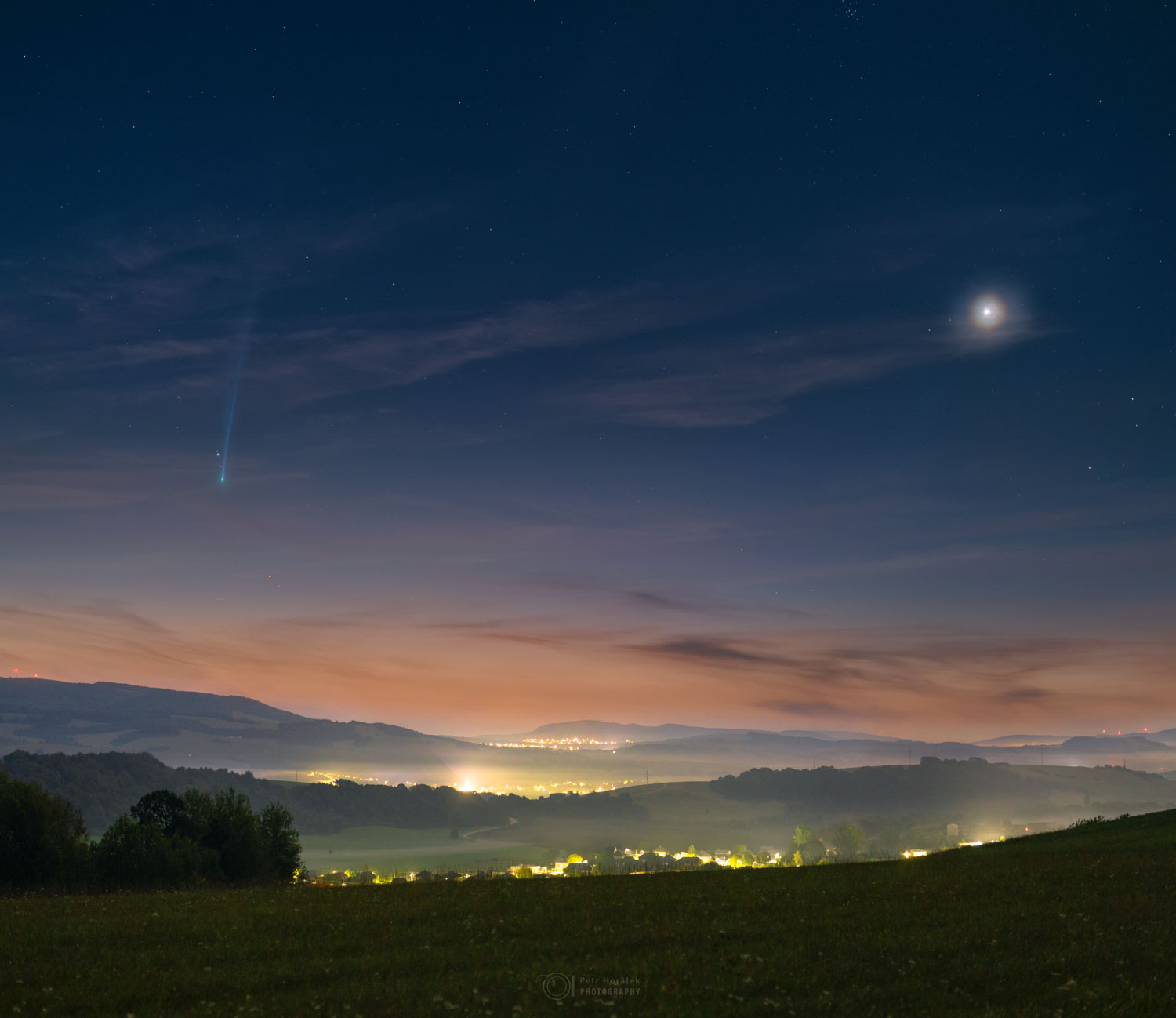
ASTRONOMY - Beautiful Comet Nishimura
2023 September 11
Credit & Copyright: Petr Horálek / Institute of Physics in Opava
Explanation: This scene would be beautiful even without the comet. By itself, the sunrise sky is an elegant deep blue on high, with faint white stars peeking through, while near the horizon is a pleasing tan. By itself, the foreground hills of eastern Slovakia are appealingly green, with the Zadňa hura and Veľká hora hills in the distance, and with the lights of small towns along the way. Venus, by itself on the right, appears unusually exquisite, surrounded by a colorful atmospheric corona. But what attracts the eye most is the comet. On the left, in this composite image taken just before dawn yesterday morning, is Comet Nishimura. On recent mornings around the globe, its bright coma and long ion tail make many a morning panoramic photo unusually beautiful. Tomorrow, C/2023 P1 (Nishimura) will pass its nearest to the Earth for about the next 434 years.
10/09/2023
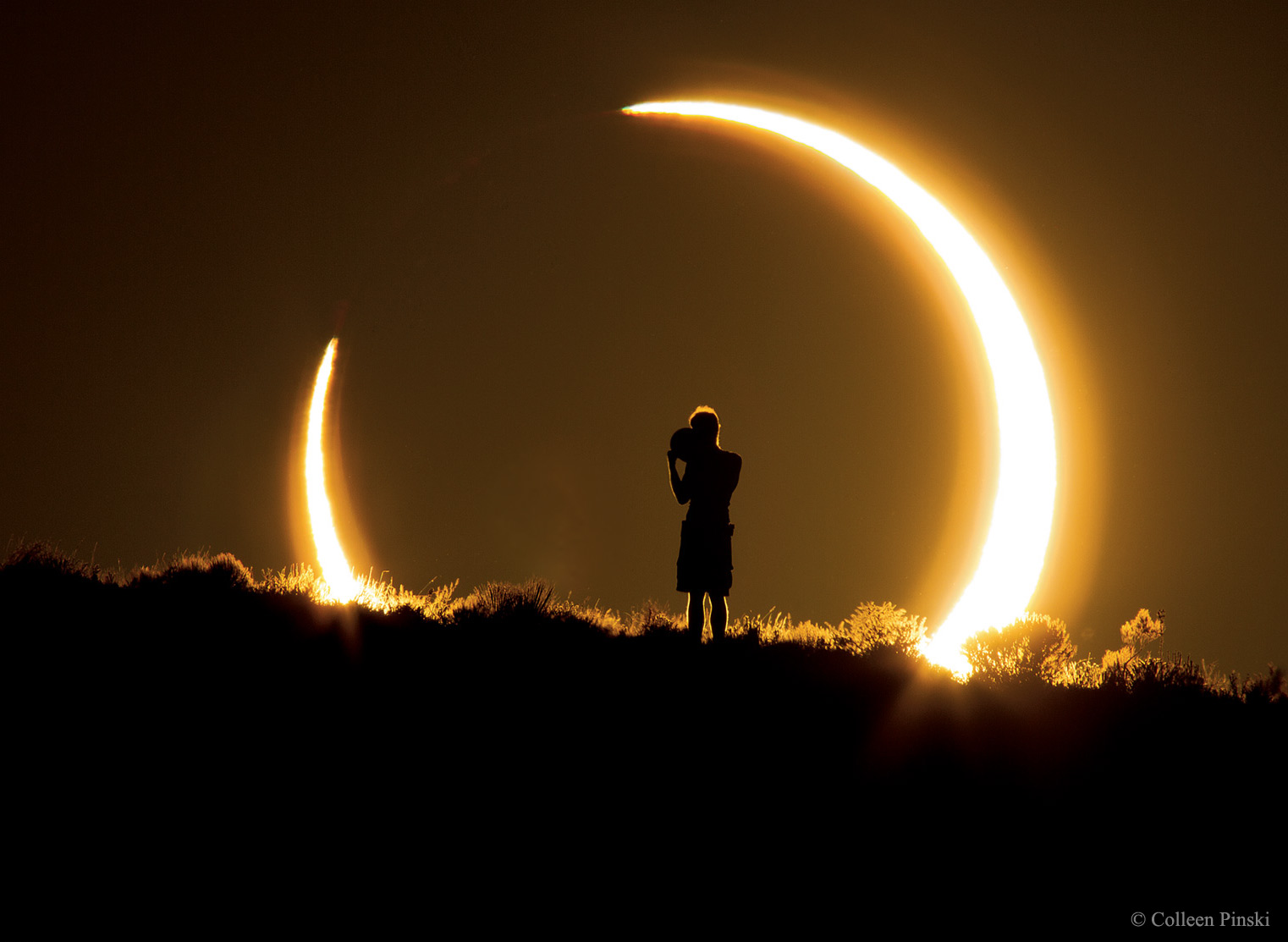
ASTRONOMY - An Annular Solar Eclipse over New Mexico
2023 September 10
Credit & Copyright: Colleen Pinski
Explanation: What is this person doing? In 2012, an annular eclipse of the Sun was visible over a narrow path that crossed the northern Pacific Ocean and several western US states. In an annular solar eclipse, the Moon is too far from the Earth to block out the entire Sun, leaving the Sun peeking out over the Moon's disk in a ring of fire. To capture this unusual solar event, an industrious photographer drove from Arizona to New Mexico to find just the right vista. After setting up and just as the eclipsed Sun was setting over a ridge about 0.5 kilometers away, a person unknowingly walked right into the shot. Although grateful for the unexpected human element, the photographer never learned the identity of the silhouetted interloper. It appears likely that the person is holding a circular device that would enable them to get their own view of the eclipse. The shot was taken at sunset on 2012 May 20 at 7:36 pm local time from a park near Albuquerque. Next month, on October 14, a different narrow swath across North and South America will be exposed to a different annular solar eclipse, if the sky is clear. Simultaneously, cloud-free observers almost anywhere on either continent will be able to see a partial solar eclipse.
09/09/2023
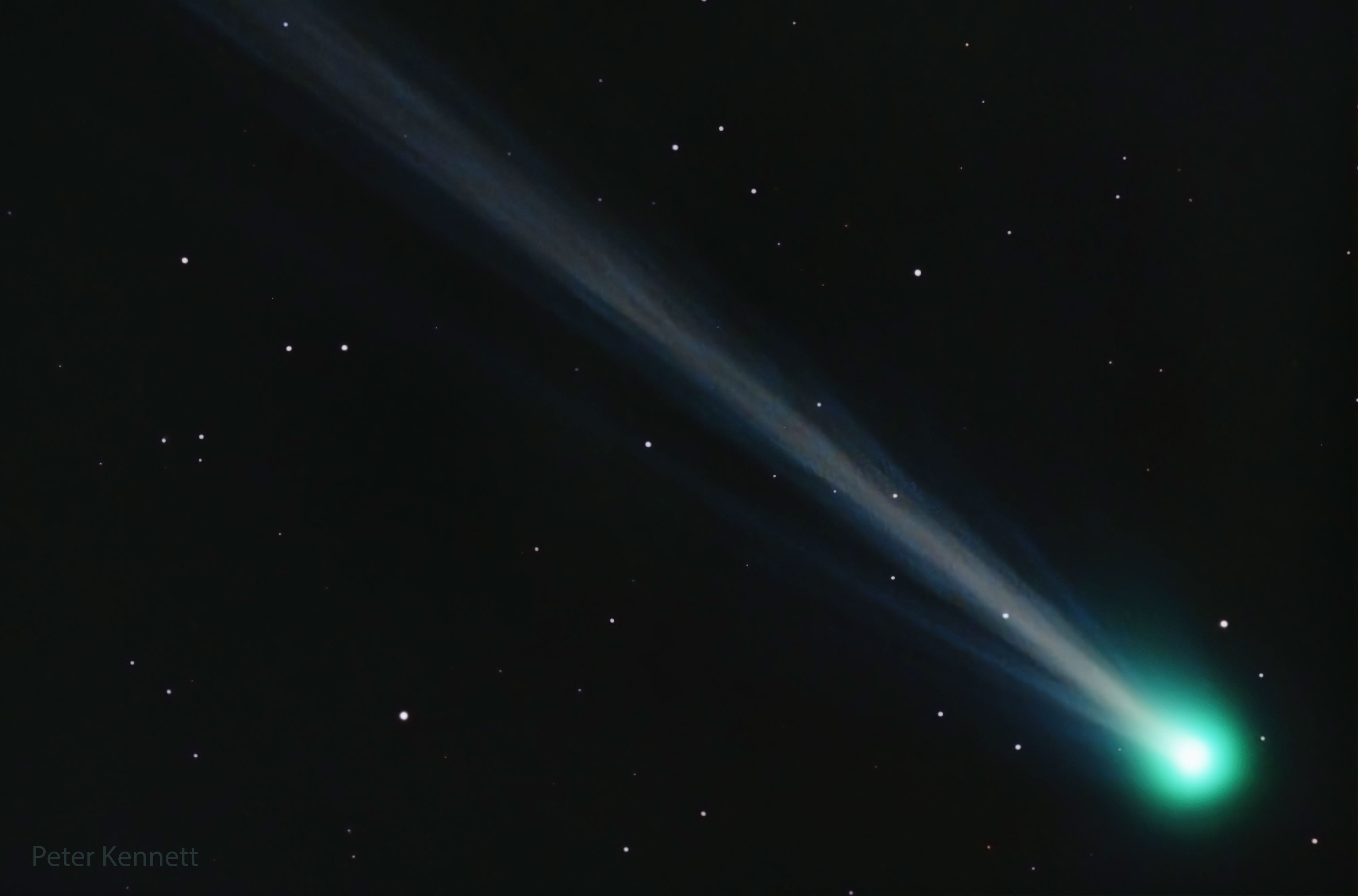
ASTRONOMY - Comet Nishimura Grows
2023 September 9
Credit & Copyright: Peter Kennett
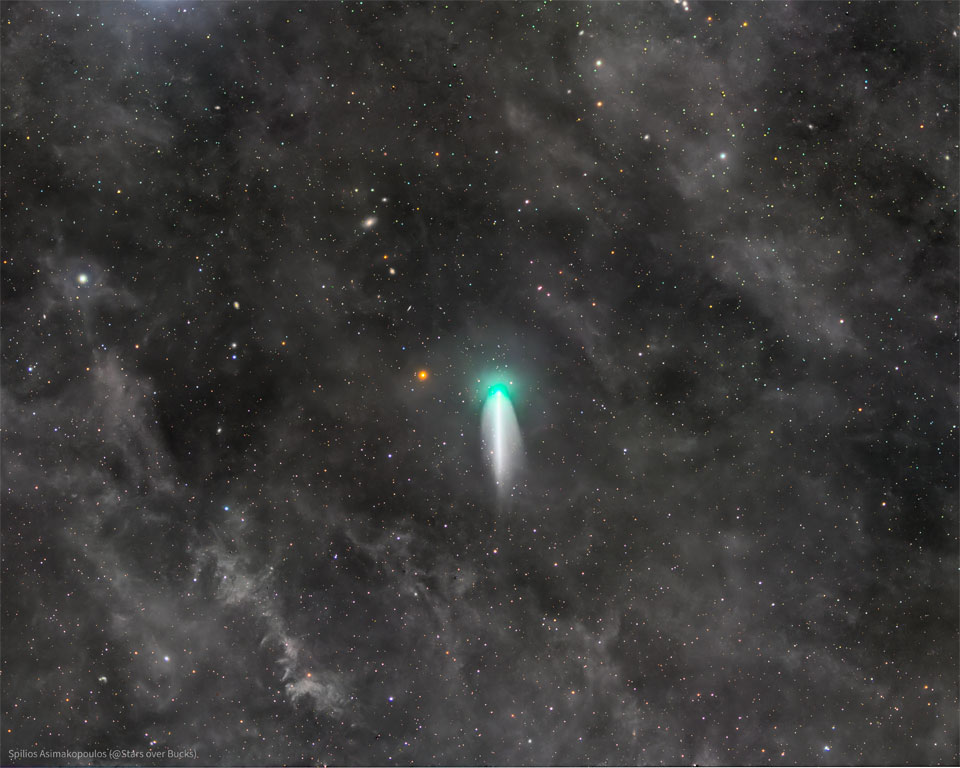
Explanation: Comet Nishimura is growing. More precisely, the tails C/2023 P1 (Nishimura) are growing as it nears the Sun. Discovered only last month, the comet is already near naked eye brightness as it now moves inside the Earth's orbit. The comet will be nearest the Earth next week, but nearest the Sun the week after -- on September 17. Speculation holds that expelled ice and dust from Comet Nishimura's last visit to the inner Solar System may have created the Sigma Hydrids meteor shower which peaks yearly in December. If so, then this meteor shower may become more active, refreshed with new comet debris. Pictured, Comet Nishimura was captured from Edgewood, New Mexico, USA four nights ago, showing a long ion tail structured by interactions with the Sun's wind. Look for this comet near your eastern horizon just before sunrise for the next few mornings, but very near your western horizon just after sunset next week -- as its coma continues to brighten and its tails continue to grow.
08/09/2023
AERONAUTIQUE - LES INVENTIONS QUI N'ONT JAMAIS VOLE - La machine volante du professeur Wellner
FuturaSciences
ANIMAUX - Le Pétrel de Hall
07/09/2023
ASTRONOMY - HESS Telescopes Explore the High-Energy Sky
2023 September 6
Credit & Copyright: Video Credit & Copyright: Jeff Dai (TWAN), H.E.S.S. Collaboration;
Music: Ibaotu catalog number 1044988 (Used with permission)
Explanation: They may look like modern mechanical dinosaurs, but they are enormous swiveling eyes that watch the sky. The High Energy Stereoscopic System (H.E.S.S.) Observatory is composed of four 12-meter reflecting-mirror telescopes surrounding a larger telescope housing a 28-meter mirror. They are designed to detect strange flickers of blue light -- Cherenkov radiation --emitted when charged particles move slightly faster than the speed of light in air. This light is emitted when a gamma ray from a distant source strikes a molecule in Earth's atmosphere and starts a charged-particle shower. H.E.S.S. is sensitive to some of the highest energy photons (TeV) crossing the universe. Operating since 2003 in Namibia, H.E.S.S. has searched for dark matter and has discovered over 50 sources emitting high energy radiation including supernova remnants and the centers of galaxies that contain supermassive black holes. Pictured in June, H.E.S.S. telescopes swivel and stare in time-lapse sequences shot in front of our Milky Way Galaxy and the Magellanic Clouds -- as the occasional Earth-orbiting satellite zips by.
ASTRONOMY - Sunset Solstice over Stonehenge
2025 December 22 Sunset Solstice over Stonehenge Image Credit & Copyright: English Heritage , Josh Dury Explanation: Yesterday the Su...
-
2022 September 26 All the Water on Planet Earth Illustration Credit: Jack Cook, Adam Nieman, Woods Hole Oceanographic Institution ; Data ...
-
2025 May 11 The Surface of Venus from Venera 14 Image Credit: Soviet Planetary Exploration Program , Venera 14 ; Processing & Copyri...