Nombre total de pages vues

17/10/2024

INVENTIONS A L'HORIZON 2050 - Les vêtements en spray révolutionneront l'habillement et la santé


Marre de ne jamais trouver votre taille de T-shirt dans les boutiques ? La société britannique Fabrican semble avoir trouvé la solution : le vêtement en spray. L'invention a été développée par le designer de mode espagnol Manuel Torres. Elle consiste à mélanger des fibres textile à un polymère et à un solvant et de projeter le mélange sur une surface. En séchant, le solvant s'évapore et on obtient un vrai tissu, réutilisable.

La technique ne sera pas limitée à la mode. Dans le domaine médical, par exemple, elle permettra de diffuser des substances actives à travers la peau ou de servir de pansement. Elle pourrait aussi servir pour les garnitures intérieures d'une voiture ou dans l'industrie.

JournalDuNet

LES NUAGES DIEUX DU CIEL - Paysage avec cumulus

Photo de paysage avec cumulus.
© John Day, Cloudman's Gallery, www.cloudman.com

ASTRONOMY - The Clipper and the Comet

 2024 October 17

See Explanation.  Clicking on the picture will download
the highest resolution version available.

The Clipper and the Comet
Image Credit & CopyrightBen Cooper (Launch Photography)

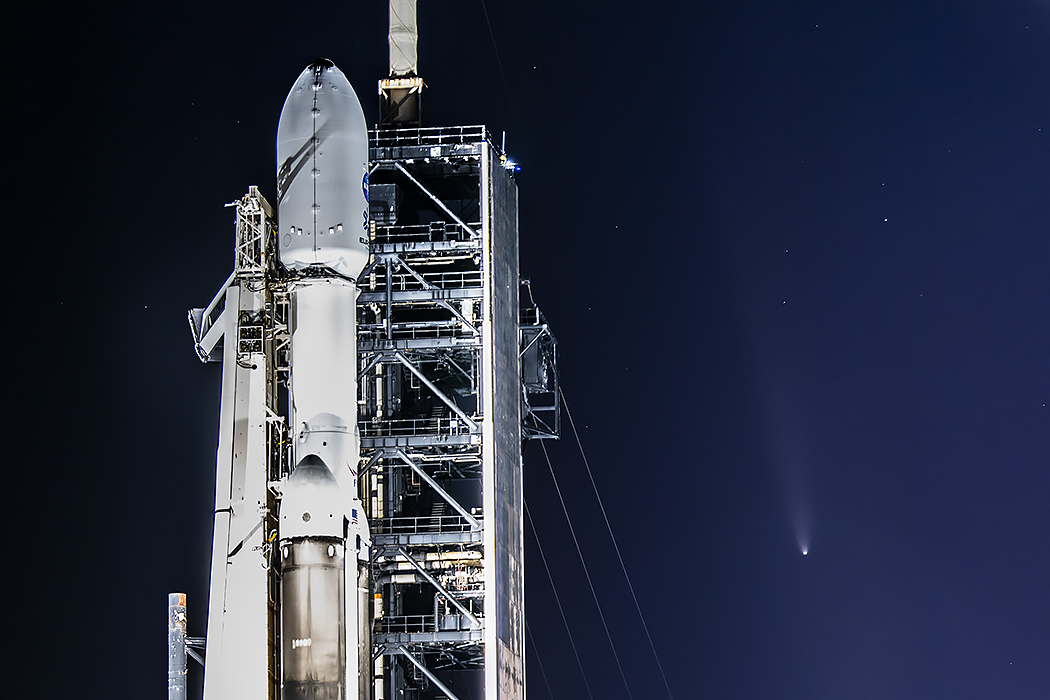
Explanation: NASA's Europa Clipper is now headed toward an ocean world beyond Earth. The large spacecraft is tucked into the payload fairing atop the Falcon Heavy rocket in this photo, taken at Kennedy Space Center the day before the mission's successful October 14 launch. Europa Clipper's interplanetary voyage will first take it to Mars, then back to Earth, and then on to Jupiter on gravity assist trajectories that will allow it to enter orbit around Jupiter in April 2030. Once orbiting Jupiter, the spacecraft will fly past Europa 49 times, exploring a Jovian moon with a global subsurface ocean that may have conditions to support life. Posing in the background next to the floodlit rocket is Comet Tsuchinsan-ATLAS, about a day after the comet's closest approach to Earth. A current darling of evening skies, the naked-eye comet is a vistor from the distant Oort cloud

16/10/2024

LES NUAGES DIEUX DU CIEL - Stratocumulus au parc national des Arches (États-Unis)

Stratocumulus stratiformis perlucidus castellanus cumulogenitus. Photo prise dans l'Utah, au parc national des Arches (États-Unis).

© Bernhard Mühr, Der Karlsruher Wolkenatlas, www.wolkenatlas.de

ASTRONOMY - Colorful Aurora over New Zealand

 2024 October 16

A night sky is shown that appears mostly red due to pervasive
aurora. In the foreground is covered by watery grasslands. Clouds 
are visible above the horizon. Thin green aurora are visible 
toward the top of the frame. In the background one can find the Moon,
the LMC, SMC, Venus, a meteor, and the band of our Milky Way galaxy.
Please see the explanation for more detailed information.

Colorful Aurora over New Zealand
Image Credit & Copyright: Tristian McDonald

Explanation: Sometimes the night sky is full of surprises. Take the sky over Lindis PassSouth IslandNew Zealand one-night last week. Instead of a typically calm night sky filled with constant stars, a busy and dynamic night sky appeared. Suddenly visible were pervasive red aurora, green picket-fence aurora, a red SAR arc, a STEVE, a meteor, and the Moon. These outshone the center of our Milky Way Galaxy and both of its two satellite galaxies: the LMC and SMC. All of these were captured together on 28 exposures in five minutes, from which this panorama was composed. Auroras lit up many skies last week, as a Coronal Mass Ejection from the Sun unleashed a burst of particles toward our Earth that created colorful skies over latitudes usually too far from the Earth's poles to see them. More generally, night skies this month have other surprises, showing not only auroras -- but comets.

15/10/2024

VILLES BIONIQUES DU FUTUR - L’arche bionique de Taiwan : la nature à la verticale


Dans le parc Gateway de Taichung, à Taiwan, cette tour est comme une forêt dans la ville. Des prairies et des jardins s'étalent en palier sur 390 m de hauteur dans un bâtiment autosuffisant, grâce aux énergies solaire et éolienne. On s'y promène pour apprécier la nature et pour trouver une vision panoramique sur la mégalopole. La tour sert aussi pour les relais de télécommunications.

© Vincent Callebaut

MUSIC - Strauss : Morgen (extrait de 4 Lieder) | Musica Sancta Ensemble

"Morgen"

LES NUAGES DIEUX DU CIEL - Qu'est-ce qu'un cirrus ?


Cirrus fibratus undulatus et cirrus fibratus, en Allemagne. Le cirrus est un nuage appartenant à l'étage supérieur (aux latitudes tempérées, sa base se situe entre 6.000 et 12.500 m de hauteur avec une épaisseur de l'ordre de 300 m). Il est constitué de bancs, de bandes ou de filaments séparés, blancs le plus souvent, qui revêtent un aspect fibreux ou un éclat soyeux (les deux apparences pouvant se conjuguer). Il n'est pas associé aux précipitations.

© Bernhard Mühr, Der Karlsruher Wolkenatlas, www.wolkenatlas.de

ASTRONOMY - Animation: Comet Tsuchinshan-ATLAS Tails Prediction

 2024 October 15

Animation: Comet Tsuchinshan-ATLAS Tails Prediction
Credit & Copyright: Nico Lefaudeux

Explanation: How bright and strange will the tails of Comet Tsuchinshan-ATLAS become? The comet has brightened dramatically over the few weeks as it passed its closest to the Sun and, just three days ago, passed its closest to the Earth. C/2023 A3 (Tsuchinshan–ATLAS) became of the brightest comets of the past century over the past few days, but was unfortunately hard to see because it was so nearly superposed on the Sun. As the comet appears to move away from the Sun, it is becoming a remarkable sight -- but may soon begin to fade. The featured animated video shows how the comet's tails have developed, as viewed from Earth, and gives one prediction about how they might further develop. As shown in the video, heavier parts of the dust tail that trails the comet have begun to appear to point in nearly the opposite direction from lighter parts of the dust tail as well as the comet's ion tail, the blue tail that is pushed directly out from the Sun by the solar wind.

14/10/2024

INVENTIONS A L'HORIZON 2050 - Certaines plantes deviendront éternelles


Aujourd'hui, 70% des grandes cultures nécessitent de ressemer des graines chaque année : ce sont des plantes "annuelles". Or, selon les auteurs d'un article paru dans le magazine Science en juin 2010, les plantes vivaces (qui repoussent naturellement chaque année) nécessitent cinq fois moins d'eau et 35 fois moins d'engrais que les cultures classiques pour pousser.

Leur objectif est donc de transformer les semences classiques (le blé notamment) par transgénèse. "Ce serait la plus grande avancée de l'agriculture depuis 10 000 ans", s'enthousiasment les auteurs de l'article. Ils prévoient un aboutissement des recherches pour 2030.

JournalDuNet

ASTRONOMY - Red Sprites and Circular Elves Lightning over Italy

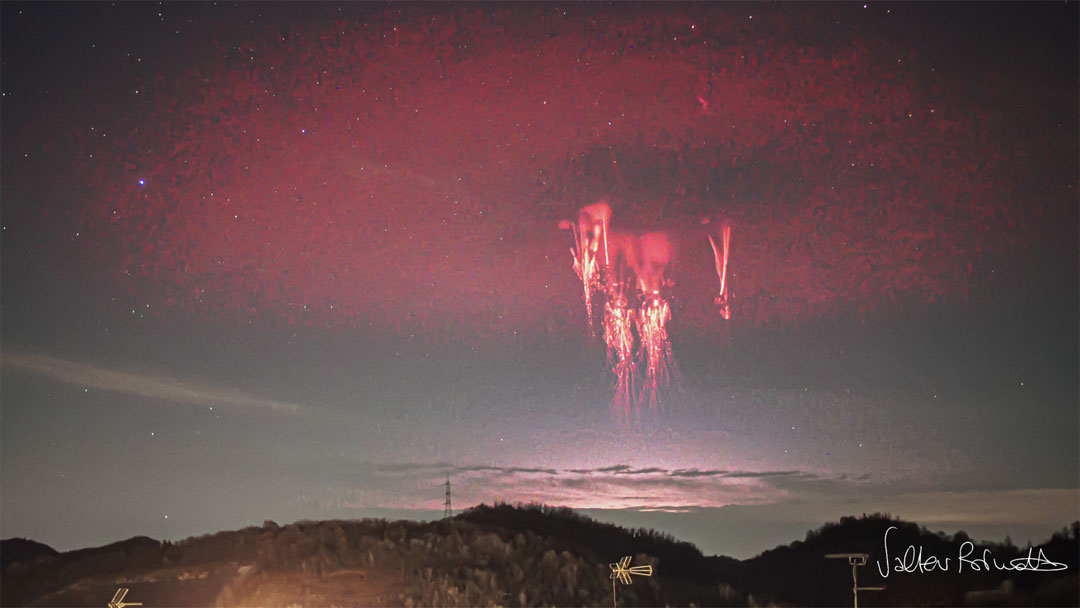
 2025 December 23 Red Sprites and Circular Elves Lightning over Italy Image Credit & Copyright:  Valter Binotto Explanation:  What's...