Cet arcus très impressionnant a été photographié sur l'île de Pag en Croatie : ce rouleau nuageux déchiqueté se présente à l'avant des orages et annonce l'arrivée de phénomènes météo violents.
© Danijel Palčić
2024 November 27

Explanation: How different are these two streaks? The streak on the upper right is Comet Tsuchinshan-Atlas showing an impressive dust tail. The comet is a large and dirty iceberg that entered the inner Solar System and is shedding gas and dust as it is warmed by the Sun's light. The streak on the lower left is a meteor showing an impressive evaporation trail. The meteor is a small and cold rock that entered the Earth's atmosphere and is shedding gas and dust as it is warmed by molecular collisions. The meteor was likely once part of a comet or asteroid -- perhaps later composing part of its tail. The meteor was gone in a flash and was only caught by coincidence during a series of exposures documenting the comet's long tail. The featured image was captured just over a month ago from Sichuan Province in China.


2024 November 26

Explanation: This floating ring is the size of a galaxy. In fact, it is a galaxy -- or at least part of one: the photogenic Sombrero Galaxy is one of the largest galaxies in the nearby Virgo Cluster of Galaxies. The dark band of dust that obscures the mid-section of the Sombrero Galaxy in visible light (bottom panel) actually glows brightly in infrared light (top panel). The featured image shows the infrared glow in false blue, recorded recently by the space-based James Webb Space Telescope (JWST) and released yesterday, pictured above an archival image taken by NASA's Hubble Space Telescope in visible light. The Sombrero Galaxy, also known as M104, spans about 50,000 light years and lies 28 million light years away. M104 can be seen with a small telescope in the direction of the constellation Virgo.
2024 November 25
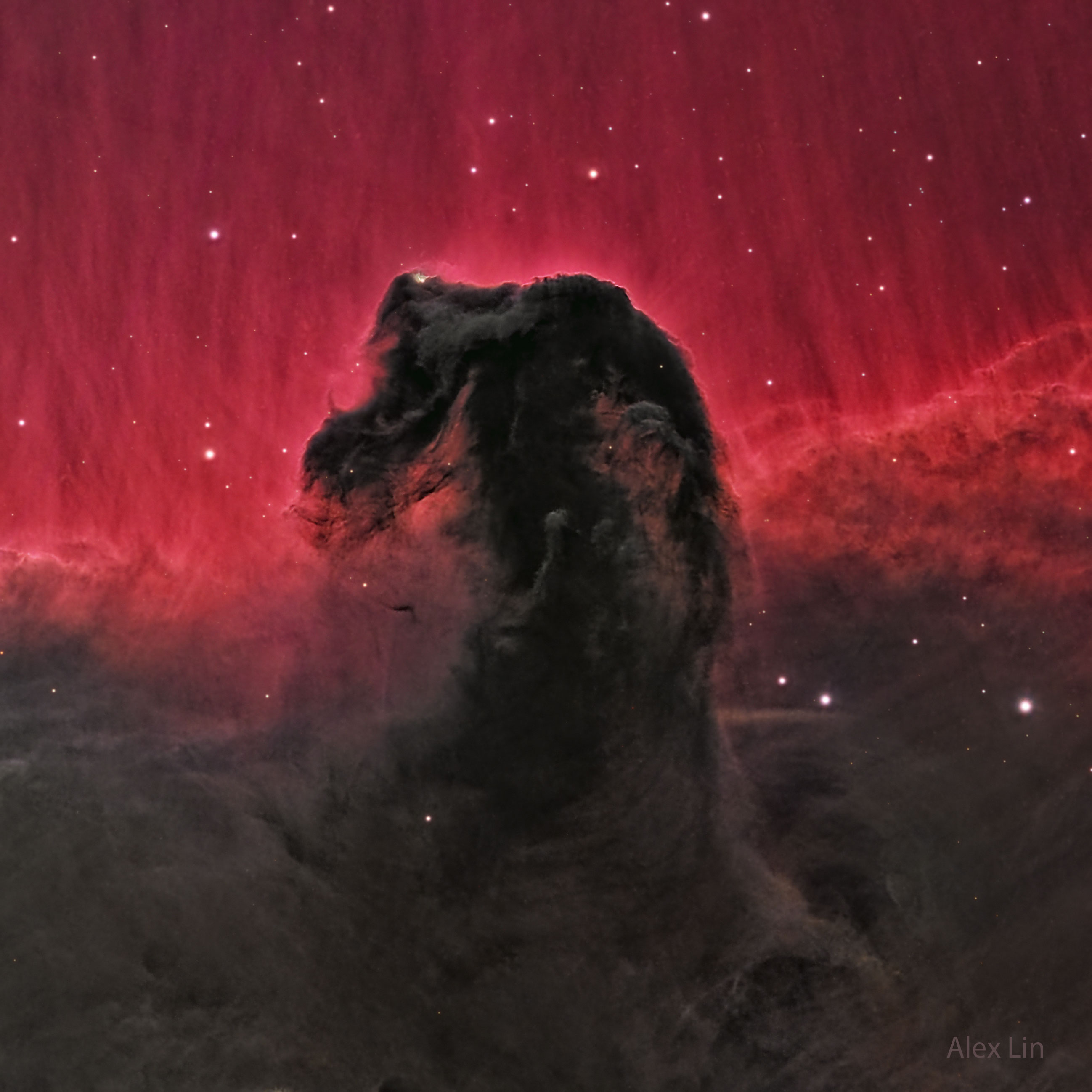
Explanation: One of the most identifiable nebulas in the sky, the Horsehead Nebula in Orion, is part of a large, dark, molecular cloud. Also known as Barnard 33, the unusual shape was first discovered on a photographic plate in the late 1800s. The red glow originates from hydrogen gas predominantly behind the nebula, ionized by the nearby bright star Sigma Orionis. The darkness of the Horsehead is caused mostly by thick dust, although the lower part of the Horsehead's neck casts a shadow to the left. Streams of gas leaving the nebula are funneled by a strong magnetic field. Bright spots in the Horsehead Nebula's base are young stars just in the process of forming. Light takes about 1,500 years to reach us from the Horsehead Nebula. The featured image was taken from the Chilescope Observatory in the mountains of Chile.
2024 November 24
Explanation: What lies at the center of our galaxy? In Jules Verne's science fiction classic, A Journey to the Center of the Earth, Professor Liedenbrock and his fellow explorers encounter many strange and exciting wonders. Astronomers already know of some of the bizarre objects that exist at our Galactic Center, including vast cosmic dust clouds, bright star clusters, swirling rings of gas, and even a supermassive black hole. Much of the Galactic Center is shielded from our view in visible light by the intervening dust and gas, but it can be explored using other forms of electromagnetic radiation. The featured video is actually a digital zoom into the Milky Way's center which starts by utilizing visible light images from the Digitized Sky Survey. As the movie proceeds, the light shown shifts to dust-penetrating infrared and highlights gas clouds that were recently discovered in 2013 to be falling toward the central black hole.
2024 November 23

Explanation: In an interplanetary first, on July 19, 2013 Earth was photographed on the same day from two other worlds of the Solar System, innermost planet Mercury and ringed gas giant Saturn. Pictured on the left, Earth is the pale blue dot just below the rings of Saturn, as captured by the robotic Cassini spacecraft then orbiting the outermost gas giant. On that same day people across planet Earth snapped many of their own pictures of Saturn. On the right, the Earth-Moon system is seen against the dark background of space as captured by the sunward MESSENGER spacecraft, then in Mercury orbit. MESSENGER took its image as part of a search for small natural satellites of Mercury, moons that would be expected to be quite dim. In the MESSENGER image, the brighter Earth and Moon are both overexposed and shine brightly with reflected sunlight. Destined not to return to their home world, both Cassini and MESSENGER have since retired from their missions of Solar System exploration.
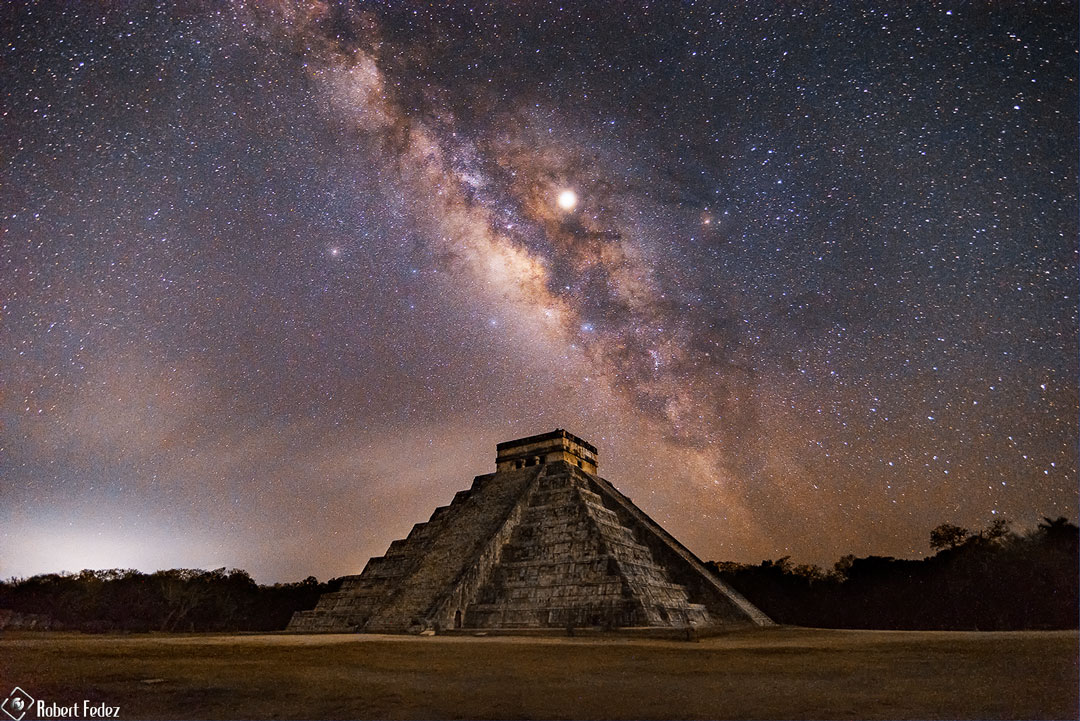
2026 March 15 Equinox at the Pyramid of the Feathered Serpent Image Credit & Copyright: Robert Fedez Explanation: To see the feathere...