"Konzert Allegro"
18/01/2025

ASTRONOMY - Full Moon, Full Mars
2025 January 18

Image Credit & Copyright: David Bowman
Explanation: On January 13 a Full Moon and a Full Mars were close, both bright and opposite the Sun in planet Earth's sky. In fact Mars was occulted, passing behind the Moon, when viewed from some locations in North America and northwest Africa. As seen from Richmond, Virginia, USA, this composite image sequence follows the evening lunar occultation before, during, and after the much anticipated celestial spectacle. The telescopic time series is constructed from an exposure made every two minutes while tracking the Moon over the hours encompassing the event. As a result, the Red Planet's trajectory seems to follow a gently curved path due to the Moon's slightly different rate of apparent motion. The next lunar occultation of bright planet Mars will be on February 9 when the moon is in a waxing gibbous phase. Lunar occultations are only ever visible from a fraction of the Earth's surface, though. The February 9 occultation of Mars will be seen from parts of Russia, China, eastern Canada, Greenland and other (mostly northern) locations, but a close conjunction of a bright Moon with Mars will be more widely visible from planet Earth.
17/01/2025
SANTé/MEDECINE - Cancer du poumon - L'importance d'un diagnostic précoce - 2/2 -

Le Dr Amy Cummings, oncologue thoracique à UCLA, conforte l'observation en indiquant qu'une toux persistante de plus de six semaines, ou qui devient de plus en plus intense, justifie une consultation. Parmi les autres symptômes associés au cancer du poumon, on retrouve des douleurs respiratoires, un essoufflement, des expectorations sanglantes ou rouillées, une perte de poids inexpliquée, ainsi que des douleurs à la poitrine lors de la respiration profonde ou du rire. Bien que ces signes puissent avoir d'autres causes, si vous les ressentez de manière persistante, il est essentiel de consulter un médecin rapidement.
Cancer du poumon : diagnostic précoce et prévention
Un diagnostic précoce est déterminant pour les chances de guérison du cancer du poumon. Le Dr Patsiornik rappelle que lorsqu'il est pris à un stade précoce, ce cancer peut être traité de manière plus efficace, offrant ainsi de meilleures chances de survie. En effet, une prise en charge rapide permet de stopper sa progression, contrairement aux formes avancées où les options thérapeutiques sont limitées. D’où l'importance des dépistages réguliers, surtout pour les personnes âgées de 50 à 80 ans, notamment celles ayant une histoire de tabagisme ou ayant arrêté de fumer dans les 15 dernières années.
Bien entendu, la prévention passe en grande partie par l'arrêt du tabac, mais il existe aussi d'autres facteurs qui peuvent augmenter le risque de cancer du poumon, même en l’absence de tabagisme. Par exemple, l'exposition prolongée à des substances chimiques, comme celles présentes dans certains environnements professionnels, constitue un facteur important. Le radon, un gaz radioactif présent dans de nombreuses maisons, est également un facteur de risque à ne pas négliger. Les autorités françaises recommandent d’ailleurs de tester son logement si l’on vit dans une zone où la concentration de radon est élevée.
En outre, des habitudes de vie saines, comme la pratique régulière d'une activité physique et une alimentation équilibrée, contribuent à diminuer les risques. Il est également crucial que les entreprises respectent des normes strictes en matière de sécurité pour limiter l'exposition à des produits cancérigènes sur les lieux de travail.
MSN
Joséphine de Buguercy
SANTé/MEDECINE - Cancer du poumon : un signe précoce - 1/2 -

La lutte contre cette maladie, qui reste l’une des plus courantes en France, notamment chez les personnes âgées, est loin d'être terminée. Le cancer du poumon concerne de nombreuses personnes parfois sans même qu’elles en soient conscientes. Si vous n'êtes pas fumeur et que vous évitez la fumée passive, vous pensez peut-être être à l’abri. Mais attention, ce n’est pas aussi simple.
Si la consommation de tabac reste le principal facteur de risque, plusieurs autres éléments peuvent accroître le risque de développer un cancer pulmonaire, parfois sans que l’on s’en rende compte. C’est pourquoi il est essentiel de reconnaître certains signes précoces qui pourraient faire toute la différence en matière de traitement (et d'espérance de vie).
Ce symptôme du cancer du poumon qui peut passer inaperçu
Le cancer du poumon est une maladie insidieuse qui, souvent, ne présente pas de symptômes évidents (ou, du moins, pas avant qu’il ne soit trop tard). Cependant, selon les oncologues, certains signes peuvent se manifester dès les premiers stades de la maladie. Le plus fréquent est une toux persistante, qui ne disparaît pas et qui peut s'aggraver avec le temps. Le Dr Yelena Patsiornik, oncologue médicale à l’hôpital de White Plains, souligne auprès du média Parade que cette toux constante est généralement le premier signe d’alerte, bien qu’elle puisse aussi se manifester par d'autres symptômes comme des douleurs thoraciques, une voix enrouée ou des infections pulmonaires récurrentes.
MSN
Joséphine de Rubercy
ASTRONOMY - Supernova Remnant Cassiopeia A
2025 January 17
Image Credit: NASA, ESA, CSA, STScI; D. Milisavljevic (Purdue University), T. Temim (Princeton University), I. De Looze (University of Gent)
Explanation: Massive stars in our Milky Way Galaxy live spectacular lives. Collapsing from vast cosmic clouds, their nuclear furnaces ignite and create heavy elements in their cores. After only a few million years for the most massive stars, the enriched material is blasted back into interstellar space where star formation can begin anew. The expanding debris cloud known as Cassiopeia A is an example of this final phase of the stellar life cycle. Light from the supernova explosion that created this remnant would have been first seen in planet Earth's sky about 350 years ago, although it took that light 11,000 years to reach us. This sharp NIRCam image from the James Webb Space Telescope shows the still hot filaments and knots in the supernova remnant. The whitish, smoke-like outer shell of the expanding blast wave is about 20 light-years across. A series of light echoes from the massive star's cataclysmic explosion are also identified in Webb's detailed images of the surrounding interstellar medium.
16/01/2025
AERONAUTIQUE - La grande épopée des ballons dirigeables - 2010 : le ballon captif de surveillance 101230-N-0020T-144
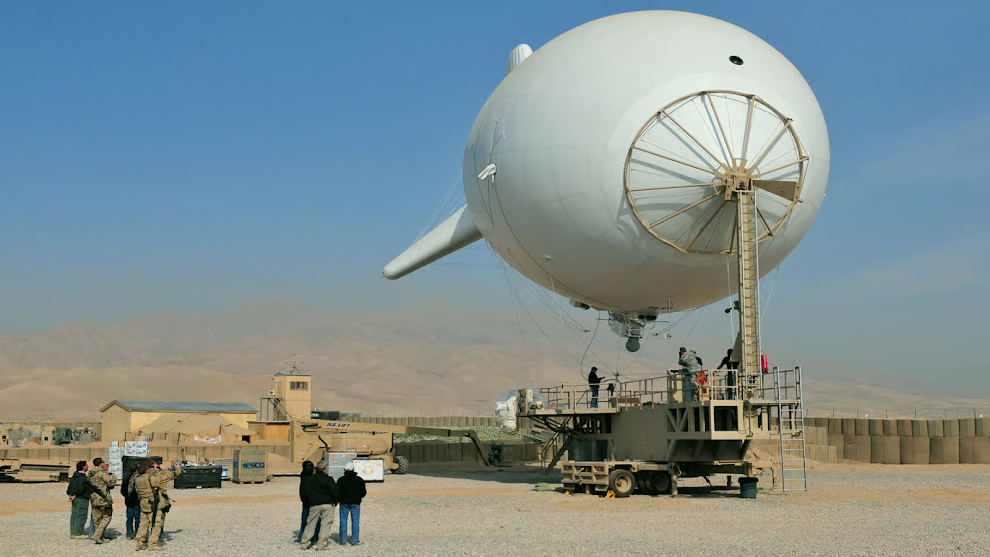
Ces aérostats sont apparus dès la fin du XIXe siècle. Dès leurs débuts, ils ont été utilisés à des fins militaires permettant l'observation et la transmission immédiate de renseignements. Ils sont depuis réactualisés sous la forme de ballons captifs de surveillance, gonflés à l'hélium, reliés au sol et pilotés par un aérostier. Ils ont été utilisés par l'armée américaine lors de l'invasion du Koweït, en 1990, puis lors de l'occupation américaine en Irak en 2004.
Ces grandes enveloppes de tissu ont un volume de 12 000 m3, elles peuvent soulever une charge de 1 000 kg jusqu'à son altitude de fonctionnement et monter jusqu'à 4 600 m. Cet aérostat peut embarquer des caméras thermiques et divers intercepteurs de communications, de telle sorte qu'il peut se positionner à mille mètres d'altitude et repérer un véhicule à 40 km ou détecter un individu à 25 km. Ces sentinelles volantes sont stables sous des vents inférieurs à 65 nœuds et sont équipées de radars d'une portée de 370 km. Économiquement peu chers, ils ont l'avantage de pouvoir être postés sur de longues périodes à la différence des drones, et d'être plus efficaces pour la surveillance urbaine et routière.
Ils ont été employés pour sécuriser des zones sensibles et ont été mis en œuvre pour la surveillance de la Fan Zone du Champ de Mars lors de l'Euro 2016 à Paris.
La photo montre ici un système de surveillance persistante (PSS), lancé depuis la base d'opérations avancée de Khilegay, en Afghanistan, le 30 décembre 2010. Une centaine de ballons, PSS, fut déployée en Irak et en Afghanistan.
Photo du spécialiste en chef des communications de masse, Matthew J. Thomas, U.S. Navy. © U.S. Department of Defense Current, Wikimedia Commons, by-sa CC0
NEWS EN IMAGES - Lancée

Depuis le Centre spatial Kennedy à Cap Canaveral en Floride, une fusée Falcon 9 de SpaceX a décollé en direction de la Lune.
Steve Nesius / REUTERS
ASTRONOMY - M83: The Southern Pinwheel
2025 January 16

Image Credit: CTIO, NOIRLab, DOE, NSF, AURA;
Processing: T. A. Rector (U. Alaska Anchorage/NOIRLab), D. de Martin & M. Zamani (NOIRLab)
Explanation: Beautiful and bright spiral galaxy M83 lies a some twelve million light-years away, near the southeastern tip of the very long constellation Hydra. Prominent spiral arms traced by dark dust lanes and blue star clusters lend this galaxy its popular name, The Southern Pinwheel. Still, reddish star forming regions that dot this cosmic pinwheel's spiral arms have suggested another nickname, the Thousand-Ruby Galaxy. A mere 40,000 light-years across, smaller than the Milky Way, M83 is a member of a group of galaxies that includes active galaxy Centaurus A. In fact, the core of M83 itself is bright at x-ray energies, showing a high concentration of neutron stars and black holes left from an intense burst of star formation. This sharp color image also features spiky foreground Milky Way stars and distant background galaxies. The image data was captured with the Dark Energy Camera and Blanco 4-meter telescope at Cerro Tololo Inter-American Observatory.

Inscription à :
Commentaires (Atom)
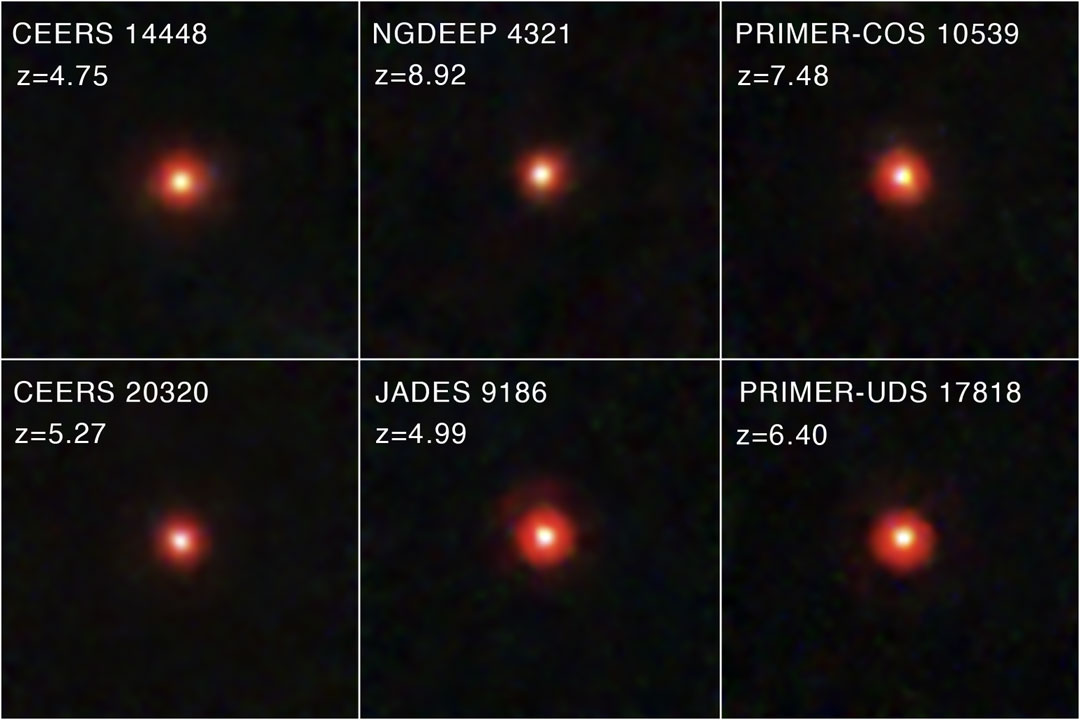
ASTRONOMY - Mystery: Little Red Dots in the Early Universe
2025 December 24 Mystery: Little Red Dots in the Early Universe Image Credit: NASA , ESA , CSA , STScI , JWST ; Dale Kocevski ( Colb...
-
2022 September 26 All the Water on Planet Earth Illustration Credit: Jack Cook, Adam Nieman, Woods Hole Oceanographic Institution ; Data ...
-
2025 May 11 The Surface of Venus from Venera 14 Image Credit: Soviet Planetary Exploration Program , Venera 14 ; Processing & Copyri...


