"Bachiana N° 5"
21/02/2025

ORNITHOLOGIE - Guit-guit : sucrier à pattes rouges

Le Guit-guit ou Sucrier à pattes rouges (Cyanerpes cyaneus) est un petit oiseau tropical, bien connu pour ses couleurs vives et ses habitudes alimentaires. Les mâles arborent un plumage bleu électrique avec des ailes noires et des pattes rouge vif, tandis que les femelles sont plutôt vertes avec des teintes plus ternes, ce qui crée un contraste saisissant entre les sexes. Cet oiseau est principalement insectivore, mais il se nourrit aussi de nectar et de fruits, fréquentant souvent les fleurs et les arbres fruitiers.
Le Sucrier à pattes rouges vit dans les forêts tropicales d'Amérique centrale et du Sud, des basses terres aux zones subtropicales, et est particulièrement présent au Costa Rica. Il construit son nid en forme de coupe dans les arbres ou arbustes denses. La femelle pond généralement 2 à 3 œufs, qu'elle incube seule pendant environ deux semaines. Ces oiseaux sont aussi très sociaux et se déplacent souvent en groupes, se perchant parfois en communauté pour se nourrir.
Adapté aux habitats tropicaux, il prospère dans les forêts humides, les lisières de forêt et même dans les plantations, démontrant une grande flexibilité écologique.
© Andy Morffew,
SANTé/MEDECINE - Le râle agonique - Un son troublant mais naturel

Lorsque la fin de vie approche, le corps subit de nombreux changements, parfois déconcertants pour l’entourage. Parmi eux, un bruit distinct, souvent qualifié de “râle agonique”, peut survenir dans les dernières heures. Ce son, semblable à un gargouillement ou à un léger ronflement, est provoqué par l’accumulation de salive et de mucus dans la gorge, que la personne mourante n’est plus en mesure d’avaler ni d’expulser en toussant.
Ce phénomène survient naturellement à mesure que les fonctions corporelles ralentissent et que la respiration devient plus irrégulière. Si ce bruit peut être difficile à entendre pour les proches, il n’entraîne aucune douleur ni souffrance pour la personne en fin de vie. Comme l’expliquent les professionnels des soins palliatifs, il s’agit simplement d’un ajustement physiologique du corps en transition vers la mort. Pour les familles et les aidants, comprendre ce phénomène peut aider à mieux l’accepter et à accompagner plus sereinement leur proche dans ses derniers instants.
©freepik
ASTRONOMY - Hubble's Andromeda Galaxy Mosaic
2025 February 21

Image Credit: NASA, ESA, Hubble Mission,
B. F. Williams (Univ Washington), Z. Chen (Univ Washington), L. C. Johnson (Northwestern),
Processing; Joseph DePasquale (STScI)
Explanation: The largest photomosaic ever assembled from Hubble Space Telescope image data is a panoramic view of our neighboring spiral Andromeda Galaxy. With 600 overlapping frames assembled from observations made from July 2010 to December 2022, the full Hubble Andromeda Galaxy mosaic spans almost six full moons across planet Earth's sky. A cropped version shown above is nearly two full moons across and partially covers Andromeda's core and inner spiral arms. Also known as M31, the Andromeda Galaxy is 2.5 million light-years away. That makes it the closest large spiral galaxy to our own Milky Way. Our perspective on the spiral Milky Way is anchored to the view from the location of the Sun, a star found within the Milky Way's galactic disk. But Hubble's magnificent Andromeda mosaic offers an expansive view of a large spiral galaxy from the outside looking in. Hubble's comprehensive, detailed data set extending across the Andromeda Galaxy will allow astronomers to make an unprecedented holistic exploration of the mysteries of spiral galaxy structure and evolution.
20/02/2025
SANTé/MEDECINE - Fin de vie - Le râle agonique

Un bruit troublant qui marque les dernières heures de vie
Quand une personne approche de la fin de sa vie, son corps subit des transformations profondes, parfois difficiles à comprendre pour ses proches. Parmi ces signes, il en est un qui intrigue autant qu’il inquiète : un bruit particulier qui survient souvent dans les dernières 24 heures. Ce son, parfois qualifié de “râle agonique”, peut sembler alarmant, mais il fait partie d’un processus naturel. S’il est éprouvant pour ceux qui accompagnent un être cher dans ses derniers instants, les experts assurent qu’il ne signifie pas nécessairement une souffrance. Mais pourquoi ce bruit apparaît-il ? Que révèle-t-il sur le corps au seuil de la mort ? Plongée dans un phénomène méconnu, mais chargé de signification.
©freepik
ASTRONOMY - Messier 87
2025 February 20

Image Credit: NASA, ESA and the Hubble Heritage Team
Explanation: Enormous elliptical galaxy Messier 87 is about 50 million light-years away. Also known as NGC 4486, the giant galaxy holds trillions of stars compared to the mere billions of stars in our large spiral Milky Way. M87 reigns as the large central elliptical galaxy in the Virgo galaxy cluster. An energetic jet from the giant galaxy's core is seen to stretch outward for about 5,000 light-years in this sharp optical and near-infrared view from the Hubble Space Telescope. In fact, the cosmic blow torch is seen across the electromagnetic spectrum from gamma-rays to radio wavelengths. Its ultimate power source is M87's central, supermassive black hole. An image of this monster in the middle of M87 has been captured by planet Earth's Event Horizon Telescope.
19/02/2025
ARCHEOLOGIE - Le trésor de Toutânkhamon - La mystérieuse barque d’albâtre

Le bassin d'albâtre est une surprenante et magnifique composition mesurant 70 centimètres de long supportant un îlot central sur lequel repose une barque emmenant un sarcophage surmonté d'un dais. Il est à supposer qu'une fois remplie de pétales de fleurs et d'eau parfumée, cette pièce-montée donne l'illusion d'une chaloupe, flottant. Les colonnes centrales sont décorées de lotus et de papyrus, des pierres précieuses et des feuilles d'or sont incrustées dans l'albâtre, ainsi que sur sa partie basse. Nue et parée de bijoux, une jeune fille se tient à l'avant, coiffée de la perruque nubienne et portant à son cœur une fleur de lotus ; à l'arrière, se tient sa « naine » dont le mouvement laisse supposer qu'elle tenait une perche pour manœuvrer la barque. À la proue et à la poupe, les antilopes ont d'authentiques cornes d'ibex (bouquetins) qui, par leur régénération naturelle, symbolisent la renaissance ou la fécondité. Également surnommée « la naine et le bouquetin », cette œuvre allégorique demeure une énigme d'une complexité sans fond pour les égyptologues qui en cherchent le chaînon manquant pour la comprendre, et ne cessent d'en donner diverses interprétations.
© لا روسا, CC by-sa 4.0
ASTRONOMY - HH 30: A Star System with Planets Now Forming
2025 February 19

Image Credit: James Webb Space Telescope, ESA, NASA & CSA, R. Tazaki et al.
Explanation: How do stars and planets form? New clues have been found in the protoplanetary system Herbig-Haro 30 by the James Webb Space Telescope in concert with Hubble and the Earth-bound ALMA. The observations show, among other things, that large dust grains are more concentrated into a central disk where they can form planets. The featured image from Webb shows many attributes of the active HH-30 system. Jets of particles are being expelled vertically, shown in red, while a dark dust-rich disk is seen across the center, blocking the light from the star or stars still forming there. Blue-reflecting dust is seen in a parabolic arc above and below the central disk, although why a tail appears on the lower left is currently unknown. Studying how planets form in HH 30 can help astronomers better understand how planets in our own Solar System once formed, including our Earth.
18/02/2025
ORNITHOLOGIE - Toucan à carène : une apparence flamboyante

Le Toucan à carène (Ramphastos sulfuratus), ou Toucan arc-en-ciel, est un oiseau emblématique des forêts tropicales d'Amérique centrale. Avec son bec multicolore, il est immédiatement reconnaissable et figure souvent parmi les espèces les plus emblématiques de la biodiversité néotropicale. Ce toucan fascine par son apparence spectaculaire et son comportement unique.
C'est un habitant des forêts humides tropicales et subtropicales, où il préfère évoluer dans la canopée des forêts denses. On le trouve dans des forêts primaires, mais aussi dans des forêts secondaires, tant qu'il y a une bonne couverture arborée. Ses habitats incluent aussi les mangroves et les forêts bordant les rivières.
Il est présent dans plusieurs pays d'Amérique centrale et du nord de l'Amérique du Sud, notamment au Costa Rica, Nicaragua, Panama, Belize. Il est célèbre pour son bec massif et multicolore, qui semble démesurément grand comparé à la taille de son corps.
Il mesure entre 42 et 55 cm, ce qui en fait un toucan de taille moyenne à grande, pèse entre 380 et 500 grammes, son bec très spectaculaire peut atteindre 15 à 20 cm de long avec un mélange de couleurs : jaune avec des touches de rouge, d'orange, de vert et de bleu. Bien que volumineux, il est relativement léger, car il est constitué d'une structure osseuse creuse. Son bec impressionnant rend son vol difficile, généralement effectué sur de courtes distances, et ondulant.
Le Toucan à carène est un oiseau social et grégaire, qui vit souvent en petits groupes de 3 à 12 individus. Il passe la majorité de son temps dans les canopées des forêts, rarement descendu au sol, sauf en cas de nécessité. Très vocal, on le reconnait souvent par ses cris rauques et bavards, qui ressemblent à des « croassements ». Ces cris servent à la communication entre les membres du groupe et jouent un rôle important dans la défense du territoire. Il est omnivore, bien que son régime soit principalement composé de fruits, mais il peut également déguster des insectes, des petits reptiles et autres invertébrés occasionnels. En mangeant les fruits et en dispersant les graines loin de l'arbre parent, il contribue à la biodiversité des écosystèmes forestiers.
Le Toucan à carène niche dans les cavités d'arbres, généralement creusées par d'autres espèces d'oiseaux, comme les pics. Comme il ne creuse pas lui-même, il dépend souvent de cavités naturelles ou abandonnées. La femelle pond entre 2 et 4 œufs blancs, et les deux parents partagent la tâche de l'incubation, qui dure environ 16 à 20 jours. Les petits restent au nid pendant environ 6 à 9 semaines avant d'être prêts à s'envoler. Ils sont nourris essentiellement de fruits régurgités par les parents.
Le Toucan à carène est actuellement classé comme une espèce de préoccupation mineure par l'UICN. Cependant, cela ne signifie pas qu'il est à l'abri de menaces. Les principales menaces auxquelles il fait face sont : la destruction de son habitat pour l'agriculture, l'exploitation forestière, et l'expansion urbaine réduit les zones de nidification et d'alimentation disponibles, le commerce illégal en raison de son apparence spectaculaire, il est parfois capturé pour être vendu dans le commerce illégal d'animaux exotiques. C'est un acteur essentiel de son environnement, aidant à maintenir l'équilibre des forêts tropicales qu'il habite. Sa survie dépendra largement des efforts de conservation des forêts tropicales humides et des lois protégeant la faune sauvage.
ASTRONOMY - Thor's Helmet versus the Seagull
2025 February 18

Image Credit & Copyright: Nicolas Martino, Adrien Soto, Louis Leroux & Yann Sainty
Explanation: Seen as a seagull and a duck, these nebulae are not the only cosmic clouds to evoke images of flight. But both are winging their way across this broad celestial landscape, spanning almost 7 degrees across planet Earth's night sky toward the constellation of the Big Dog (Canis Major). The expansive Seagull (top center) is itself composed of two major cataloged emission nebulas. Brighter NGC 2327 forms the head with the more diffuse IC 2177 as the wings and body. Impressively, the Seagull's wingspan would correspond to about 250 light-years at the nebula's estimated distance of 3,800 light-years. At the lower right, the Duck appears much more compact and would span only about 50 light-years given its 15,000 light-year distance estimate. Blown by energetic winds from an extremely massive, hot star near its center, the Duck nebula is cataloged as NGC 2359. Of course, the Duck's thick body and winged appendages also lend it the slightly more dramatic popular moniker, Thor's Helmet.
Inscription à :
Commentaires (Atom)
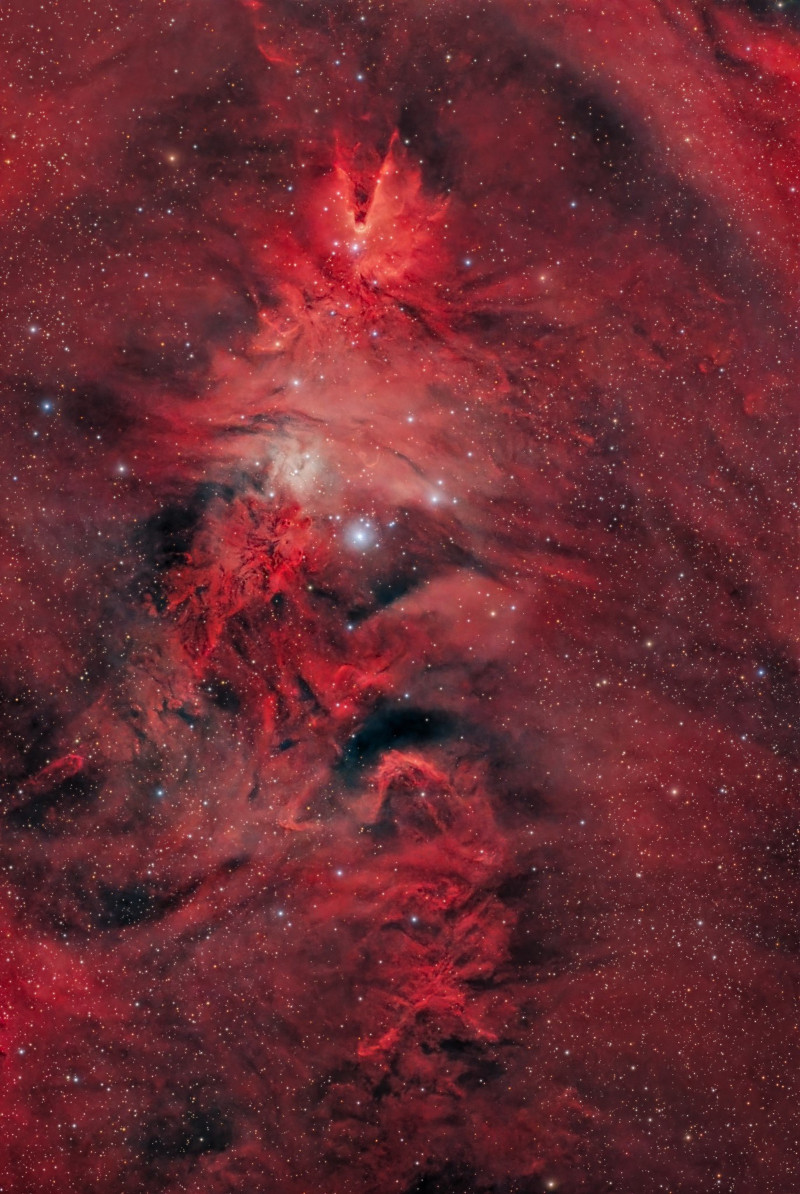
ASTRONOMY - Unicorn, Fox Fur and Christmas Tree
2025 December 25 Unicorn, Fox Fur and Christmas Tree Image Credit & Copyright : Michael Kalika Explanation: A star forming region ...
-
2022 September 26 All the Water on Planet Earth Illustration Credit: Jack Cook, Adam Nieman, Woods Hole Oceanographic Institution ; Data ...
-
2025 May 11 The Surface of Venus from Venera 14 Image Credit: Soviet Planetary Exploration Program , Venera 14 ; Processing & Copyri...


