Nombre total de pages vues

01/02/2026

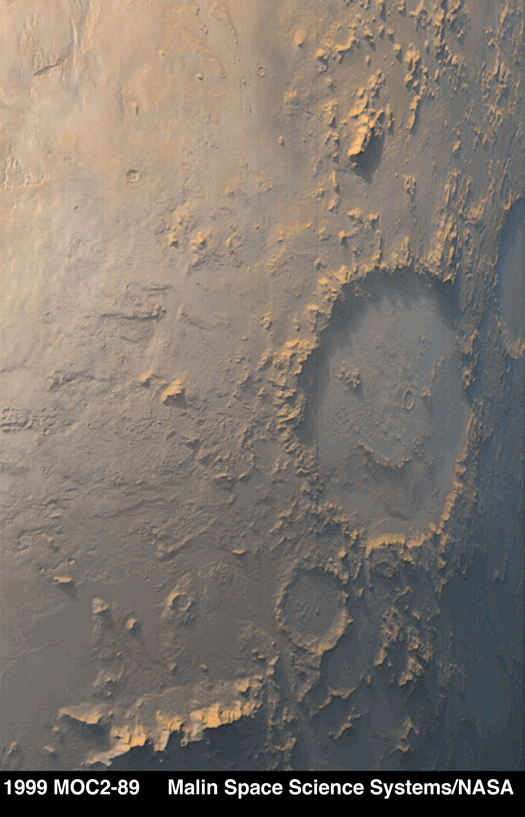
ASTRONOMY - Galle: Happy Face Crater on Mars

2026 February 1
Several craters are visible on a tan surface. 
The largest crater, on the right, has internal 
markings that make it look like a winking face
with a smile. 
Please see the explanation for more detailed information.

Galle: Happy Face Crater on Mars
Image Credit: NASAMGSMSSS

Explanation: Mars has put on a happy face. The Martian crater Galle is famous because it has internal markings that make it look like a face that is both smiling and winking. These markings were originally discovered in the 1970s in pictures taken by the Viking Orbiter. The Mars Global Surveyor (MGS) spacecraft that orbited Mars from 1996 to 2006 captured the featured picture. Happy Face Crater and its iconic features were formed by chance billions of years ago when a city-sized asteroid slammed into the Martian surface. All rocky planets and moons in our Solar System show impact craters, with the highest number of craters found on Earth's Moon and the planet MercuryEarth and Venus would show the most, though, were it not for weather and erosion

31/01/2026

SANTé/MEDECINE - Tout savoir sur le coeur humain - 5 - Vue gauche du cœur : les structures internes

Dans cette illustration, le cœur gauche est coloré en rouge et le droit en bleu, en référence aux sangs qui transitent dans leurs cavités : le cœur gauche envoie du sang riche en oxygène dans l'organisme, tandis que le cœur droit reçoit le sang pauvre en oxygène. Trois valves cardiaques sont représentées : les valves auriculo-ventriculaires et la valve du tronc pulmonaire.

© Patrick J. Lynch, CC by-sa 2.5

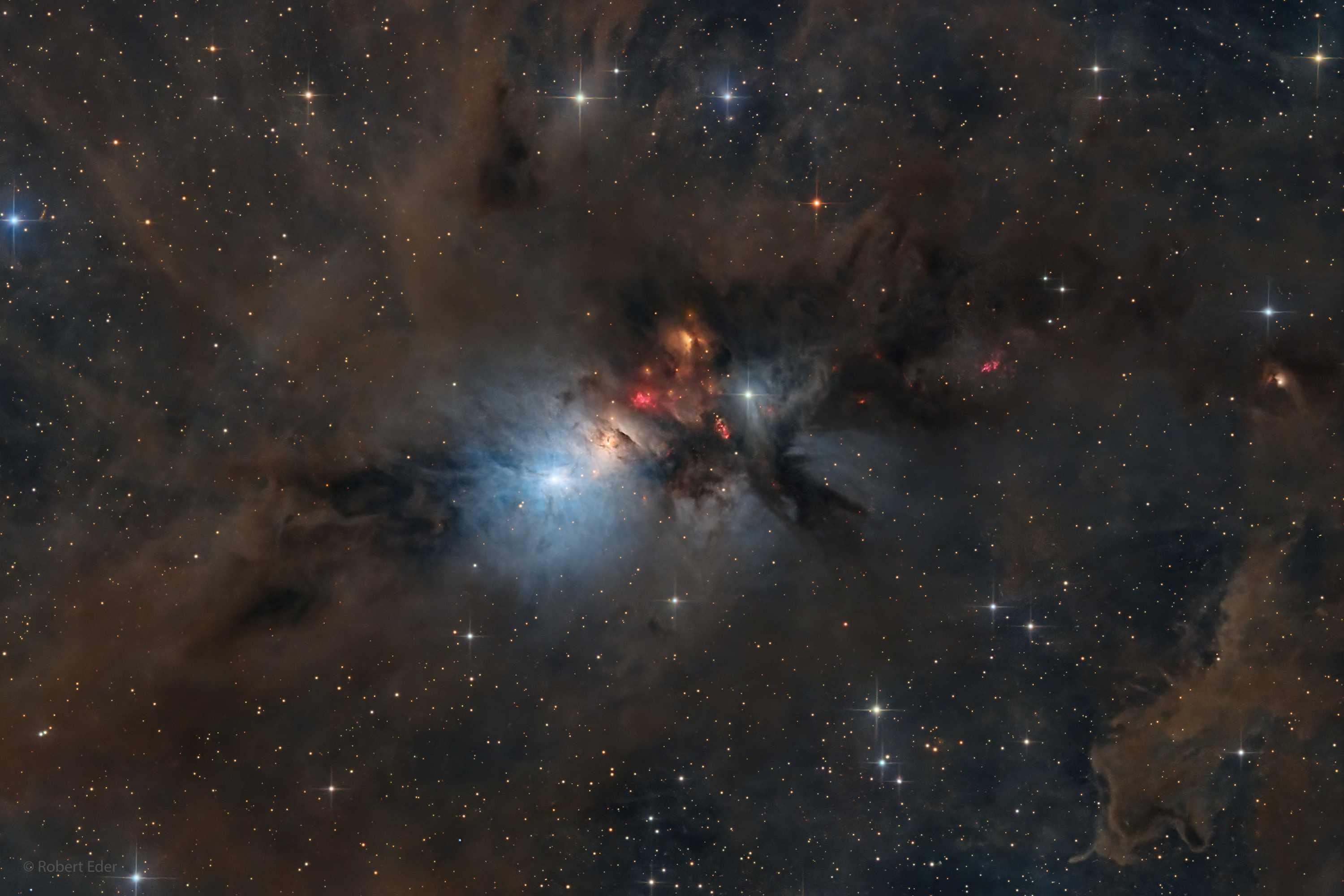
ASTRONOMY - NGC 1333: Stellar Nursery in Perseus

 2026 January 30

See Explanation.  Clicking on the picture will download
the highest resolution version available.

NGC 1333: Stellar Nursery in Perseus
Image Credit & Copyright: Robert Eder

Explanation: NGC 1333 is seen in visible light as a reflection nebula, dominated by bluish hues characteristic of starlight reflected by interstellar dust. A mere 1,000 light-years distant toward the heroic constellation Perseus, it lies at the edge of a large, star-forming molecular cloudThis telescopic close-up spans over two full moons on the sky or just over 15 light-years at the estimated distance of NGC 1333. It shows details of the dusty region along with telltale hints of contrasty red emission from Herbig-Haro objects, jets and shocked glowing gas emanating from recently formed stars. In fact, NGC 1333 contains hundreds of stars less than a million years old, most still hidden from optical telescopes by the pervasive stardust. The chaotic environment may be similar to one in which our own Sun formed over 4.5 billion years ago.

29/01/2026

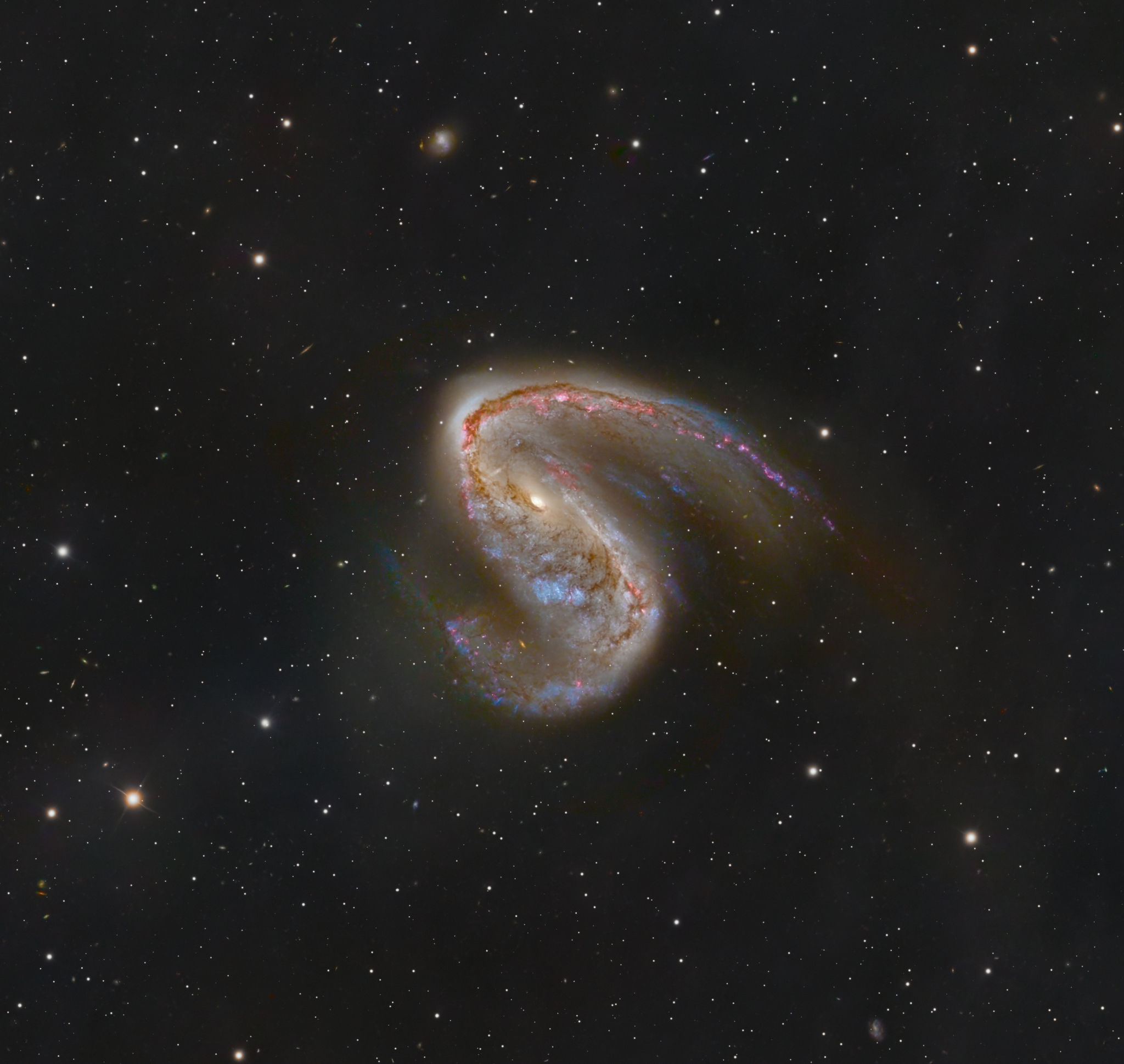
ASTRONOMY - NGC 2442: Galaxy in Volans

2026 January 29
See Explanation.  Clicking on the picture will download
the highest resolution version available.

NGC 2442: Galaxy in Volans
Image Credit & CopyrightMike Selby

Explanation: Distorted galaxy NGC 2442 can be found in the southern constellation of the flying fish, (Piscis) Volans. Located about 50 million light-years away, the galaxy's two spiral arms extending from a pronounced central bar give it a hook-shaped appearance in this deep and colorful image, with foreground stars scattered across the telescopic field of view. The image also reveals the distant galaxy's obscuring dust lanes, young blue star clusters and reddish star forming regions surrounding a core of yellowish light from an older population of stars. But the star forming regions seem more concentrated along the drawn-out (upper right) spiral arm. The distorted structure is likely the result of an ancient close encounter with a smaller galaxy that lies off top left of the frame. This telescopic field of view spans over 200,000 light-years at the estimated distance of NGC 2442. 

28/01/2026

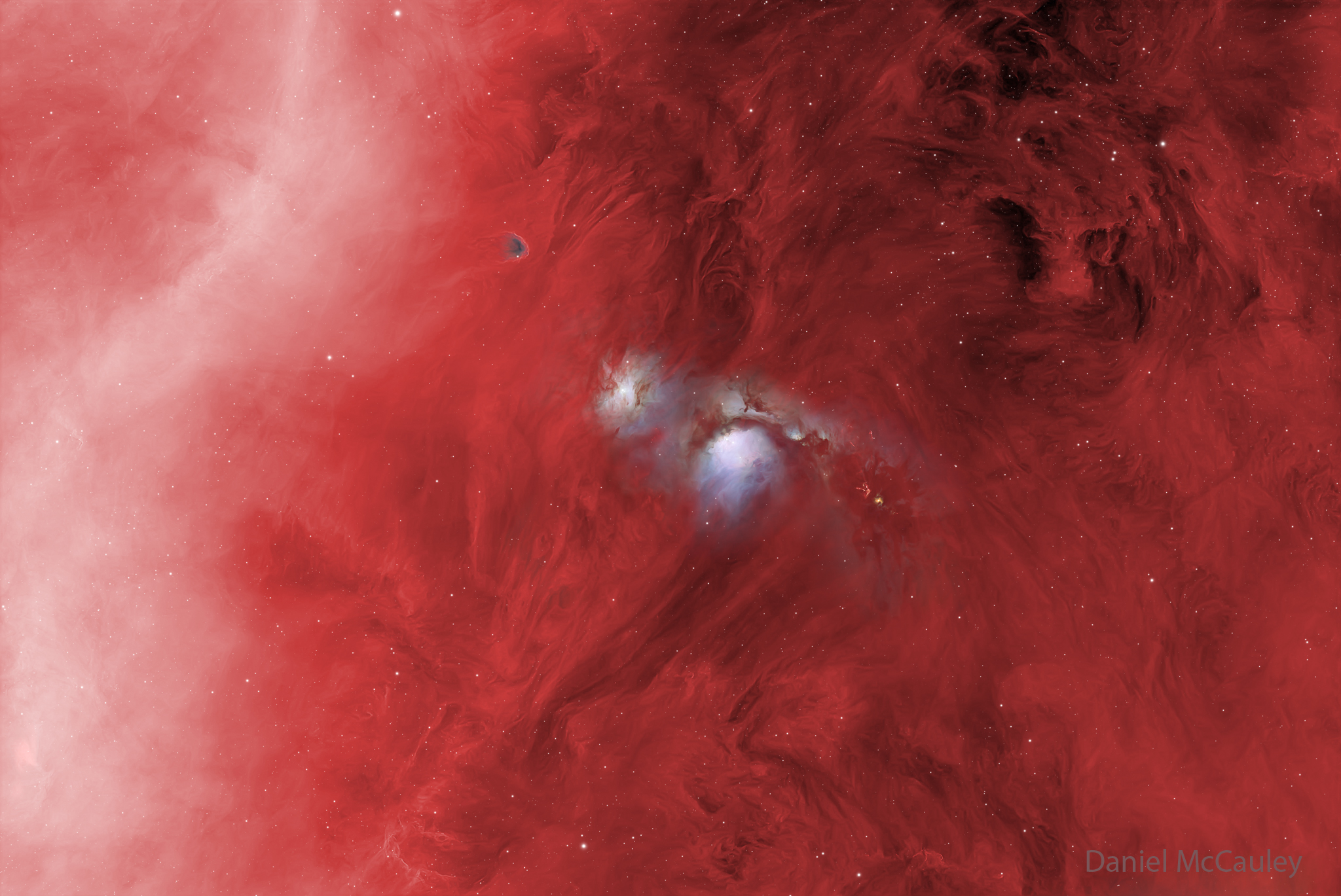
ASTRONOMY - M78: Reflecting Blue in a Sea of Red

 2026 January 28

In a starfield glowing red, several features stand
out. On the right is a diffuse white band, and on the 
upper right is some dark dust. Most prominently, though,
are two blue structures in the center, one of which has
a dark band running across near the middle. 
Please see the explanation for more detailed information.

M78: Reflecting Blue in a Sea of Red
Image Credit & Copyright: Daniel McCauley

Explanation: In the vast Orion Molecular Cloud complex, several bright blue nebulas are particularly apparent. Pictured here in the center are two of the most prominent reflection nebulas - dust clouds lit by the reflecting light of bright embedded stars. The more famous nebula is M78, in the image center, cataloged over 200 years ago. To its upper left is the lesser known NGC 2071. Astronomers continue to study these reflection nebulas to better understand how interior stars form. The overall red glow is from diffuse hydrogen gas that covers much of the Orion complex that spans much of the constellation of Orion. Nearby in the greater complex, which lies about 1,500 light years away, are the Orion Nebula, the Horsehead Nebula, and Barnard's Loop -- partially seen here as the white band on the upper left.

27/01/2026

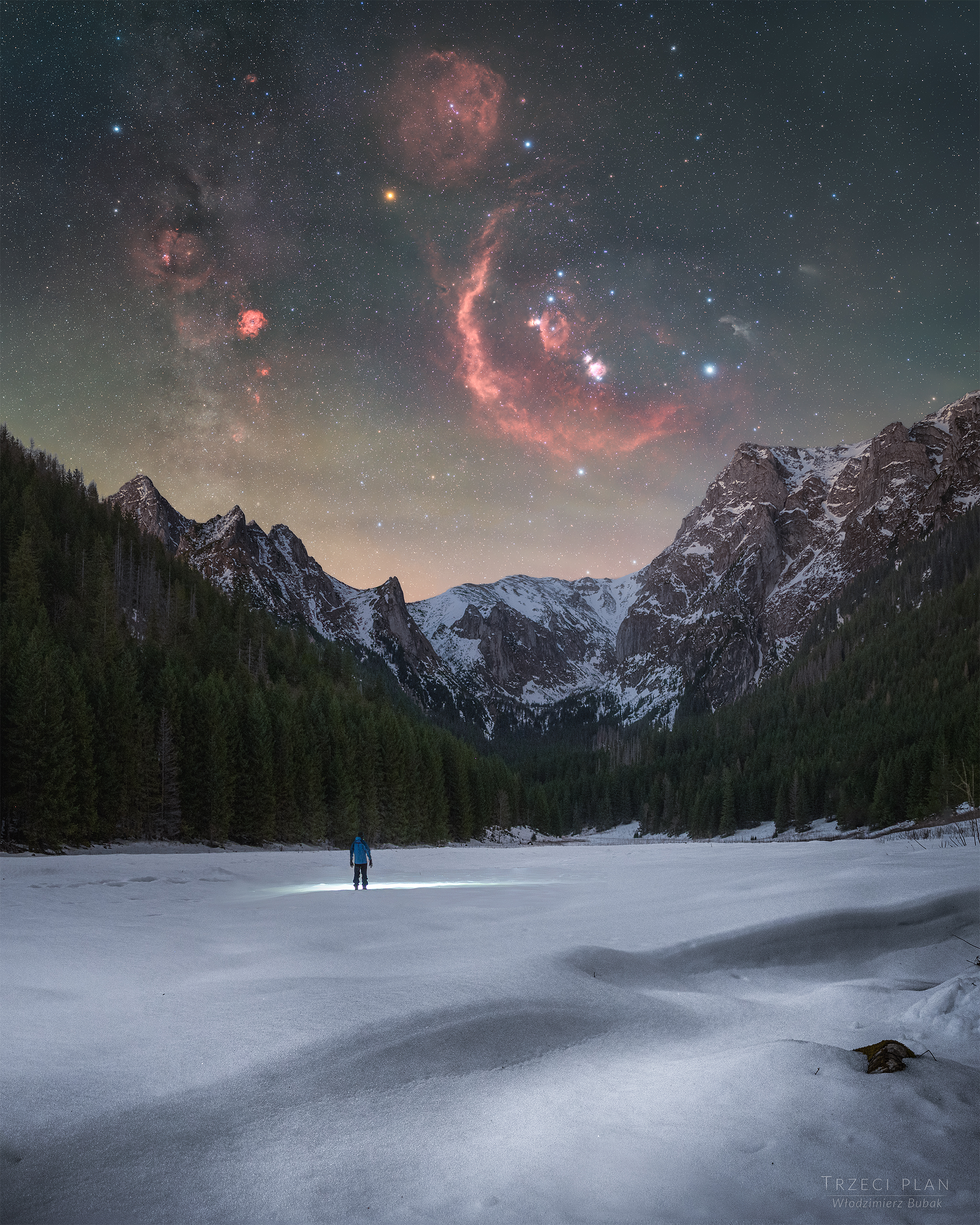
ASTRONOMY - Orion's Treasures over Snowy Mountains

 2026 January 27

A person stands in the distance on a snowy landscape shining
a flashlight on the ground. Trees and snow capped mountains are
on the horizon. In the starry sky above, several iconic red
nebulas are visible. 
Please see the explanation for more detailed information.

Orion's Treasures over Snowy Mountains
Image Credit & Copyright: Włodzimierz Bubak; Text: Ogetay Kayali (MTU)

Explanation: Rising over a frozen valley in the Tatra Mountains, the familiar stars and nebulas of Orion dominate this wide-field nightscape. The featured deep photo was taken in southern Poland's highest mountain range last month, where dark skies and alpine terrain combined to reveal both Earth's rugged beauty and the structure of our galaxy. Above the snowy mountains, Orion's bright belt stars anchor a region of glowing interstellar clouds. The Great Orion Nebula, a vast stellar nursery visible even to the unaided eye, shines near the center of the scene. Surrounding it is the enormous arc of Barnard's Loop, a faint shell of ionized hydrogen gas spanning much of the constellation. To the left, the round Rosette Nebula glows softly, while the grayish Witch Head Nebula hovers to the right, illuminated by nearby starlight. Near the top, the orange supergiant Betelgeuse marks the hunter's shoulder.

SANTé/MEDECINE - Tout savoir sur le coeur humain - 4 - Les valves

Pour que le sang circule en sens unique dans le cœur, sans revenir en arrière, il existe des valves cardiaques qui s'ouvrent et se ferment pour empêcher le reflux du sang. Ces quatre valves sont : les deux valves auriculo-ventriculaires situées entre les oreillettes et les ventricules, la valve de l'aorte et la valve du tronc pulmonaire. La valve auriculo-ventriculaire droite est appelée tricuspide, et la valve auriculo-ventriculaire gauche valve bicuspide ou valve mitrale, en raison de sa ressemblance avec la mitre d'un évêque.

© Patrick J. Lynch, CC by-sa 2.5

26/01/2026

LANGAGE - Quelle langue vivante ressemble le plus au latin ? 1/4

Quelle descendante directe de la langue de Cicéron parlons-nous aujourd'hui sans même le savoir ? Parmi les héritières du latin, une langue se distingue grâce à sa fidélité exceptionnelle à la phonologie antique. Cette proximité linguistique révèle des surprises inattendues qui bouleversent nos idées reçues sur les langues romanes.

La question de l'héritage linguistique de Rome enchante linguistes et passionnés depuis des décennies. Identifier quelle langue contemporaine préserve le mieux les caractéristiques du latin nécessite une analyse phonologique minutieuse. Cette exploration nous réserve quelques révélations étonnantes sur l'évolution des idiomes issus de l'Empire romain.

/...

FuturaSciences

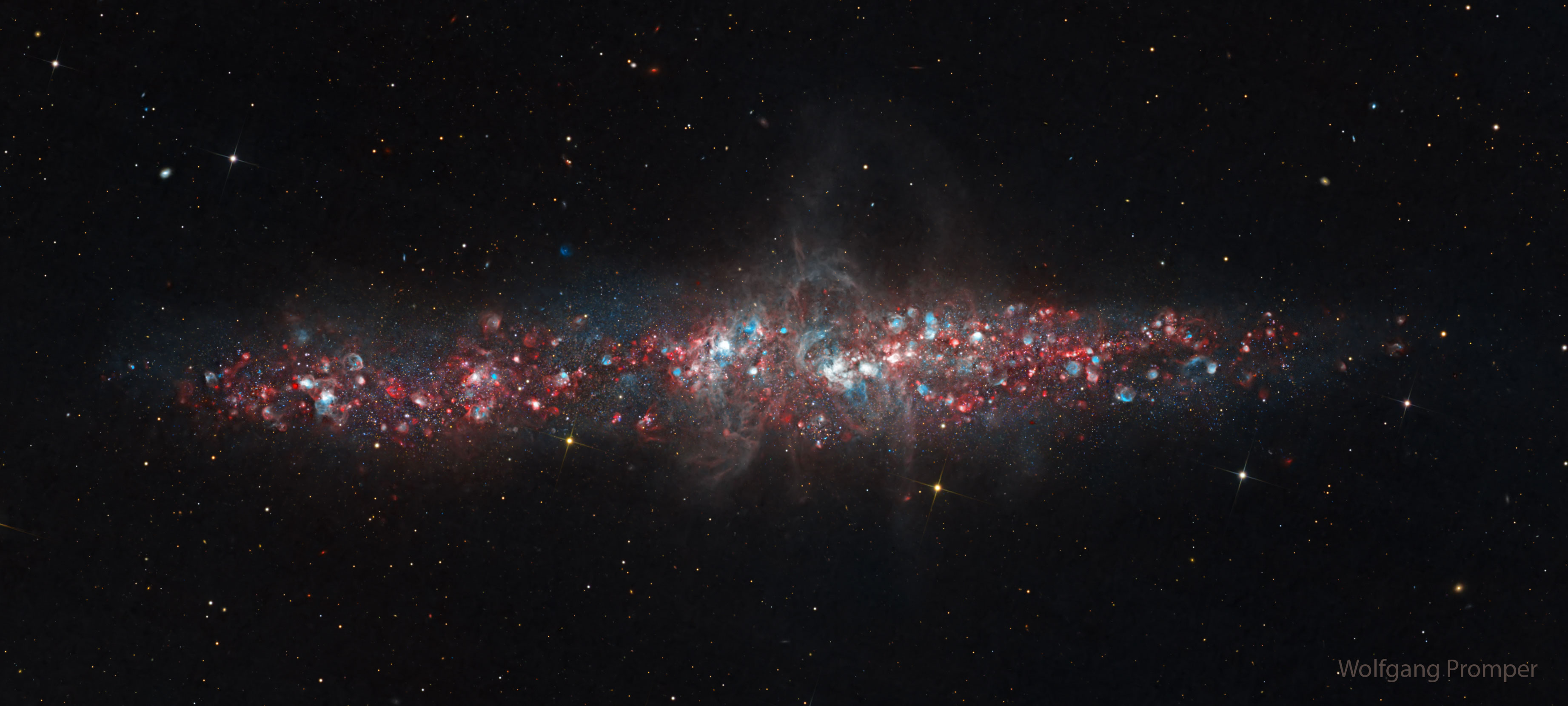
ASTRONOMY - NGC 55: A Galaxy of Nebulas

 2026 January 26

A galaxy is shown that has a lot of blue and red dots in it. The 
galaxy is an long elliptical blob across the middle and not a classic spiral. 
Please see the explanation for more detailed information.

NGC 55: A Galaxy of Nebulas
Image Credit & Copyright: Wolfgang Promper; Text: Ogetay Kayali (MTU)

Explanation: Can you see nebulas in other galaxies? Yes, some nebulas shine brightly enough -- if you know how to look. Clouds of hydrogen and oxygen emit light at very specific colors, and by isolating them, astronomers and astrophotographers can reveal structures that would otherwise be too faint to notice. This deep, 50-hour exposure highlights glowing hydrogen (red) and oxygen (blue) across galaxy NGC 55, viewed nearly edge-on. Also known as the String of Pearls Galaxy, NGC 55 is often compared to our Milky Way's satellite galaxy the Large Magellanic Cloud (LMC), although NGC 55 lies much farther away at about 6.5 million light-years. The resulting image uncovers a sprinkling of emission nebulas within and sometimes above the galaxy's dusty disk, offering a detailed look at distant star-forming regions.

25/01/2026

SANTé/MEDECINE - Tout savoir sur le coeur humain - 3 - Coupe dans le ventricule gauche

La paroi du ventricule gauche est particulièrement épaisse car ce compartiment du cœur doit projeter du sang dans l'aorte, une grosse artère qui alimente tous les organes du corps. À la jonction entre l'oreillette et le ventricule se trouve la valve auriculo-ventriculaire, ou valve mitrale, qui empêche le sang de refluer dans l'oreillette quand le ventricule se contracte. Des cordons de collagène blanc sont attachés à la valve.

(à suivre)

© Patrick J. Lynch, CC by-sa 2.5

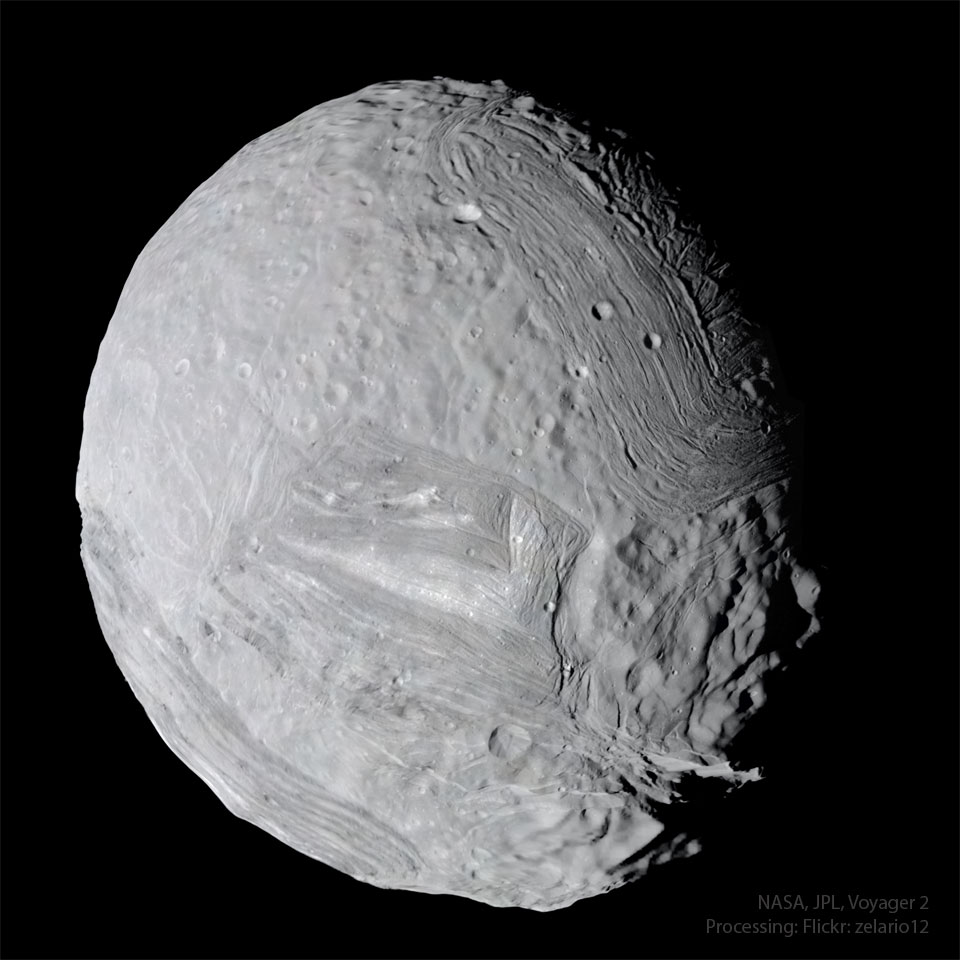
ASTRONOMY - Miranda Revisited

 2026 February 9 Miranda Revisited Image Credit:  NASA ,  JPL ,  Voyager 2 ; Processing & License: Flickr:  zelario12 ; Text:  Keighley ...