Nombre total de pages vues

16/01/2026

ASTRONOMY - NGC 7023: The Iris Nebula

 2026 January 16

See Explanation.  Clicking on the picture will download
the highest resolution version available.

NGC 7023: The Iris Nebula
Image Credit & Copyright: Justus Falk

Explanation: These cosmic clouds have blossomed 1,300 light-years away in the fertile starfields of the constellation Cepheus. Called the Iris Nebula, NGC 7023 is not the only nebula to evoke the imagery of flowers. Still, this deep telescopic image shows off the Iris Nebula's range of colors and symmetries embedded in surrounding fields of interstellar dust. Within the Iris itself, dusty nebular material surrounds a hot, young star. The dominant color of the brighter reflection nebula is blue, characteristic of dust grains reflecting starlight. Central filaments of the reflection nebula glow with a faint reddish photoluminescence as some dust grains effectively convert the star's invisible ultraviolet radiation to visible red light. Infrared observations indicate that this nebula contains complex carbon molecules known as PAHs. The dusty blue petals of the Iris Nebula span about six light-years.

15/01/2026

ASTRONOMY - Plato and the Lunar Alps

 2026 January 15

See Explanation.  Clicking on the picture will download
the highest resolution version available.

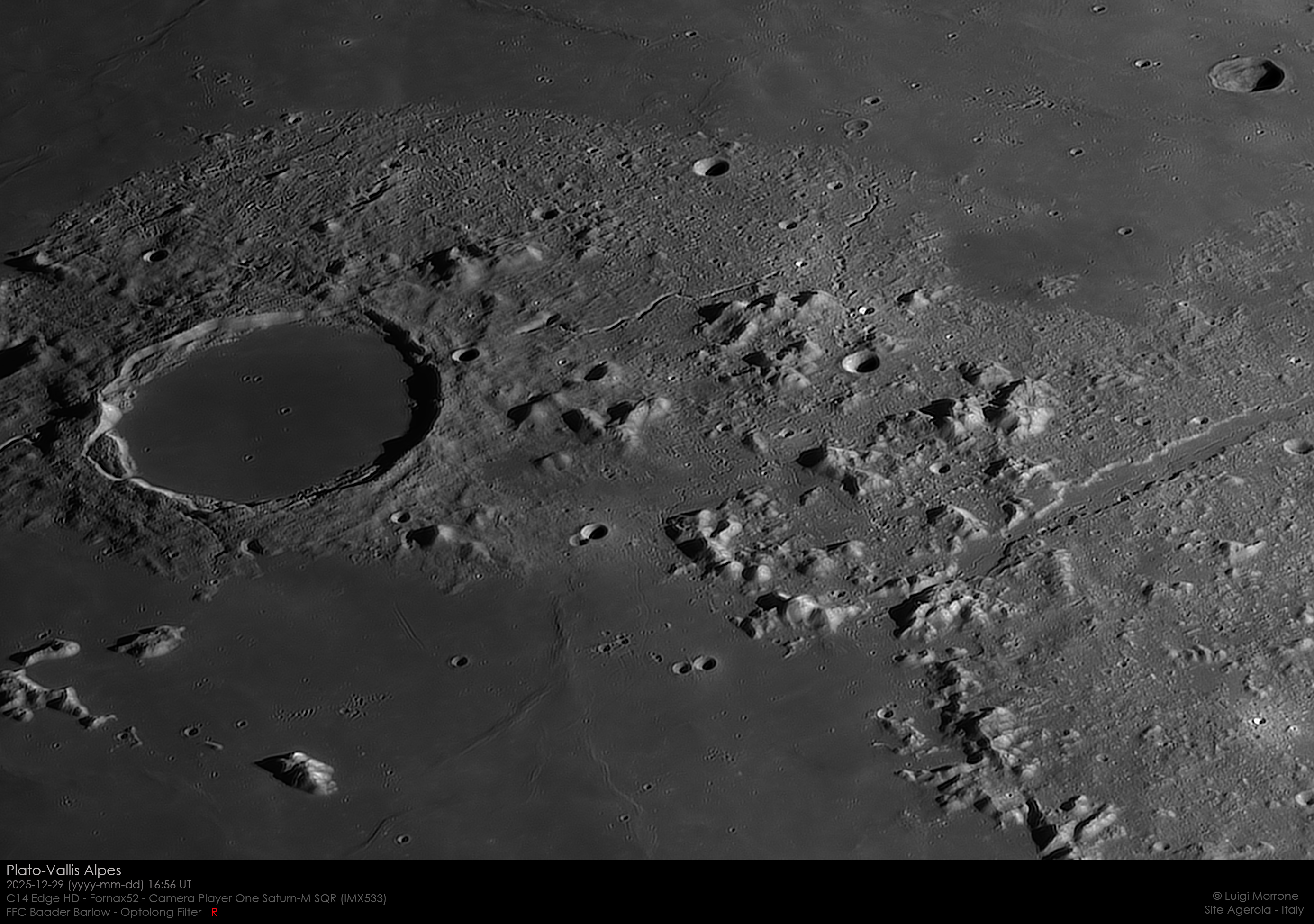
Plato and the Lunar Alps
Image Credit & Copyright: Luigi Morrone

Explanation: The dark-floored, 95 kilometer wide crater Plato and sunlit peaks of the lunar Alps (Montes Alpes) are highlighted in this this sharp telescopic snapshot of the Moon's surface. While the Alps of planet Earth were uplifted over millions of years as continental plates slowly collided, the lunar Alps were likely formed by a sudden collision that created the giant impact basin known as the Mare Imbrium or Sea of Rains. The mare's generally smooth, lava-flooded floor is seen below the bordering mountain range. The prominent straight feature cutting through the mountains is the lunar Alpine Valley (Vallis Alpes). Joining the Mare Imbrium and northern Mare Frigoris (Sea of Cold) the valley extends toward the upper right, about 160 kilometers long and up to 10 kilometers wide. Of course, the large, bright lunar alpine mountain below and right of Plato crater is named Mont Blanc. Lacking an atmosphere, not to mention snow, the lunar Alps are probably not an ideal location for a winter vacation. Still, a 150 pound skier would weigh a mere 25 pounds on the Moon.

14/01/2026

ASTRONOMY - M51: The Whirlpool Galaxy

 2026 January 14

A big spiral galaxy fills the frame, complete with blue
spiral arms dotted with red dust and nebulas. Above the 
spiral galaxy is another more diffuse galaxy that has
faint wisps extending in many directions. 
Please see the explanation for more detailed information.

M51: The Whirlpool Galaxy
Image Credit & Copyright: Michael Sleeman

Explanation: The Whirlpool Galaxy is a classic spiral galaxy. At only 30 million light years distant and fully 60 thousand light years across, M51, also known as NGC 5194, is one of the brightest and most picturesque galaxies on the sky. The featured deep image is a digital combination of images taken in different colors over 58 hours with a telescope from LijiangChina. Anyone with a good pair of binoculars, however, can see this Whirlpool toward the constellation of the Hunting Dogs (Canes Venatici). M51 is a spiral galaxy of type Sc and is the dominant member of a whole group of galaxies. Astronomers speculate that M51's spiral structure is primarily due to its gravitational interaction with the smaller galaxy just above it.

13/01/2026

LES BELLES INVENTIONS DE LEONARD DE VINCI - L'Homme de Vitruve - le compas et les proportions

L'Homme de Vitruve est probablement le dessin le plus emblématique de Léonard de Vinci. Il est le symbole des idéaux de la Renaissance et de l'humanisme, ce courant culturel où l'art, la science et la philosophie n'étaient qu'un et où l'Homme était au centre de l'univers. Annoté et réalisé vers 1490, ce dessin est fait à la plume, à l'encre et au lavis.

L'artiste s'est ici inspiré de sa lecture des théories exposées par Vitruve dans son traité d'architecture. Vitruve était un ingénieur et architecte romain vivant à l'époque de l'empereur Auguste. Le dessin de Léonard est censé représenter des proportions parfaites d'un corps humain idéal. Ces proportions sont basées sur des structures mathématiques et symbolisent l'harmonie de l'univers.

L'Homme de Vitruve est associé ici à un compas, un fac-similé réalisé d'après le folio 696r du Codex Atlanticus de Léonard de Vinci (1514-1515).

© Caroline Léna Becker, CC0 1.0

ASTRONOMY - A Solar Eruption from SDO

 2026 January 13

A Solar Eruption from SDO
Video Credit: NASASDOAIAHelioviewer; Processing & Text: Ogetay Kayali (MTU)

Explanation: What just leapt from the Sun? A towering structure of solar plasma suddenly rose from the Sun's surface and unfurled into space -- a structure so large that many Earths would easily fit within it-- marking the onset of a dramatic Coronal Mass Ejection (CME). The event was captured in striking detail in late 2024 by NASA's Solar Dynamics Observatory (SDO), whose continuous monitoring improves space weather forecasts and helps humanity better understand how solar activity affects satellites, GPS, radio communications, and power grids on Earth. The featured video blends three extreme-ultraviolet views from SDO’s Atmospheric Imaging Assembly (AIA), revealing how plasma at different temperatures surged upward as the eruption unfolded. Here, red highlights cooler, denser material lifted from the Sun’s lower atmosphere, while yellow traces hotter, million-degree coronal loops stretching outward as magnetic fields open. After the main outburst, the Sun’s magnetic fields quickly reorganize.

12/01/2026

ASTRONOMY - Meteor Dust

2026 January 12
A view of mountains over clouds shows a starfield
with a purple glow. Prominent on the right is the trail
of a bright meteor. To the left of the meteor and 
connecting to the meteor is something unusual: a light
brown triangular puff. 
Please see the explanation for more detailed information.

Meteor Dust
Image Credit & Copyright: Xu Chen

Explanation: What's happening to this meteor? It is shedding its outer layers as it passes through the Earth's atmosphere and heats up. The sudden high temperatures not only cause the bright glow along the dramatic streak but also melt and vaporize the meteor's component rock and ice, creating dust. Wind in the atmosphere typically blows this dust away over the next few seconds, leaving no visible trace after only a few minutes. Much of this dust will eventually settle down to the Earth. The featured image was captured in mid-December, coincident with the Geminids meteor shower. On the upper left is Sirius, the brightest star in the night sky, while in the foreground is fog-engulfed Huangshan, the Yellow Mountains of eastern China

11/01/2026

MICROPHOTOGRAPHIE - Quand le micromonde s’autoassemble

Pareille fleur ne pousse pas dans n'importe quel jardin. Seulement dans celui de Stefan Diller, le photographe scientifique allemand, qui sait jouer des couleurs et des lumières pour sublimer le mystérieux du monde microscopique. Et lui donner un visage presque familier.

Une fleur, dites-vous ? Pas du tout. Simplement des microstructures de carbonate-silice cultivées dans un système dynamique de réaction-diffusion. De quoi sculpter avec précision une grande variété de formes élémentaires par diffusion de dioxyde de carbone dans une solution de chlorure de baryum et de métasilicate de sodium.

Les échantillons ont été préparés à Amsterdam, à l'Institut Amolf (Pays-Bas) par Lukas Helmbrecht avec Wim L. Noorduin. Ils ont été scannés à l'aide d'un microscope électronique à balayage à émission de champ Tescan Mira3 et colorés à la volée avec un système d'imagerie multidétecteur à quatre canaux développé par Point electronic Halle.

Le champ de vision est de 77 microns de large.

NUCLEAIRE/RADIOACTIVITé - Le kit de survie anti-nucléaire après un impact de bombe

Le monde est constamment au bord d'une guerre nucléaire. Nous le savons tous, mais peu d'entre nous s'y sont préparés. Eh bien ne vous inquiétez pas, car certains des objets les plus importants pour votre survie se trouvent peut-être déjà chez vous. Vous voulez savoir comment du ruban adhésif peut vous sauver la vie ? Ou pourquoi vos lunettes de soleil sont plus importantes que votre téléphone portable ? Aujourd'hui nous allons vous aider à constituer le kit de survie anti-nucléaire ultime avec seulement huit objets de votre maison.

CommentSurvivre

10/01/2026

MICROPHOTOGRAPHIE - Une amibe dans sa coquille

Étrange objet que celui présenté ici par le photographe allemand scientifique Stefan Diller sous cet éclairage bleuté qui ajoute encore un peu au mystère. Et quelle surprise en apprenant qu'il ne s'agit pas d'un objet inanimé, mais d'une amibe. Un être vivant unicellulaire eucaryote de moins d'un millimètre.

Ce qui caractérise les amibes, c'est que leur corps change constamment de forme en se prolongeant en sortes de pieds factices, les pseudopodes. Ceux-ci leur permettent de ramper et de capturer des proies microscopiques. On peut trouver des amibes libres ou parasites. Et des amibes nues ou protégées d'une sorte de coquille. Une enveloppe dure et minéralisée comme celle que l'on reconnaît maintenant à l'amibe présentée sur ce cliché.

Les échantillons ont été empilés en Z et scannés par un microscope électronique à balayage à émission de champ Tescan Mira3 et colorisés à la volée avec un système d'imagerie multidétecteur à quatre canaux développé par Point electronic Halle.

Le champ de vision est de 100 microns de large.

ASTRONOMY - Jupiter with the Great Red Spot

 2026 January 10

See Explanation.  Clicking on the picture will download
the highest resolution version available.

Jupiter with the Great Red Spot
Image Credit & Copyright: Christopher Go

Explanation: Jupiter reaches its 2026 opposition today, January 10. That puts our Solar System's most massive planet opposite the Sun and near its closest and brightest for viewing from planet Earth. In fact, captured only 3 days ago this sharp telescopic snapshot reveals excellent details of the ruling gas giant's swirling cloudtops, in light zones and dark belts girdling the rapidly rotating outer planet. Jupiter's famous, persistent anticyclonic vortex, known as the Great Red Spot, is south of the equator at the lower right. But two smaller red spots are also visible, one near the top in the northernmost zone, and one close to Jupiter's south pole. And while Jupiter's Great Red Spot is known to be shrinking, it's still about the size of the Earth itself.

SANTé/MEDECINE - Tout savoir sur le coeur humain - 2 - Anatomie du cœur humain

Le cœur comprend quatre cavités : deux oreillettes , situées dans la partie supérieure, et deux ventricules , dans la partie inférieure du c...