Nombre total de pages vues

Affichage des articles dont le libellé est ASTRONOMY - Earthset from Orion. Afficher tous les articles

24/01/2026

ASTRONOMY - Earthset from Orion

 2026 January 24

See Explanation.  Clicking on the picture will download
the highest resolution version available.

Earthset from Orion
Image Credit: NASAArtemis 1

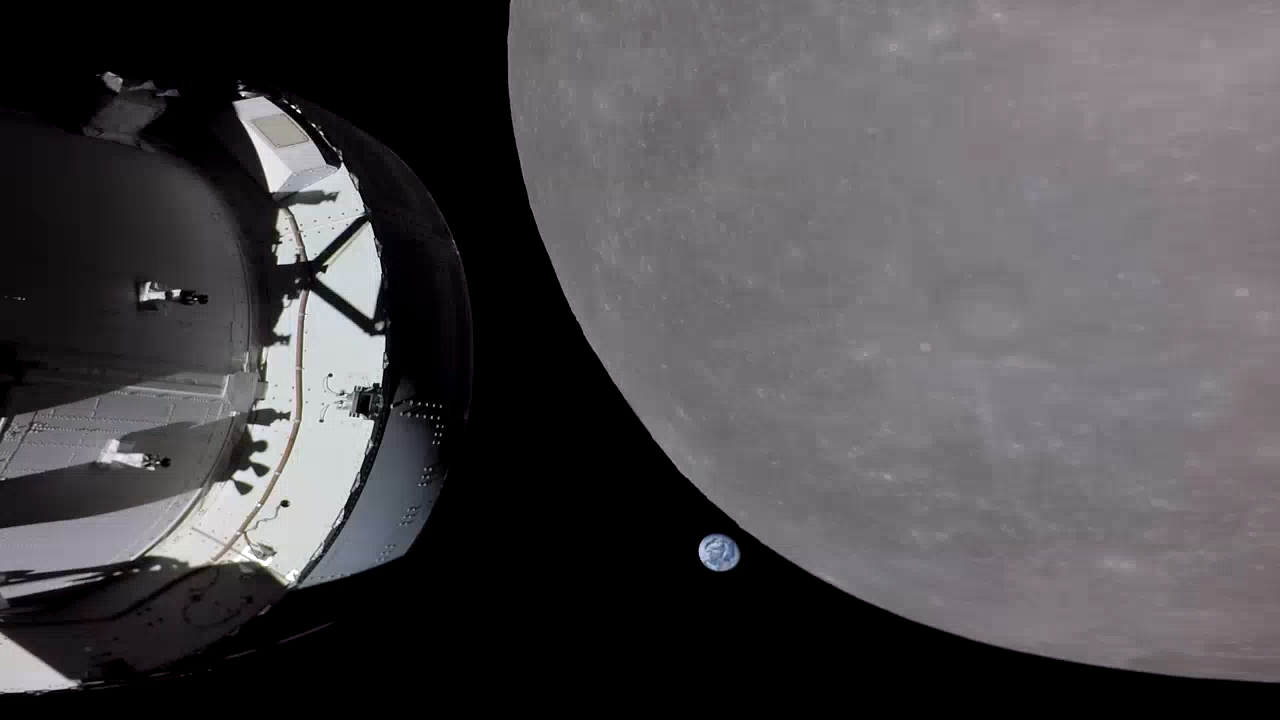
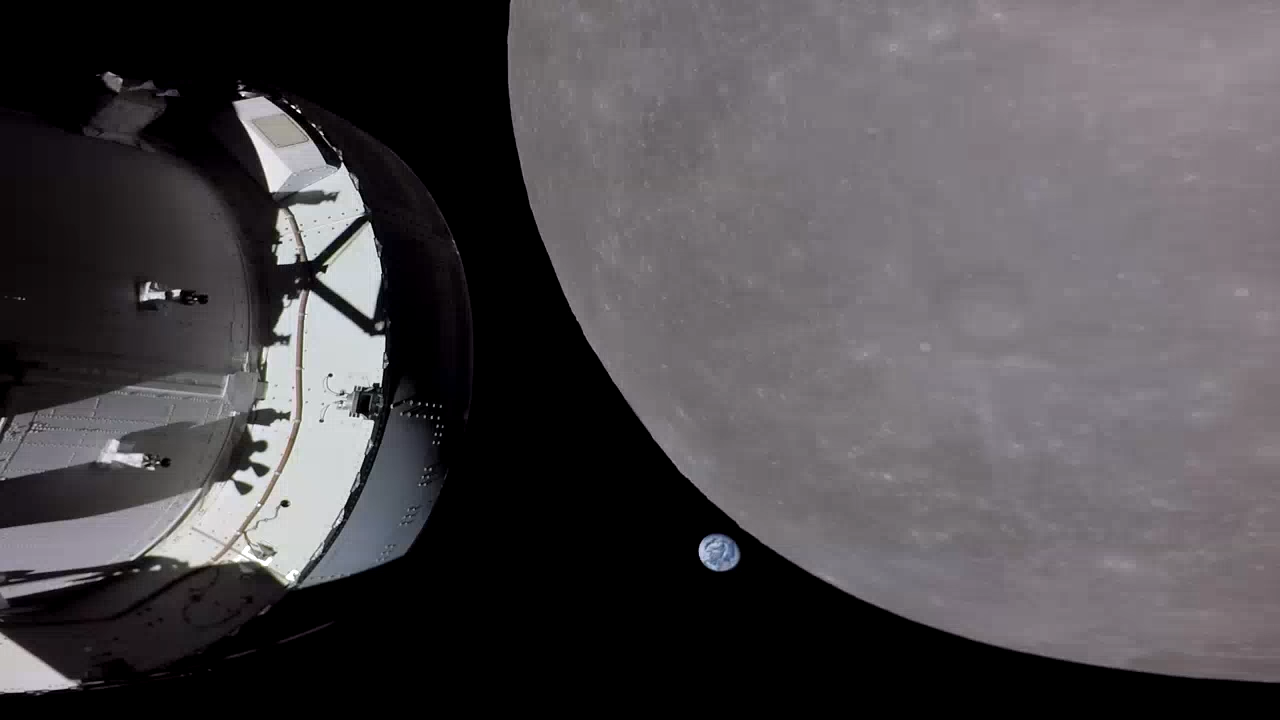
Explanation: Eight billion people are about to disappear in this snapshot from space taken on 2022 November 21. On the sixth day of the Artemis I mission, their home world is setting behind the Moon's bright edge as viewed by an external camera on the outbound Orion spacecraft. Orion was headed for a powered flyby that took it to within 130 kilometers of the lunar surface. Velocity gained in the flyby maneuver was used to reach a distant retrograde orbit around the Moon. That orbit is considered distant because it's another 92,000 kilometers beyond the Moon, and retrograde because the spacecraft orbited in the opposite direction of the Moon's orbit around planet Earth. Swinging around the Moon, Orion reached a maximum distance (just over 400,000 kilometers) from Earth on 2022 November 28, exceeding a record set by Apollo 13 for most distant spacecraft designed for human space explorationThe Artemis II mission, carrying 4 astronauts around the moon and back again, is due to launch as early as February 6.

Explication : Huit milliards de personnes sont sur le point de disparaître dans cette image prise de l'espace le 21 novembre 2022. Le sixième jour de la mission Artemis I , leur planète se couche derrière le bord lumineux de la Lune, comme le montre une caméra externe du vaisseau spatial Orion, en route vers la Terre. Orion effectuait un survol motorisé qui l'a amené à 130 kilomètres de la surface lunaire. La vitesse acquise lors de cette manœuvre a permis d'atteindre une orbite rétrograde lointaine autour de la Lune. Cette orbite est dite lointaine car elle se situe à 92 000 kilomètres au-delà de la Lune, et rétrograde car le vaisseau spatial orbitait dans le sens inverse de l'orbite lunaire autour de la Terre. En survolant la Lune , Orion a atteint une distance maximale (un peu plus de 400 000 kilomètres) de la Terre le 28 novembre 2022, dépassant ainsi le record établi par Apollo 13 pour le vaisseau spatial conçu pour l'exploration spatiale humaine le plus éloigné . La mission Artemis II , qui transportera 4 astronautes autour de la Lune et retour, devrait être lancée dès le 6 février.

20/11/2024

ASTRONOMY - Earthset from Orion

 2024 November 20

See Explanation.  Clicking on the picture will download
the highest resolution version available.

Earthset from Orion
Image Credit: NASAArtemis 1

Explanation: Eight billion people are about to disappear in this snapshot from space taken on 2022 November 21. On the sixth day of the Artemis I mission, their home world is setting behind the Moon's bright edge as viewed by an external camera on the outbound Orion spacecraft. Orion was headed for a powered flyby that took it to within 130 kilometers of the lunar surface. Velocity gained in the flyby maneuver was used to reach a distant retrograde orbit around the Moon. That orbit is considered distant because it's another 92,000 kilometers beyond the Moon, and retrograde because the spacecraft orbited in the opposite direction of the Moon's orbit around planet Earth. Orion entered its distant retrograde orbit on November 25. Swinging around the Moon, Orion reached a maximum distance (just over 400,000 kilometers) from Earth on November 28, exceeding a record set by Apollo 13 for most distant spacecraft designed for human space explorationThe Artemis II mission, carrying 4 astronauts around the moon and back again, is scheduled to launch no earlier than September 2025.

23/11/2022

ASTRONOMY - Earthset from Orion

 2022 November 23

See Explanation.  Clicking on the picture will download
the highest resolution version available.

Earthset from Orion
Image Credit: NASAArtemis 1

Explanation: Eight billion people are about to disappear in this snapshot from space. Taken on November 21, the sixth day of the Artemis 1 mission, their home world is setting behind the Moon's bright edge as viewed by an external camera on the outbound Orion spacecraft. The Orion was headed for a powered flyby that took it to within 130 kilometers of the lunar surface. Velocity gained in the flyby maneuver will be used to reach a distant retrograde orbit around the Moon. That orbit is considered distant because it's another 92,000 kilometers beyond the Moon, and retrograde because the spacecraft will orbit in the opposite direction of the Moon's orbit around planet Earth. Orion will enter its distant retrograde orbit on Friday, November 25. Swinging around the Moon, Orion will reach a maximum distance (just over 400,000 kilometers) from Earth on Monday November 28 exceeding a record set by Apollo 13 for most distant spacecraft designed for human space exploration.

ASTRONOMY - NGC 2442: Galaxy in Volans

2026 January 29 NGC 2442: Galaxy in Volans Image Credit &  Copyright :  Mike Selby Explanation:  Distorted galaxy NGC 2442  can be found...