Nombre total de pages vues

Affichage des articles dont le libellé est ASTRONOMY - M1: The Crab Nebula. Afficher tous les articles

29/12/2025

ASTRONOMY - M1: The Crab Nebula

 2025 December 29

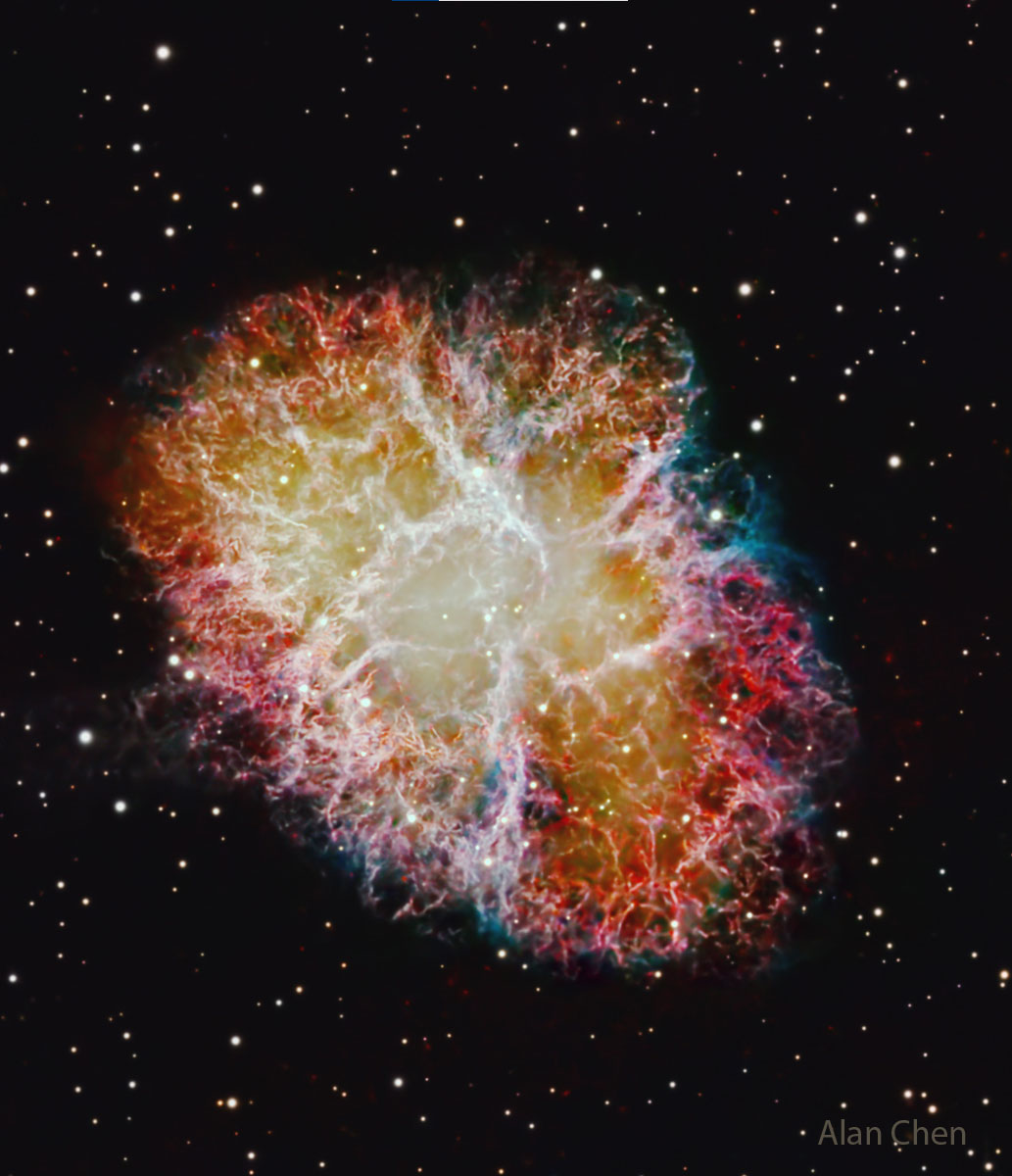
A dark starfield surrounds a colorful nebula filled with
tangled filaments.  
Please see the explanation for more detailed information.

M1: The Crab Nebula
Image Credit & Copyright: Alan Chen

Explanation: This is the mess that is left when a star explodes. The Crab Nebula, the result of a supernova seen in 1054 AD, is filled with mysterious filaments. The filaments are not only tremendously complex but appear to have less mass than expelled in the original supernova and a higher speed than expected from a free explosion. The featured image was taken by an amateur astronomer in LeesburgFloridaUSA over three nights last month. It was captured in three primary colors but with extra detail provided by specific emission by hydrogen gas. The Crab Nebula spans about 10 light years. In the Nebula's very center lies a pulsar: a neutron star as massive as the Sun but with only the size of a small town. The Crab Pulsar rotates about 30 times each second.

09/11/2023

ASTRONOMY - M1: The Crab Nebula

 2023 November 9

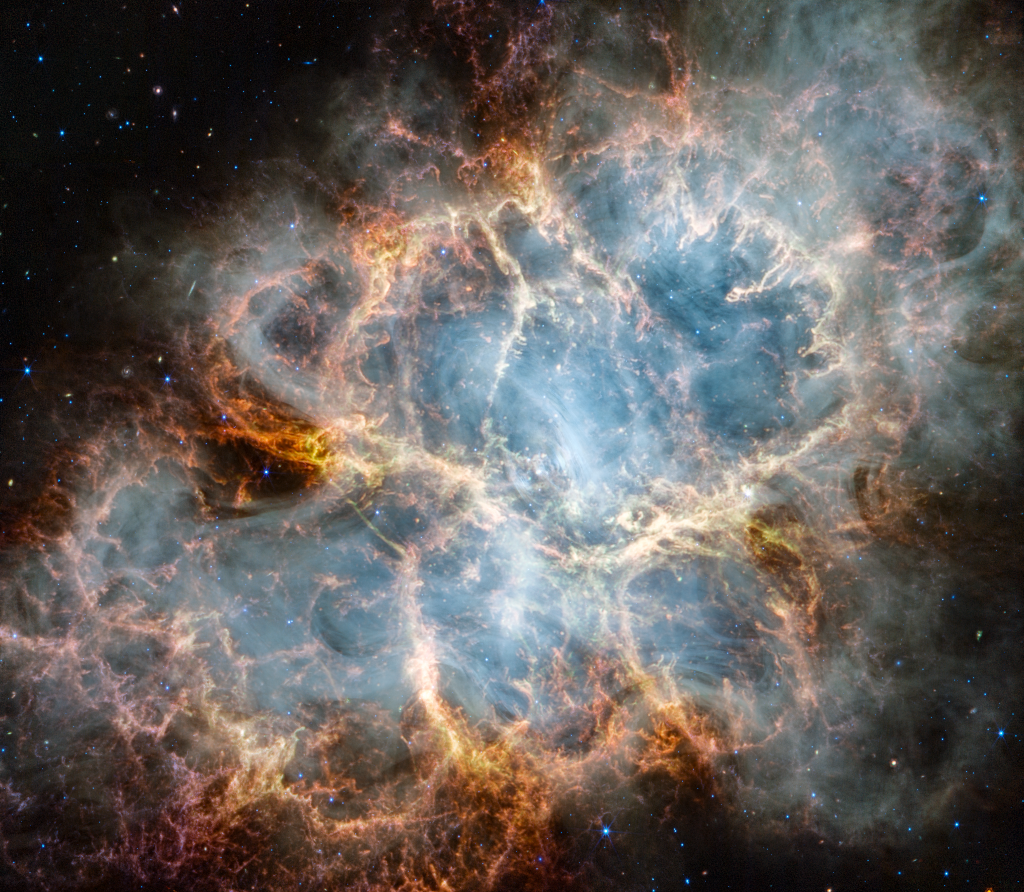
See Explanation.  Clicking on the picture will download the highest resolution version available.

M1: The Crab Nebula
Image Credit: NASAESACSASTScITea Temim (Princeton University)

Explanation: The Crab Nebula is cataloged as M1, the first object on Charles Messier's famous 18th century list of things which are not comets. In fact, the Crab is now known to be a supernova remnant, debris from the death explosion of a massive star witnessed by astronomers in the year 1054. This sharp image from the James Webb Space Telescope’s NIRCam (Near-Infrared Camera) and MIRI (Mid-Infrared Instrument) explores the eerie glow and fragmented strands of the still expanding cloud of interstellar debris in infrared light. One of the most exotic objects known to modern astronomers, the Crab Pulsar, a neutron star spinning 30 times a second, is visible as a bright spot near the nebula's center. Like a cosmic dynamo, this collapsed remnant of the stellar core powers the Crab's emission across the electromagnetic spectrum. Spanning about 12 light-years, the Crab Nebula is a mere 6,500 light-years away in the head-strong constellation

ASTRONOMY - Simeis 147: The Spaghetti Nebula Supernova Remnant

2026 January 7 Simeis 147: The Spaghetti Nebula Supernova Remnant Image Credit & Copyright:  Saverio Ferretti Explanation:  Its popular ...