Nombre total de pages vues

13/03/2019

Science et Technologie - Cette chambre d'hôtel se nettoie toute seule


[L'industrie c'est fou] À Copenhague, cette chambre d'hôtel se nettoie toute seule

Nous assistons à la naissance de la chambre d'hôtel autonome. Ouvert en janvier à Copenhague (Danemark), l'Hôtel Ottilia a des chambres qui se nettoient toutes seules grâce à une solution de la startup ACT Global. De quoi rassurer les maniaques des germes ?


Après les toilettes publiques automatiques, les chambres d’hôtel aussi se nettoient toutes seules. Ne fuyez pas tout de suite, l’approche est ici un peu plus haut de gamme. C’est en effet un établissement quatre étoiles de Copenhague (Danemark) qui opte pour cette solution. Ouvert en janvier 2019, l’Hôtel Ottilia a intégré dans ses chambre une technologie qui leur permet de se désinfecter toutes seules.


N’imaginez pas des robots nettoyeurs ou des lits capables de changer leurs draps en autonomie. L’hôtel danois s’appuie sur une solution de la startup ACT Global baptisée CleanCoat. Il s’agit en réalité d’un spray à diffuser sur les surfaces de la chambre pour éliminer les microbes. Semblable à du téflon, “le revêtement est transparent et inodore et il peut être appliqué sur toutes les surfaces”, indique l’entreprise. “Une fois exposé au soleil, une réaction photocatalytique débute qui décompose les microbes et purifie l’air.”

Lire en intégralité sur
Usine Nouvelle

Science et Technologie - Le monde minéral et ses trésors cachés : "Malachite"

Splendide malachite et ses verts bleutés
"Malachite"
La malachite est d'une belle couleur verte. Elle présente diverses nuances : vert bleuté, vert émeraude, vert sapin, vert sombre et parfois vert de gris sous la forme d'une simple oxydation decuivre.

Les gisements importants se trouvent dans l'Oural, en République démocratique du Congo, au Chili, en Namibie et en Australie. L'échantillon présenté ici est la coupe d'une stalagmite issue de la ceinture cuprifère du Katanga, au sud de la République Démocratique du Congo et au nord de la Zambie.

Bruno Cupillard

Sciences aéronautique - L'Europe interdit le Boeing 737 MAX dans son espace aérien


L'Europe interdit le Boeing 737 MAX dans son espace aérien

Après la France, au tour de l'Europe d'interdire le Boeing 737 MAX dans son espace aérien. L'autorité européenne de l'aviation, l'EASA, a décidé d'interdire préventivement de vol les 737 MAX-8 et 737 MAX-9 à partir de 19 heures ce 12 mars, deux jours après le crash d'Ethiopian Airlines.

Auparavant ce mardi 12 mars, la Direction Générale de l’Aviation Civile (DGAC) indiquait interdire tout vol commercial effectué sur un Boeing 737 MAX à destination, au départ, ou survolant le territoire français, y compris les territoires d'Outre Mer.

Les compagnies aériennes françaises ne disposent d’aucun appareil dans leur flotte, mais la DGAC a décidé de prendre ces mesures préventives compte tenu des incertitudes concernant les raisons du crash d’un de ces avions en Ethiopie le 10 mars. Certaines compagnies européennes font voler le 737 Max comme Air Italia, TUI, Icelandair, Norwegian.

Au lendemain de l’accident, la Chine a été la première à fermer son espace aérien aux Boeing 737 MAX. Depuis, de nombreux pays lui ont emboîté le pas, dont Singapour, le Royaume-Uni, l’Irlande ou encore l’Allemagne. Dans le pays du constructeur, pas d’interdiction, mais l’administration américaine de l’aviation civile (Federal Aviation Administration, FAA) a exigé le 11 mars des modifications de l’avion d’ici avril.

L’avionneur a quant à lui déclaré qu’il procéderait à une mise à jour du logiciel de bord des appareils en service dans les prochaines semaines. C’est ce logiciel de contrôle de vol qui est pointé du doigtdans le crash survenu dimanche et qui a fait 157 victimes, et dans celui d’un autre Boeing 737 MAX opéré par la compagnie Lion Air, qui s’était écrasé en mer de Java en octobre dernier.

Usine Nouvelle

12/03/2019

Science et Technologie - Le monde minéral et ses trésors cachés : Jaspe aux allures d'océan agité

Jaspe aux allures d'océan agité

Jaspe aux allures d'océan agité
Ce jaspe particulièrement esthétique et dont la photo ressemble à un océan agité provient de la province de Mahajanga, près de Marovato, au nord-ouest de Madagascar.

Les jaspes sont des calcédoines opaques, massives, à grains fins. La couleur de base peut être blanche, rose, verte, rouge, ou jaune. C'est l'apport d'oxydes et les changements de concentration qui donnent sa couleur au jaspe et l'animent agréablement.

Science & Technology - Astronomy picture of the day : The Central Magnetic Field of the Cigar Galaxy

2019 March 12
See Explanation.  Clicking on the picture will download
the highest resolution version available.
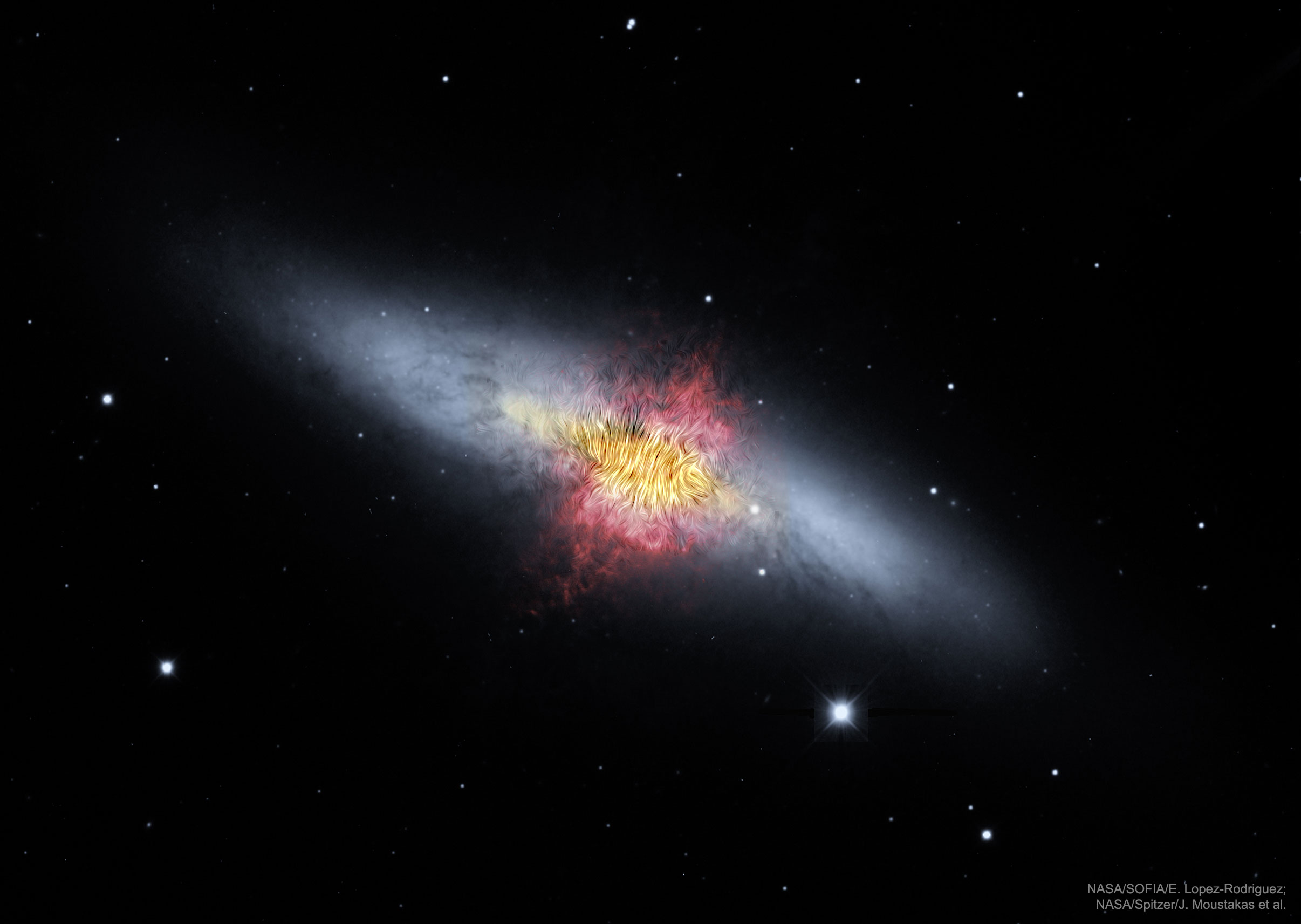
The Central Magnetic Field of the Cigar Galaxy 
Image Credit: NASASOFIAE. Lopez-RodriguezNASASpitzer, J. Moustakas et al.

Explanation: Are galaxies giant magnets? Yes, but the magnetic fields in galaxies are typically much weaker than on Earth's surface, as well as more complex and harder to measure. Recently, though, the HAWC+ instrument onboard the airborne (747SOFIA observatory has been successful in detailing distant magnetic fields by observing infrared light polarized by reflection from dust grains. Featured here, HAWC+ observations of the M82, the Cigar galaxy, show that the central magnetic field is perpendicular to the disk and parallel to the strong supergalactic wind. This observation bolsters the hypothesis that M82's central magnetic field helps its wind transport the mass of millions of stars out from the central star-burst region. The featured image shows magnetic field lines superposed on top of an optical light (gray) and hydrogen gas (red) image from Kitt Peak National Observatory, further combined with infrared images (yellow) from SOFIA and the Spitzer Space Telescope. The Cigar Galaxy is about 12 million light years distant and visible with binoculars towards the constellation of the Great Bear.

09/03/2019

Science & Technology - Astronomy : Magnetic Fields May Be the Key to Black Hole Activity

Artist’s conception of the core of Cygnus A
Parallel jets provide astronomers with some of the most powerful evidence that a supermassive black hole lurks in the heart of most galaxies. Some of these black holes appear to be active, gobbling up material from their surroundings and launching jets at ultra-high speeds, while others are quiescent, even dormant.

Recent observations from SOFIA, the Stratospheric Observatory for Infrared Astronomy, are shedding light on this question. SOFIA data indicate that magnetic fields are trapping and confining dust near the center of the active galaxy, Cygnus A, and feeding material onto the supermassive black hole at its center.

This artist’s conception of the core of Cygnus A shows the dusty donut-shaped surroundings, called a torus, and jets launching from its center. Magnetic fields are illustrated trapping the dust in the torus. These magnetic fields could be helping power the black hole hidden in the galaxy’s core by confining the dust in the torus and keeping it close enough to be gobbled up by the hungry black hole.

Image Credit: NASA/SOFIA/Lynette Cook
Last Updated: Feb. 13, 2019
Editor: Yvette Smith

Science & Technology - Astronomy picture of the day : Crescent Enceladus

2019 March 9
See Explanation.  Clicking on the picture will download
 the highest resolution version available.
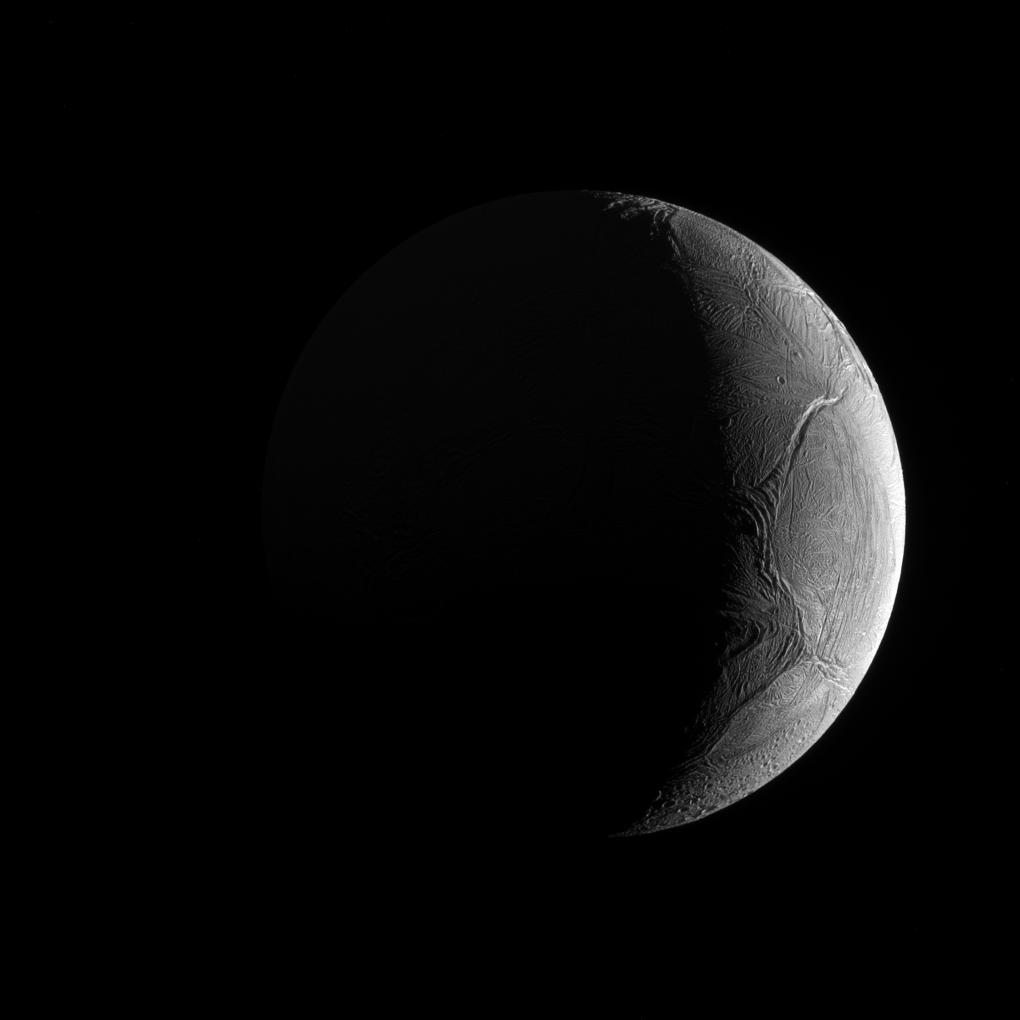
Crescent Enceladus Image Credit: Cassini Imaging TeamSSIJPLESANASA

Explanation: Peering from the shadows, the Saturn-facing hemisphere of tantalizing inner moon Enceladus poses in this Cassini spacecraft image. North is up in the dramatic scene captured during November 2016 as Cassini's camera was pointed in a nearly sunward direction about 130,000 kilometers from the moon's bright crescent. In fact, the distant world reflects over 90 percent of the sunlight it receives, giving its surface about the same reflectivity as fresh snow. A mere 500 kilometers in diameter, Enceladus is a surprisingly active moon. Data collected during Cassini's flybys and years of images have revealed the presence of remarkable south polar geysers and a possible global ocean of liquid water beneath an icy crust.

Science et Technologie - Le monde minéral et ses trésors cachés : Stromatolite rougeoyante

Stromatolite rougeoyante

Les stromatolites se développent toujours dans de rares endroits du monde comme les sources chaudes du Parc de Yellowstone (États-Unis) ou en bordure d'océan, en Australie. Celle-ci provient de la mine de Corsica, située dans le Minnesota, aux États-Unis.

© Bruno Cupillard

08/03/2019

Science & Technology - Le monde minéral et ses trésors cachés : "Chrysocolle de Katanga aux airs de mangrove"

Chrysocolle de Katanga aux airs de mangrove
"Chrysocolle de Katanga aux airs de mangrove"
La chrysocolle est un minéral d'altération des minéraux de cuivre. Elle est généralement associée à d'autres minéraux de cuivre, comme ici à la malachite. Ces associations procurent des verts et des bleus plus ou moins intenses et zonés aux motifs contrastés. Elle se présente en formes massives, en concrétions, en stalactites ou en croûtes et enduits, mais très rarement en cristaux aciculaires.

Cet échantillon provient de la province du Katanga, dans la ceinture cuprifère de Kolwezi et Likasi, au sud de la République démocratique du Congo, près de Lubumbashi (ancienne Elisabethville).

Bruno Cupillard

Science & Technology - Astronomy picture of the day : Stardust and Starlight in M78

2019 March 8
See Explanation.  Clicking on the picture will download
 the highest resolution version available.
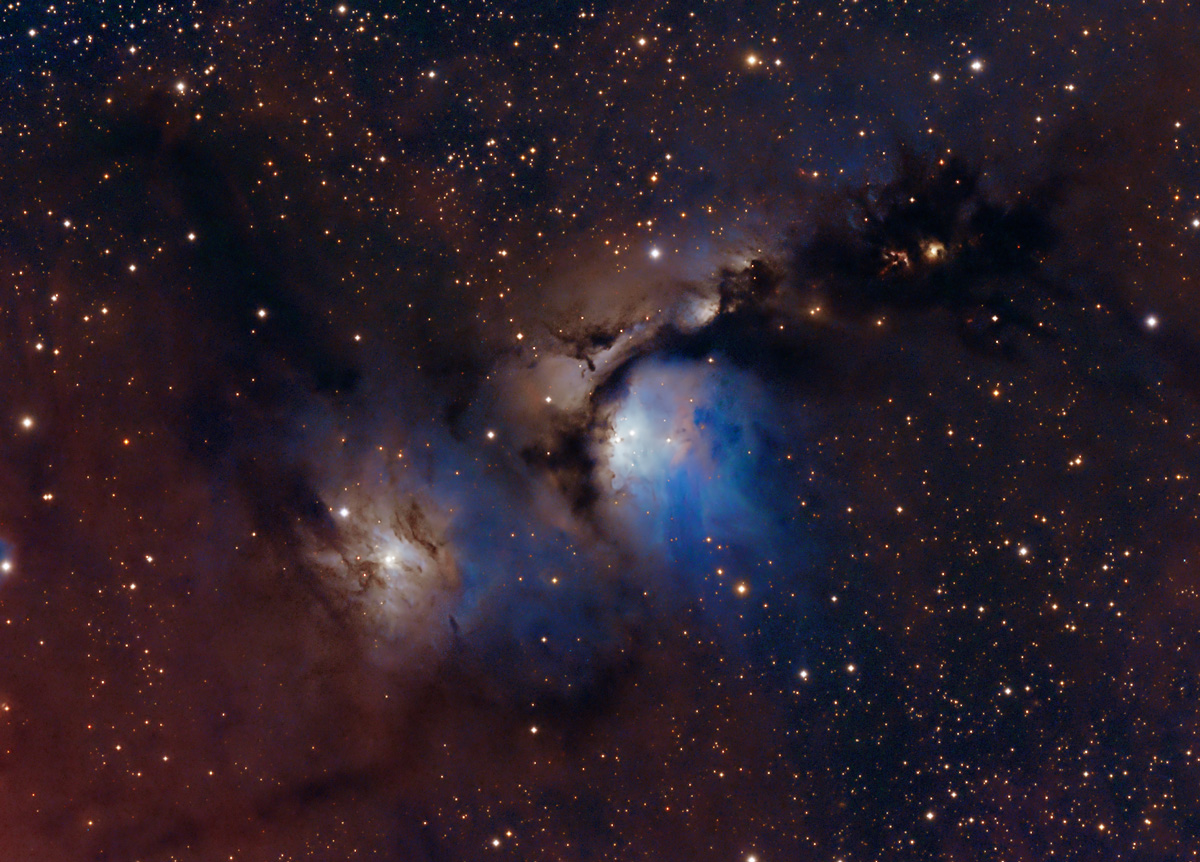
Stardust and Starlight in M78 
Image Credit & CopyrightRichard S. Wright Jr.
Explanation: Interstellar dust clouds and bright nebulae abound in the fertile constellation of Orion. One of the brightest, M78, is near the center in this colorful telescopic view, covering an area north of Orion's belt. At a distance of about 1,500 light-years, the bluish nebula itself is about 5 light-years across. Its blue tint is due to dust preferentially reflecting the blue light of hot, young stars in the region. Dark dust lanes and other nebulae can easily be traced through the gorgeous skyscape that includes many Herbig- Haro objects, energetic jets from stars in the process of formation. But missing from this image is McNeil's nebula. A major discovery only recognized in 2004, the enigmatic, variable nebula was found along the dark lane of dust above and right of larger M78. McNeil's nebula is associated with a protostar and seen to be sometimes present and sometimes absent in photos of the well-imaged region. McNeil's nebula faded from view late last year and is still absent in this deep image recorded in February 2019.

ASTRONOMY - Red Sprites and Circular Elves Lightning over Italy

 2025 December 23 Red Sprites and Circular Elves Lightning over Italy Image Credit & Copyright:  Valter Binotto Explanation:  What's...