
Les tempêtes de sable sont courantes dans les régions désertiques, comme ici à Basra en Iraq : celles-ci donnent lieu à un ciel rouge ou orange et peuvent générer de nombreux accidents sur les routes en raison du manque de visibilité.
FuturaSciences
2024 November 22

Explanation: Braided and serpentine filaments of glowing gas suggest this nebula's popular name, The Medusa Nebula. Also known as Abell 21, this Medusa is an old planetary nebula some 1,500 light-years away in the constellation Gemini. Like its mythological namesake, the nebula is associated with a dramatic transformation. The planetary nebula phase represents a final stage in the evolution of low mass stars like the sun as they transform themselves from red giants to hot white dwarf stars and in the process shrug off their outer layers. Ultraviolet radiation from the hot star powers the nebular glow. The Medusa's transforming star is the faint one near the center of the overall bright crescent shape. In this deep telescopic view, fainter filaments clearly extend below and to the left. The Medusa Nebula is estimated to be over 4 light-years across.
2024 November 21
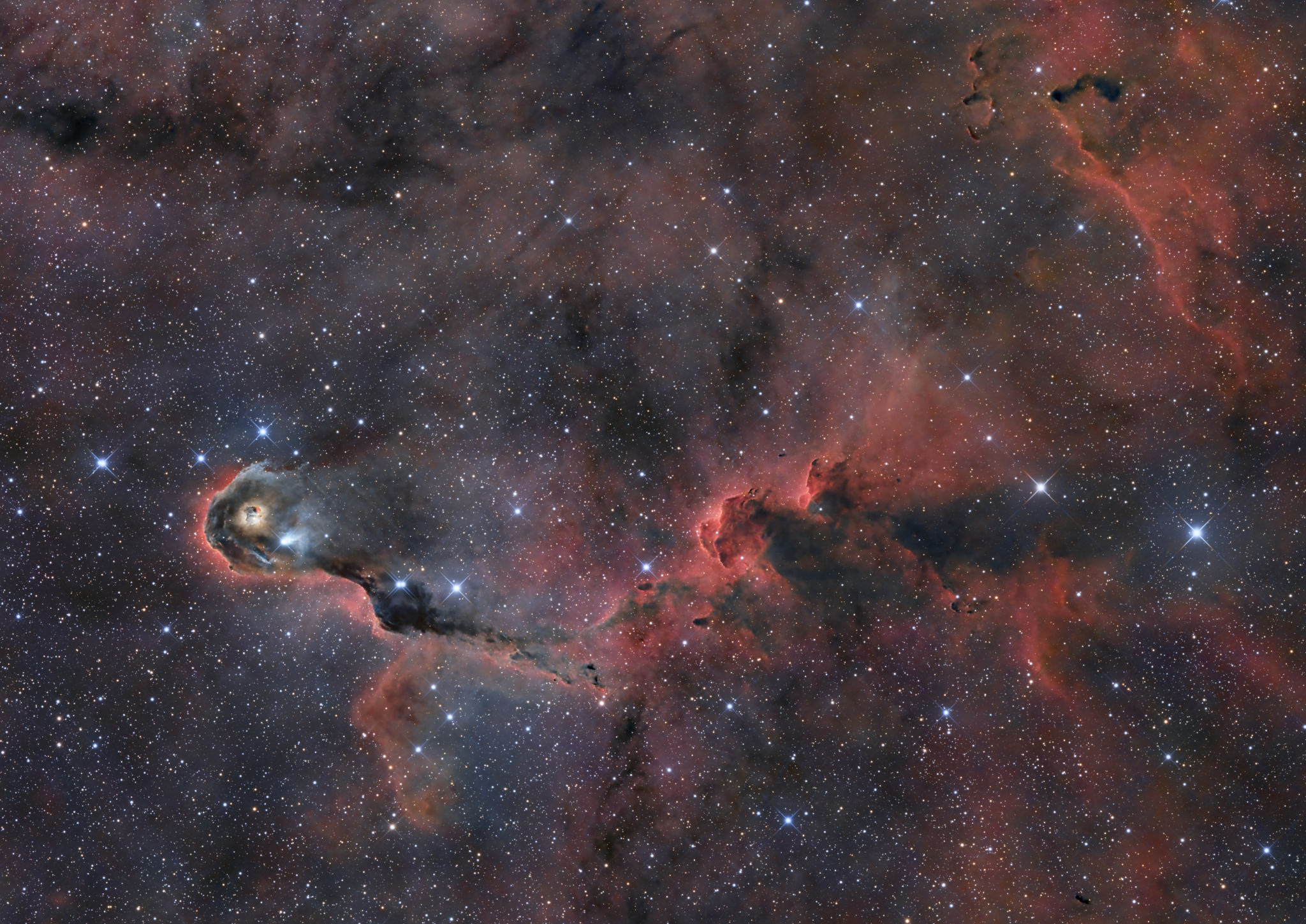
Explanation: Like an illustration in a galactic Just So Story, the Elephant's Trunk Nebula winds through the emission region and young star cluster complex IC 1396, in the high and far off constellation of Cepheus. Also known as vdB 142, this cosmic elephant's trunk is over 20 light-years long. The detailed telescopic view features the bright swept-back ridges and pockets of cool interstellar dust and gas that abound in the region. But the dark, tendril-shaped clouds contain the raw material for star formation and hide protostars within. Nearly 3,000 light-years distant, the relatively faint IC 1396 complex covers a large region on the sky, spanning over 5 degrees. This rendition spans a 1 degree wide field of view though, about the angular size of 2 full moons.
2024 November 20

Explanation: Eight billion people are about to disappear in this snapshot from space taken on 2022 November 21. On the sixth day of the Artemis I mission, their home world is setting behind the Moon's bright edge as viewed by an external camera on the outbound Orion spacecraft. Orion was headed for a powered flyby that took it to within 130 kilometers of the lunar surface. Velocity gained in the flyby maneuver was used to reach a distant retrograde orbit around the Moon. That orbit is considered distant because it's another 92,000 kilometers beyond the Moon, and retrograde because the spacecraft orbited in the opposite direction of the Moon's orbit around planet Earth. Orion entered its distant retrograde orbit on November 25. Swinging around the Moon, Orion reached a maximum distance (just over 400,000 kilometers) from Earth on November 28, exceeding a record set by Apollo 13 for most distant spacecraft designed for human space exploration. The Artemis II mission, carrying 4 astronauts around the moon and back again, is scheduled to launch no earlier than September 2025.
2024 November 19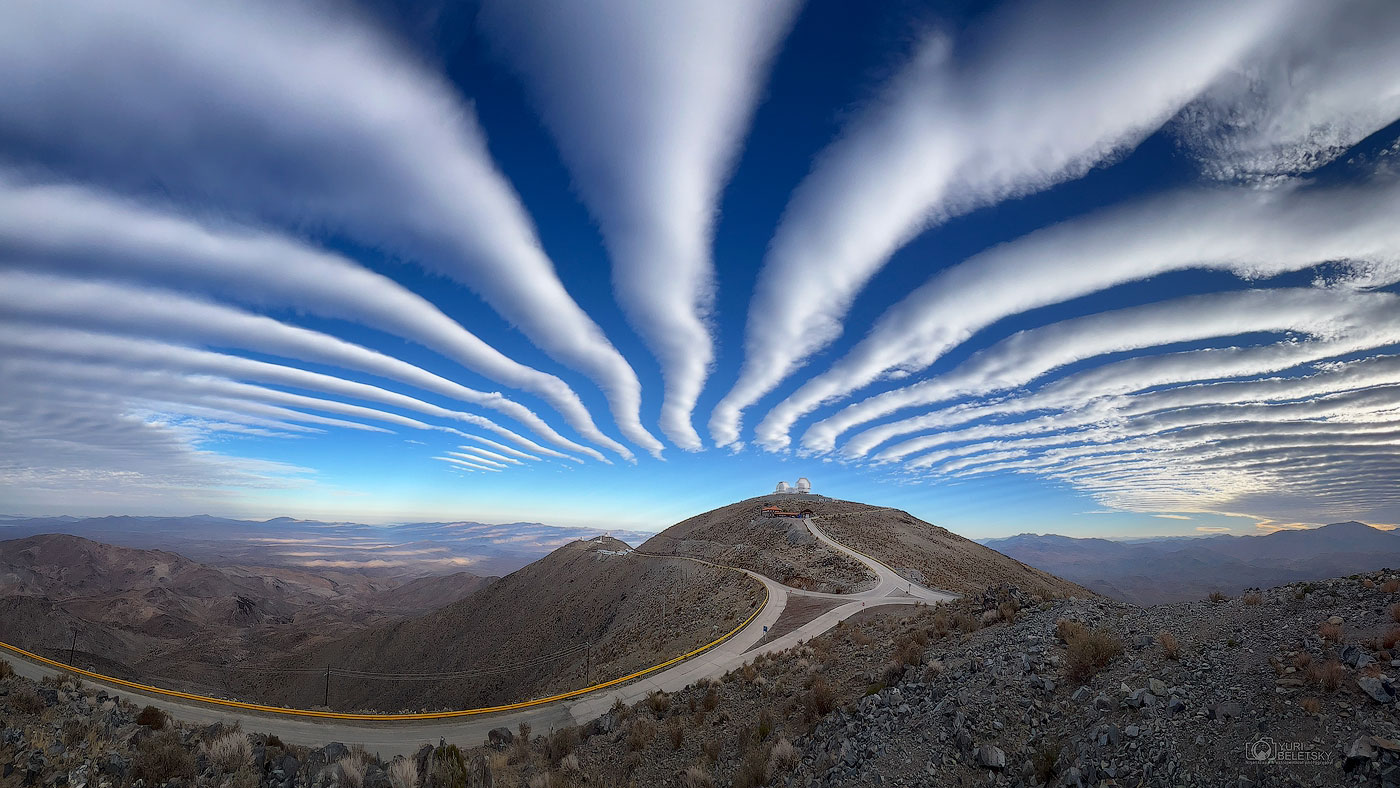
Explanation: What's happening with these clouds? While it may seem that these long and thin clouds are pointing toward the top of a hill, and that maybe a world-famous observatory is located there, only part of that is true. In terms of clouds, the formation is a chance superposition of impressively periodic undulating air currents in Earth's lower atmosphere. Undulatus, a type of Asperitas cloud, form at the peaks where the air is cool enough to cause the condensation of opaque water droplets. The wide-angle nature of the panorama creates the illusion that the clouds converge over the hill. In terms of land, there really is a world-famous observatory at the top of that peak: the Carnegie Science's Las Campanas Observatory in the Atacama Desert of Chile. The two telescope domes visible are the 6.5-meter Magellan Telescopes. The featured coincidental vista was a surprise but was captured by the phone of a quick-thinking photographer in late September.

2024 November 18

Explanation: Stars can create huge and intricate dust sculptures from the dense and dark molecular clouds from which they are born. The tools the stars use to carve their detailed works are high energy light and fast stellar winds. The heat they generate evaporates the dark molecular dust as well as causing ambient hydrogen gas to disperse and glow. Pictured here, a new open cluster of stars designated IC 1590 is nearing completion around the intricate interstellar dust structures in the emission nebula NGC 281, dubbed the Pac-man Nebula because of its overall shape. The dust cloud just above center is classified as a Bok Globule as it may gravitationally collapse and form a star -- or stars. The Pacman Nebula lies about 10,000 light years away toward the constellation of Cassiopeia.
Lorsqu'on leur parle de feuilles d'herbe, les amoureux de poésie pensent immédiatement à l'Américain Walt Whitman et à son chef ...


