Nombre total de pages vues

08/01/2025

ASTRONOMY - Supernova Remnants Big and Small

 2025 January 8

A star field appears that has several nebulas. Toward the upper
left is a angularly small supernova remnant colored blue, while 
dominating the lower right is a large supernova remnant in both
red and blue. 
Please see the explanation for more detailed information.

Supernova Remnants Big and Small
Image Credit & Copyright: Stéphane Vetter (Nuits sacrées)

Explanation: What happens after a star explodes? A huge fireball of hot gas shoots out in all directions. When this gas slams into the existing interstellar medium, it heats up so much it glows. Two different supernova remnants (SNRs) are visible in the featured image, taken at the Oukaïmeden Observatory in Morocco. The blue soccer ball-looking nebula toward the upper left is SNR G179.0+02.6, which appears to be the smaller one. This supernova, about 11,000 light years distant, detonated about 50,000 years ago. Although composed mostly of hydrogen gas, the blue light is emitted by a trace amount of oxygen. The seemingly larger SNR, dominating the lower right of the frame, is the Spaghetti Nebula, cataloged as Simeis 147 and sh2-240. This supernova, only about 3,000 light years away, exploded about 40,000 years ago. Comparatively, even though they appear different sizes, both supernova remnants are not only roughly the same age, but about the same size, too.

07/01/2025

ASTRONOMY - A New Year's Aurora and SAR Arc

 2025 January 7

A star field appears above a town at night. The left part
of the sky shows a pinkish-red glow that is an aurora, while the
right part of the sky shows a smoother and darker glow that is
a SAR arc. 
Please see the explanation for more detailed information.

A New Year's Aurora and SAR Arc
Image Credit & Copyright: Alessandra Masi

Explanation: It was a new year, and the sky was doubly red. The new year meant that the Earth had returned to its usual place in its orbit on January 1, a place a few days before its closest approach to the Sun. The first of the two red skyglows, on the left, was a red aurora, complete with vertical rays, caused by a blast from the Sun pushing charged particles into Earth's atmosphere. The second red glow, most prominent on the far right, was possibly a SAR arc caused by a river of charged particles flowing across Earth's atmosphere. Although both appear red, the slight color difference is likely due to the aurora being emitted by both oxygen and nitrogen, whereas the higher SAR arc was possibly emitted more purely by atmospheric oxygen. The featured image was taken on January 1 from near Pieve di Cadore in Italy.

06/01/2025

AERONAUTIQUE - La grande épopée des ballons dirigeables - 1904 : Baldwin's Airship


Né en 1854, Thomas Scott Baldwin a commencé sa carrière comme serre-freins dans une compagnie de chemin de fer de l'Illinois (États-Unis). Puis, comme acrobate dans un cirque où il présente un numéro de trapèze et de montgolfière. Surnommé le père du dirigeable américain, Baldwin est un pionnier de l'aéronautique. Pilote, inventeur, constructeur de ballons, de dirigeables et d'avions, il fut commandant de l'armée américaine lors de la Première Guerre mondiale. Premier américain à faire un saut en parachute depuis un ballon. Il construisit un dirigeable nommé « California Arrow » qui devint en 1904 le premier aéronef motorisé à effectuer un vol circulaire aux États-Unis. La structure en bois sert de nacelle et de cockpit, là où se trouve le pilote qui utilisait son propre poids comme pendule pour contrôler la direction.

Lors de l'exposition organisée pour le centenaire de l'achat de la Louisiane en 1904 à Saint-Louis (Missouri), le dirigeable, piloté par l'ingénieur Roy Knabenshue effectua un vol d'une heure et trente minutes de vol. Lors de cette exposition universelle, plus de 60 pays et 43 des 45 États américains ont participé à cette foire qui fut visitée par 19,7 millions de personnes. L'année suivante, Roy Knabenshue est le premier à survoler New York, en 1905.

Désireuse de rattraper son retard par rapport à l'Europe, l'armée américaine sollicita ensuite Baldwin. Il créa un dirigeable de 29 mètres de long, propulsé par un nouveau moteur Curtiss plus puissant, pour le Corps des transmissions de l'armée américaine, le SC-I.

Baldwin's Airship, ballon prêt à décoller avec Roy Knabenshue debout sur le châssis. Exposition du Département des transports à l'exposition universelle de 1904.

© Jessie Tarbox Beals, CC0

ASTRONOMIE - Les plus beaux astres de la Voie Lactée - Saturne et ses anneaux


Sixième planète du Système solaire par ordre de distance au Soleil, Saturne est également la deuxième plus grande, après Jupiter. Majoritairement composée d'hydrogène et d'hélium, il s'agit d'une géante gazeuse, au même titre que Jupiter, Uranus et Neptune. Cette planète est facilement reconnaissable par ses anneaux, constitués de roches et de glaces.

Superficie de Saturne : 4,35 x 10¹⁰ km2

© Nasa, JPL, Space Science Institute, Wikimedia Commons, DP

SANTé/MEDECINE - LES INGREDIENTS A BANNIR AU SUPERMARCHé - Le glutamate monosodique


Est-ce que vous aussi vous êtes atteint du syndrome du paquet de chips ouvert ? Vous savez, c'est ce besoin irrésistible de finir un paquet de chips une fois qu'il est ouvert. Eh bien, on tient le responsable de cette manie : c'est le glutamate monosodique (E621 ou GMS). C'est un additif dont la mission est de tromper vos papilles. Cet exhausteur de goût agit comme un excitant sur le cerveau. On le trouve par exemple dans les bouillons, les sauces industrielles et les charcuteries.

Le problème ? Il peut entraîner une dépendance, favoriser l’obésité, et aggraver certains troubles neurologiques.

CommentEconomiser

ASTRONOMY - Colliding Spiral Galaxies from Webb and Hubble

 2025 January 6

Two spiral galaxies are pictured on the left and right. 
They galaxy on the left is smaller. Both show red lanes of
dust in their spiral arms. 
Please see the explanation for more detailed information.

Colliding Spiral Galaxies from Webb and Hubble
Image Credit: NASAESACSASTScI

Explanation: Billions of years from now, only one of these two galaxies will remain. Until then, spiral galaxies NGC 2207 and IC 2163 will slowly pull each other apart, creating tides of matter, sheets of shocked gas, lanes of dark dust, bursts of star formation, and streams of cast-away stars. The featured image in scientifically assigned colors is a composite of Hubble exposures in visible light and Webb exposures in infrared light. Astronomers predict that NGC 2207, the larger galaxy on the right, will eventually incorporate IC 2163, the smaller galaxy on the left. In the most recent encounter that about peaked 40 million years ago, the smaller galaxy is swinging around counter-clockwise and is now slightly behind the larger galaxy. The space between stars is so vast that when galaxies collide, the stars in them usually do not collide.

05/01/2025

ASTRONOMY - Rocket Launch as Seen from the International Space Station

 2025 January 5

Rocket Launch as Seen from the International Space Station
Video Credit: ISAANASAExpedition 57 Crew (ISS);
Processing: Riccardo Rossi (ISAA, AstronautiCAST); Music: Inspiring Adventure Cinematic Background by Maryna

Explanation: Have you ever seen a rocket launch -- from space? A close inspection of the featured time-lapse video will reveal a rocket rising to Earth orbit as seen from the International Space Station (ISS). The RussiaSoyuz-FG rocket was launched in November 2018 from the Baikonur Cosmodrome in Kazakhstan, carrying a Progress MS-10 (also 71P) module to bring needed supplies to the ISS. Highlights in the 90-second video (condensing about 15-minutes) include city lights and clouds visible on the Earth on the lower left, blue and gold bands of atmospheric airglow running diagonally across the center, and distant stars on the upper right that set behind the Earth. A lower stage can be seen falling back to Earth as the robotic supply ship fires its thrusters and begins to close on the ISS, a space laboratory that celebrated its 25th anniversary in 2023. Astronauts who live aboard the Earth-orbiting ISS conduct, among more practical duties, numerous science experiments that expand human knowledge and enable future commercial industry in low Earth orbit.

04/01/2025

ASTRONOMY - Welcome to Perihelion

 2025 January 4

See Explanation.  Clicking on the picture will download
the highest resolution version available.

Welcome to Perihelion
Image Credit & Copyright: Peter Ward (Barden Ridge Observatory)

Explanation: Earth's orbit around the Sun is not a circle, it's an ellipse. The point along its elliptical orbit where our fair planet is closest to the Sun is called perihelion. This year perihelion is today, January 4, at 13:28 UTC, with the Earth about 147 million kilometers from the Sun. For comparison, at aphelion on last July 3 Earth was at its farthest distance from the Sun, some 152 million kilometers away. But distance from the Sun doesn't determine Earth's seasons. It's only by coincidence that the beginning of southern summer (northern winter) on the December solstice - when this H-alpha picture of the active Sun was taken - is within 14 days of Earth's perihelion date. And it's only by coincidence that Earth's perihelion date is within 11 days of the historic perihelion of NASA's Parker Solar Probe. Launched in 2018, the Parker Solar Probe flew within 6.2 million kilometers of the Sun's surface on 2024 December 24, breaking its own record for closest perihelion for a spacecraft from planet Earth.

03/01/2025

ASTRONOMIE - Les plus beaux astres de la Voie Lactée - La lune


Cette photographie de la Pleine Lune a été prise le 22 octobre 2010 à Madison, dans l'Alabama (États-Unis).

Superficie de la Lune : 3,79 x 10⁷ km2

© Gregory H. Revera, Wikimedia Commons, CC by-sa 3.0

ASTRONOMY - Eclipse pair

 2025 January 3

See Explanation.  Clicking on the picture will download
the highest resolution version available.

Eclipse Pair
Image Credit & Copyright: Josh Dury

Explanation: Eclipses tend to come in pairs. Twice a year, during an eclipse season that lasts about 34 days, Sun, Moon, and Earth can nearly align. Then the full and new phases of the Moon, separated by just over 14 days, create a lunar and a solar eclipse. But only rarely is the alignment at both new moon and full moon phases during a single eclipse season close enough to produce a pair with both total (or a total and an annular) lunar and solar eclipses. More often, partial eclipses are part of any eclipse season. In fact, the last eclipse season of 2024 produced this fortnight-separated eclipse pair: a partial lunar eclipse on 18 September and an annular solar eclipse on 2 October. The time-lapse composite images were captured from Somerset, UK (left) and Rapa Nui planet Earth. The 2025 eclipse seasons will see a total lunar eclipse on 14 March paired with a partial solar eclipse on 29 March, and a total lunar eclipse on 8 September followed by a partial solar eclipse on 21 September.

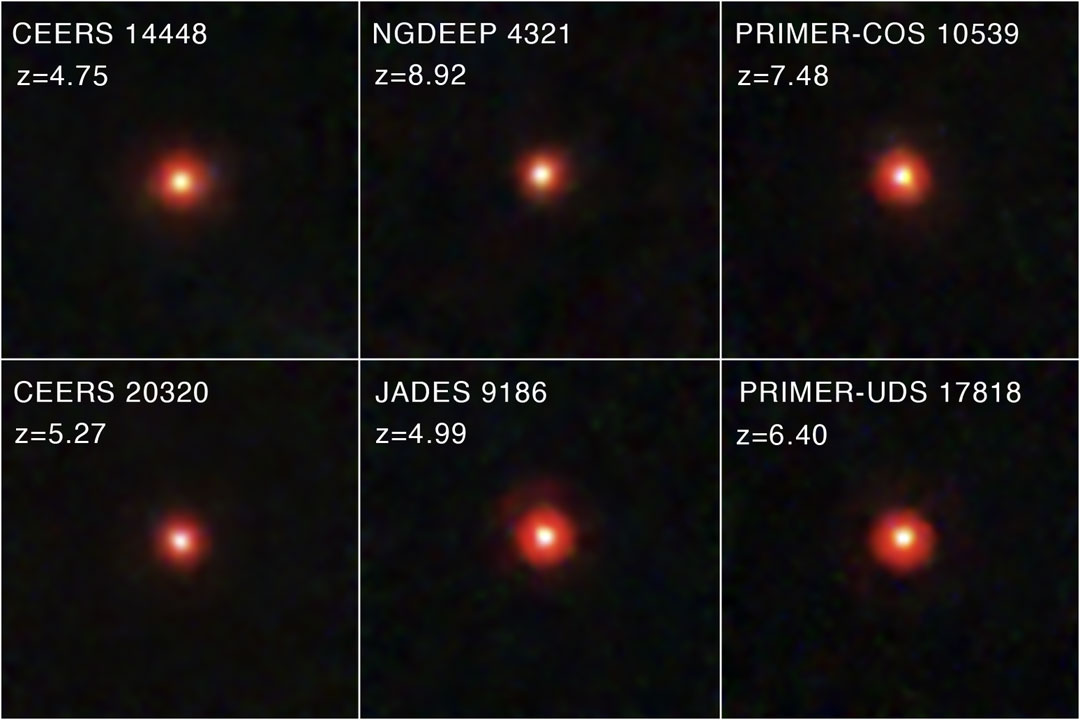
ASTRONOMY - Mystery: Little Red Dots in the Early Universe

 2025 December 24 Mystery: Little Red Dots in the Early Universe Image Credit:  NASA ,  ESA ,  CSA ,  STScI ,  JWST ;  Dale Kocevski  ( Colb...