Nombre total de pages vues
09/01/2025
AERONAUTIQUE - La grande épopée des ballons dirigeables - 1932 : l'USS Macon
ASTRONOMY - Peculiar Galaxies of Arp 273
2025 January 9
Image Credit & Copyright: Dave Doctor
Explanation: The colorful, spiky stars are in the foreground of this image taken with a small telescope on planet Earth. They lie well within our own Milky Way Galaxy. But the two eye-catching galaxies in the frame lie far beyond the Milky Way, at a distance of over 300 million light-years. The galaxies' twisted and distorted appearance is due to mutual gravitational tides as the pair engage in close encounters. Cataloged as Arp 273 (also as UGC 1810), these galaxies do look peculiar, but interacting galaxies are now understood to be common in the universe. Closer to home, the large spiral Andromeda Galaxy is known to be some 2 million light-years away and inexorably approaching the Milky Way. In fact the far away peculiar galaxies of Arp 273 may offer an analog of the far future encounter of Andromeda and Milky Way. Repeated galaxy encounters on a cosmic timescale ultimately result in a merger into a single galaxy of stars. From our perspective, the bright cores of the Arp 273 galaxies are separated by only a little over 100,000 light-years.
08/01/2025
ASTRONOMIE - Galaxies - NGC 4603
ASTRONOMY - Supernova Remnants Big and Small
2025 January 8
Image Credit & Copyright: Stéphane Vetter (Nuits sacrées)
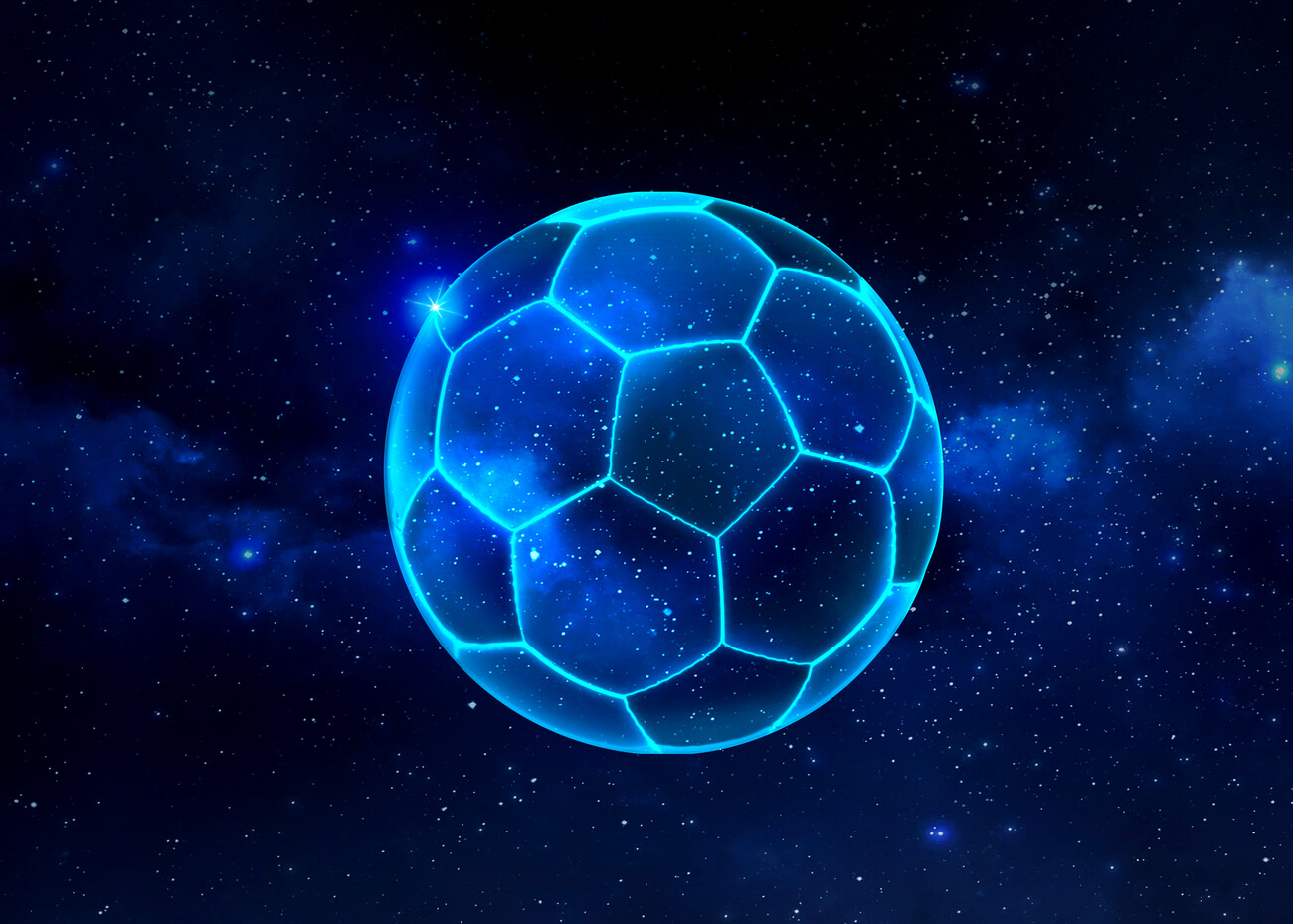
Explanation: What happens after a star explodes? A huge fireball of hot gas shoots out in all directions. When this gas slams into the existing interstellar medium, it heats up so much it glows. Two different supernova remnants (SNRs) are visible in the featured image, taken at the Oukaïmeden Observatory in Morocco. The blue soccer ball-looking nebula toward the upper left is SNR G179.0+02.6, which appears to be the smaller one. This supernova, about 11,000 light years distant, detonated about 50,000 years ago. Although composed mostly of hydrogen gas, the blue light is emitted by a trace amount of oxygen. The seemingly larger SNR, dominating the lower right of the frame, is the Spaghetti Nebula, cataloged as Simeis 147 and sh2-240. This supernova, only about 3,000 light years away, exploded about 40,000 years ago. Comparatively, even though they appear different sizes, both supernova remnants are not only roughly the same age, but about the same size, too.
07/01/2025
ASTRONOMY - A New Year's Aurora and SAR Arc
2025 January 7
Image Credit & Copyright: Alessandra Masi
Explanation: It was a new year, and the sky was doubly red. The new year meant that the Earth had returned to its usual place in its orbit on January 1, a place a few days before its closest approach to the Sun. The first of the two red skyglows, on the left, was a red aurora, complete with vertical rays, caused by a blast from the Sun pushing charged particles into Earth's atmosphere. The second red glow, most prominent on the far right, was possibly a SAR arc caused by a river of charged particles flowing across Earth's atmosphere. Although both appear red, the slight color difference is likely due to the aurora being emitted by both oxygen and nitrogen, whereas the higher SAR arc was possibly emitted more purely by atmospheric oxygen. The featured image was taken on January 1 from near Pieve di Cadore in Italy.
06/01/2025
AERONAUTIQUE - La grande épopée des ballons dirigeables - 1904 : Baldwin's Airship
ASTRONOMIE - Les plus beaux astres de la Voie Lactée - Saturne et ses anneaux
SANTé/MEDECINE - LES INGREDIENTS A BANNIR AU SUPERMARCHé - Le glutamate monosodique
ASTRONOMY - Colliding Spiral Galaxies from Webb and Hubble
2025 January 6
Image Credit: NASA, ESA, CSA, STScI
Explanation: Billions of years from now, only one of these two galaxies will remain. Until then, spiral galaxies NGC 2207 and IC 2163 will slowly pull each other apart, creating tides of matter, sheets of shocked gas, lanes of dark dust, bursts of star formation, and streams of cast-away stars. The featured image in scientifically assigned colors is a composite of Hubble exposures in visible light and Webb exposures in infrared light. Astronomers predict that NGC 2207, the larger galaxy on the right, will eventually incorporate IC 2163, the smaller galaxy on the left. In the most recent encounter that about peaked 40 million years ago, the smaller galaxy is swinging around counter-clockwise and is now slightly behind the larger galaxy. The space between stars is so vast that when galaxies collide, the stars in them usually do not collide.
05/01/2025
ASTRONOMY - Rocket Launch as Seen from the International Space Station
2025 January 5
Video Credit: ISAA, NASA, Expedition 57 Crew (ISS);
Processing: Riccardo Rossi (ISAA, AstronautiCAST); Music: Inspiring Adventure Cinematic Background by Maryna
Explanation: Have you ever seen a rocket launch -- from space? A close inspection of the featured time-lapse video will reveal a rocket rising to Earth orbit as seen from the International Space Station (ISS). The Russian Soyuz-FG rocket was launched in November 2018 from the Baikonur Cosmodrome in Kazakhstan, carrying a Progress MS-10 (also 71P) module to bring needed supplies to the ISS. Highlights in the 90-second video (condensing about 15-minutes) include city lights and clouds visible on the Earth on the lower left, blue and gold bands of atmospheric airglow running diagonally across the center, and distant stars on the upper right that set behind the Earth. A lower stage can be seen falling back to Earth as the robotic supply ship fires its thrusters and begins to close on the ISS, a space laboratory that celebrated its 25th anniversary in 2023. Astronauts who live aboard the Earth-orbiting ISS conduct, among more practical duties, numerous science experiments that expand human knowledge and enable future commercial industry in low Earth orbit.
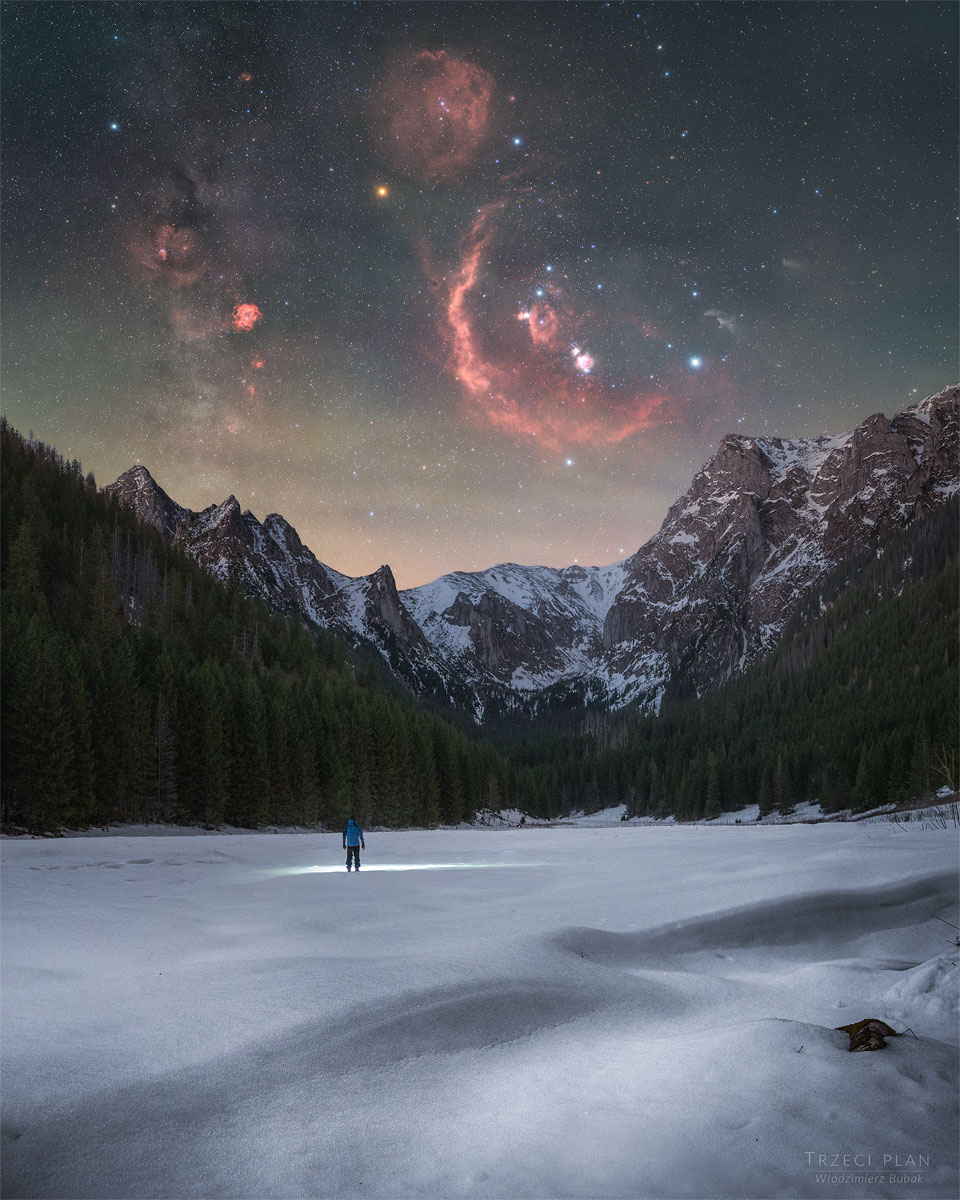
ASTRONOMY - Orion's Treasures over Snowy Mountains
2026 January 27 Orion's Treasures over Snowy Mountains Image Credit & Copyright: Włodzimierz Bubak ; Text: Ogetay Kayali ( MTU )...
-
2022 September 26 All the Water on Planet Earth Illustration Credit: Jack Cook, Adam Nieman, Woods Hole Oceanographic Institution ; Data ...
-
2025 May 11 The Surface of Venus from Venera 14 Image Credit: Soviet Planetary Exploration Program , Venera 14 ; Processing & Copyri...