Nombre total de pages vues

13/01/2025

ASTRONOMY - Comet ATLAS Before Sunrise

 2025 January 13

A morning sky is shown about a line of trees. In the sky is a 
faint comet. The comet is shown in better detailed in an inset
image on the upper left. 
Please see the explanation for more detailed information.

Comet ATLAS Before Sunrise
Image Credit & Copyright: Petr Horalek / Institute of Physics in Opava

Explanation: Comet ATLAS is really bright now, but also really close to the Sun. Outside the glow of the Sun, Comet C/2024 G3 (ATLAS) would be one of the more remarkable comet sights of recent years, reflecting about as much sunlight to Earth as Comet Tsuchinshan-ATLAS did in October, and now rivaling even planet Venus. But the giant snowball is now so close to the Sun that it can only be seen through the light of the early morning dawn or the early evening dusk. Today, Comet ATLAS is at perihelion -- its closest ever to the Sun. Although the future brightness of comets is notoriously hard to predict, there is hope that Comet ATLAS will survive its close pass near the Sun and remain bright enough to be seen with the unaided eye over the next few days -- and possibly a good camera comet for weeks. The featured image was taken early yesterday morning near TornaľaSlovakia.

12/01/2025

ASTRONOMIE - Galaxies des Antennes en X


Galaxies des Antennes vues par Chandra en rayons X 

(APOD 03/02/2004)

ASTRONOMY - Mimas: Small Moon with a Big Crater

 2025 January 12

A cratered object is shown that shows on really large
crater on its right side.
Please see the explanation for more detailed information.

Mimas: Small Moon with a Big Crater
Image Credit: NASAJPL-CaltechSpace Science InstituteCassini

Explanation: Whatever hit Mimas nearly destroyed it. What remains is one of the largest impact craters on one of Saturn's smallest round moons. Analysis indicates that a slightly larger impact would have destroyed Mimas entirely. The huge crater, named Herschel after the 1789 discoverer of Mimas, Sir William Herschel, spans about 130 kilometers and is featured hereMimas' low mass produces a surface gravity just strong enough to create a spherical body but weak enough to allow such relatively large surface features. Mimas is made of mostly water ice with a smattering of rock - so it is accurately described as a big dirty snowball. The featured image was taken during the closest-ever flyby of the robot spacecraft Cassini past Mimas in 2010 while in orbit around Saturn.

11/01/2025

ASTRONOMIE - Galaxies - NGC 7742


Une galaxie Seyfert, comportant un noyau actif en son centre, probablement un trou noir supermassif

(photo HST, APOD 26/07/2003)

SANTé/MEDECINE - Remèdes de grand-mère 100 % naturels - Dépuratif du foie

À jeun, dès votre réveil, avalez 1 cuillère à soupe d'huile d'olive "première pression à froid". Pour faciliter l'ingestion de l'huile d'olive, ajoutez quelques gouttes de jus de citron pressé dans la cuillère.

Sachez que les mauvais aliments pour le foie sont ceux qui ont une haute teneur en graisse, les sauces grasses, les fritures, les pâtisseries et l'alcool. Les bons aliments pour le foie sont les artichauts et les pissenlits qui ont le pouvoir de désintoxiquer un foie irrité. Et si vous cherchez les "légumes-miracles" pour le foie, tournez-vous vers les carottes, le cresson, toutes les salades (même cuites), les tomates et les olives.

Certains fruits ont aussi des bienfaits sur le foie comme les agrumes, le raisin sec et les pommes.

CommentEconomiser

ASTRONOMY - An Evening Sky Full of Planets

 2025 January 11

See Explanation.  Clicking on the picture will download
the highest resolution version available.

An Evening Sky Full of Planets
Image Credit & Copyright: Dario Giannobile

Explanation: Only Mercury is missing from a Solar System parade of planets in this early evening skyscape. Rising nearly opposite the Sun, bright Mars is at the far left. The other naked-eye planets Jupiter, Saturn, and Venus, can also be spotted, with the the position of too-faint Uranus and Neptune marked near the arcing trace of the ecliptic plane. On the far right and close to the western horizon after sunset is a young crescent Moon whose surface is partly illuminated by earthshine. In the foreground of the composite panorama captured on 2 January, planet Earth is represented by Mount Etna's lower Silvestri Crater. Of course Earth's early evening skies are full of planets for the entire month of January. On 13 January, a nearly Full Moon will appear to pass in front of Mars for skywatchers in the continental U.S. and Eastern Canada.

10/01/2025

ASTRONOMIE - Galaxies - NGC 4414


(photo HST, APOD 09/09/1999)

SANTé/MEDECINE - A la découverte de l'oreille - Anatomie de l'oreille


L'oreille externe comprend le pavillon qui entoure le canal qui mène au tympan. Dans l'oreille moyenne se trouvent les osselets (marteau, enclume, étrier), les plus petits os du corps. L'oreille interne ou labyrinthe comprend le limaçon (ou cochlée).

© Iain

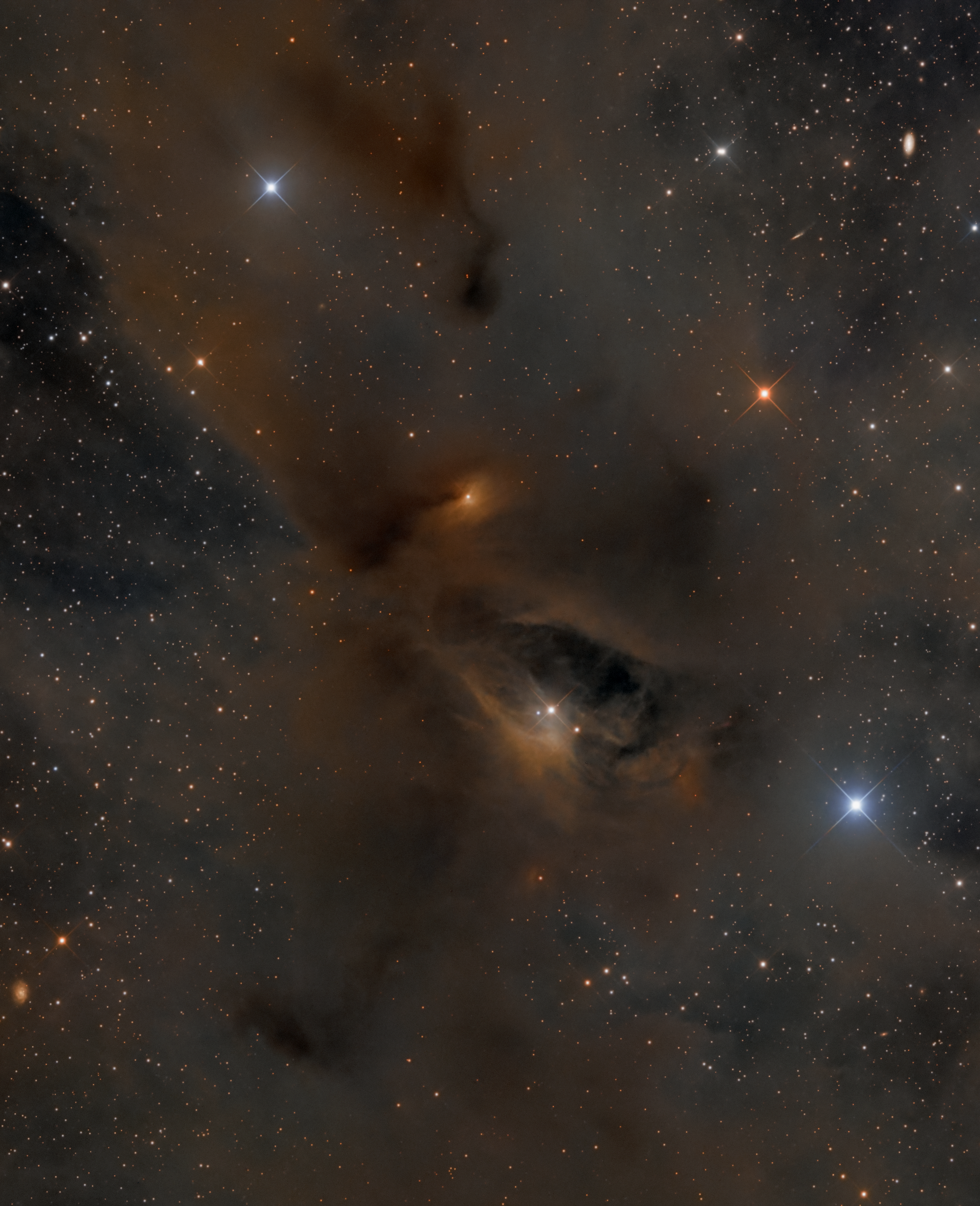
ASTRONOMY - Young Stars, Dark Nebulae

 2025 January 10

See Explanation.  Clicking on the picture will download
the highest resolution version available.

Young Stars, Dark Nebulae
Image Credit & Copyright: Long Xin

Explanation: An unassuming region in the constellation Taurus holds these dark and dusty nebulae. Scattered through the scene, stars in multiple star systems are forming within their natal Taurus molecular cloud complex some 450 light-years away. Millions of years young and still going through stellar adolescence, the stars are variable in brightness and in the late phases of their gravitational collapse. Known as T-Tauri class stars they tend to be faint and take on a yellowish hue in the image. One of the brightest T-Tauri stars in Taurus, V773 (aka HD283447) is near the center of the telescopic frame that spans over 1 degree. Toward the top is the dense, dark marking on the sky cataloged as Barnard 209.

09/01/2025

SANTé/MEDECINE - A la découverte de l'oreille - La structure de l'oreille


Ce schéma présente les trois parties de l'oreille :

l'oreille externe, avec son pavillon (ou auricule) et le conduit auditif externe qui mène à la membrane du tympan ;
l'oreille moyenne, avec ses osselets : marteau (malléus), enclume (incus) et étrier (stapès) ;
l'oreille interne (labyrinthe), avec les canaux semi-circulaires et la cochlée, qui communique avec le nerf auditif.

La trompe d'Eustache relie l'oreille à l'arrière du nez.

© Didier Descouens, CC by-sa 3.0

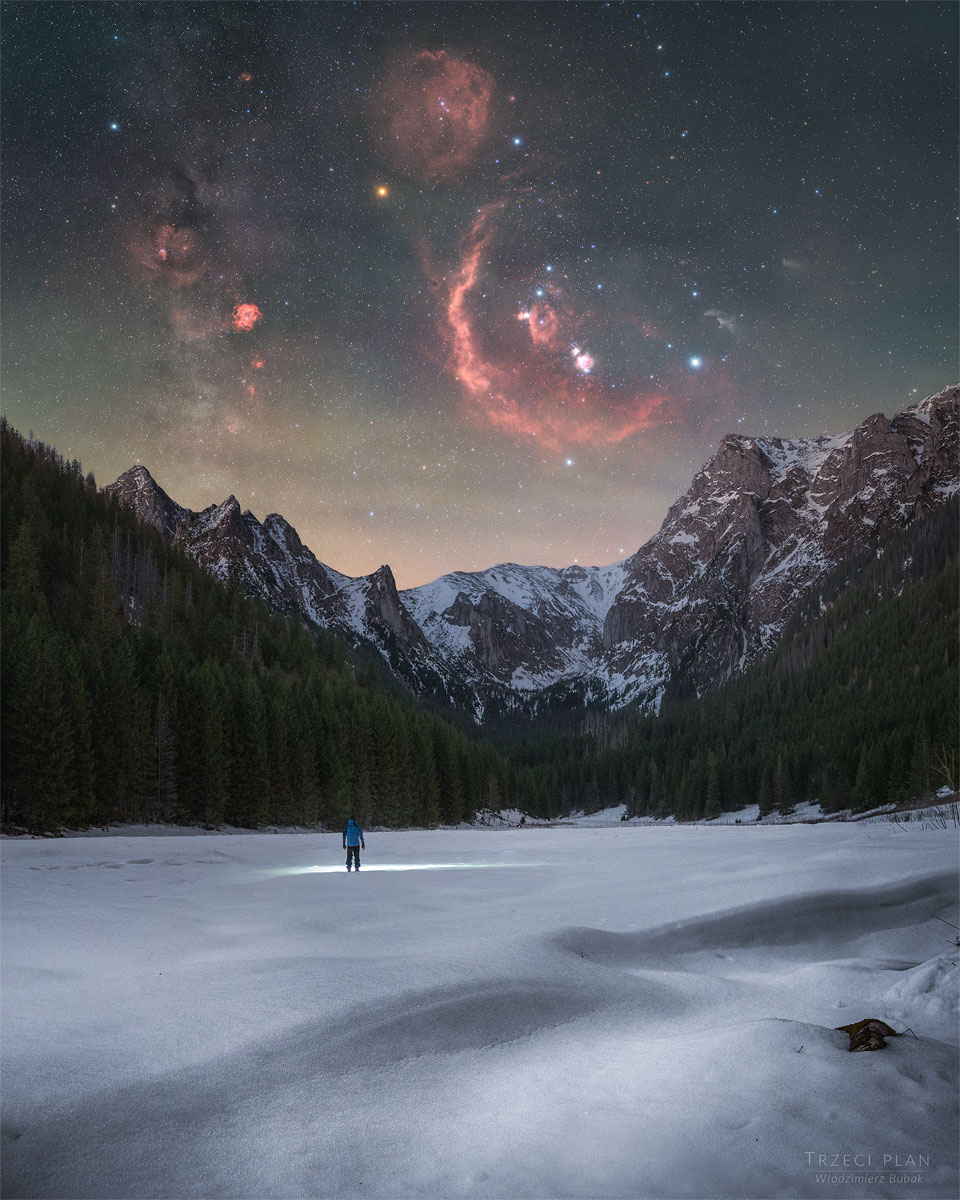
ASTRONOMY - Orion's Treasures over Snowy Mountains

 2026 January 27 Orion's Treasures over Snowy Mountains Image Credit & Copyright:  Włodzimierz Bubak ; Text:  Ogetay Kayali  ( MTU )...