Nombre total de pages vues

29/09/2025

ASTRONOMY - Two Camera Comets in One Sky

2025 September 29
A starfield is shown that has two short streaks 
running diagonally.  At closer inspection, they are 
two comets both with white-green heads and white
tails. 
Please see the explanation for more detailed information.

Two Camera Comets in One Sky
Image Credit & Copyright: Luc Perrot (TWAN)

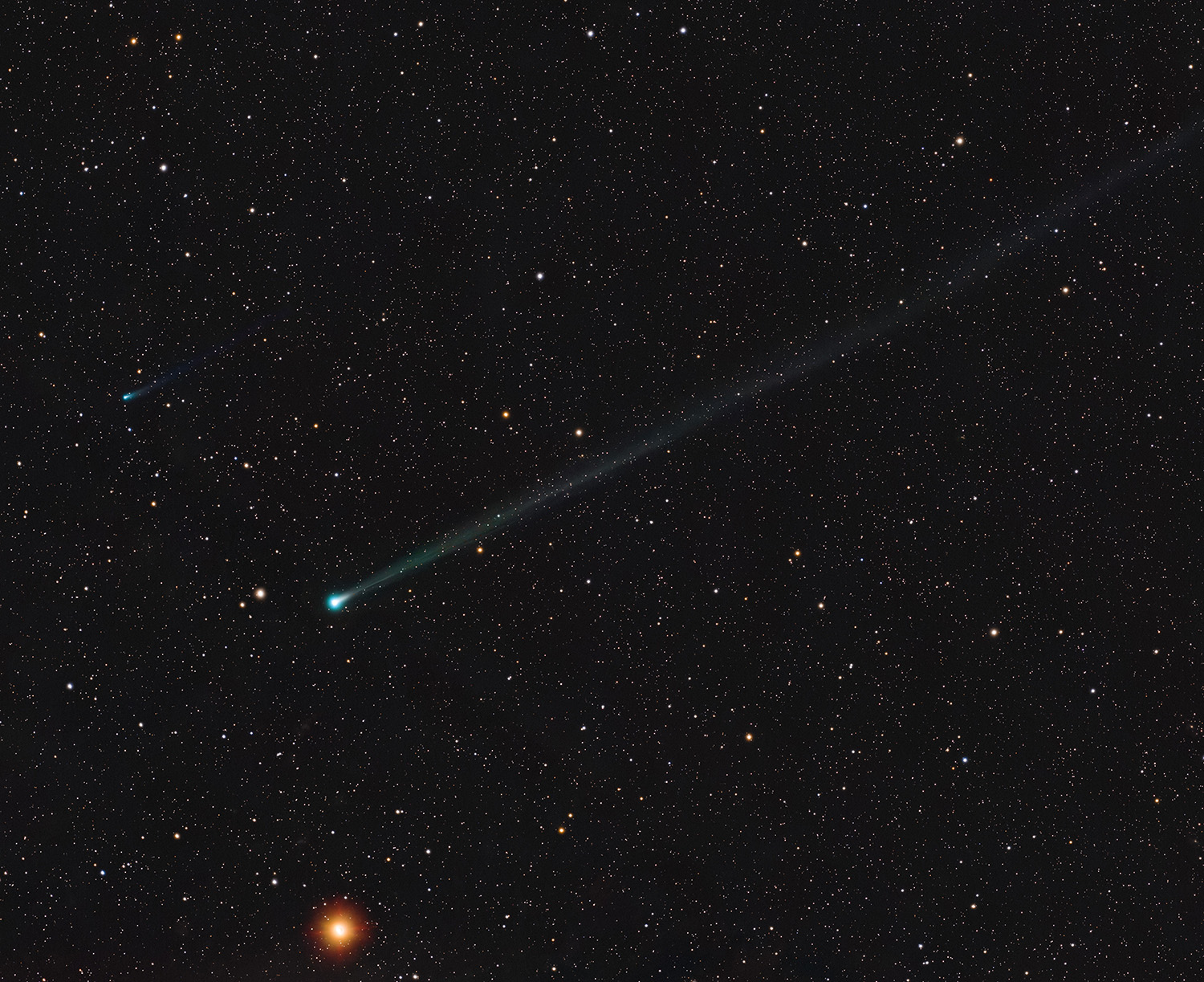
Explanation: It may look like these comets are racing, but they are not. Comets C/2025 K1 ATLAS (left) and C/2025 R2 SWAN (right) appeared near each other by chance last week in the featured image taken from France's Reunion Island in the southern Indian Ocean. Fainter Comet ATLAS is approaching our Sun and will reach its closest approach in early October when it is also expected to be its brightest -- although still only likely visible with long exposures on a camera. The brighter comet, nicknamed SWAN25B, is now headed away from our Sun, although its closest approach to Earth is expected in mid-October, when optimistic estimates have it becoming bright enough to see with the unaided eye. Each comet has a greenish coma of expelled gas and an ion tail pointing away from the Sun. 

28/09/2025

ASTRONOMY - Nebulas and Clusters in Sagittarius

 2025 September 17

A starfield surrounds a several large nebulas
that appear mostly red but also white and blue.
Dark dust and blue filaments also populate the frame. 
Please see the explanation for more detailed information.

Nebulas and Clusters in Sagittarius
Image Credit & Copyright: J. De WinterC. HumbertC. Robert & V. Sabet; Text: Ogetay Kayali (MTU)

Explanation: Can you spot famous celestial objects in this image? 18th-century astronomer Charles Messier cataloged only two of them: the bright Lagoon Nebula (M8) at the bottom, and the colorful Trifid Nebula (M20) at the upper right. The one on the left that resembles a cat's paw is NGC 6559, and it is much fainter than the other two. Even harder to spot are the thin blue filaments on the left, from supernova remnant (SNR G007.5-01.7). Their glow comes from small amounts of glowing oxygen atoms that are so faint that it took over 17 hours of exposure with just one blue color to bring up. Framing this scene of stellar birth and death are two star clusters: the open cluster M21 just above Trifid, and the globular cluster NGC 6544 at lower left.

MUSIQUE - Camille Saint-Saens - Danse macabre

"Danse macabre"

27/09/2025

ASTRONOMY - A Rocket in the Sun

2025 September 27
See Explanation.  Clicking on the picture will download
the highest resolution version available.

A Rocket in the Sun
Image Credit & Copyright: Pascal Fouquet

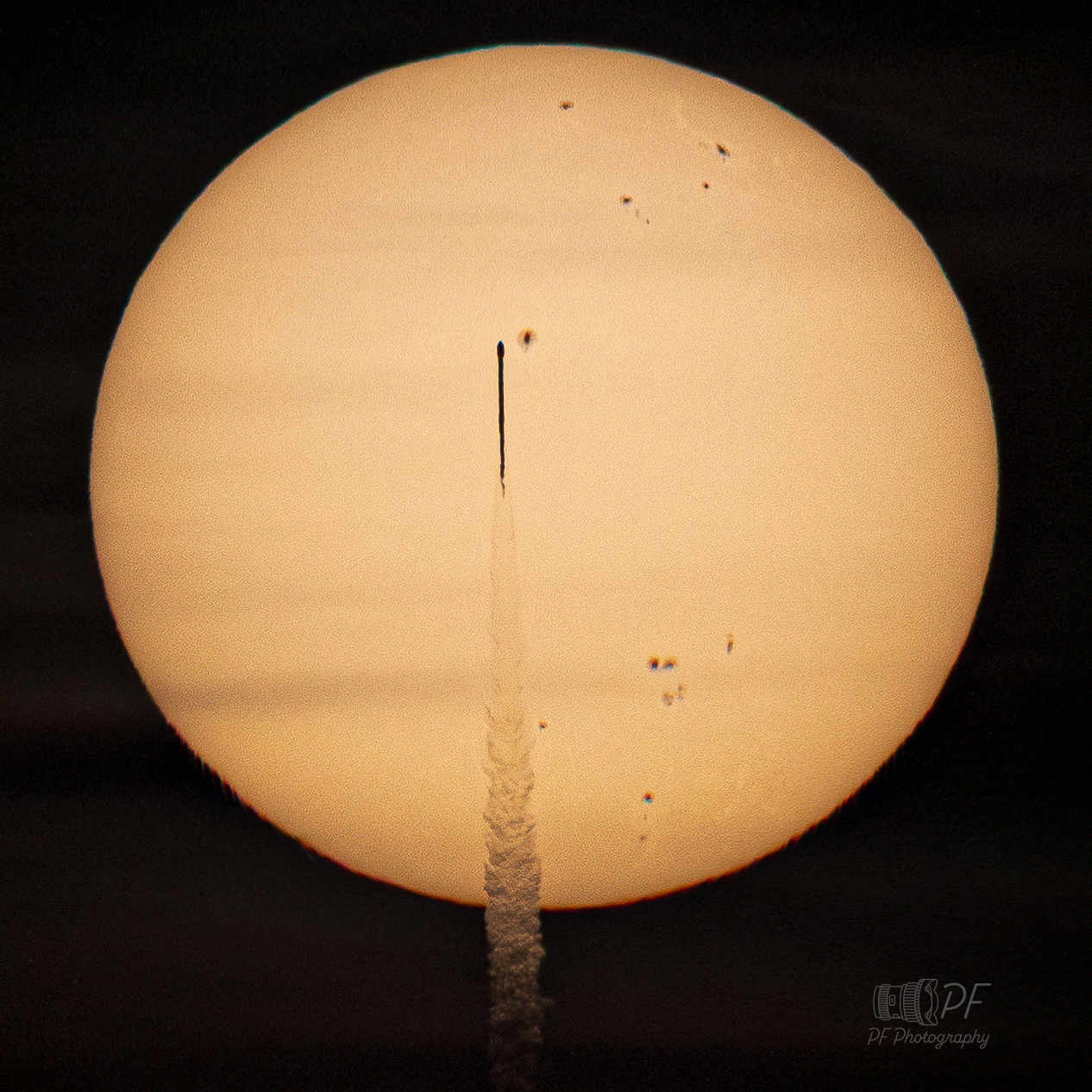
Explanation: On the morning of September 24 a rocket crosses the bright solar disk in this long range telescopic snapshot captured from Orlando, Florida. That's about 50 miles north of its Kennedy Space Center launch site. This rocket carried three new space weather missions to space. Signals have now been successfully acquired from all three - NASA's Interstellar Mapping and Acceleration Probe, NASA’s Carruthers Geocorona Observatory, and the National Oceanic and Atmospheric Administration (NOAA) Space Weather Follow-On Lagrange 1 (SWFO-L1) - as they begin their journey to L1, an Earth-Sun lagrange point. L1 is about 1.5 million kilometers in the sunward direction from planet Earth. Appropriately, major space weather influencers, aka dark sunspots in active regions across the Sun, are posing with the transiting rocket. In fact, large active region AR4225 is just right of the rocket's nose. 

26/09/2025

ASTRONOMY - A SWAN, an ATLAS, and Mars

 2025 September 26

See Explanation.  Clicking on the picture will download
the highest resolution version available.

A SWAN, an ATLAS, and Mars
Image Credit & Copyright: Adam Block

Explanation: A new visitor to the inner Solar System, comet C/2025 R2 (SWAN) sports a long ion tail extending diagonally across this almost 7 degree wide telescopic field of view recorded on September 21. A fainter fellow comet also making its inner Solar System debut, C/2025 K1 (ATLAS), can be spotted above and left of SWAN's greenish coma, just visible against the background sea of stars in the constellation Virgo. Both new comets were only discovered in 2025 and are joined in this celestial frame by ruddy planet Mars (bottom), a more familiar wanderer in planet Earth's night skies. The comets may appear to be in a race, nearly neck and neck in their voyage through the inner Solar System and around the Sun. But this comet SWAN has already reached its perihelion or closest approach to the Sun on September 12 and is now outbound along its orbit. This comet ATLAS is still inbound though, and will make its perihelion passage on October 8.

OCEANOGRAPHIE - Les vagues scélérates - Le jour où l'océan a riposté

Le jour de l'An 1995, une vague scélérate de 24 mètres (80 pieds) s'est abattue sur la plate-forme pétrolière Draupner en mer du Nord, tordant les garde-corps en acier et projetant du matériel lourd à travers le pont.

©Getty Images

25/09/2025

ASTRONOMY - Saturn Opposite the Sun

 2025 September 25

See Explanation.  Clicking on the picture will download
the highest resolution version available.

Saturn Opposite the Sun
Image Credit & Copyright: Jin Wang

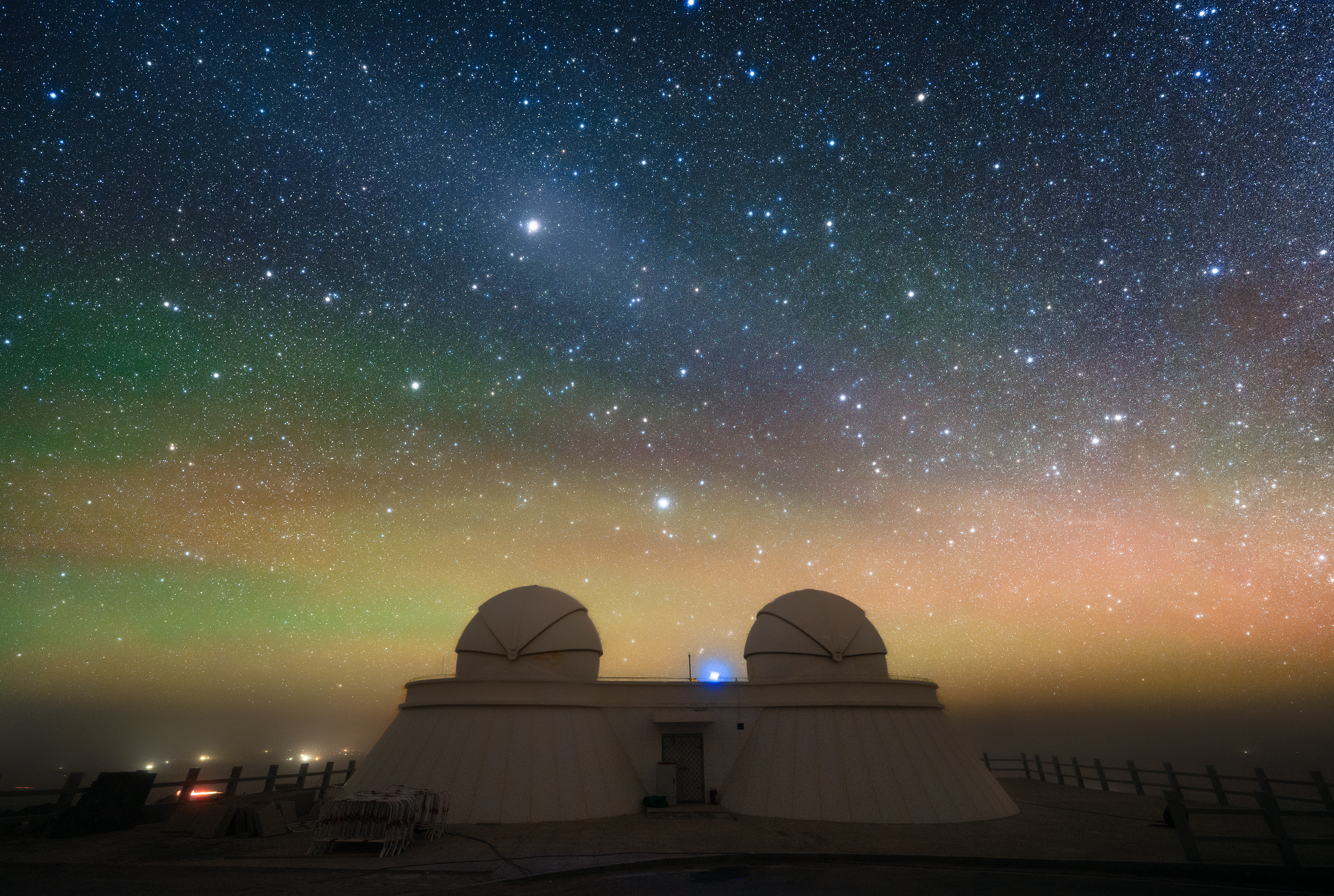
Explanation: This year Saturn was at opposition on September 21, opposite the Sun in planet Earth's sky. At its closest to Earth, Saturn was also at its brightest of the year, rising as the Sun set and shining above the horizon all night long among the fainter stars of the constellation Pisces. In this snapshot from the Qinghai Lenghu Observatory, Tibetan Plateau, southwestern China, the outer planet is immersed in a faint, diffuse oval of light known as the gegenschein or counter glow. The diffuse gegenschein is produced by sunlight backscattered by interplanetary dust along the Solar System's ecliptic plane, opposite the Sun in planet Earth's sky. Like a giant eye, on this dark night Saturn and gegenschein seem to stare down on the observatory's telescope domes from their antisolar perspective. Strong, atmospheric airglow forms a colorful background along the horizon.

24/09/2025

ASTRONOMY - GW250114: Rotating Black Holes Collide

 2025 September 24

Artwork depicts a colorful version of two black 
holes nearing collision from between the black holes.
Swirling gas is depicted with wavey lined depicting
gravitational waves ringing and an artificial grid
depicting spacetime shown distorting. 
Please see the explanation for more detailed information.

GW250114: Rotating Black Holes Collide
Illustration Credit: Aurore Simonnet (SSU/EdEon), LVK, URI; LIGO Collaboration

Explanation: It was the strongest gravitational wave signal yet measured -- what did it show? GW250114 was detected by both arms of the Laser Interferometer Gravitational-wave Observatory (LIGO) in Washington and Louisiana USA earlier this year. Analysis showed that the event was created when two black holes, each of mass around 33 times the mass of the Sun, coalesced into one larger black hole with a mass of around 63 solar masses. Even though the event happened about a billion light years away, the signal was so strong that the spin of all black holes, as well as initial ringing of the final black hole, was deduced with exceptional accuracy. Furthermore, it was confirmed better than before, as previously predicted, that the total event horizon area of the combined black hole was greater than those of the merging black holes. Featured, an artist's illustration depicts an imaginative and conceptual view from near one of the black holes before collision.

23/09/2025

OCEANOGRAPHIE - Les vagues scélérates - Hollywood versus la réalité (2/29)

Dans le film catastrophe "Poséidon" sorti en 2006, un paquebot de luxe est renversé par une énorme vague scélérate, obligeant les passagers à lutter pour leur survie. Si Hollywood exagère le côté dramatique, ces vagues géantes représentent un danger bien réel en pleine mer.

©NL Beeld

ASTRONOMY - NGC 6357: Cathedral to Massive Stars

2025 September 23
Stars dot the frame that has a blue background.
Covering the lower part of the image, and the far
right, are brown and tan nebular structures.  
Please see the explanation for more detailed information.

NGC 6357: Cathedral to Massive Stars
Image Credit: NASAESACSASTScIJWST; Processing: Alyssa Pagan (STScI);
Rollover: NASAESAHST, & J. M. Apellániz (IAA, Spain); Acknowledgement: D. De Martin (ESA/Hubble)

Explanation: How massive can a normal star be? Estimates made from distance, brightness and standard solar models had given one star in the open cluster Pismis 24 over 200 times the mass of our Sun, making it one of the most massive stars known. This star is the brightest object located in the central cavity near the bottom center of the featured image taken with the Webb Space Telescope in infrared light. For comparison, a rollover image from the Hubble Space Telescope is also featured in visible light. Close inspection of the images, however, has shown that Pismis 24-1 derives its brilliant luminosity not from a single star but from three at least. Component stars would still remain near 100 solar masses, making them among the more massive stars currently on record. Toward the bottom of the image, stars are still forming in the associated emission nebula NGC 6357. Appearing perhaps like a Gothic cathedral, energetic stars near the center appear to be breaking out and illuminating a spectacular cocoon