"Salut l'amour"
30/04/2026

Astronomy - A DOUBLE HELIX LUNAR ECLIPSE
2025 November 3

Image Credit & Copyright: Chunlin Liu
Explanation: The image was timed to capture a total lunar eclipse -- but it came with quite a twist. First, the eclipse: the fully Earth-shadowed Moon is visible as the orange orb near the top. The eclipsed Moon's orange color is caused by a slight amount of red light scattered first by Earth's atmosphere, adding a color like a setting Sun. Now, the twist: one of the apparent double helix bands is the Milky Way, the central disk of our home galaxy. The second band is zodiacal light, sunlight scattered by dust in our Solar System. The reason they cross is because the plane where dust orbits our Sun is tilted relative to the plane where stars orbit our Galaxy. This well-known tilt is shown dramatically in the featured wide-angle Mercator-projected picture, spanning from horizon to horizon, captured in early September from Mingantu Observing Station in Inner Mongolia, China.
29/04/2026
Santé/Médecine - LES SYMPTOMES DE LA FIBROMYALGIE: 5. PERTURBATION DU SOMMEIL (7/12)

Cette maladie affecte aussi le sommeil, ce qui aggrave davantage les symptômes de fatigue. Même après une longue nuit de sommeil, on se réveille fatigué. Ceux qui en souffrent décrivent un sommeil trop léger et non réparateur.
CommentEconomiser
Astronomy- THE MOON VENUS AND THE PLEIADES
2026 April 29
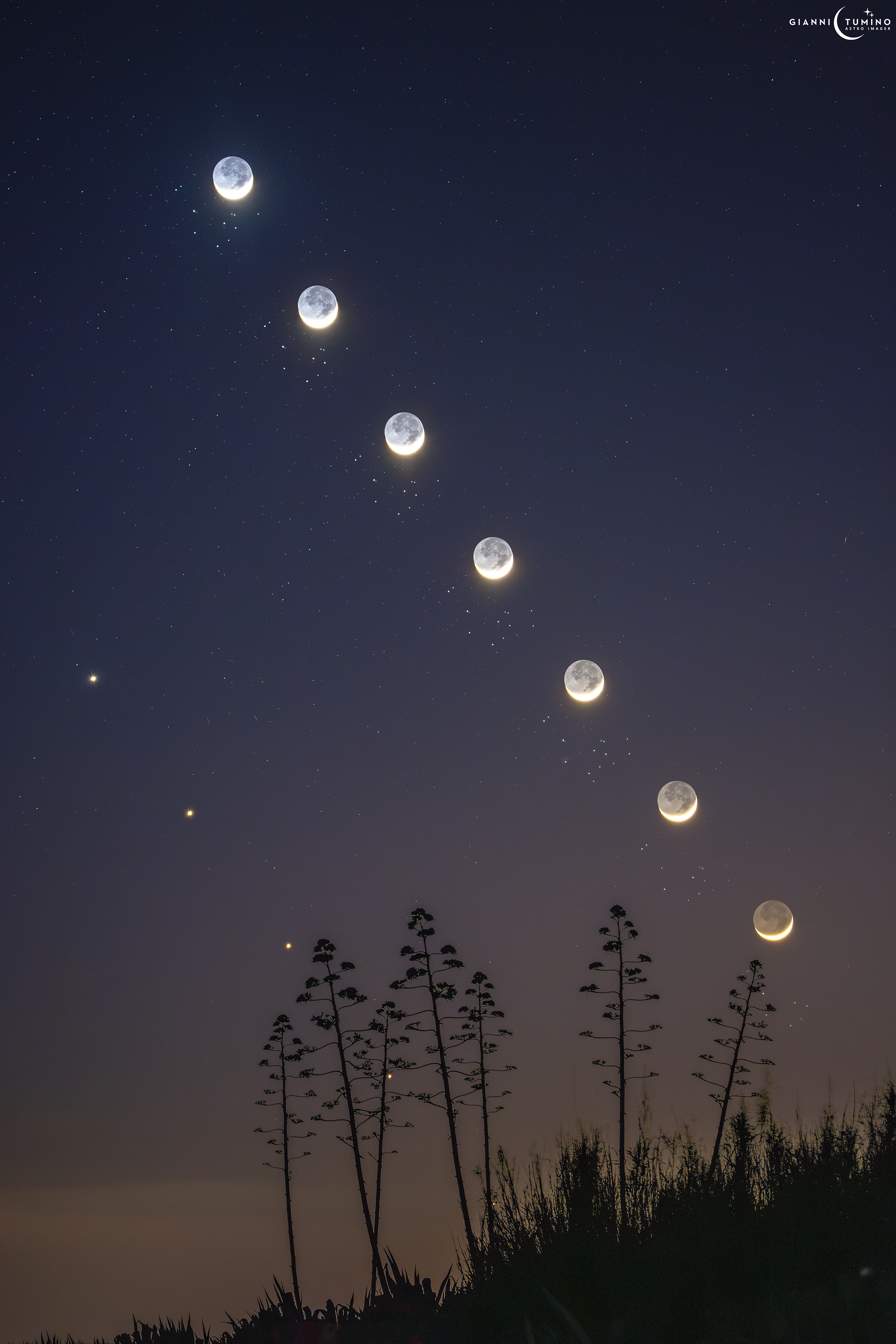
Image Credit & Copyright: Gianni Tumino
Text: Keighley Rockcliffe (NASA GSFC, UMBC CSST, CRESST II)
Explanation: No, Earth did not recently acquire six more moons! Today’s APOD is a combination of images following the Moon, Venus, and the Pleiades across a southern Sicilian sky as twilight turned to evening on April 19. From 2023 to 2029, the Pleiades' and the Moon “visit" each other once per month due to the Pleiades' location in the ecliptic plane. April 2026 saw the celestial alignment of their visit with Venus. About six stars in the Pleiades cluster (Messier 45) are typically visible with the unaided eye. Due to the cluster’s visibility across the world, there are many myths and legends across cultures associated with the Pleiades. The Haudenosaunee people of North America, for example, say that seven boys danced so enthusiastically that they lifted off into the sky. Astronomers recently found thousands more Pleiades members, showing that after thousands of years of gazing upon this cluster, there is yet more to learn about the Pleiades.
28/04/2026
Astronomy - CG 30: COMETARY GLOBULES
2026 April 28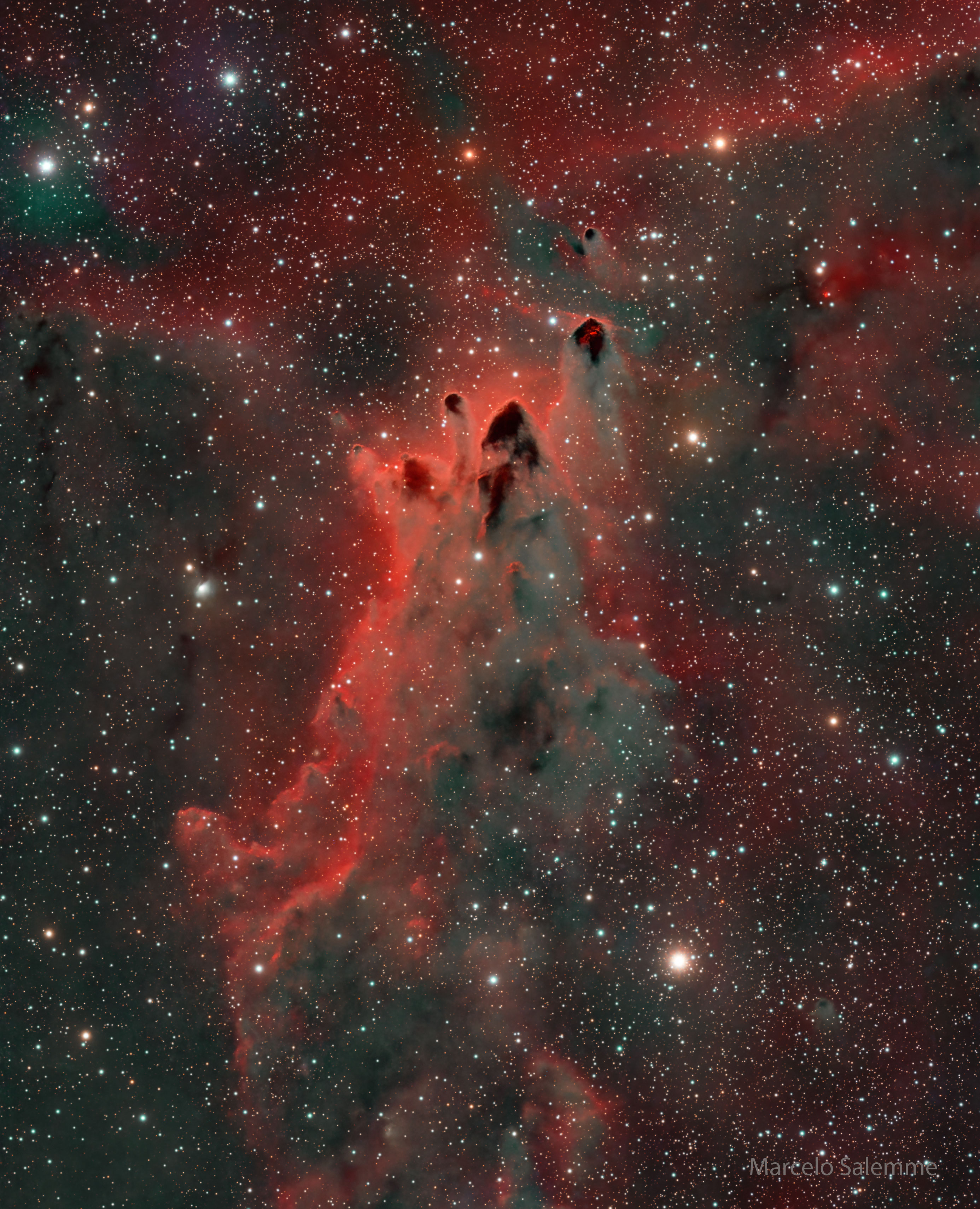
Image Credit & Copyright: Marcelo Salemme
Explanation: They're like mountain peaks, but they are forming stars. Bright-rimmed, flowing shapes gather near the center of this rich starfield toward the borders of the nautical southern constellations Puppis and Vela. Composed of interstellar gas and dust, the grouping of light-year sized cometary globules is about 1300 light-years distant. Energetic ultraviolet light from nearby hot stars has molded the globules and ionized their bright rims. The globules also stream away from the Vela supernova remnant which may have influenced their swept-back shapes. Within them, cores of cold gas and dust are likely collapsing to form low mass stars whose formation will ultimately cause the globules to disperse. In fact, cometary globule CG 30 (upper right in the group) sports a small reddish glow inside its head, a telltale sign of energetic jets from a star in the early stages of formation.
Santé/Médecine - LES SYMPTOMES DE LA FIBROMYALGIE: 4. UNE FATIGUE PERSISTANTE (6/12)

Très fréquemment, la fibromyalgie cause une fatigue persistante, et ce, dès le réveil. L’intensité varie d’une personne à l’autre. Elle oscille entre fatigue légère et sensation d’épuisement, comme celle que l’on ressent avec la grippe. La fatigue peut être ressentie au moindre effort et vider la personne de son énergie. Lorsque c’est le cas, c’est l’épuisement total : À ce moment là, la personne se sent incapable de faire quoi que ce soit.
CommentEconomiser
27/04/2026
Astronomy - CG 4: THE GLOBULE AND THE GALAXY
2026 March 11
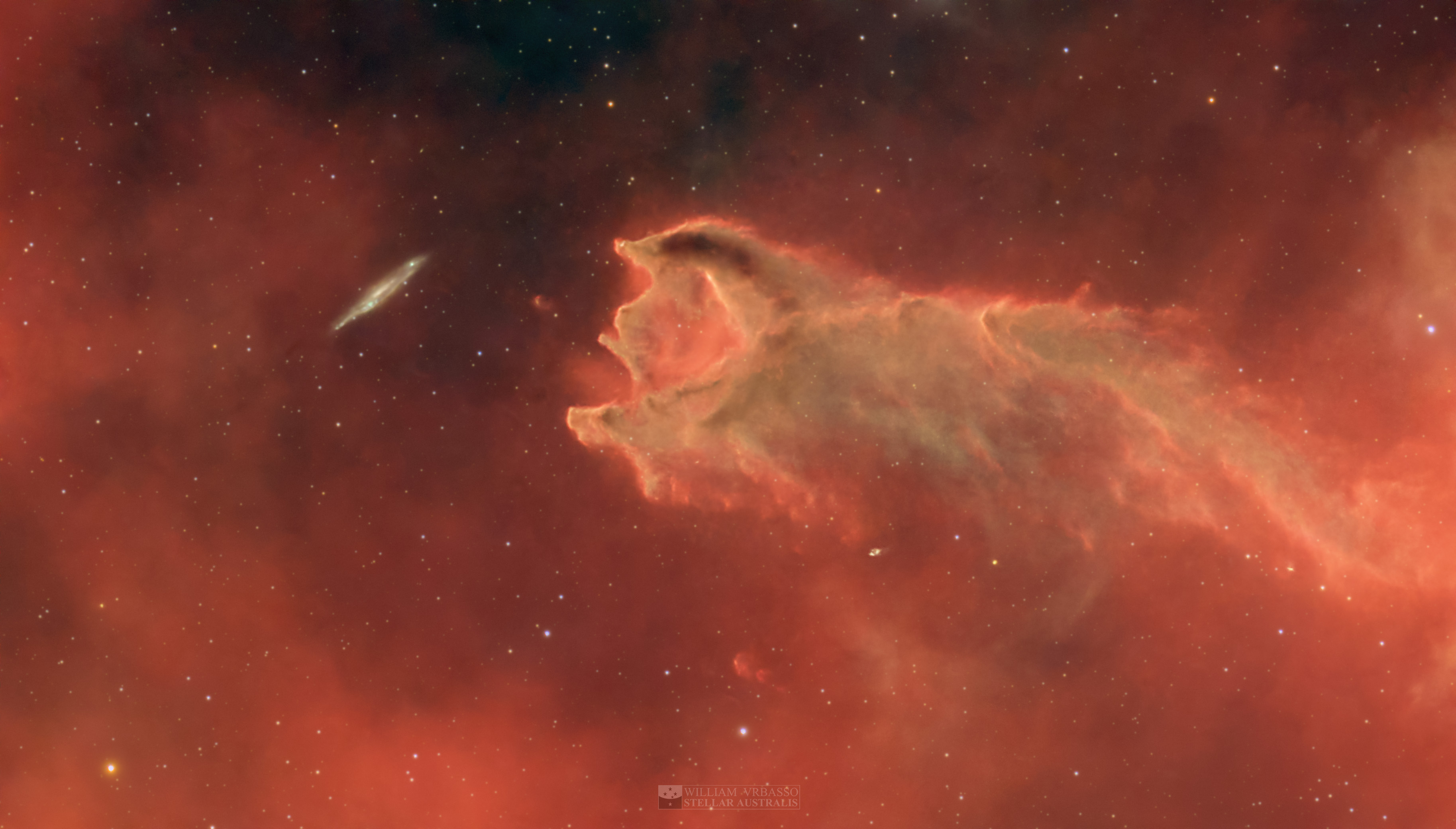
Image Credit & Copyright: William Vrbasso
Text: Cecilia Chirenti (NASA GSFC, UMCP, CRESST II)
Explanation: Is this a cosmic monster ready to devour an unsuspecting galaxy? Thankfully, that is not the case. The red “monster” shown in the featured image is Cometary Globule CG 4, 1,300 light-years away in the Constellation Puppis. CG 4 is a molecular cloud, where hydrogen becomes cold enough to form molecules that can be brought together by gravity to create stars. The shape of CG 4 resembles that of a comet, but its head is 1.5 light-year in diameter and its tail is 8 light-years long; for comparison, the distance from the Earth to the sun is only 8 light-minutes. Astronomers believe that the tail of a cometary globule could have been shaped by a nearby supernova explosion or by irradiation from hot, massive stars. Indeed, CG 4 and other nearby globules point away from the Vela Supernova Remnant, at the center of the Gum Nebula. The edge-on spiral galaxy, ESO 257-19, is more than a hundred million light-years beyond CG 4, and is completely safe from the “monster”.
26/04/2026
Astronomy - MYSTIC MOUNTAIN MONSTER BEING DESTROYED
2026 April 26
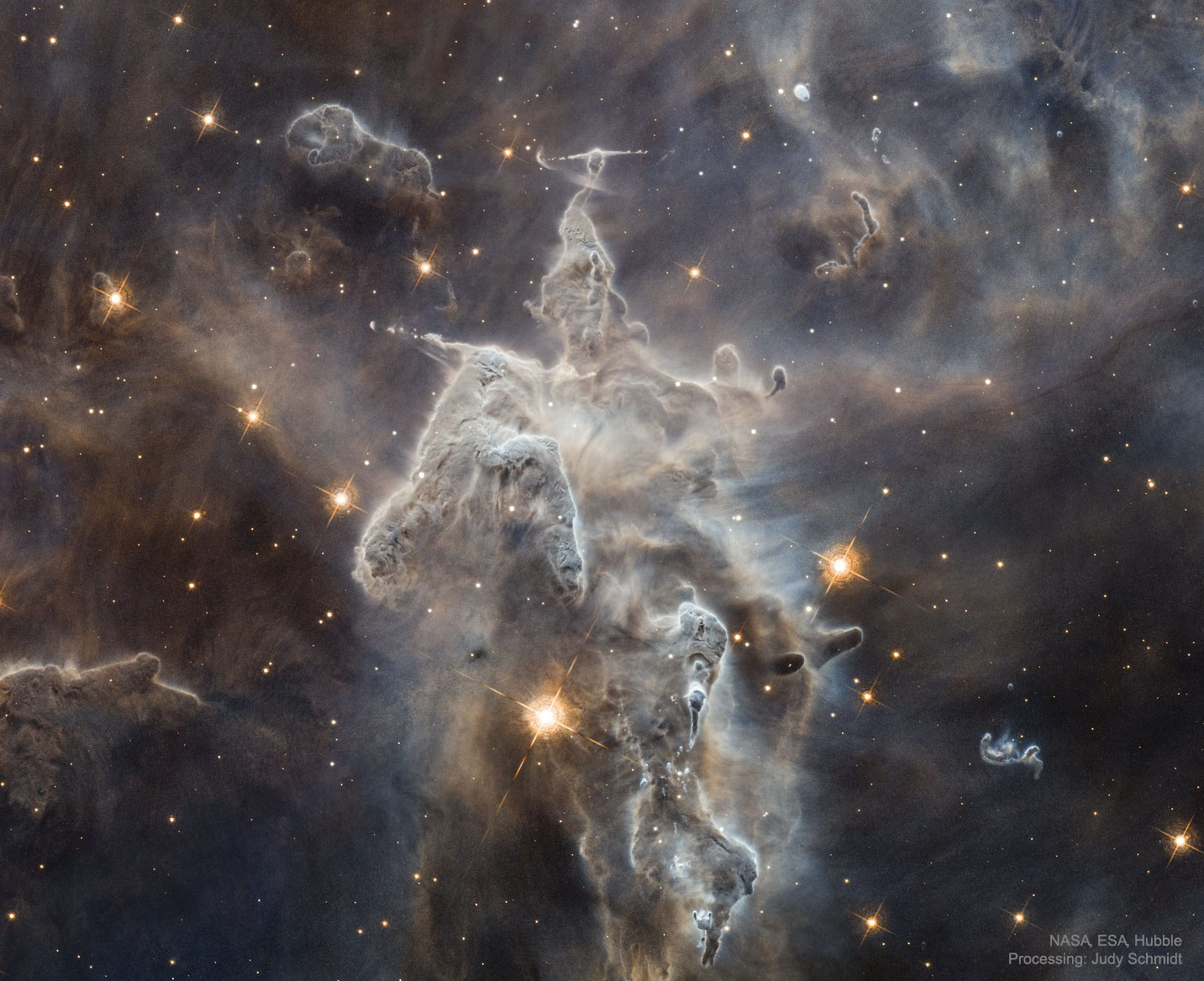
Image Credit: Hubble, NASA, ESA; Processing & License: Judy Schmidt
Explanation: Inside the head of this interstellar monster is a star that is slowly destroying it. The huge monster, actually an inanimate series of pillars of gas and dust, measures light years in length. The in-head star is not itself visible through the opaque interstellar dust but is bursting out partly by ejecting opposing beams of energetic particles called Herbig-Haro jets. Located about 7,500 light years away in the Carina Nebula and known informally as Mystic Mountain, the appearance of these pillars is dominated by dark dust even though they are composed mostly of clear hydrogen gas. The featured image was taken with the Hubble Space Telescope. All over these pillars, the energetic light and winds from massive newly formed stars are evaporating and dispersing the dusty stellar nurseries in which they formed. Within a few million years, the head of this giant, as well as most of its body, will have been completely evaporated by internal and surrounding stars.
25/04/2026
Santé/Médecine - LES SYMPTOMES DE LA FIBROMYALGIE: 3. - DES RAIDEURS MATINALES (5/12)

Beaucoup de personnes atteintes de fibromyalgies souffrent de raideurs. Généralement, elles sont plus intenses le matin, au réveil. Mais on peut aussi les ressentir en journée, si l’on reste trop longtemps dans la même position.
Au toucher, les muscles deviennent plus durs et plus sensibles. Souvent, les raideurs provoquent aussi des spasmes. C'est quoi des spasmes ? Ce sont des contractions musculaires douloureuses.
CommentEconomiser
Astronomy - THE PERSISTENCE OF SUNLIGHT
2026 April 25
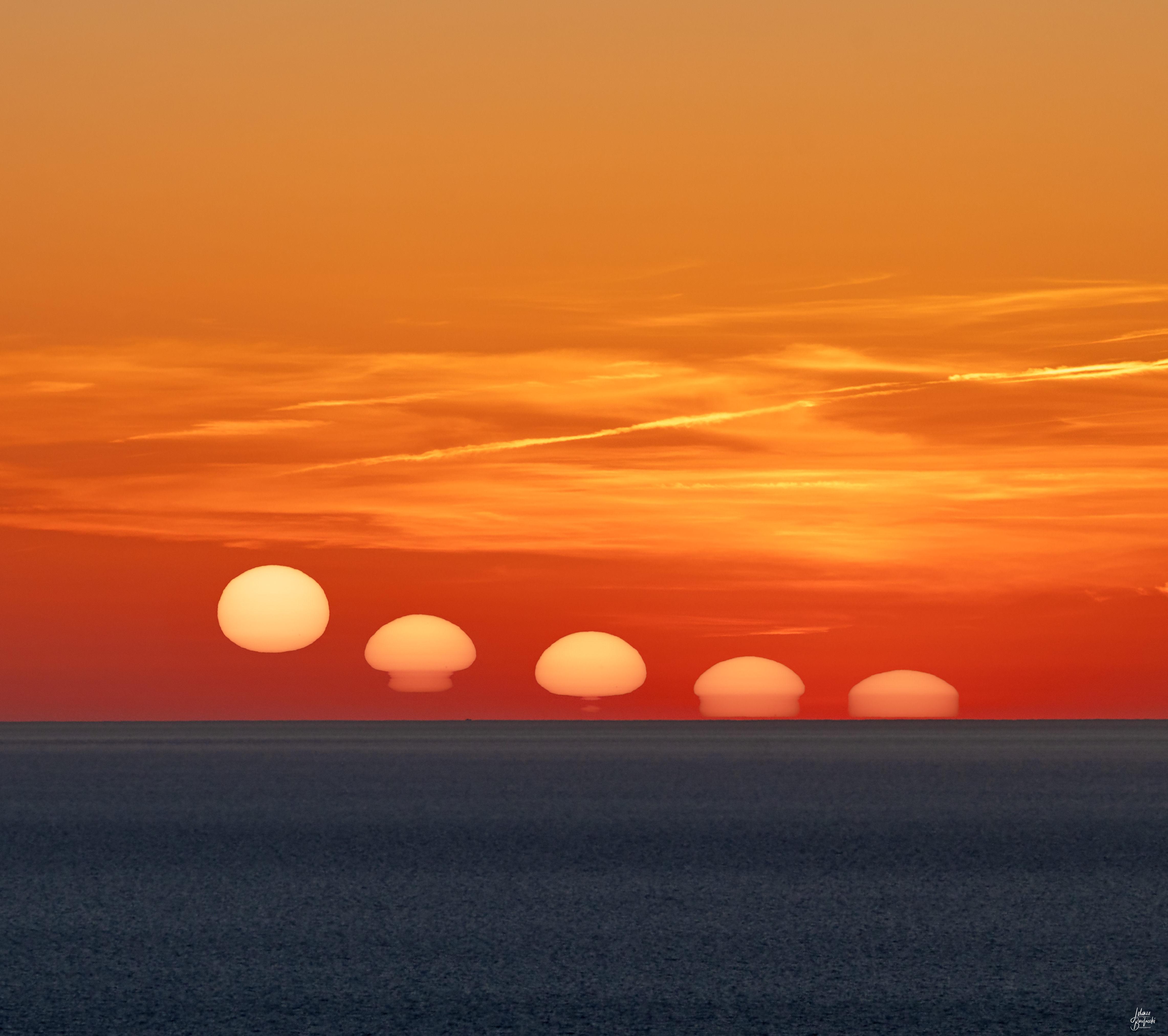
Image Credit & Copyright: Lorenzo Busilacchi
Explanation: This seaside sunset offered a surreal experience, captured in a sea and skyscape from the west coast of Sardinia, Italy, planet Earth. The Daliesque scene is a composition of sequential exposures made with a camera and long telephoto lens. The Sun is not melting, though. Its shifting and fluid appearance as it nears the horizon is caused as refraction along the line of sight changes and creates distorted images or mirages of the reddened solar disk. The changes in atmospheric refraction correspond to atmospheric layers with sharply different temperatures and densities. Another famous but fleeting effect of atmospheric refraction produced by a long sight-line to the setting (or rising) Sun is often called the green flash.
24/04/2026
Astronomy - YOUNG MOON AND SISTER STARS
2026 April 24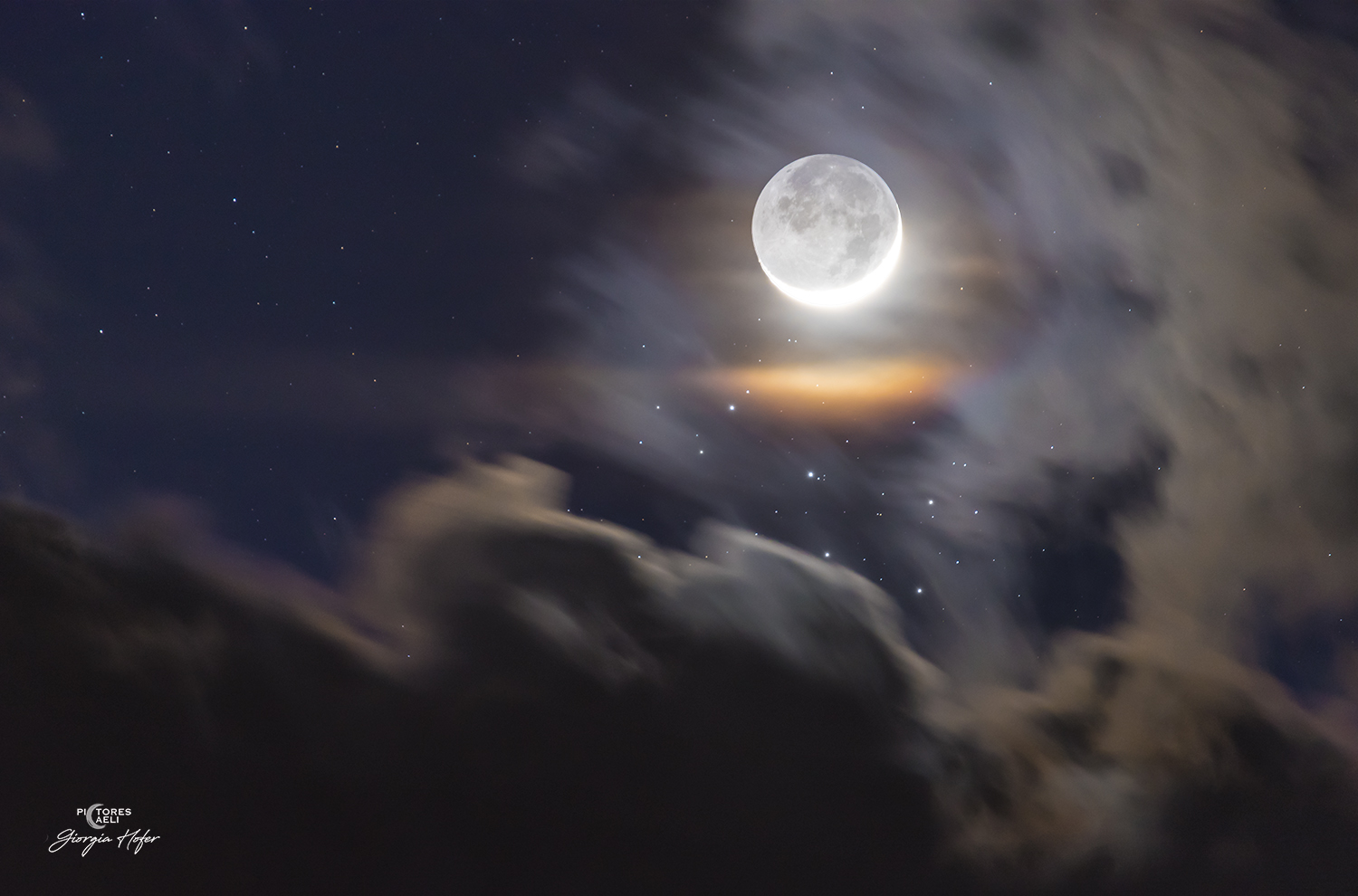
Image Credit & Copyright: Giorgia Hofer
Explanation: Sunlit arms of a crescent moon seem to embrace the faint lunar night side in this dramatic celestial scene from planet Earth. The single telephoto exposure tracking the sky was captured on the night of April 19, when a two day old Moon was near perigee in its elliptical orbit. On that date, the young Moon was also close on the sky to the lovely Pleiades Star Cluster. With the moonlight dimmed by clouds the Pleiades sister stars gather below the Moon's bright crescent, seen through a faint but colorful lunar corona. The lunar night side is illuminated by earthshine, sunlight reflected from the Earth itself. The Moon's ashen glow, also known as the "old moon in the young moon's arms", tends to be brighter in the northern hemisphere spring. And for now, the Moon's orbit takes it near the Pleiades stars each month in planet Earth's sky, though their close conjunctions are easiest to see when the Moon is near a crescent phase.
23/04/2026
Santé/Médecine - LES SYMPTOMES DE LA FIBROMYALGIE: 2. UNE GRANDE SENSIBILITE A LA DOULEUR - (4/12)

La fibromyalgie peut aussi augmenter la sensibilité à la douleur. Dans les cas les plus sévères, un simple toucher ou même un effleurement provoque des douleurs sur tout le corps. Les médecins définissent ce symptôme par les termes suivants :
- l’hyperalgésie pour décrire une sensibilité excessive à la douleur.
- l’allodynie, pour décrire une douleur déclenchée par quelque chose qui normalement ne fait pas mal. Un effleurement de la peau, par exemple.
Et ce n’est pas tout. En plus du toucher, on peut aussi avoir une plus grande sensibilité :
- aux odeurs,
- aux bruits,
- à certains aliments,
- à la lumière et
- aux changements de température.
Souvent, s’exposer aux choses auxquelles on a une grande sensibilité peut aggraver les autres symptômes de la fibromyalgie.
CommentEconomiser
Astronomy - LARGE SCALE STRUCTURE OF THE UNIVERSE
2026 April 23
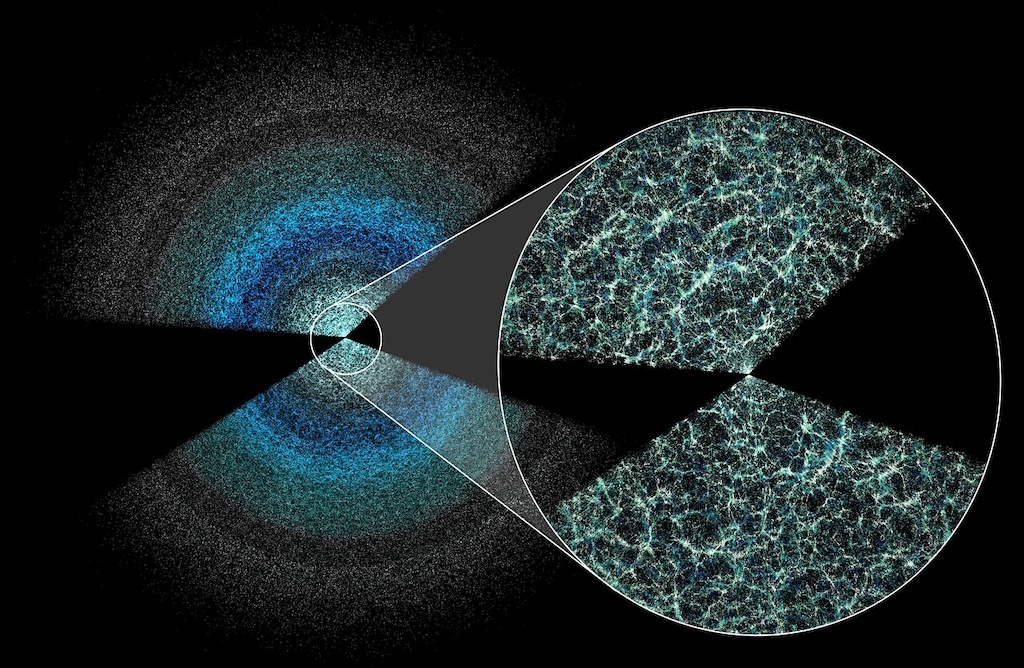
Image Credit: Claire Lamman/DESI collaboration
Text: Cecilia Chirenti (NASA GSFC, UMCP, CRESST II)
Explanation: This is a map of the universe. The Dark Energy Spectroscopic Instrument (DESI) at Kitt Peak National Observatory, Arizona, has finished its five-year survey. It observed more than 47 million galaxies and quasars and created a 3D map centered on the Earth. Today's featured image shows a thin slice of these data: the black gaps indicate where our Galaxy obscures distant objects. The feathery web in the inset shows the large scale structure of the universe. Light of the most distant galaxies shown here travelled for 11 billion years to reach the Earth. Galaxies cluster throughout cosmic history under the competing influences of gravity and dark energy, responsible for the accelerated expansion of the universe. Analysis of early DESI results hinted at the possibility that dark energy, described as a cosmological constant by Albert Einstein, may not be constant after all. But we still have to wait for the analysis of the now complete dataset. The nature of dark energy is the biggest mystery of cosmology.
22/04/2026
Astronomy - EARTHSET WITH AN IPHONE
2026 April 22
Video Credit: NASA, Reid Wiseman
Text: Keighley Rockcliffe (NASA GSFC, UMBC CSST, CRESST II)
Explanation: What does it mean for the Earth to set? Artemis II Commander Reid Wiseman gave us another spectacular view of Earth from their historic flyby of the Moon. Commander Wiseman's video, taken with an iPhone at 8x zoom, shows our entire planet gradually blocked from view by the Moon. On the Earth, the 24-hour planetary rotation causes the Sun to set below your horizon every night. However, on Artemis II the Earthset was caused not by the Moon’s rotation but by the spacecraft moving behind the Moon (at about 55 seconds in this video). Once rare, views of Earth are now taken many times a day from many spacecraft, including NASA’s SWOT (Surface Water and Ocean Topography) satellite tracking freshwater resources and USGS Landsat 8 and 9 satellites supporting water management for farmers, for example. Space agencies around our home planet now work together to provide unique and ever-improving views of our Earth.
21/04/2026
Santé/Médecine - LES SYMPTOMES DE LA FIBROMYALGIE: 1. DES DOULEURS MUSCULAIRES - (3/12)

1. Des douleurs musculaires
Ce sont les douleurs musculaires qui caractérisent cette maladie. Plus spécifiquement, ces douleurs sont diffuses, c’est-à-dire qu’elles peuvent s’étendre à tout le corps. Souvent, elles sont plus intenses dans les zones autour de la colonne vertébrale :
- la nuque,
- les épaules,
- la région entre les 2 épaules,
- les omoplates,
- le bas du dos,
- les hanches.
Autre caractéristique des douleurs de la fibromyalgie : Elles sont constantes. Avec des périodes où elles s’aggravent, et d’autres où elles s’améliorent. Elles peuvent aussi varier en intensité ou être très localisées.
CommentEconomiser
Astronomy - THREE SKY ARCHES OVER SNOWY ALPS
2026 April 21
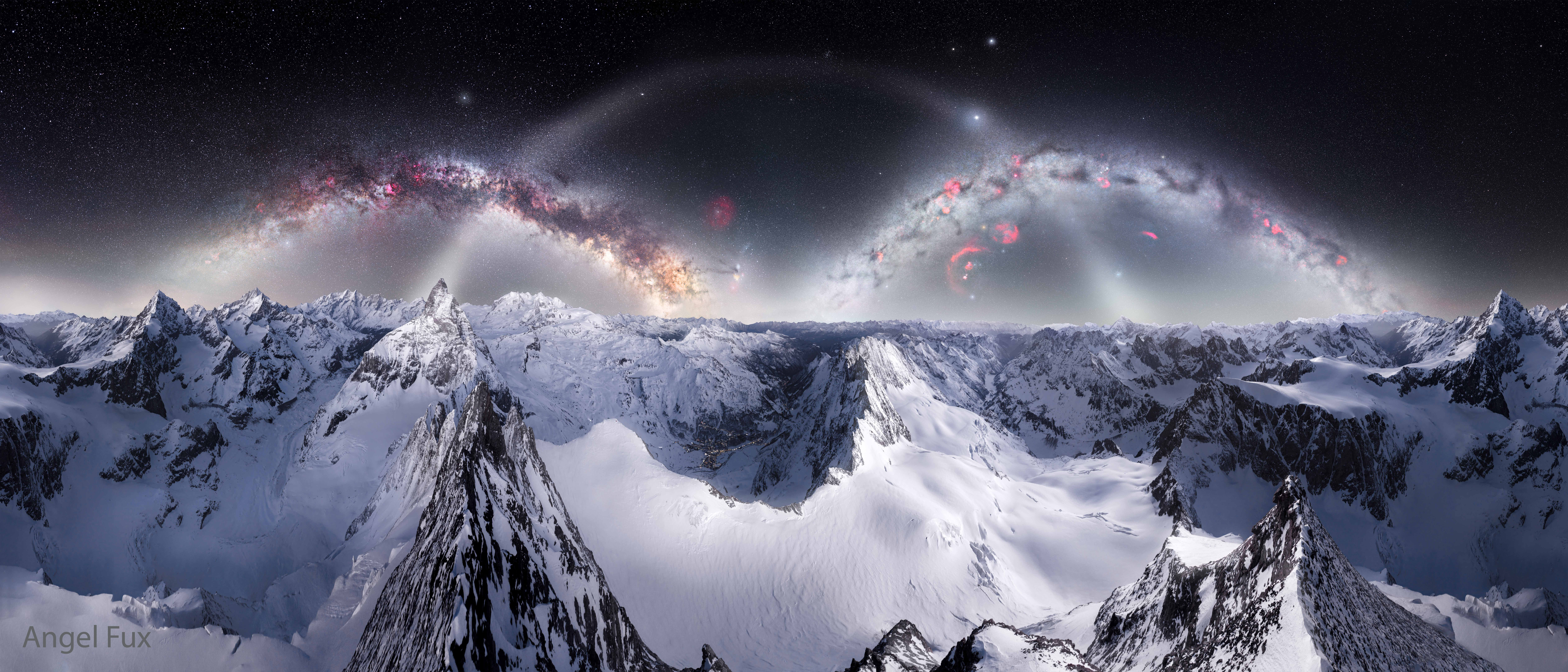
Image Credit & Copyright: Angel Fux
Explanation: Why are there three arches across the sky instead of two? Last month, after being dropped off by a helicopter at a high mountain peak in the Alps near the Swiss Italian border, an adventurous astrophotographer expected two arches of our Milky Way galaxy to be visible during the night. These were the inner arch looking in toward the center of our galaxy on the left, visible just before sunrise, and the outer arch on the right visible just after sunset. But there were three arches. The surprised astrophotographer soon realized that the sky was so dark that an entire arc of faint zodiacal light was also noticeable -- sunlight scattered by inner Solar System dust. And it artfully connected the two Milky Way arches! The next morning a helicopter picked the astrophotographer back up, and after 40 hours of processing and combining that night's images, the featured triple-arch 360-degree panorama resulted.
20/04/2026
Santé/Medecine - LA FIBROMYALGIE (2/12)

Voici les symptômes de la fibromyalgie chez l'homme et la femme :
Certaines choses du quotidien peuvent aggraver les symptômes de cette maladie. Voici les 4 principales à connaître :
- les niveaux de stress,
- le froid,
- l’humidité et
- l’effort physique.
Et inversement, ceux qui les calment, mais seulement de manière temporaire, sont :
- la chaleur (par exemple, une douche ou un bain chauds) et
- le sommeil.
Voyons maintenant ensemble quels sont les symptômes que vous devez identifier pour savoir si vous souffrez de fibromyalgie...
CommentEconomiser
Astronomy - COMET R3 PauSTARRS OVER A HIMALAYAN VALLEY
2026 April 20
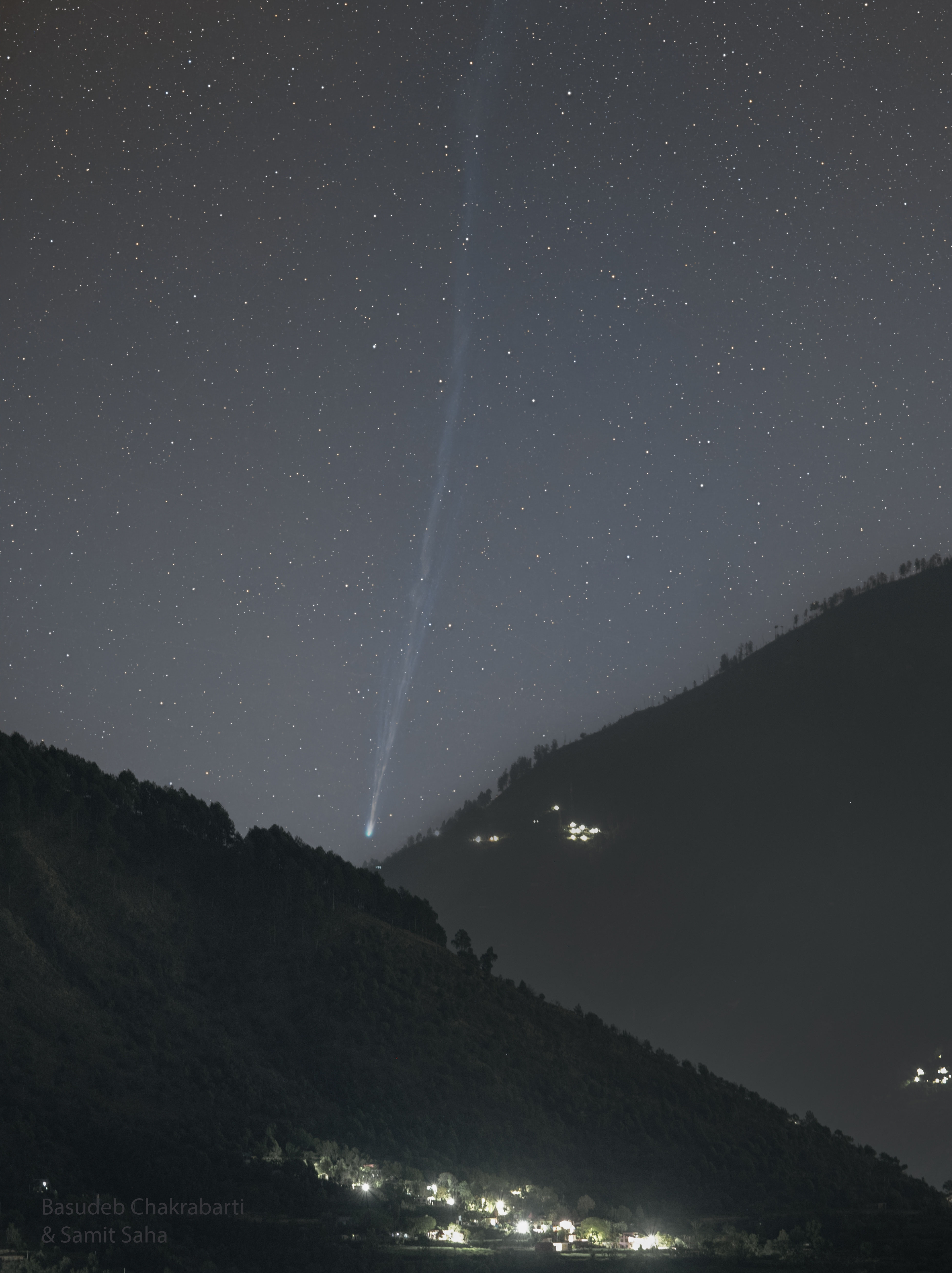
Image Credit & Copyright: Basudeb Chakrabarti & Samit Saha
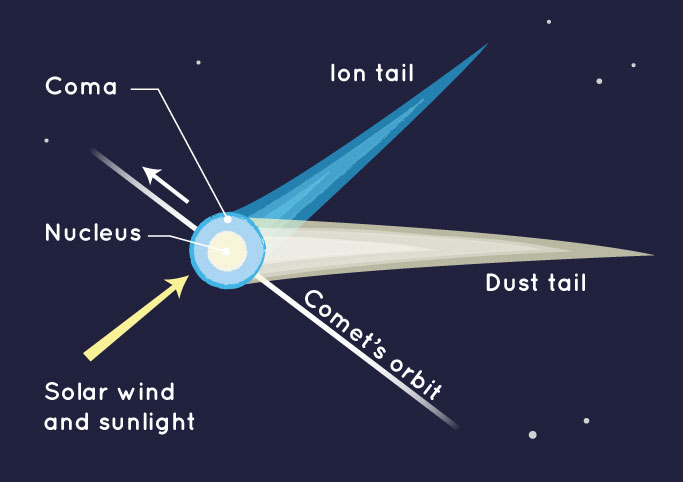
Explanation: The best way to see comet R3 PanSTARRS’s long tail is with a camera. This week, the recently brightened comet appears in northern skies to the east just before dawn, but is only barely visible to the unaided eye. The many-degree ion tail captured on long duration camera exposures is not unusual for a comet - it is primarily due to the Earth's nearly sideways view of the tail as it points away from the Sun. In the featured image taken last week, Comet C/2025 R3 (PanSTARRS) showed off its flowing tail through a valley between two peaks in the Himalayan mountains of India. The comet passed its closest to the Sun yesterday. As it nears its closest approach to Earth next week, a bushy dust tail may become visible. The comet is slowly moving out of northern skies and by the end of the month will be visible after sunset in southern skies as it fades and leaves our Solar System.
19/04/2026
Santé/Médecine - LA FIBROMYALGIE FATIGUE BEAUCOUP ET PROVOQUE DES DOULEURS ARTICULAIRES - (1/12)

La fibromyalgie provoque des douleurs articulaires. Mais pas seulement ! Elle fatigue beaucoup ceux qui en souffrent surtout pendant une crise. Cette maladie, au nom difficile à dire, est un ensemble de symptômes. Et le principal, c’est une douleur chronique et diffuse. Souvent, les personnes qui en souffrent disent avoir "mal partout". Les autres symptômes ? Ils varient énormément d’une personne à l’autre. Ainsi, il peut y avoir des périodes où ils s’améliorent, et d’autres où ils s’aggravent. Si vous pensez souffrir de cette maladie, parlez-en sans attendre à votre médecin. En effet, il existe des traitements pour vous soulager, même si les smptomes ne disparaissent jamais complètement.
CommentEconomiser
Astronomy - EYE ON THE MILKY WAY
2026 April 19
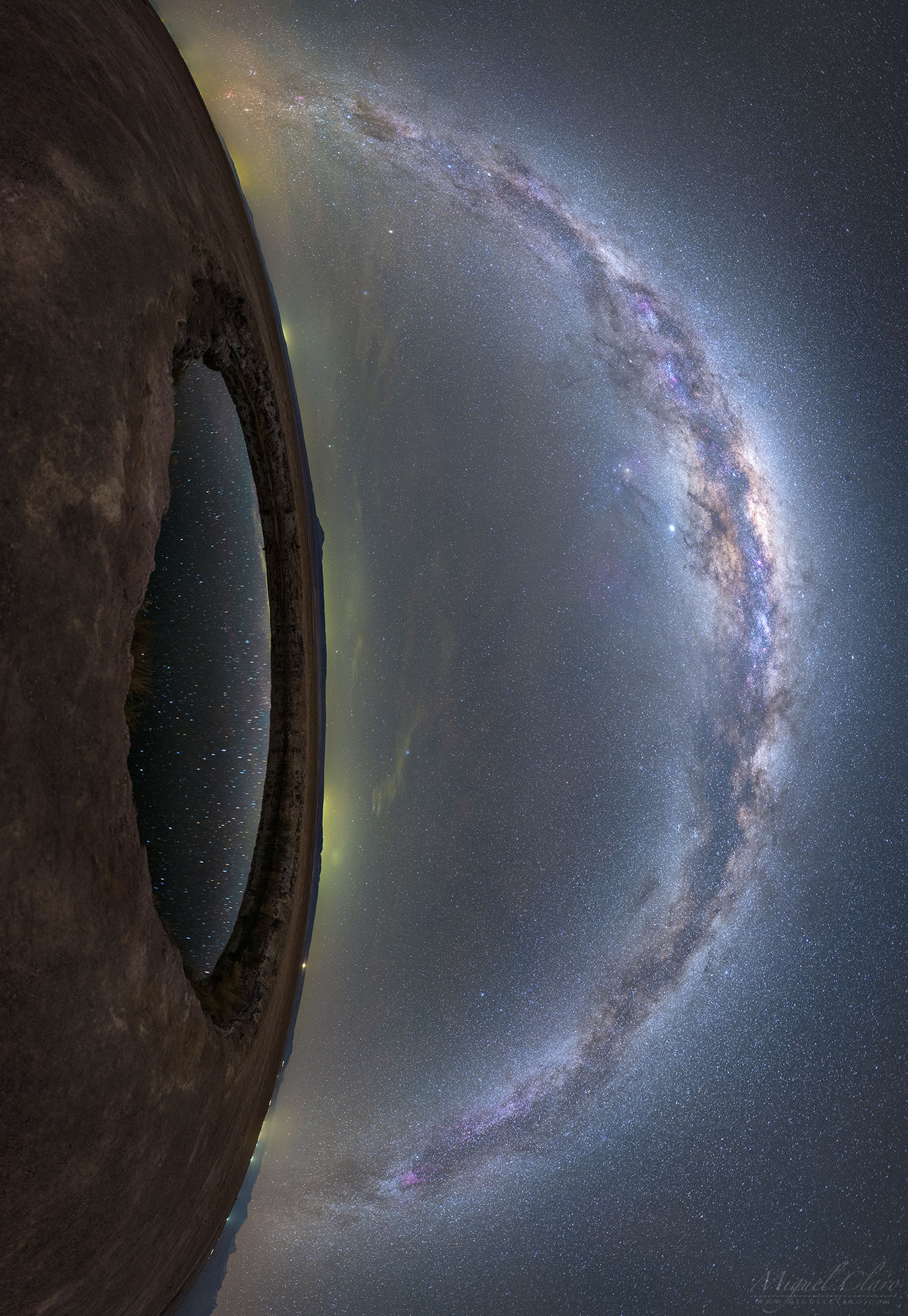
Image Credit & Copyright: Miguel Claro (TWAN, Dark Sky Alqueva)
Explanation: Have you ever had stars in your eyes? It appears that the eye on the left does, and moreover, it appears to be gazing at even more stars. The featured 27-frame mosaic was taken in 2019 from Ojas de Salar in the Atacama Desert of Chile. The eye is actually a small lagoon captured reflecting the dark night sky as the Milky Way Galaxy arched overhead. The seemingly smooth band of the Milky Way is really composed of billions of stars, but decorated with filaments of light-absorbing dust and red-glowing nebulas. Additionally, both Jupiter (slightly left the galactic arch) and Saturn (slightly to the right) are visible. The lights of small towns dot the unusual vertical horizon. The rocky terrain around the lagoon appears to some more like the surface of Mars than our Earth.
17/04/2026
Astronomie - ETOILES FILANTES - LE RADIANT DES PERSEIDES

Image composite réunissant 29 météores photographiés au cours de la nuit du 11 au 12 août 2016. Le radiant de l'essaim météoritique est clairement visible au centre, en direction de la constellation de Persée, alors en pleine ascension au-dessus du lac Collins, en Californie.
© Rick Whitacre, Flickr
Astronomy - M82: STARBURST GALAXY WITH A SUPERWIND
2026 April 17
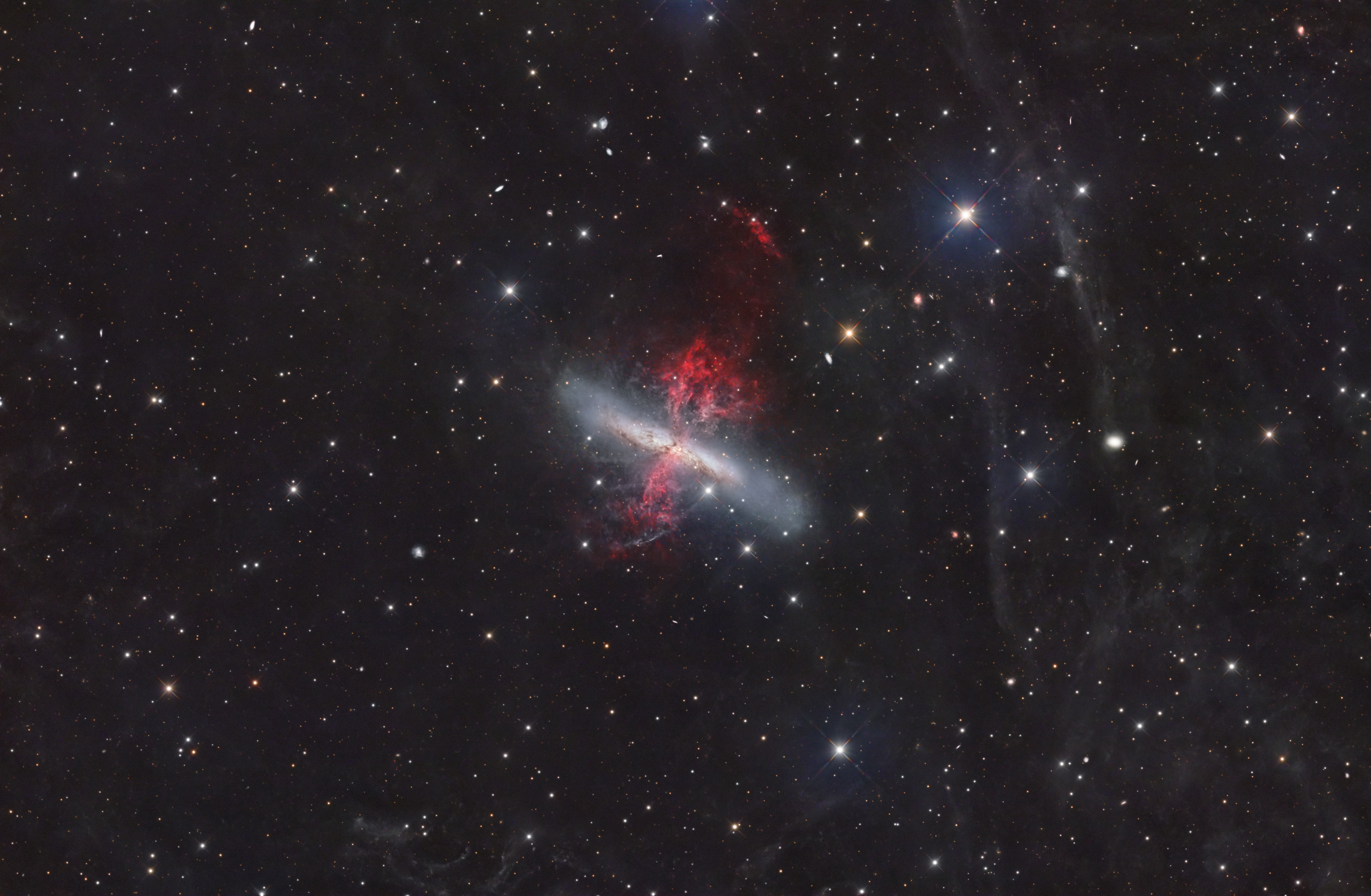
Image Credit & Copyright: Arnaud Malleval
Explanation: Messier 82 is a starburst galaxy with a superwind. In fact, through supernova explosions and powerful winds from massive stars, the burst of star formation in M82 is driving a prodigious outflow. Evidence for the superwind from the galaxy's central regions is clear in the sharp telescopic portrait. The composite image includes 33 hours of narrowband data, highlighting emission from long outflow filaments of atomic hydrogen gas in reddish hues. Some of the gas in the superwind, enriched in heavy elements forged in the massive stars, will eventually escape into intergalactic space. Triggered by a close encounter with nearby large galaxy M81, the furious burst of star formation in M82 should last about 100 million years or so. Also known as the Cigar Galaxy for its elongated visual appearance, M82 is about 30,000 light-years across. It lies 12 million light-years away near the northern boundary of Ursa Major.
16/04/2026
Astronomy - LAUNCH PLUME : SPACE X JELLYFISH
2026 March 19
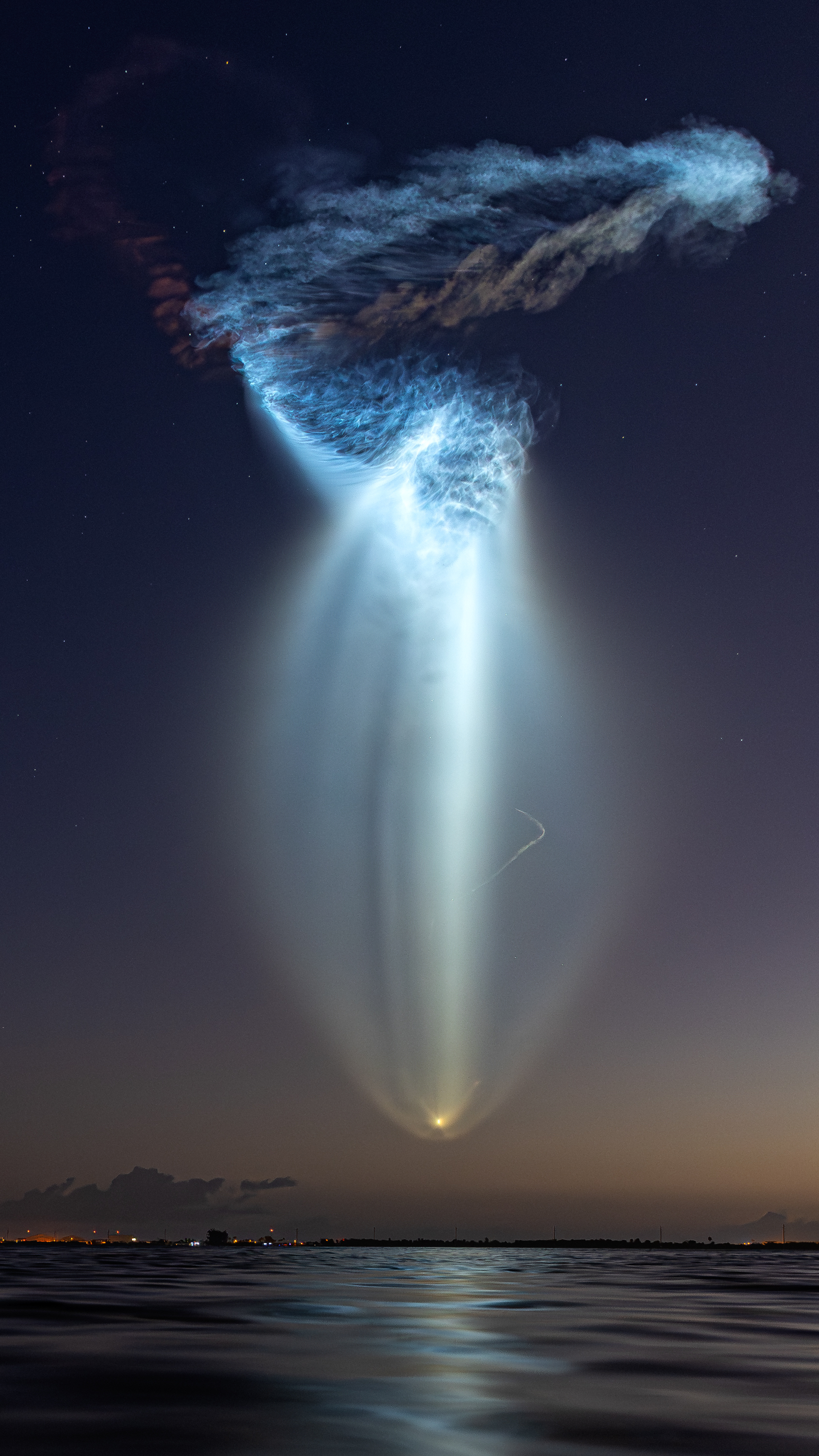
Image Credit & Copyright: Michael Seeley
Text: Cecilia Chirenti (NASA GSFC, UMCP, CRESST II)
Explanation: Even if you live with your head in the clouds, you won’t find a jellyfish like this one very often. The featured image shows a SpaceX Falcon 9 rocket launch from Cape Canaveral in Florida on March 4. The launch happened 52 minutes before sunrise, and the second stage rocket exhaust plume was high enough in the sky to catch the light of the rising sun, while the photographer was still in the dark. This combination of light and shadow, possible at dawn or dusk, makes the exhaust, mostly water vapor and carbon dioxide, appear as a glowing cloud. It only looks like it's going down, as the rocket follows the curvature of the Earth on its way to space. A related effect is the twilight phenomenon, which causes colorful contrails sometimes mistaken for UFOs. But, in case you are wondering: real jellyfish were sent to space by NASA in the 1990s as part of a science experiment.
15/04/2026
Astronomie -ETOILES FILANTES - DANS LE CIEL JAPONAIS

Magnifique étoile filante associée à l'essaim météoritique des Perséides photographiée dans le ciel de Narusawa-mura, au sud-ouest de Tokyo, le 13 août 2016. Comme on peut le voir, le bolide semble avoir été décoché par Persée (à gauche de la photo). La grappe d'étoiles en dessous de l'horizon est celle des Pléiades (Subaru, en japonais).
© reonides, Flickr
Astronomy - THE ISS TRANSITS THE MOON
2026 April 15
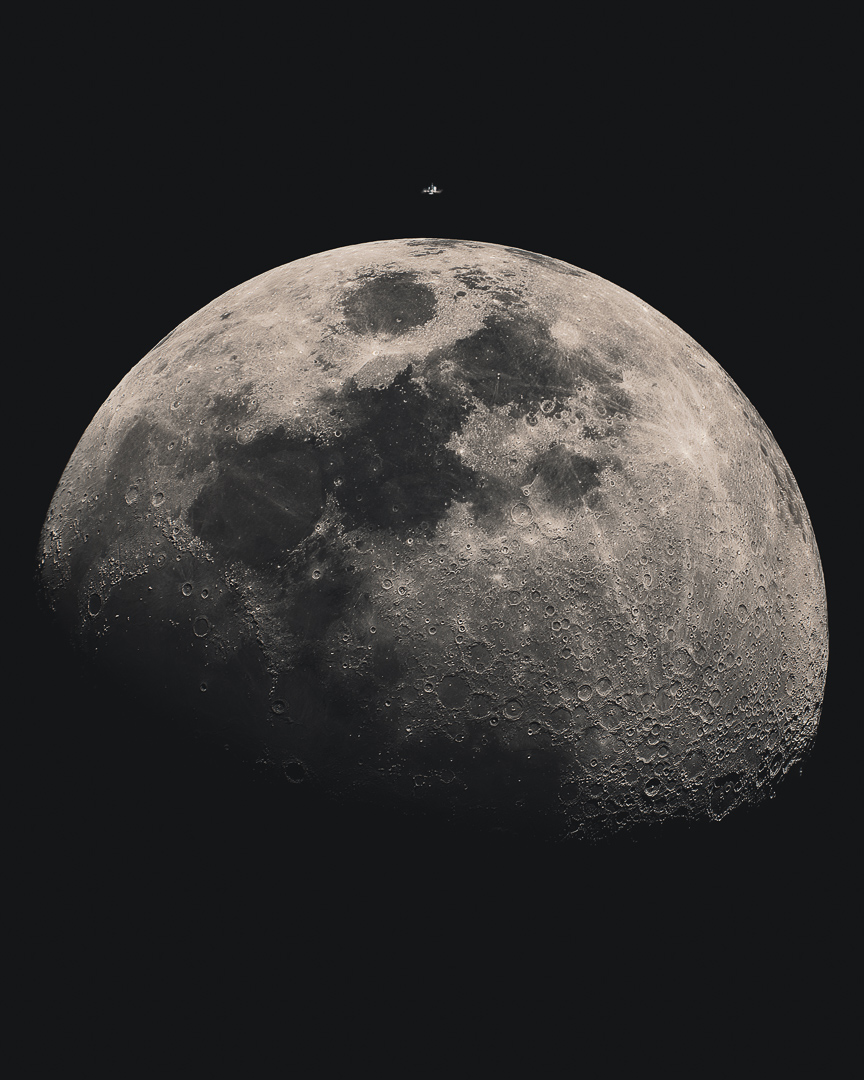
Image Credit & Copyright: Sébastien Borie
Text: Keighley Rockcliffe (NASA GSFC, UMBC CSST, CRESST II)
Explanation: Nope, that is not an alien spaceship landing on the Moon! This is an image of the International Space Station (ISS) as it begins to transit in front of the Moon. The ISS is in low-Earth orbit (LEO) where it wizzes around the Earth every 90 minutes. Orbiting the Earth 16 times per day for 25 years, the ISS has photobombed many familiar celestial objects including Venus, Mars, Saturn, and the Sun. Thousands of experiments led by researchers from over one hundred countries have been conducted on the ISS. Growing protein crystals in low gravity was one of the first experiments onboard the ISS and continues to contribute to new medical treatments. ISS astronauts study plant growth, water recycling, human health, and more to support the Artemis missions which will take humans farther than they’ve ever gone before. Next time you are out and about at night, try to spot the ISS zooming across the sky!
14/04/2026
Astronomie - ETOILES FILANTES - AVERSE DE PERSEIDES EN UKRAINE

Image composite réunissant deux heures d'exposition de la pluie annuelle d'étoiles filantes, les Perséides, le 12 août 2016 (nuit du maximum d'activité), au-dessus du lac Svityaz, en Ukraine.
© Ihor Khomych, via Spaceweather
Astronomy - NGC 602 AND BEYOND
2026 April 13
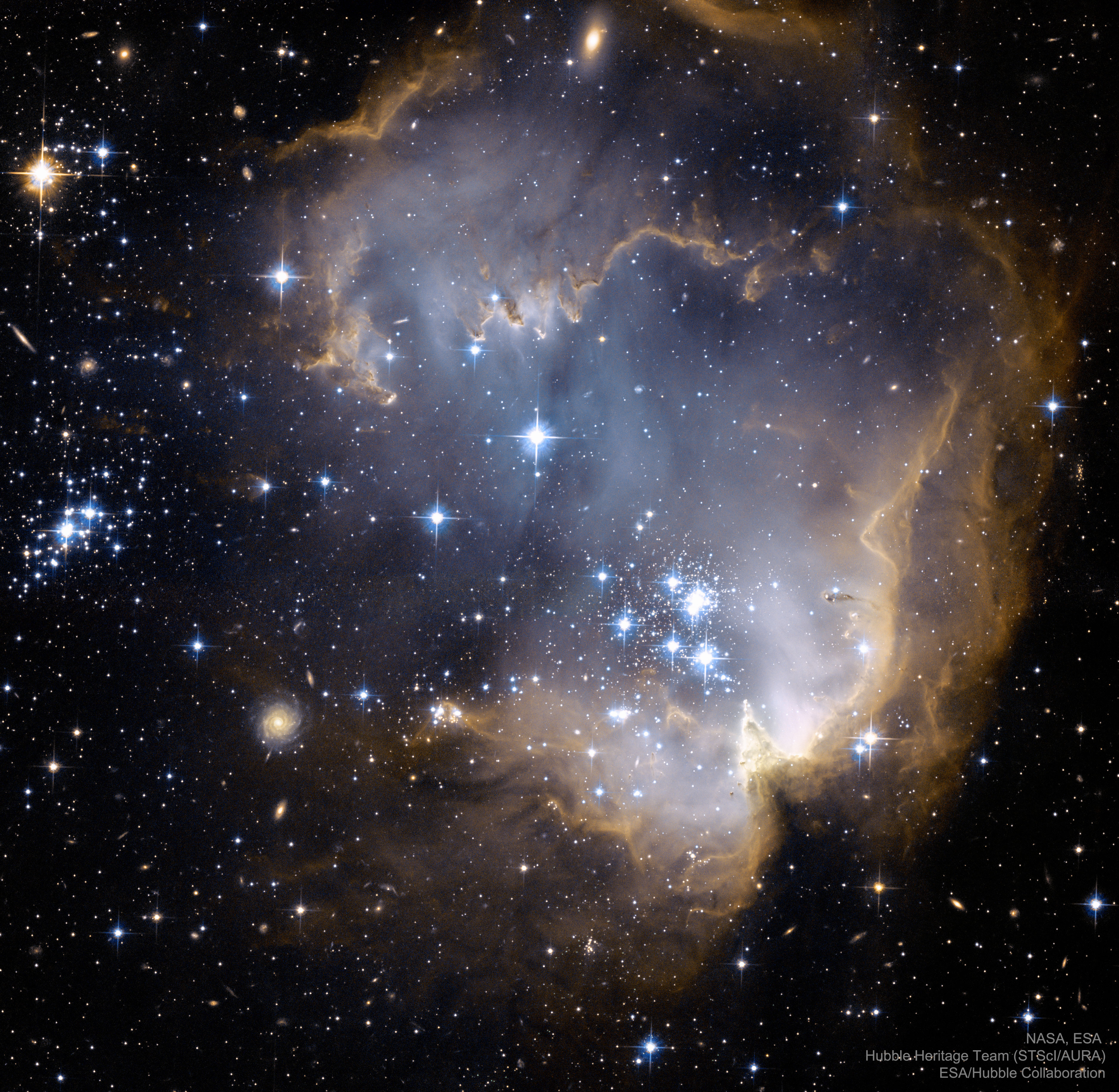
Image Credit: NASA, ESA, and the Hubble Heritage Team (STScI/AURA) - ESA/Hubble Collaboration
Explanation: The clouds may look like an oyster, and the stars like pearls, but look beyond. Near the outskirts of the Small Magellanic Cloud, a satellite galaxy some 200 thousand light-years distant, lies 5 million year young star cluster NGC 602. Surrounded by natal gas and dust, NGC 602 is featured in this stunning Hubble image of the region. Fantastic ridges and swept back shapes strongly suggest that energetic radiation and shock waves from NGC 602's massive young stars have eroded the dusty material and triggered a progression of star formation moving away from the cluster's center. At the estimated distance of the Small Magellanic Cloud, the featured picture spans about 200 light-years, but a tantalizing assortment of background galaxies are also visible in this sharp multi-colored view. The background galaxies are hundreds of millions of light-years or more beyond NGC 602.
11/04/2026
News en Images - ARTEMIS II ET LA FACE CACHéE DE LA LUNE

C’est un profil qu’on ne voit pas souvent. Sur cette image diffusée par la Nasa, notre Lune dévoile son bassin oriental et certaines parties de sa face cachée, non visibles depuis la Terre – notre satellite tourne sur son orbite à la même vitesse que notre planète. C’est notamment en s’éloignant, dans la nuit de lundi à mardi dernier, à plus de 406 000 kilomètres de la Terre (un record !), que les membres de la mission Artemis II ont pu l’observer de très près avec un survol à 6 500 kilomètres. C’est à cette frontière entre la face visible et celle cachée que les astronautes ont découvert un cratère – un point clair observable à certains moments du transit lunaire – qu’ils ont souhaité baptiser Carroll, en hommage à la femme du commandant de la mission, morte d’un cancer en 2020.
NASA / AFP
10/04/2026
Astronomy - ESPLORING THE ANTENNAE
2026 April 10
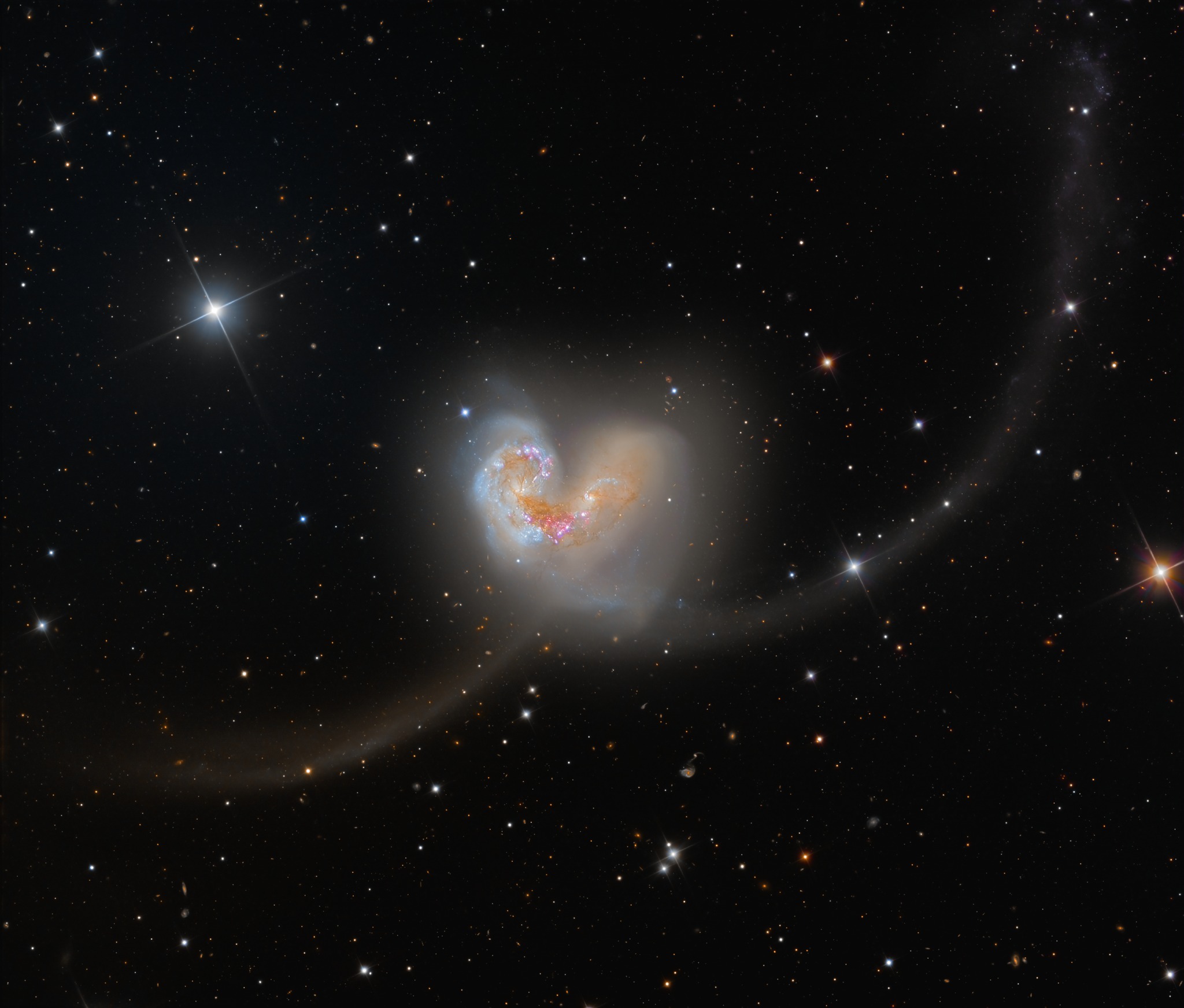
Image Credit & Copyright: Acquisition - Mike Selby Processing - Roberto Colombari
Explanation: Some 60 million light-years away in the southerly constellation Corvus, two large galaxies are colliding. Stars in the two galaxies, cataloged as NGC 4038 and NGC 4039, very rarely collide in the course of the ponderous cataclysm that lasts for hundreds of millions of years. But the galaxies' large clouds of molecular gas and dust often do, triggering furious episodes of star formation near the center of the cosmic wreckage. Spanning over 50 thousand light-years, this stunning telescopic frame also reveals new star clusters and matter flung far from the scene of the accident by gravitational tidal forces. The remarkably sharp ground-based image follows the faint tidal tails and distant background galaxies in the field of view. The suggestive overall visual appearance of the extended arcing structures gives the galaxy pair, also known as Arp 244, its popular name - The Antennae.
09/04/2026
Santé/Médecine - CANCER - AVANCEES MAJEURES ET ESPOIR - CES CELLULES QUI CONTRIBUENT AU DEVELOPPEMENT DE CANCERS
 .../
.../L'hypothèse était que les lymphocytes TH17 ne constituent pas une population homogène, mais qu'ils peuvent en fait être divisés en plusieurs sous-groupes. En utilisant des approches dites de « séquençage de l'ARN à cellule unique », les scientifiques ont démontré cette hétérogénéité des cellules TH17 au sein de l'intestin.
« Plus précisément, dans cette étude, nous montrons pour la première fois qu'il existe en fait huit sous-types de lymphocytes TH17 ayant des rôles distincts. L'un d'entre eux a un rôle tumorigénique, c'est-à-dire que lorsque certains freins d'activation sont levés, il va contribuer au développement de cancers. Au contact de ces cellules TH17, les cellules de l'intestin qui étaient pourtant saines jusqu'ici vont devenir cancéreuses », explique Julien Marie.
Les scientifiques ont ensuite montré que cette population tumorigénique est accrue chez des patients à fort risque de cancer. Enfin, ils ont aussi identifié qu'une protéine, la cytokine TGF-β, est capable d'inhiber la formation des TH17 tumorigéniques.
Les risques de l’immunothérapie prolongée mieux évalués
« Cette étude peut interroger les cliniciens sur l'utilisation, sur une période longue des immunothérapies chez des patients atteints de cancer, un traitement qui vise à stimuler les lymphocytes », souligne Julien Marie.
En effet, si ces thérapies ont transformé la prise en charge en oncologie, elles sont aussi connues pour entraîner de l’inflammation chronique intestinale. Il est donc important de s'interroger, pour un patient donné, sur les risques que l'immunothérapie s'accompagne de l'émergence de lymphocytes TH17 tumorigéniques qui pourraient à terme donner lieu au développement d'un autre cancer. Par ailleurs, cette étude pose les bases pour le développement de nouvelles thérapies préventives du cancer en bloquant l'apparition du sous-type de TH17 mis en cause par les scientifiques dans ce travail.
FuturaSciences
08/04/2026
Astronomy - EARTHSET
2026 April 8
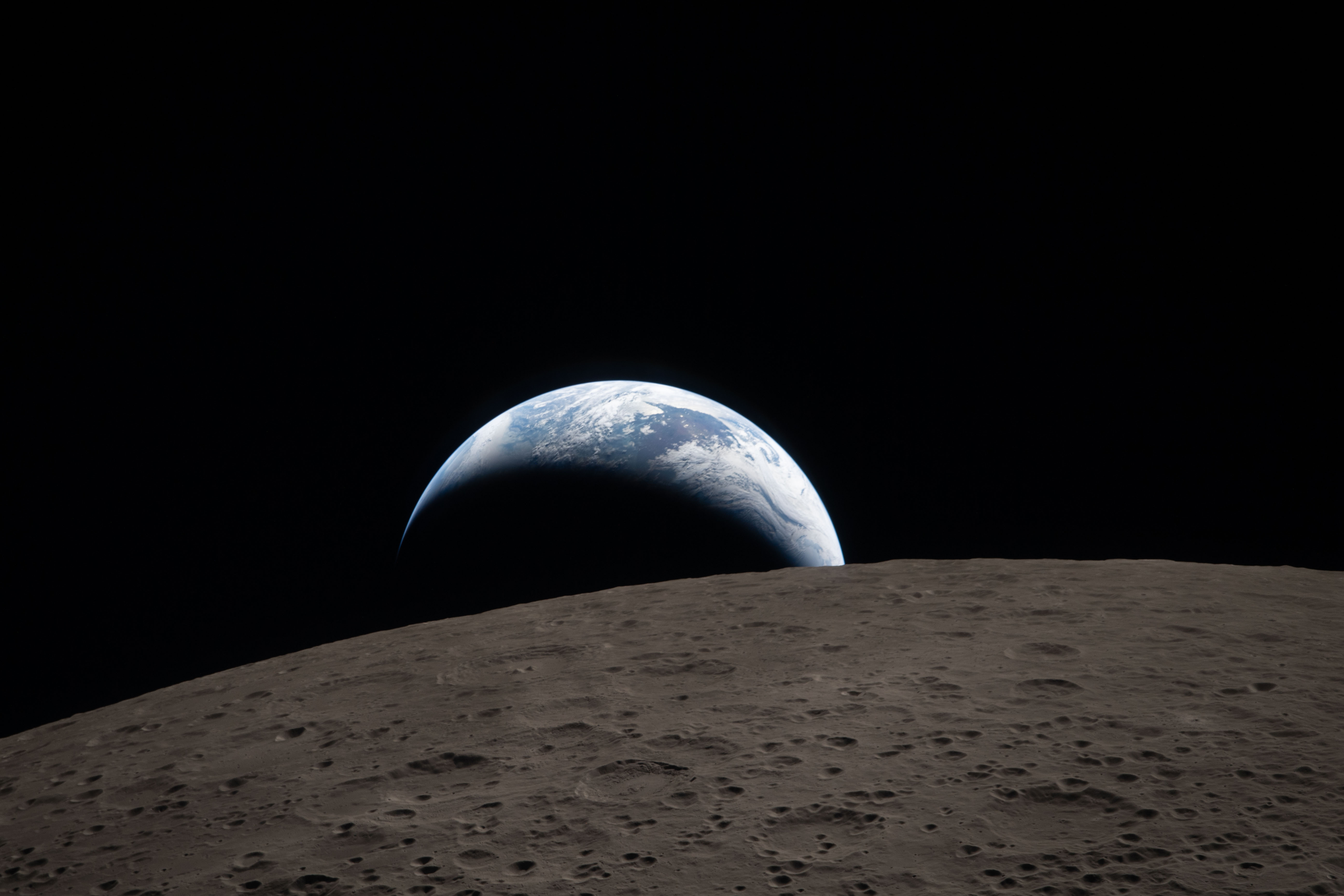
Image Credit: NASA
Text: Keighley Rockcliffe (NASA GSFC, UMBC CSST, CRESST II)
Explanation: And to all of you down there on Earth and around Earth, we love you, from the Moon. We will see you on the other side,
said Artemis II pilot Victor Glover on April 6th at 6:44pm ET as 8.3 billion minus four people and one Earth set below the Moon's horizon. The Orion spacecraft, Integrity, then traveled behind the Moon as part of its seven-hour lunar flyby. The crew characterized never-before-seen regions of the far side of the Moon, which is puzzlingly less volcanically active than the near side. New observations of crater peaks, floors, terraces, and rings preserved on the lunar surface will help piece together the impact history of the Solar System. Among many other surface characterizations, the crew observed one of the Moon's best-preserved basins, the Orientale basin, and identified two new craters. As Earth rose above the Moon’s horizon and Integrity began its return home, Artemis II mission specialist Christina Koch powerfully summarized humanity’s grander mission: ...we will always choose Earth. We will always choose each other.
07/04/2026
Santé/Médecine - CANCER : AVANCEES MAJEURES ET ESPOIR -

Une étude a exploré le lien entre l'inflammation chronique, le système immunitaire et le développement du cancer, notamment dans les intestins. Les chercheurs ont identifié un mécanisme par lequel certaines cellules immunitaires, en particulier un sous-type de lymphocytes TH17, peuvent contribuer à la formation du cancer, bien que ce processus puisse être inhibé par des molécules produites par les cellules épithéliales. Cette découverte soulève des questions sur l'usage prolongé des immunothérapies qui stimulent ces lymphocytes et ouvre la voie à de nouvelles thérapies préventives ciblant ce sous-type pour réduire le risque de cancer.
Près d'un cancer sur trois se développe à la suite d'une inflammation chronique, dont l'origine reste incomprise. Dans une nouvelle étude, des chercheurs et chercheuses de l'Inserm, du CNRS, de l'université Claude-Bernard Lyon 1 et du Centre Léon Bérard au Centre de recherche en cancérologie de Lyon, ont identifié des lymphocytes impliqués dans les processus inflammatoires et qui seraient en cause dans la génération de ces cancers. Ce travail ouvre de nouvelles perspectives thérapeutiques et de prévention. Les résultats sont publiés dans la revue Nature Immunology.
Comprendre l'origine de la maladie
Environ 30 % des cancers apparaissent à la suite d'une inflammation chronique localisée. C'est notamment le cas de certains cancers colorectaux, de l'intestin grêle, du foie ou encore du pancréas. De nombreuses questions demeuraient toutefois en suspens pour mieux comprendre le développement de ces cancers. Une ou plusieurs cellules immunitaires sont-elles à l'origine du processus inflammatoire conduisant aux cancers ? Si oui, de quelles cellules s'agit-il ?
Répondre à ces interrogations est l'un des objectifs de Julien Marie, directeur de recherche à l'Inserm, et de son équipe au Centre de recherche en cancérologie de Lyon (Inserm/CNRS/Université Claude-Bernard Lyon 1/Centre Léon Bérard) afin de mieux comprendre la manière dont la maladie est initiée.

Les chercheurs et chercheuses se sont intéressés tout particulièrement à une population de cellules immunitaires, les lymphocytes TH17, qui sont déjà connus pour être impliqués dans de nombreuses maladies inflammatoires, comme la sclérose en plaques ou encore la maladie de Crohn...
FuturaSciences
Astronomy - IC 4592:THE BLUE HORSEHEAD REFLECTION NEBULA
2026 April 7
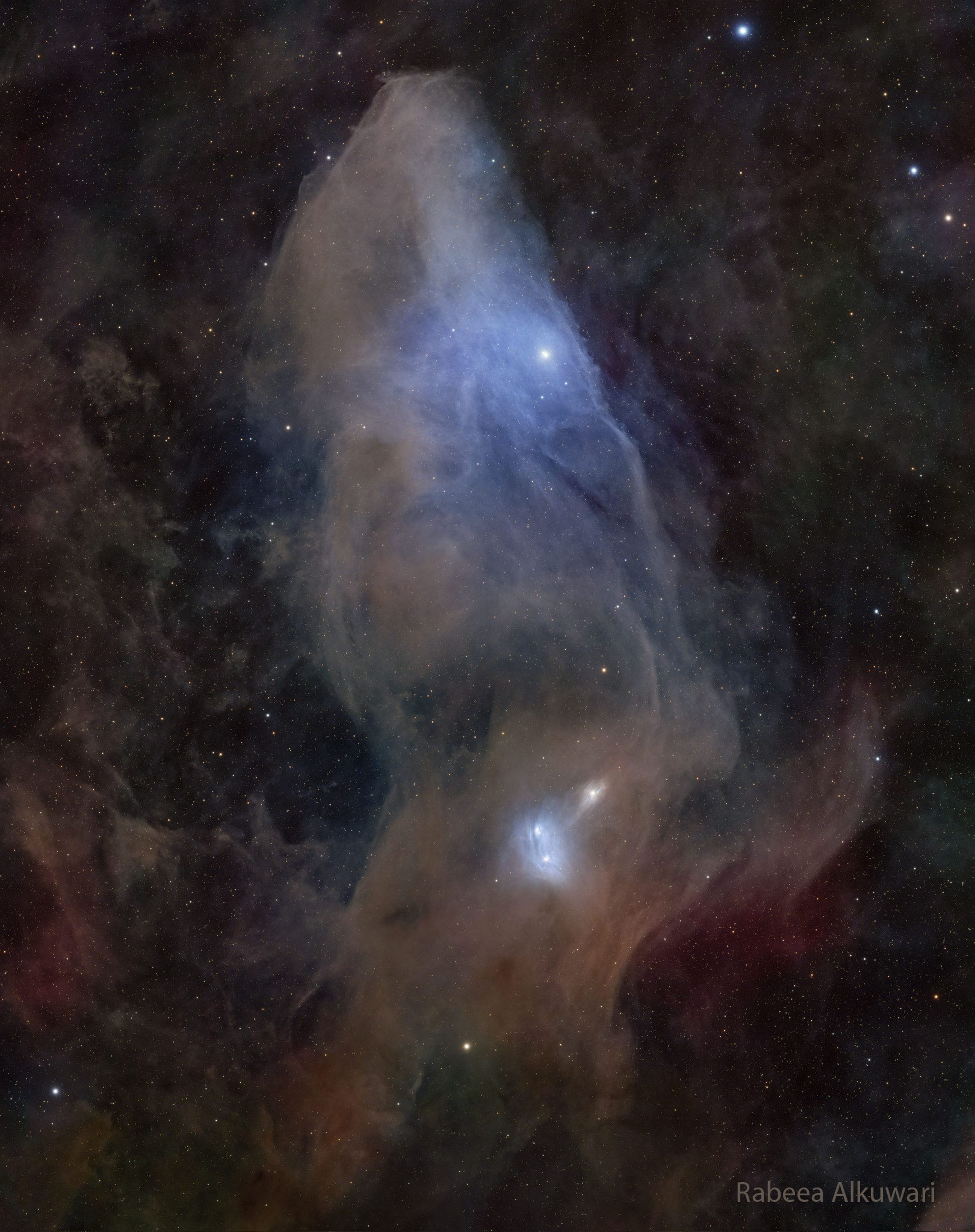
Image Credit & Copyright: Rabeea Alkuwari
Explanation: Do you see the horse's head? What you are seeing is not the famous Horsehead nebula toward Orion, but rather a fainter nebula that only takes on a familiar form with deeper imaging. The main part of the here-imaged molecular cloud complex is reflection nebula IC 4592. Reflection nebulas are made up of very fine dust that normally appears dark but can look quite blue when reflecting the visible light of energetic nearby stars. In this case, the source of much of the reflected light is a star at the eye of the horse. That star is part of Nu Scorpii, one of the brighter star systems toward the constellation of the Scorpion (Scorpius). A second reflection nebula dubbed IC 4601 is visible surrounding two stars just below the image center. The featured picture was taken from Sawda Natheel in Qatar.
04/04/2026
Astronomy - HELLO WORLD
2026 April 4
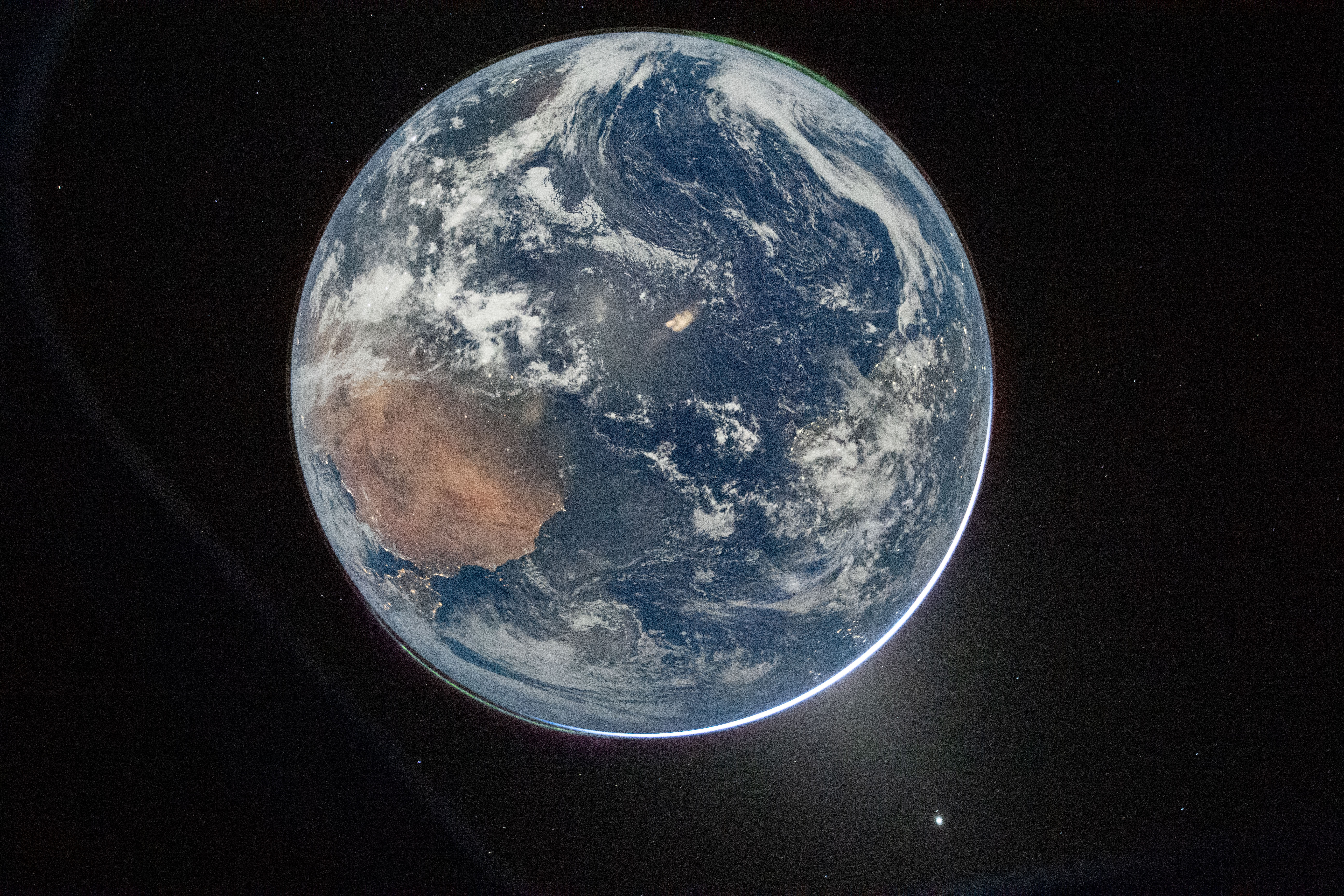
Image Credit: NASA, Reid Wiseman, Artemis II
Explanation: From pole to pole our fair planet is captured in this snapshot from space, an evocative image from a window of the Orion spacecraft Integrity. From the spacecraft's perspective the Sun is moving behind Earth's bright limb along the lower right. Africa and the Iberian peninsula are in view on the pale blue planet's surface, while aurorae crown Earth's south and north poles at top right and bottom left. Commander Reid Wiseman took the historic picture on Artemis II mission flight day 2 (April 2), after the completion of the planned translunar injection burn. That burn boosted the spacecraft out of Earth orbit, sending Integrity and crew on a trajectory that will take them around the Moon and back again. That's a journey humans last made over 50 years ago.
03/04/2026
Astronomy - CAUGHT IN THE WEB: VISUALIZATION OF A BLACK HOLE MERGER IN THE TARANTULA NEBULA
2026 April 3
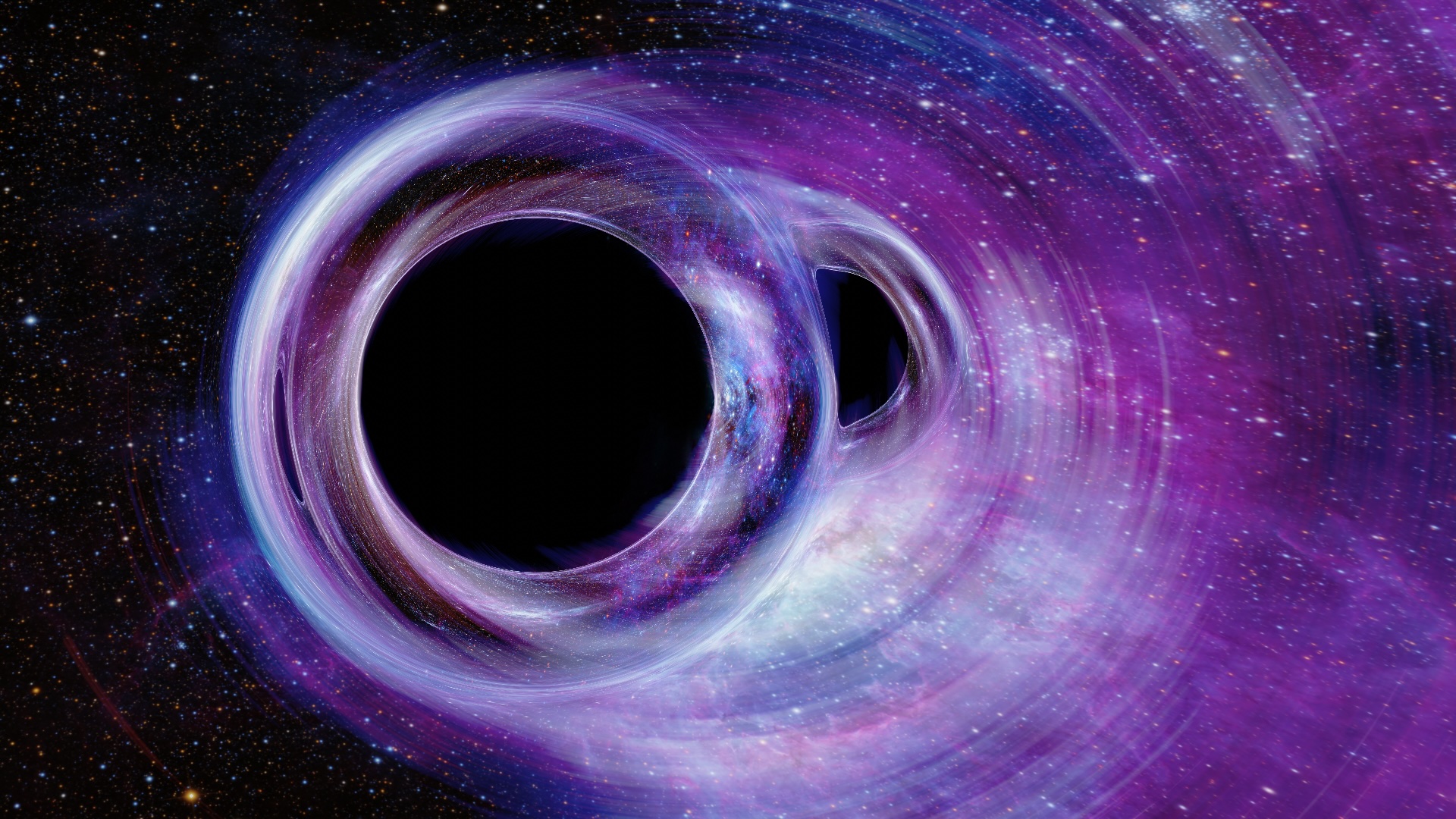
Illustration Credit & Copyright: Artwork: Carl Knox (OzGrav, Swinburne University of Technology);
Astrophotography: Blake Estes & Christian Sasse, iTelescope.net; Text: Cecilia Chirenti (NASA GSFC, UMCP, CRESST II)
Explanation: How can we see what is invisible? Black holes are not easy to see in the dark cosmic night, but astronomers can find them by analyzing their gravitational effects on matter, light and spacetime. The featured image shows an illustration that combines a simulation of a black hole binary system in its final "death-dance" with an astrophotography image of the Tarantula Nebula in the background. Even though black holes don't emit light, they distort the path of light rays, acting like a gravitational lens. As a result, the nebula appears extremely distorted, forming Einstein rings and multiple images. Tarantula Nebula lies in the Large Magellanic Cloud, a dwarf galaxy that is one of the satellite galaxies of the Milky Way, 160,000 light-years away. That is more than 1,000 times closer than any of the binary black hole mergers detected so far. We'll probably never detect a merger so close to home!
Santé/Médecine - CANCER : AVANCEES MAJEURES ET ESPOIR - LA DANGEROSITé DES METASTASES

Les métastases : quand le cancer s’étend et change la donne. © Sam Adobe Stock
Silencieuses et redoutées, les métastases transforment un cancer localisé en une maladie qui envahit d’autres organes et dont les enjeux deviennent bien plus complexes. Comment naissent ces foyers secondaires ? Pourquoi certains organes sont-ils plus touchés que d’autres ? Existe-t-il des traitements ?
Lorsqu'un cancer est métastasé, le pronostic s'assombrit. Mais que sont réellement les métastases ? Comment se forment-elles ?
Lorsqu'une tumeur survient, elle est souvent localisée dans un organe. Mais il arrive aussi qu'à partir de cellules cancéreuses qui se détachent du cancer primitif et migrent par les vaisseaux lymphatiques ou les vaisseaux sanguins, une nouvelle tumeur se forme ailleurs dans le corps. Ce sont des métastases.
Où se forment les métastases ?
« Dans le cas du cancer du sein, par exemple, on observe plus souvent des métastases osseuses, pulmonaires, hépatiques ou parfois cérébrales, pour certains sous-types histologiques », indique le Dr Lionel Uwer, oncologue à l'institut de cancérologie de Lorraine et spécialiste des tumeurs du sein et des tumeurs pulmonaires à la revue RoseUp. « Mais d'autres atteintes plus rares sont parfois observées. Par exemple au niveau de la peau ou du péritoine. »
Les mêmes cellules que le cancer initial
Les métastases ne sont donc pas un autre cancer, mais des cellules du cancer initial qui se sont propagées. « Par exemple, une métastase d'un cancer du sein installée sur un poumon est une tumeur constituée de cellules de sein ; ce n'est pas un cancer du poumon », précise l'Institut national du Cancer (INCa). Lorsqu'un cancer a produit des métastases, on le qualifie de cancer métastatique.
Quels traitements ?
« Il est habituellement plus difficile de traiter le cancer métastatique que le cancer qui ne s'est pas propagé, indique la Société canadienne du Cancer. Dans la plupart des cas, le traitement a pour but d'aider une personne à vivre aussi longtemps que possible et à maintenir sa qualité de vie. Les traitements maîtrisent et ralentissent la croissance des métastases, mais celles-ci ne disparaissent habituellement pas complètement ».
Comme une maladie « chronique »
Il existe toutefois des approches thérapeutiques prometteuses comme l'immunothérapie. Celle-ci est « déjà utilisée avec succès contre les cancers ORL, du rein, du poumon et les mélanomes, elle est également accessible aux patientes ayant un cancer du sein métastatique dit triple négatif, dans le cadre d'une autorisation temporaire d'utilisation », précise le Dr Lionel Uwer.
Mais quoi qu'il arrive, en cas de métastases, « on entre dans une logique de maladie chronique », ajoute-t-il. Le patient doit bénéficier d'un suivi à vie en raison du risque élevé de rechute.

Dans un cancer, ce ne sont pas toujours les tumeurs visibles qui tuent, mais leurs métastases. Ces foyers invisibles s’installent et prolifèrent ailleurs dans le corps. © MattLphotography, shutterstock.com
FuturaSciences
Inscription à :
Articles (Atom)
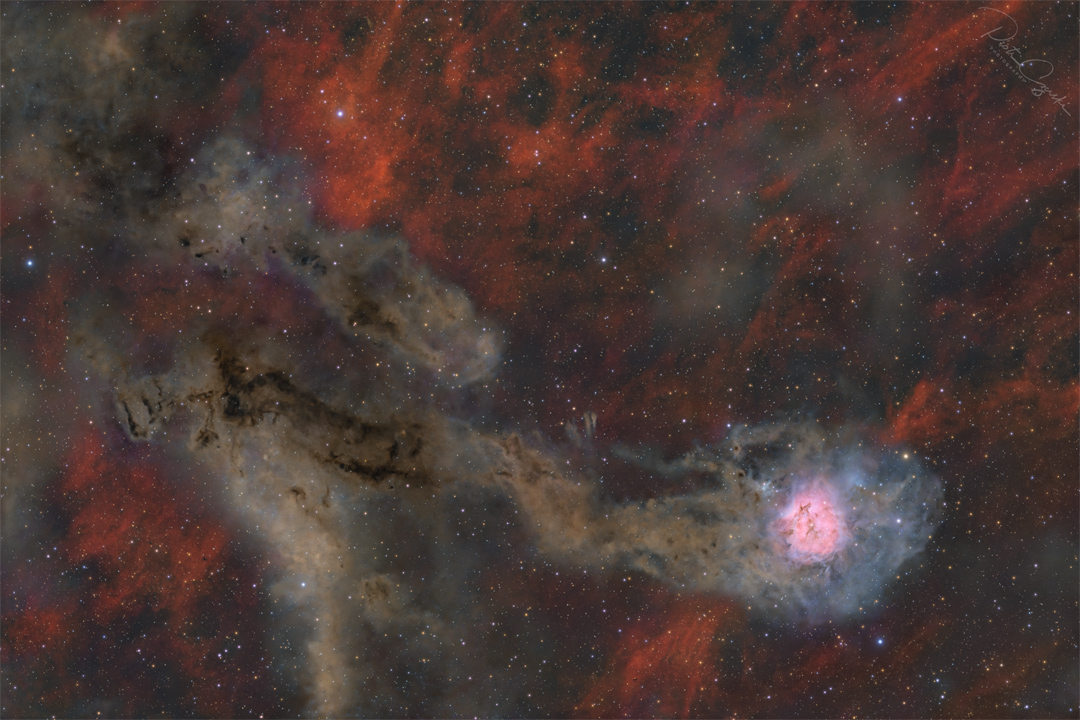
Astronomy - COCOON NEBULA WIDE FIELD
2026 September 21 Cocoon Nebula Wide Field Image Credit & Copyright: Piotr Czerski Explanation: When does a nebula look like a comet? I...
-
2026 January 2 NanoSail-D2 Image Credit & Copyright : Ralf Vandebergh Explanation: In 2011, on January 20, NASA's NanoSail-D2 ...
-
2026 January 1 Auroral Corona Image Credit & Copyright : Roi Levi Explanation: Cycle 25 solar maximum made 2025 a great year for ...