Nombre total de pages vues
27/11/2025
SANTé/MEDECINE - CANCER - 12 AVANCEES REVOLUTIONNAIRES - 10. Une goutte de sang pour détecter le cancer du pancréas
26/11/2025
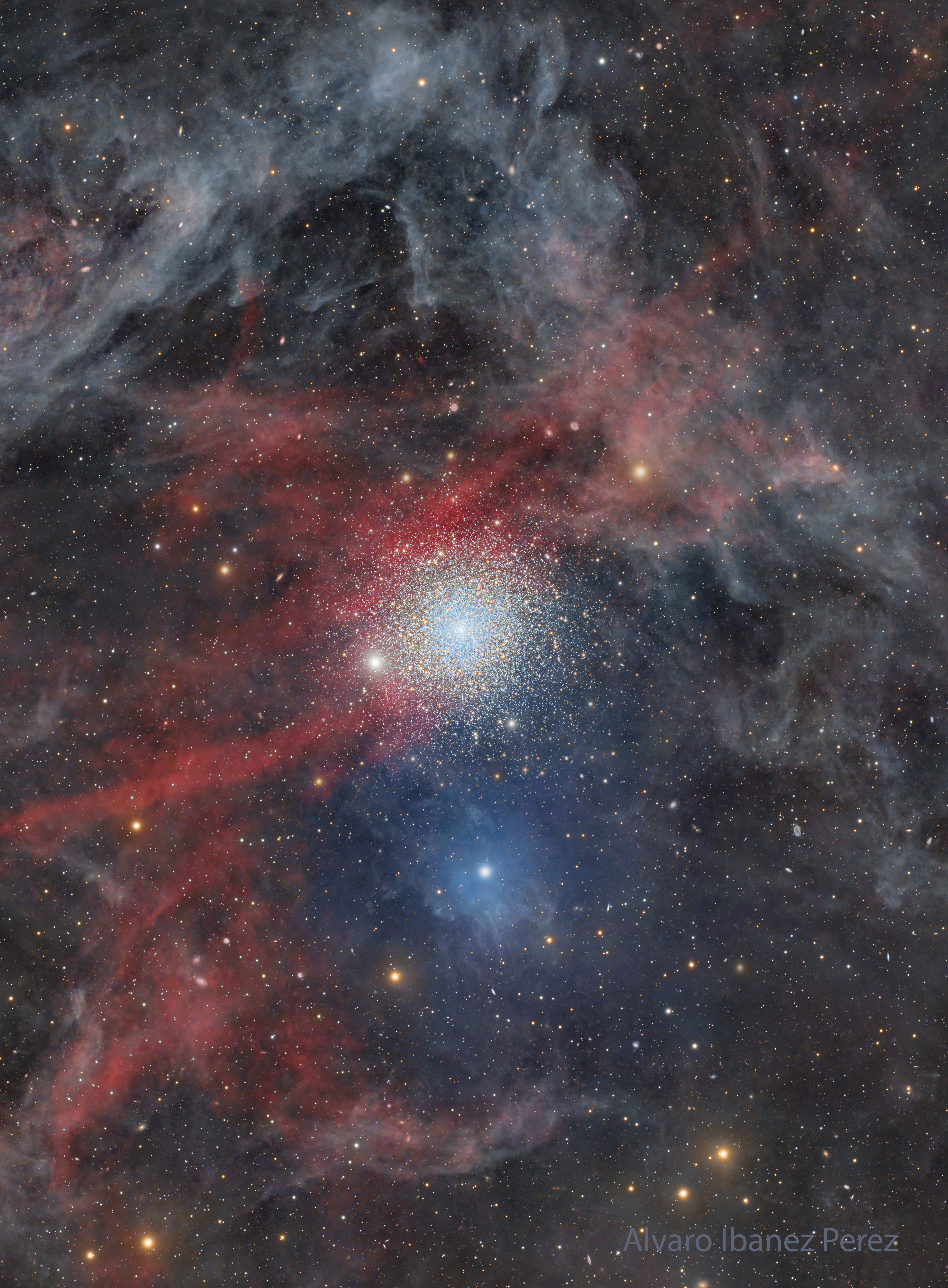
ASTRONOMY - Globular Cluster M15 Deep Field
2025 November 26
Image Credit & Copyright: Alvaro Ibanez Perez
Explanation: Stars, like bees, swarm around the center of bright globular cluster M15. The central ball of over 100,000 stars is a relic from the early years of our Galaxy, and continues to orbit the Milky Way's center. M15, one of about 150 globular clusters remaining, is noted for being easily visible with only binoculars, having at its center one of the densest concentrations of stars known, and containing a high abundance of variable stars and pulsars. The featured image of M15 was taken by combining very long exposures -- 122 hours in all -- and so brings up faint wisps of gas and dust in front of the giant ball of stars. M15 lies about 35,000 light years away toward the constellation of the Winged Horse (Pegasus).
25/11/2025
SANTé/MEDECINE - CANCER - 12 AVANCEES REVOLUTIONNAIRES - 9. Un traitement du cancer du col de l’utérus qui réduit drastiquement la mortalité
ASTRONOMY - Comet Lemmon and the Milky Way
2025 November 25
Image Credit & Copyright: Lin Zixuan (Tsinghua U.)
Explanation: What did Comet Lemmon look like when it was at its best? One example is pictured here, featuring three celestial spectacles all at different distances. The closest spectacle is the snowcapped Meili Mountains, part of the Himalayas in China. The middle marvel is Comet Lemmon near its picturesque best early this month, showing not only a white dust tail trailing off to the right but its blue solar wind-distorted ion tail trailing off to the left. Far in the distance on the left is the magnificent central plane of our Milky Way Galaxy, featuring dark dust, red nebula, and including billions of Sun-like stars. Comet C/2025 A6 (Lemmon) is already fading as it heads back into the outer Solar System, while the Himalayan mountains will gradually erode over the next billion years. The Milky Way Galaxy, though, will live on -- forming new mountains and comets -- for many billions of years into the future.
24/11/2025
ASTRONOMY - Apep: Unusual Dust Shells from Webb
2025 November 24
Image Credit: NASA, ESA, CSA, STScI, JWST; Science: Y. Han (Caltech), R. White (Macquarie U.); Image Processing: A. Pagan (STScI)
Explanation: What created this unusual space sculpture? Stars. This unusual system of swirls and shells, known as Apep, was observed in unprecedented detail by NASA’s James Webb Space Telescope in infrared light in 2024. Observations indicate that the unusual shape originates from two massive Wolf-Rayet stars orbiting each other every 190 years with each close passes causing a new shell of dust and gas to be expelled. Holes in these shells are thought to be caused by a third orbiting star. This stellar dust dance will likely continue for hundreds of thousands of years, possibly ending only when one of the massive stars runs out of internal nuclear fuel and explodes in a supernova punctuated by a burst of gamma-rays.
SANTé/MEDECINE - CANCER - 12 AVANCEES REVOLUTIONNAIRES - 8. Le décryptage de l’ADN tumoral pour comprendre l’origine du cancer
23/11/2025
ASTRONOMY - The Observable Universe
2025 November 23
Illustration Credit & Licence: Wikipedia, Pablo Carlos Budassi
Explanation: How far can you see? Everything you can see, and everything you could possibly see, right now, assuming your eyes could detect all types of radiations around you -- is the observable universe. In light, the farthest we can see comes from the cosmic microwave background, a time 13.8 billion years ago when the universe was opaque like thick fog. Some neutrinos and gravitational waves that surround us come from even farther out, but humanity does not yet have the technology to detect them. The featured image illustrates the observable universe on an increasingly compact scale, with the Earth and Sun at the center surrounded by our Solar System, nearby stars, nearby galaxies, distant galaxies, filaments of early matter, and the cosmic microwave background. Cosmologists typically assume that our observable universe is just the nearby part of a greater entity known as "the universe" where the same physics applies. However, there are several lines of popular but speculative reasoning that assert that even our universe is part of a greater multiverse where either different physical constants occur, different physical laws apply, higher dimensions operate, or slightly different-by-chance versions of our standard universe exist.
20/11/2025
SANTé/MEDECINE - CANCER - 12 AVANCEES REVOLUTIONNAIRES - 7. Des biopsies liquides et synthétiques moins invasives et plus rapides
OCEANOGRAPHIE - Vagues scélérates - Du mythe à la réalité (6/29)
ASTRONOMY - Lynds Dark Nebula 43
2025 October 30
Image Credit & Copyright: Team Ciel Austral
Explanation: Sure, Halloween is an astronomy holiday. But astronomers always enjoy scanning the heavens for spook-tacular galaxies, stars, and nebulae. This favorite is item number 43 from the Beverly Lynds 1962 Catalog of Dark Nebulae, fondly known as the Cosmic Bat nebula. While its visage looks alarmingly like a scary flying mammal, Lynds Dark Nebula 43 is over 12 light-years across. Glowing with eerie light, stars are forming within the dusty interstellar molecular cloud that is dense enough to appear in silhouette against a luminous background of Milky Way stars. Watch out. This Cosmic Bat nebula is a mere 400 light-years distant toward the serpent-bearing constellation Ophiucus.
MICROPHOTOGRAPHIE - Quand le micromonde s’autoassemble
Pareille fleur ne pousse pas dans n'importe quel jardin. Seulement dans celui de Stefan Diller , le photographe scientifique allemand, q...
-
2022 September 26 All the Water on Planet Earth Illustration Credit: Jack Cook, Adam Nieman, Woods Hole Oceanographic Institution ; Data ...
-
2025 May 11 The Surface of Venus from Venera 14 Image Credit: Soviet Planetary Exploration Program , Venera 14 ; Processing & Copyri...

/https%3A%2F%2Flanature.ca%2Fapp%2Fuploads%2F2025%2F04%2Ffreepik__adjust__26120.jpeg)