
En Floride, les fans d’espace sont au rendez-vous à quelques heures du décollage de la mission Artémis 2, qui acheminera un équipage autour de la Lune pour la première fois depuis plus de 50 ans.
Marino Joe/UPI/ABACA
2026 April 01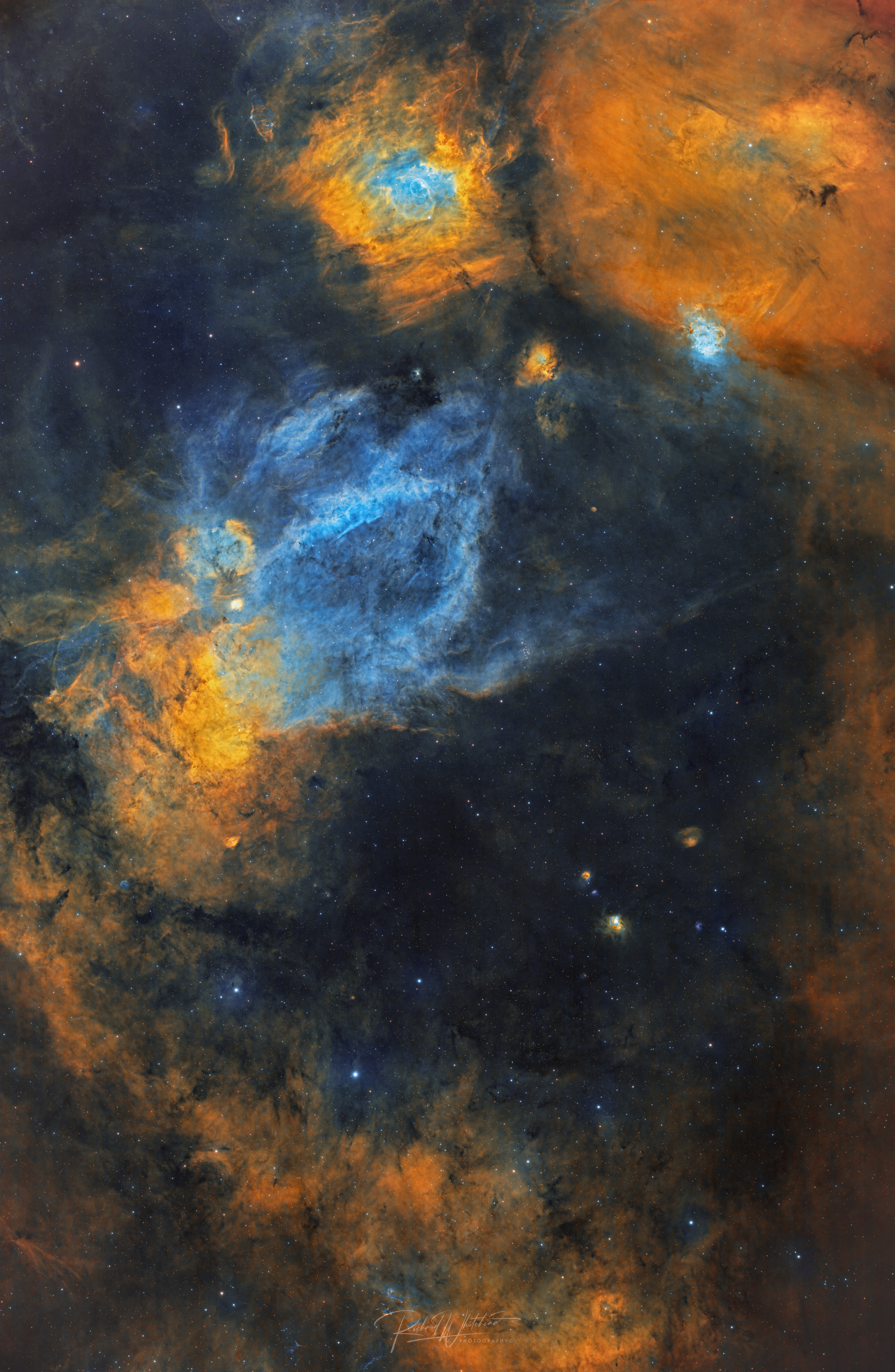
Explanation: What unexpected things do you see when you look up at the night sky? Today’s image resembles an abstract painting, with large swaths of color strewn across a cosmic canvas seemingly without design. Despite the image's abstract nature, the human mind finds patterns, identifying a large claw reaching up towards a floating bubble. Embedded within these seemingly random structures are the physical laws that govern how light and matter interact. The Claw (Sh2-157) and Bubble (NGC 7635) Nebulae glow colors that are mapped to the yellow and blue shown, indicating the presence of hydrogen and oxygen ionized by the intense light emitted from stars several times the mass of the Sun. This image depicts both the chaos and structure of astronomical processes, showing that a common thread between art and science is to look for the unexpected.

2026 March 31
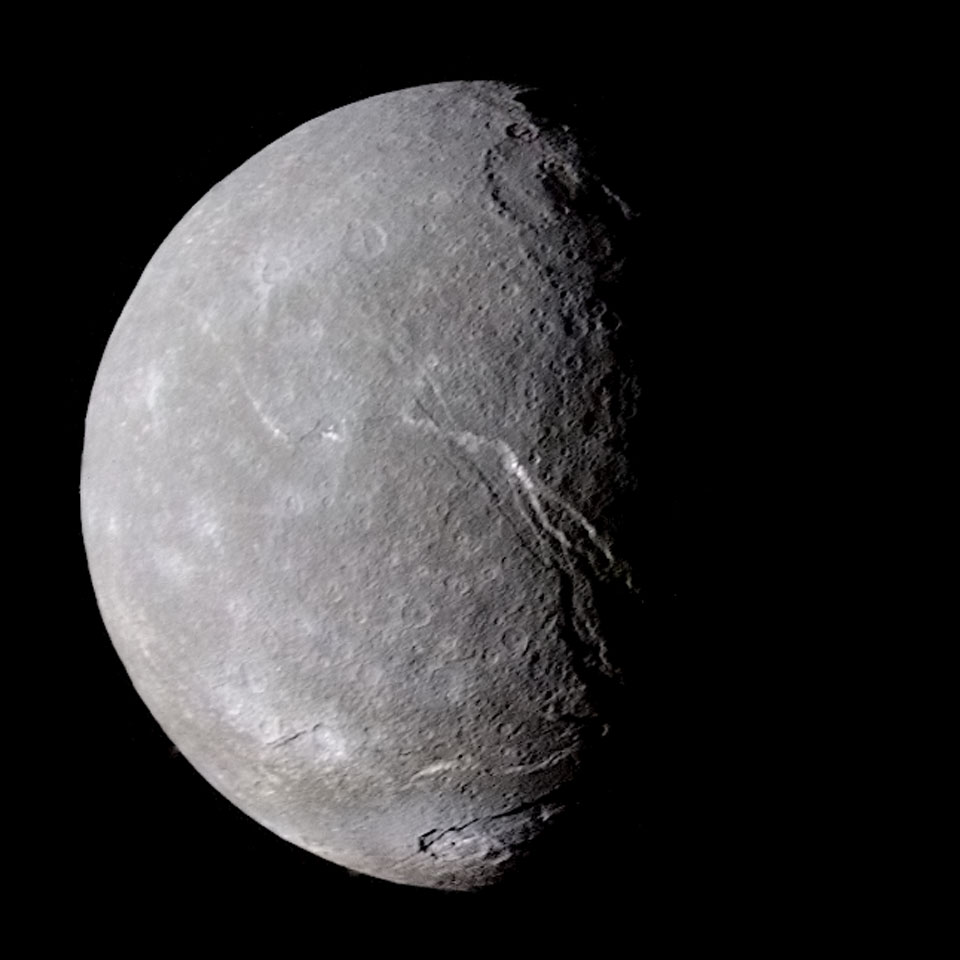
Explanation: Titania's tortured terrain is a mix of canyons, cliffs, and craters. NASA's interplanetary robot spacecraft Voyager 2 passed the largest moon of Uranus in 1986 and took the feature picture. That the trenches of Titania resemble those on another moon of Uranus, Ariel, indicate that Titania underwent some violent surface event possibly related to water freezing and expanding in its distant past. Although Titania is Uranus's largest moon, it is only about half the radius of Triton - the largest moon of Uranus's sister planet Neptune, which itself is slightly smaller than Earth's Moon. Titania, discovered by William Herschel in 1787, is essentially a large dirty iceball that is composed of about half water-ice and half rock. There is recent speculation that radioactive heating melts some underground ice into oceans.

En France, le SCPRI du professeur Pellerin veille. Fin 1988, en réaction à un dossier publié par la CRIIRAD, il rassure : les mineurs respireraient beaucoup moins de radon “que l’homme des cavernes dont nous descendons”, et il faudrait plutôt s’occuper “des autres pollutions bien réelles celles-là”.

2026 March 28
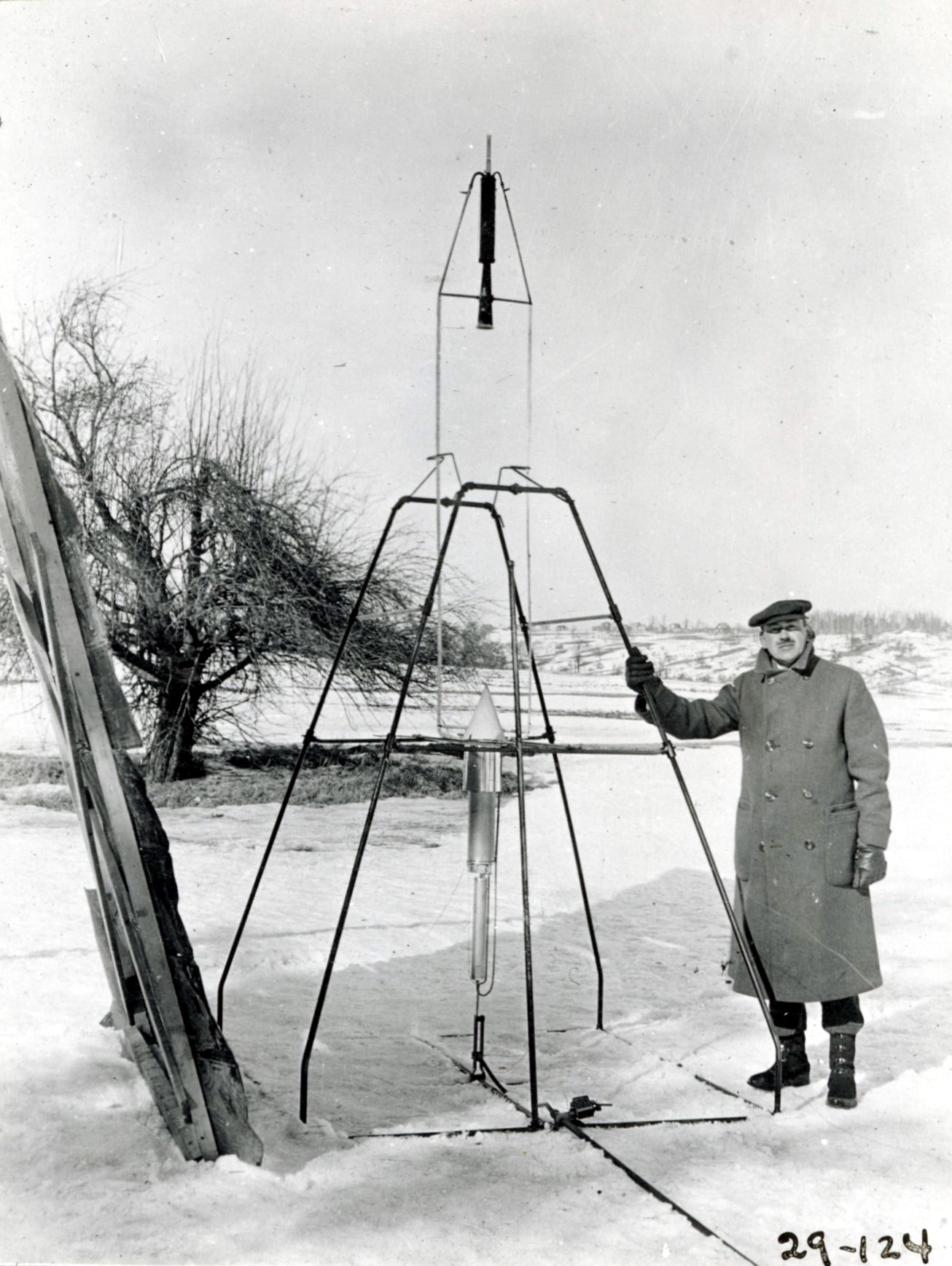
Explanation: Robert H. Goddard, considered the father of modern rocketry, was born in Worcester Massachusetts in 1882. As a 16 year old, Goddard read H.G. Wells' science fiction classic "War Of The Worlds" and dreamed of space flight. By 1926 he had designed, built, and flown the world's first liquid fuel rocket. Launched 100 years ago, on March 16, 1926 from his aunt Effie's farm in Auburn Massachusetts, the rocket dubbed "Nell", rose to an altitude of 41 feet in a flight that lasted about 2 1/2 seconds. In this posed photo Goddard stands next to the 10 foot tall rocket, holding the launch stand frame. To achieve a stable flight without the need for fins, the rocket's heavy motor was located at the top, fed by lines from liquid oxygen and gasoline fuel tanks at the bottom. Widely recognized as a gifted experimenter and engineering genius, his rockets were many years ahead of their time. Goddard was awarded over 200 patents in rocket technology, most of them after his death in 1945. A liquid fuel rocket constructed on principles developed by Goddard landed humans on the Moon in 1969.
2026 March 27
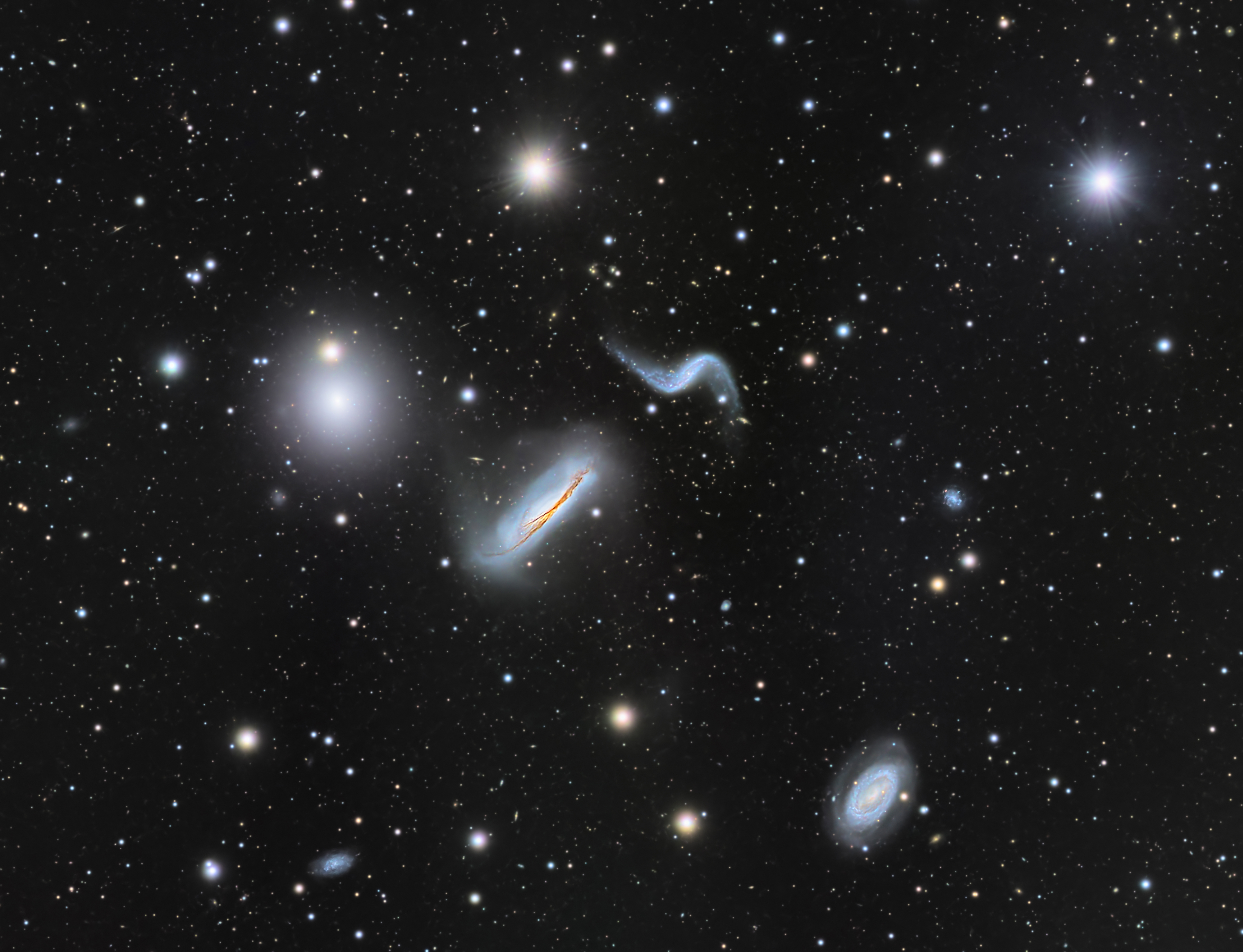
Explanation: Scanning the skies for galaxies, Canadian astronomer Paul Hickson and colleagues identified some 100 compact groups of galaxies, now appropriately called Hickson Compact Groups. The four prominent galaxies seen in this intriguing telescopic skyscape are one such group, Hickson 44. The Hickson 44 galaxy group is about 100 million light-years distant, far beyond the foreground Milky Way stars, toward the northern springtime constellation Leo. The two spiral galaxies in the center of the image are edge-on NGC 3190 with distinctive, warped dust lanes, and S-shaped NGC 3187. Along with the bright elliptical, NGC 3193 (left) they are also known as Arp 316. The spiral toward the lower right corner is NGC 3185, the 4th member of the Hickson group. Like other galaxies in Hickson groups, these show signs of distortion and enhanced star formation, evidence of a gravitational tug of war that will eventually result in galaxy mergers on a cosmic timescale. The merger process is now understood to be a normal part of the evolution of galaxies, including our own Milky Way. For scale, NGC 3190 is about 75,000 light-years across at the estimated distance of Hickson 44.

2026 March 25
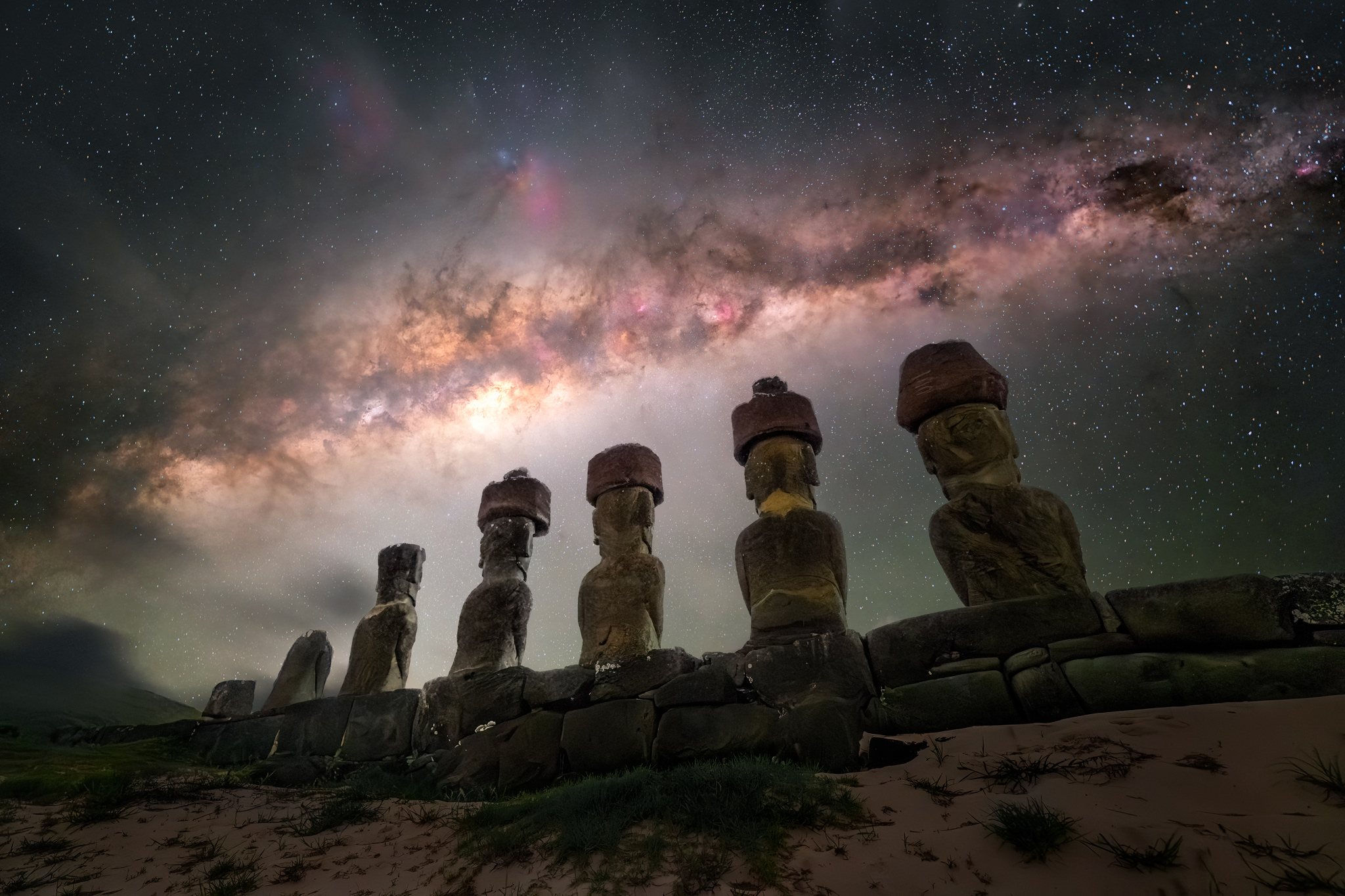
Explanation: In the words of today's astrophotographer, Rositsa Dimitrova, "What have these silent sentinels watched pass across the sky?" The volcanic mo'ai (meaning statue) of Ahu Tongariki stand guard over Rapa Nui (Isla de Pascua, Easter Island), a Polynesian island (annexed by Chile in 1888) located thousands of kilometers off the coast of South America in the Pacific Ocean. Due to the island's remoteness, the mo'ai, with their backs to the dark ocean, are able to gaze upon a clear and vibrant night sky. Pictured, these larger-than-life statues stare at the bright band of the Milky Way, partly obscured by interstellar dust and blurred by Earth's clouds. Under such clear night skies, the Rapa Nui created observatories and used astronomical observations for navigation, calendar calibration, celebrations, and more. Images like this one remind us of the importance of dark skies, protecting the land underneath them, and preserving the culture that they inspire.
C’est un profil qu’on ne voit pas souvent. Sur cette image diffusée par la Nasa, notre Lune dévoile son bassin oriental et certaines parties...


