"Atterrissage d'urgence"
aeronewstv.com
2021 April 2
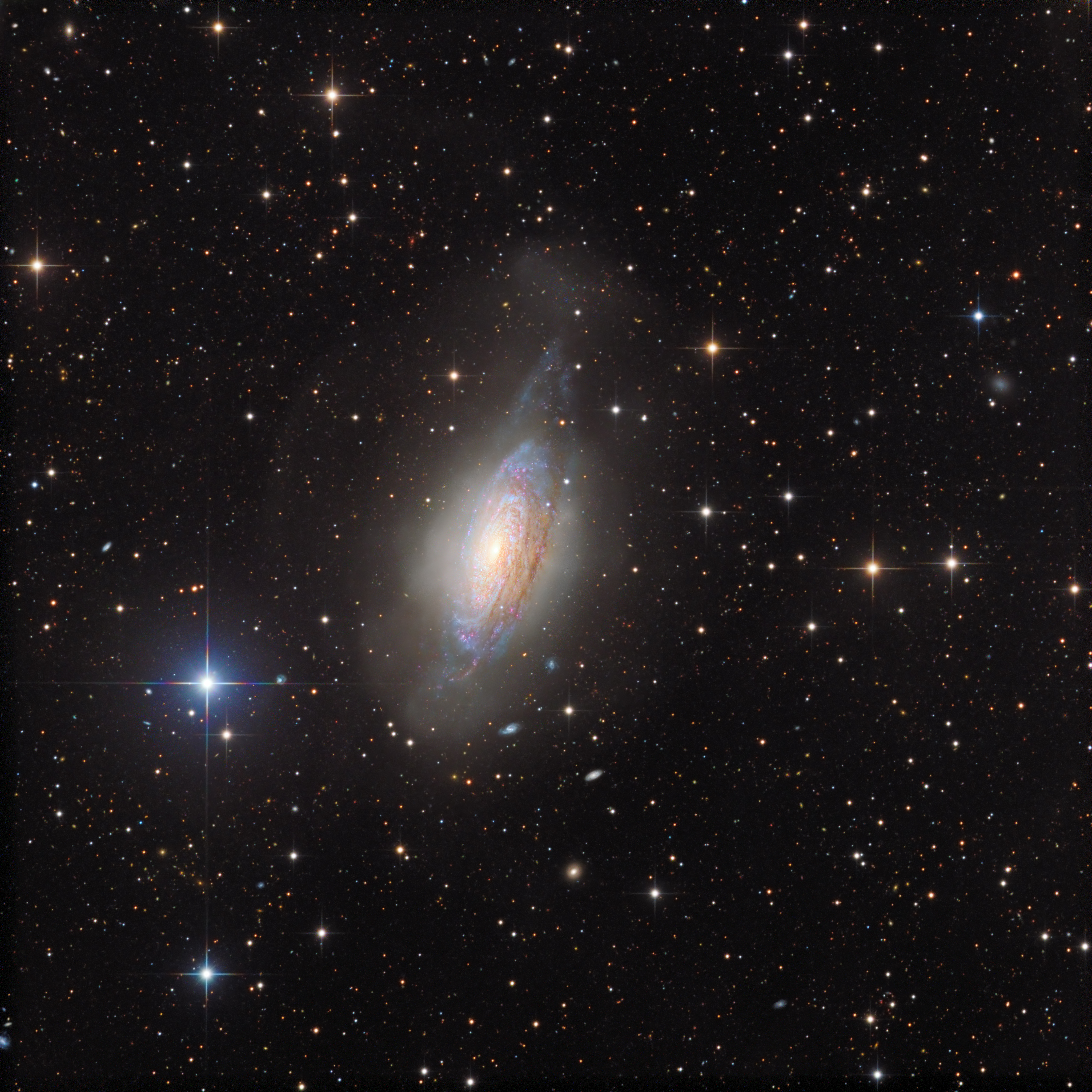
Explanation: Gorgeous spiral galaxy NGC 3521 is a mere 35 million light-years away, toward the constellation Leo. Relatively bright in planet Earth's sky, NGC 3521 is easily visible in small telescopes but often overlooked by amateur imagers in favor of other Leo spiral galaxies, like M66 and M65. It's hard to overlook in this colorful cosmic portrait, though. Spanning some 50,000 light-years the galaxy sports characteristic patchy, irregular spiral arms laced with dust, pink star forming regions, and clusters of young, blue stars. Remarkably, this deep image also finds NGC 3521 embedded in gigantic bubble-like shells. The shells are likely tidal debris, streams of stars torn from satellite galaxies that have undergone mergers with NGC 3521 in the distant past.
2021 April 1
Explanation: Have you ever seen a rocket launch -- from space? A close inspection of the featured time-lapse video will reveal a rocket rising to Earth orbit as seen from the International Space Station (ISS). The Russian Soyuz-FG rocket was launched in November 2018 from the Baikonur Cosmodrome in Kazakhstan, carrying a Progress MS-10 (also 71P) module to bring needed supplies to the ISS. Highlights in the 90-second video (condensing about 15-minutes) include city lights and clouds visible on the Earth on the lower left, blue and gold bands of atmospheric airglow running diagonally across the center, and distant stars on the upper right that set behind the Earth. A lower stage can be seen falling back to Earth as the robotic supply ship fires its thrusters and begins to close on the ISS, a space laboratory that celebrated its 20th anniversary in 2018. Astronauts who live aboard the Earth-orbiting ISS conduct, among more practical duties, numerous science experiments that expand human knowledge and enable future commercial industry in low Earth orbit.
2021 March 31
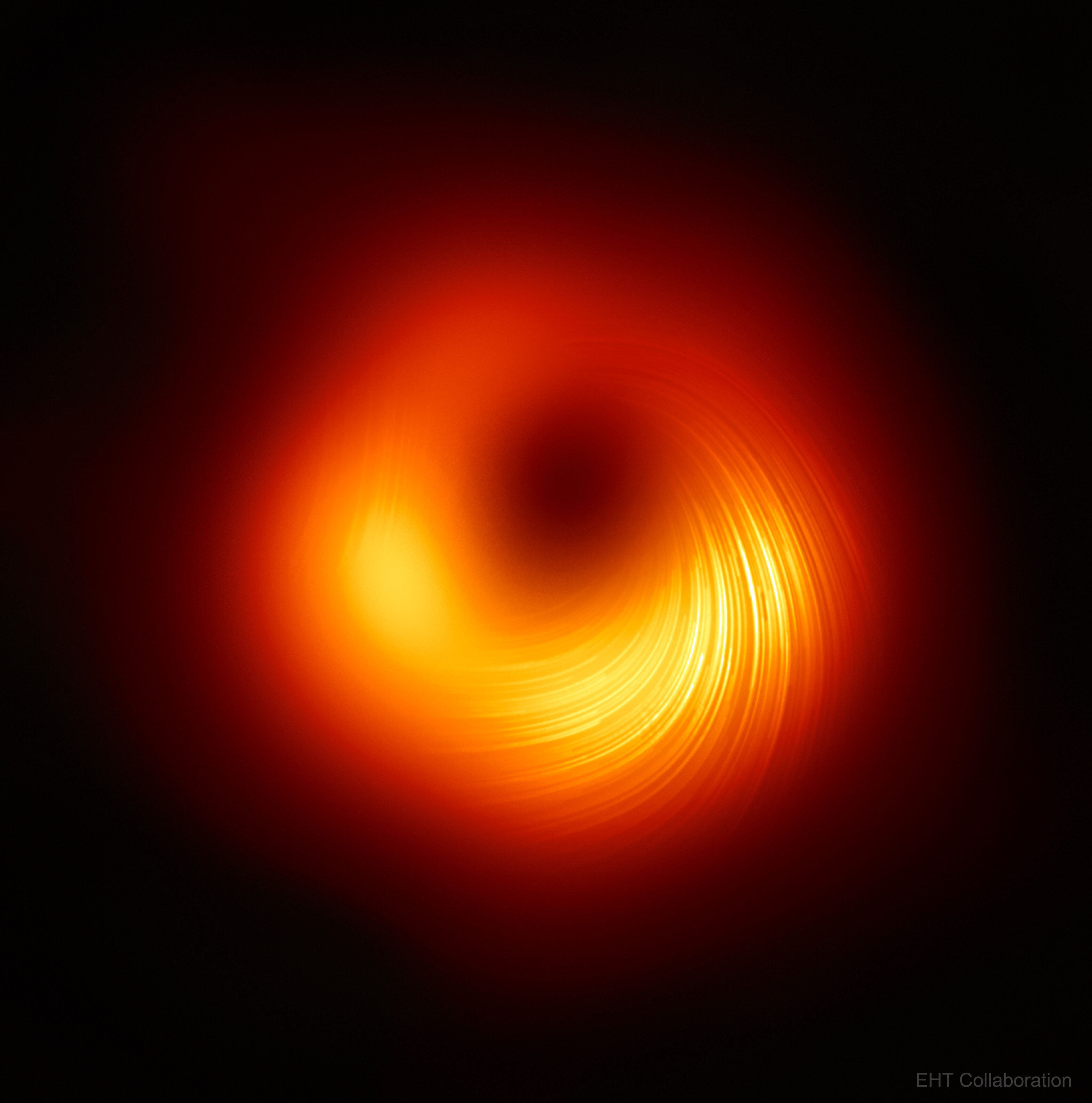
Explanation: To play on Carl Sagan’s famous words "If you wish to make black hole jets, you must first create magnetic fields." The featured image represents the detected intrinsic spin direction (polarization) of radio waves. The polarizationi is produced by the powerful magnetic field surrounding the supermassive black hole at the center of elliptical galaxy M87. The radio waves were detected by the Event Horizon Telescope (EHT), which combines data from radio telescopes distributed worldwide. The polarization structure, mapped using computer generated flow lines, is overlaid on EHT’s famous black hole image, first published in 2019. The full 3-D magnetic field is complex. Preliminary analyses indicate that parts of the field circle around the black hole along with the accreting matter, as expected. However, another component seemingly veers vertically away from the black hole. This component could explain how matter resists falling in and is instead launched into M87’s jet.
2021 March 29
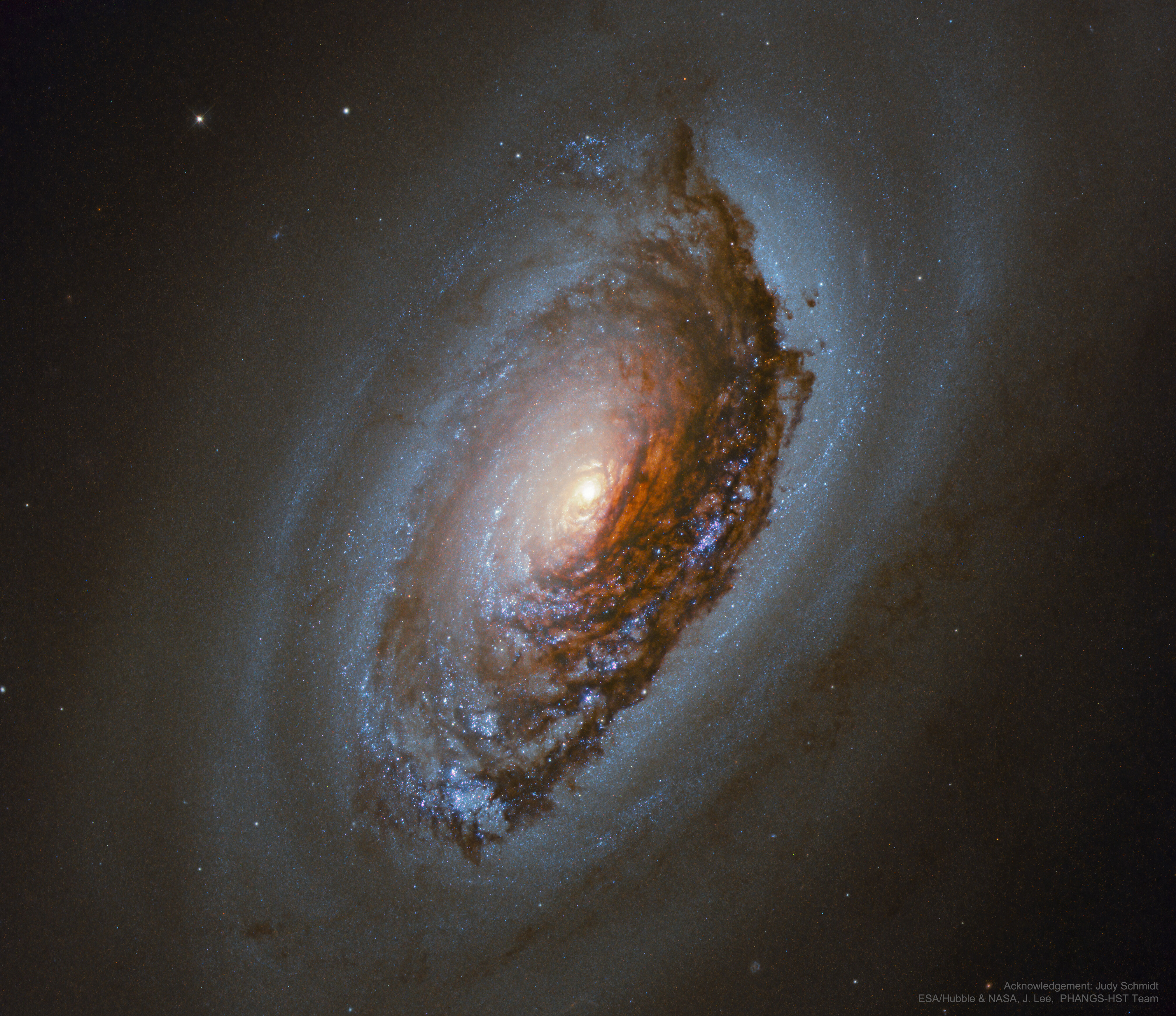
Explanation: Who knows what evil lurks in the eyes of galaxies? The Hubble knows -- or in the case of spiral galaxy M64 -- is helping to find out. Messier 64, also known as the Evil Eye or Sleeping Beauty Galaxy, may seem to have evil in its eye because all of its stars rotate in the same direction as the interstellar gas in the galaxy's central region, but in the opposite direction in the outer regions. Captured here in great detail by the Earth-orbiting Hubble Space Telescope, enormous dust clouds obscure the near-side of M64's central region, which are laced with the telltale reddish glow of hydrogen associated with star formation. M64 lies about 17 million light years away, meaning that the light we see from it today left when the last common ancestor between humans and chimpanzees roamed the Earth. The dusty eye and bizarre rotation are likely the result of a billion-year-old merger of two different galaxies.
2021 March 28
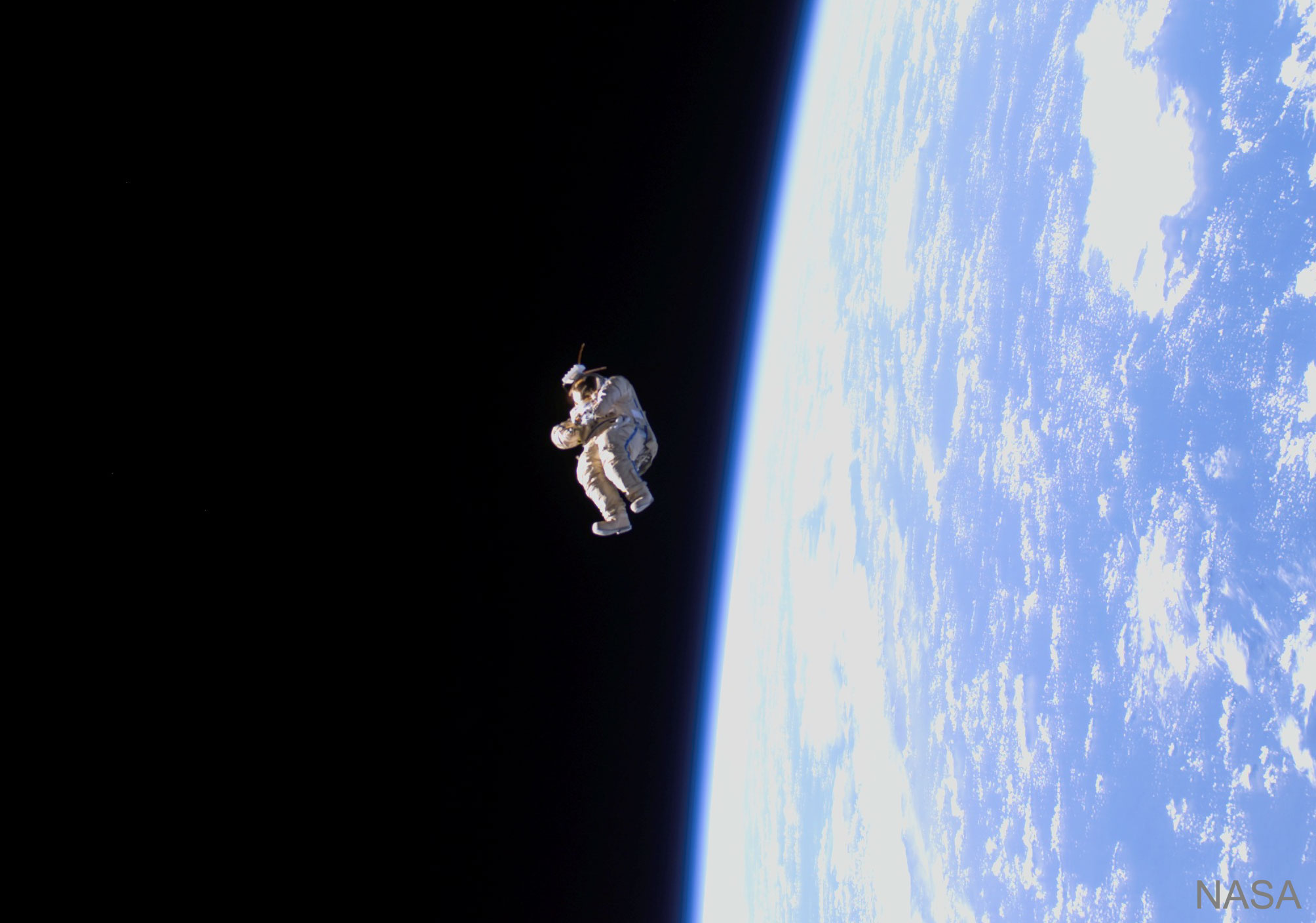
Explanation: A spacesuit floated away from the International Space Station 15 years ago, but no investigation was conducted. Everyone knew that it was pushed by the space station crew. Dubbed Suitsat-1, the unneeded Russian Orlan spacesuit filled mostly with old clothes was fitted with a faint radio transmitter and released to orbit the Earth. The suit circled the Earth twice before its radio signal became unexpectedly weak. Suitsat-1 continued to orbit every 90 minutes until it burned up in the Earth's atmosphere after a few weeks. Pictured, the lifeless spacesuit was photographed in 2006 just as it drifted away from space station.
2021 March 26
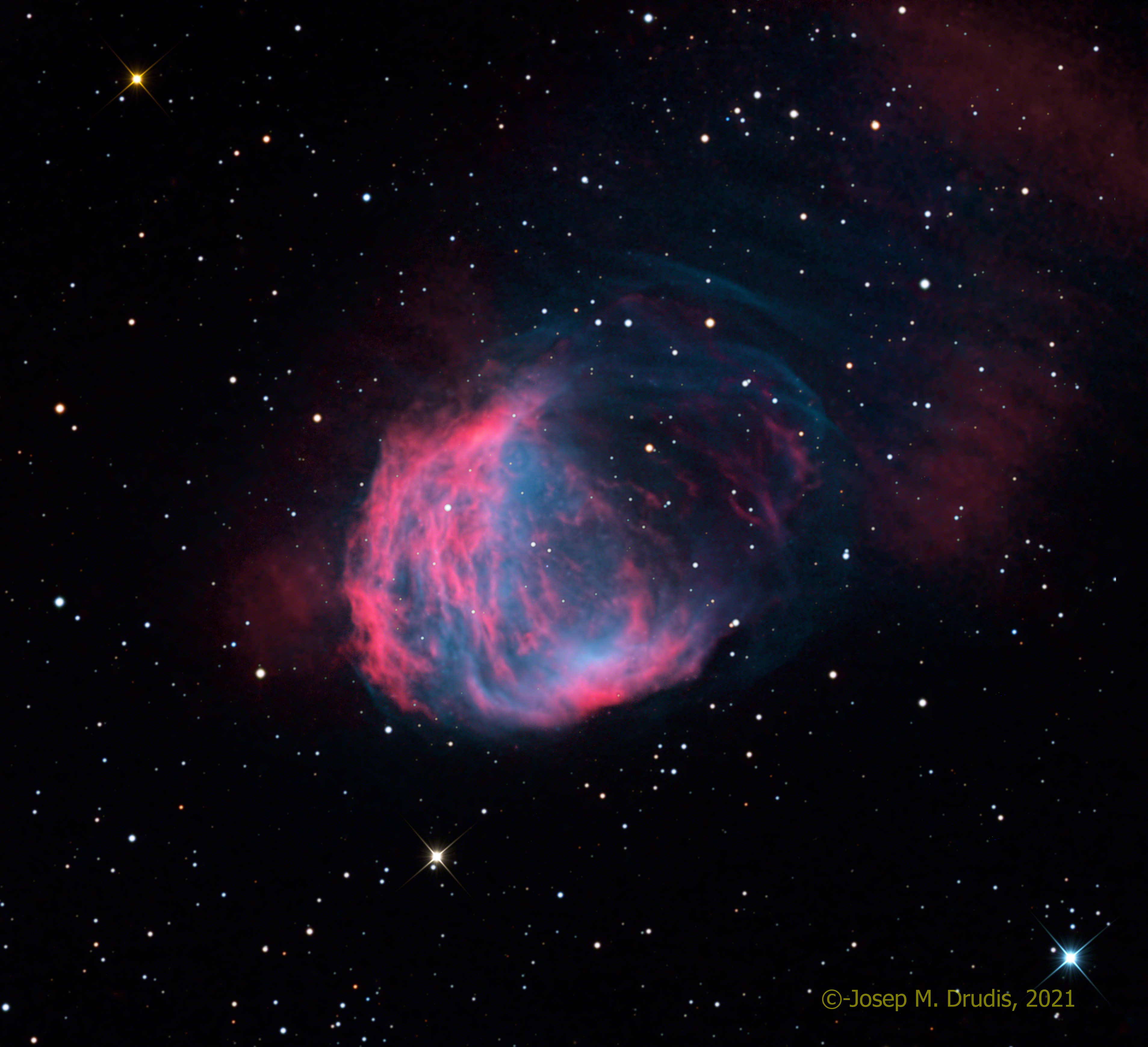
Explanation: Braided and serpentine filaments of glowing gas suggest this nebula's popular name, The Medusa Nebula. Also known as Abell 21, this Medusa is an old planetary nebula some 1,500 light-years away in the constellation Gemini. Like its mythological namesake, the nebula is associated with a dramatic transformation. The planetary nebula phase represents a final stage in the evolution of low mass stars like the sun as they transform themselves from red giants to hot white dwarf stars and in the process shrug off their outer layers. Ultraviolet radiation from the hot star powers the nebular glow. The Medusa's transforming star is the faint one near the center of the overall bright crescent shape. In this deep telescopic view, fainter filaments clearly extend above and right of the bright crescent region. The Medusa Nebula is estimated to be over 4 light-years across.
2021 March 25

Explanation: Before Perseverance there was Curiosity. In fact, the Curiosity rover accomplished the first sky crane maneuver touchdown on Mars on August 5, 2012. March 2, 2021 marked Curiosity's 3,048th martian day operating on the surface of the Red Planet. This 360 degree panorama from sol 3048 is a mosaic of 149 frames from Curiosity's Mastcam above the rover's deck. It includes 23 frames of icy, thin, high clouds drifting through the martian sky. The cloudy sky frames were recorded throughout that martian day and are digitally stitched together in the panoramic view. Near center is a layered and streaked Mont Mercou. The peak of central Mount Sharp, rising over 5 kilometers above the floor of Gale Crater, is in the distant background on the left.
2021 March 24
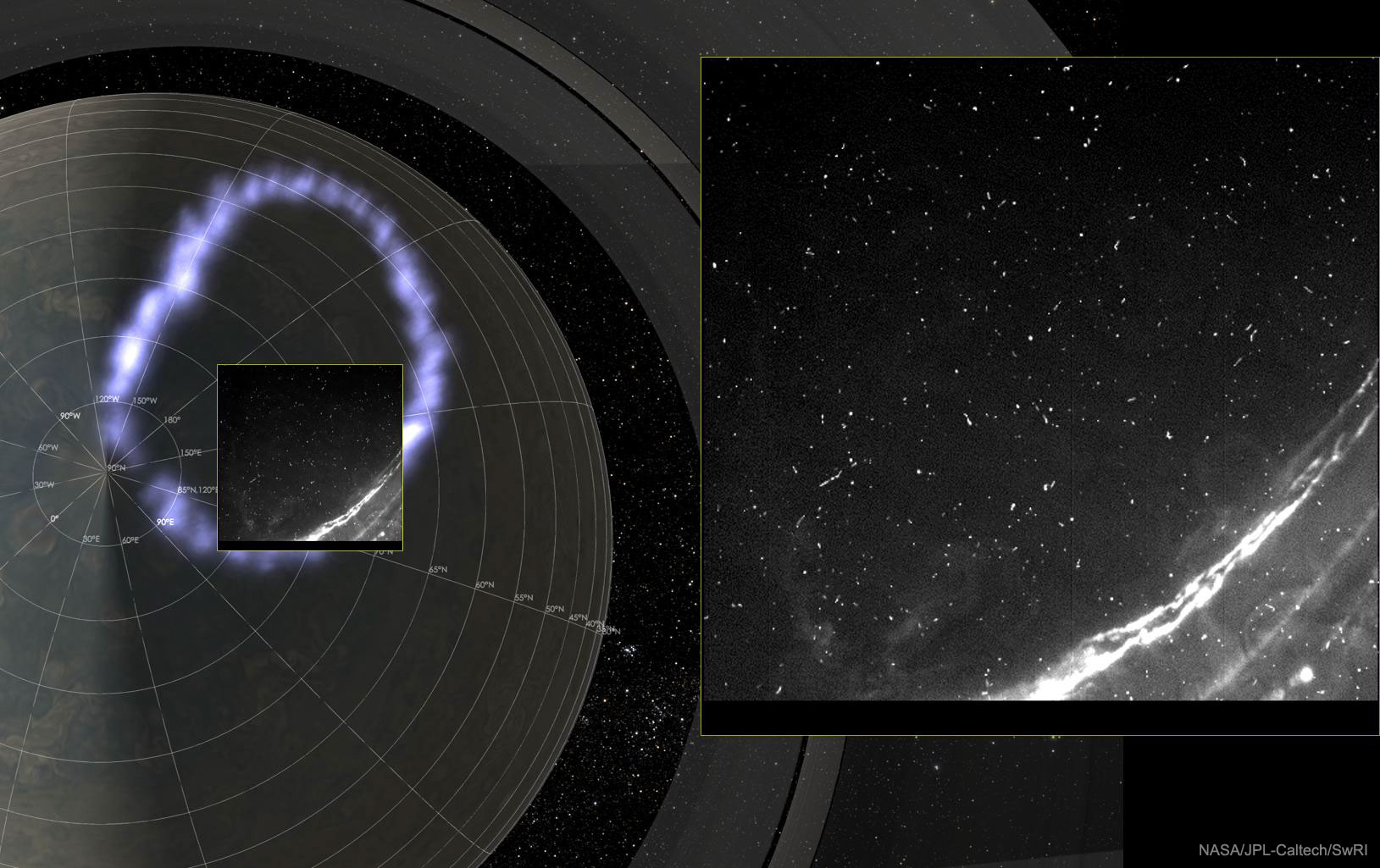
Explanation: Why does so much of Jupiter's lightning occur near its poles? Similar to Earth, Jupiter experiences both aurorae and lightning. Different from Earth, though, Jupiter's lightning usually occurs near its poles -- while much of Earth's lightning occurs near its equator. To help understand the difference, NASA's Juno spacecraft, currently orbiting Jupiter, has observed numerous aurora and lightning events. The featured image, taken by Juno's Stellar Reference Unit camera on 2018 May 24, shows Jupiter's northern auroral oval and several bright dots and streaks. An eye-catching event is shown in the right inset image -- which is a flash of Jupiter's lightning -- one of the closest images of aurora and lightning ever. On Earth (which is much nearer to the Sun than Jupiter), sunlight is bright enough to create, by itself, much stronger atmospheric heating at the equator than the poles, driving turbulence, storms, and lightning. On Jupiter, in contrast, atmospheric heating comes mostly from its interior (as a remnant from its formation), leading to the hypothesis that more intense equatorial sunlight reduces temperature differences between upper atmospheric levels, hence reducing equatorial lightning-creating storms.

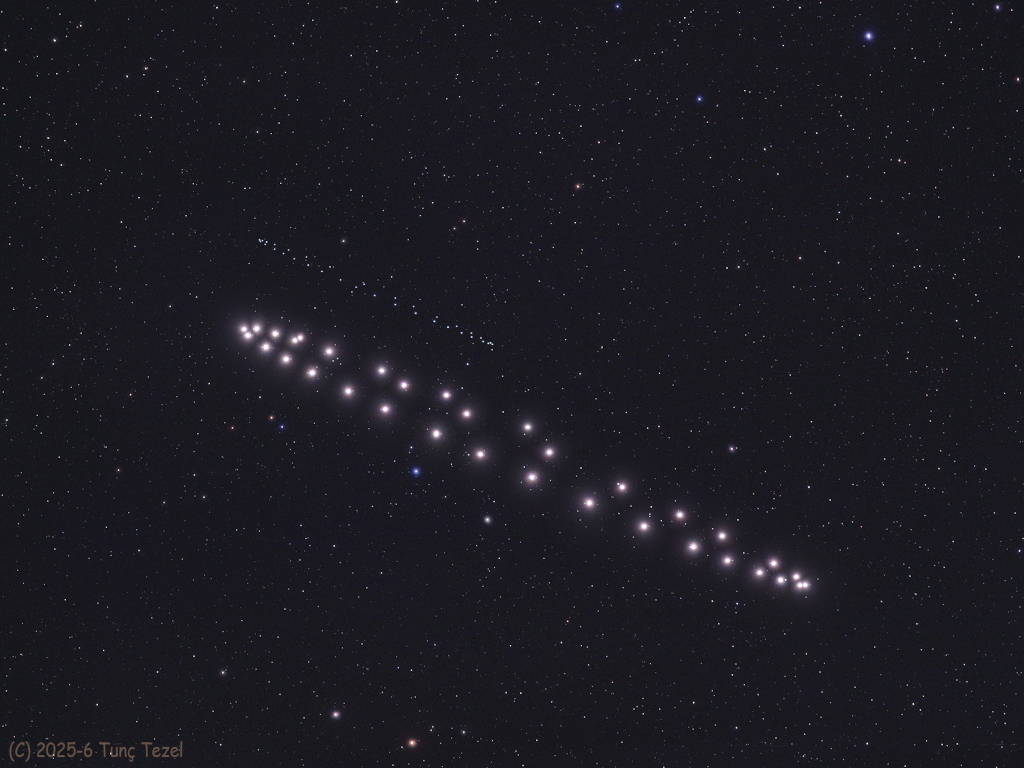
2026 May 6 The Retrograde Dance of Saturn and Neptune Image Credit & Copyright: Tunç Tezel ( TWAN ) Text: Keighley Rockcliffe ( NA...