Nombre total de pages vues
28/08/2021
MINERAUX - Le sélénite, une pierre de lune
ASTRONOMY - Mars Rock Rochette
2021 August 28
Image Credit: NASA, JPL-Caltech
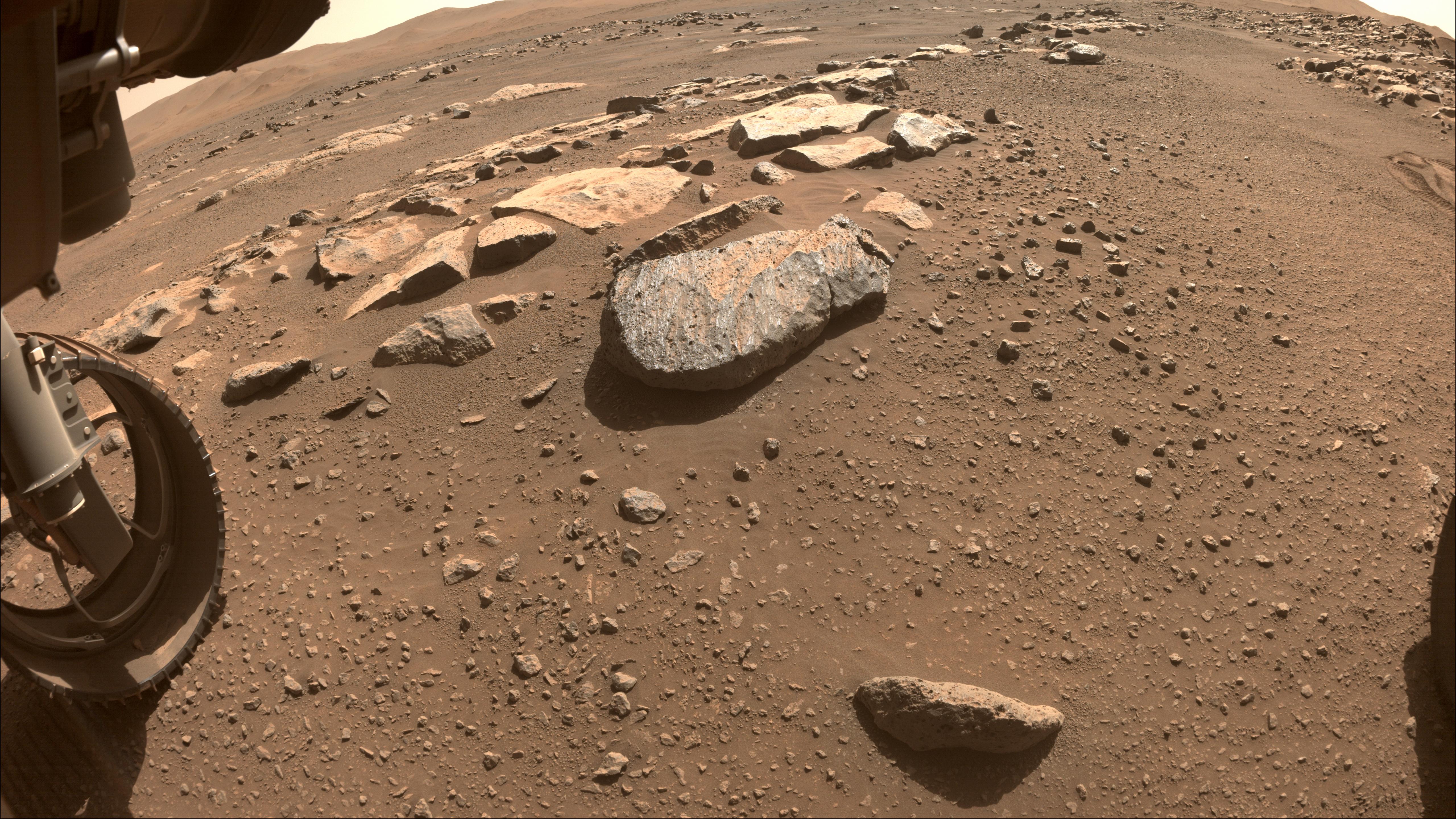
Explanation: Taken on mission sol 180 (August 22) this sharp image from a Hazard Camera on the Perseverance rover looks out across a rock strewn floor of Jezero crater on Mars. At 52.5 centimeters (21 inches) in diameter, one of the rover's steerable front wheels is at lower left in the frame. Near center is a large rock nicknamed Rochette. Mission planners don't want to avoid Rochette though. Instead Perseverance will be instructed to reach out with its 2 meter long robotic arm and abrade the rock's surface, to determine whether it has a consistency suitable for obtaining a sample, slightly thicker than a pencil, using the rover's coring bit. Samples collected by Perseverance would be returned to Earth by a future Mars mission.
25/08/2021
ASTRONOMY - Solar System Ball Drop
2021 August 25
Video Credit & Copyright: James O'Donoghue (JAXA) & Rami Mandow (Space Australia); Text: James O'Donoghue
Explanation: Does a ball drop faster on Earth, Jupiter, or Uranus? The featured animation shows a ball dropping from one kilometer high toward the surfaces of famous solar system bodies, assuming no air resistance. The force of gravity depends on the mass of the attracting object, with higher masses pulling down with greater forces. But gravitational force also depends on distance from the center of gravity, with shorter distances causing the ball to drop faster. Combining both mass and distance, it might be surprising to see that Uranus pulls the ball down slightly slower than Earth, despite containing over 14 times more mass. This happens because Uranus has a much lower density, which puts its cloud tops further away from its center of mass. Although the falling ball always speeds up, if you were on the ball you would not feel this acceleration because you would be in free-fall. Of the three planets mentioned, the video demonstrates a ball drops even faster on Jupiter than either Earth and Uranus.
24/08/2021
PRATIQUE - Comment Déboucher Un Évier En 3 Étapes Faciles
L'évier de la cuisine est complètement bouché ? Il reflue et en plus, ça pue dans la maison ? Et pour ne rien arranger, ça tombe un dimanche.... Heureusement, mon plombier m'a partagé une astuce super efficace pour déboucher un évier facilement. C'est une méthode rapide et économique en 3 étapes faciles. Elle évite d'appeler un plombier ou d'utiliser des produits toxiques comme le Destop. L'astuce naturelle est de mettre du bicarbonate, du vinaigre blanc et enfin de l'eau bouillante. Regardez :
23/08/2021
PRATIQUE/POURQUOI - Pourquoi a-t-on une meilleure réception lorsqu'on touche l'antenne d'une radio ?

ASTRONOMY - Island Universe, Cosmic Sand
2021 August 14
Image Credit & Copyright: Marzena Rogozinska
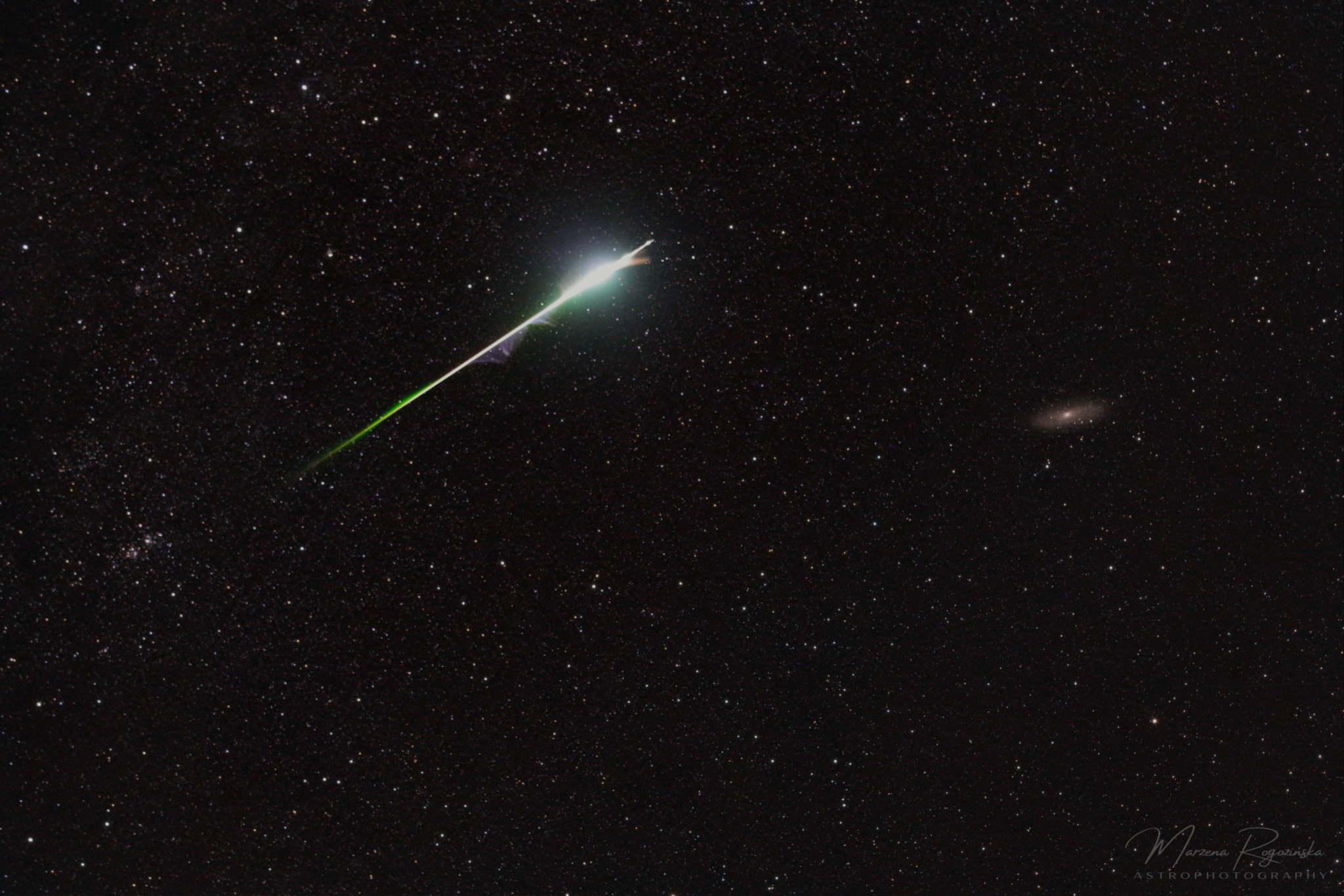
Explanation: Stars in our own Milky Way Galaxy are scattered through this eye-catching field of view. From the early hours after midnight on August 13, the 30 second exposure of the night sky over Busko-Zdroj, Poland records the colorful and bright trail of a Perseid meteor. Seen near the peak of the annual Perseid meteor shower it flashes from lower left to upper right. The hurtling grain of cosmic sand, a piece of dust from periodic comet Swift-Tuttle, vaporized as it passed through planet Earth's atmosphere at almost 60 kilometers per second. Just above and right of center, well beyond the stars of the Milky Way, lies the island universe known as M31 or the Andromeda Galaxy. The Andromeda Galaxy is the most distant object easily visible to the naked-eye, about 2.5 million light-years away. The visible meteor trail begins only about 100 kilometers above Earth's surface, though. It points back to the meteor shower radiant in the constellation Perseus off the lower left edge of the frame. Follow this bright perseid meteor trail below and left to the stars of NGC 869and NGC 884, the double star cluster in Perseus.
22/08/2021
ASTRONOMY - Explosions from White Dwarf Star RS Oph
2021 August 22
Illustration Credit & Copyright: David A. Hardy & PPARC
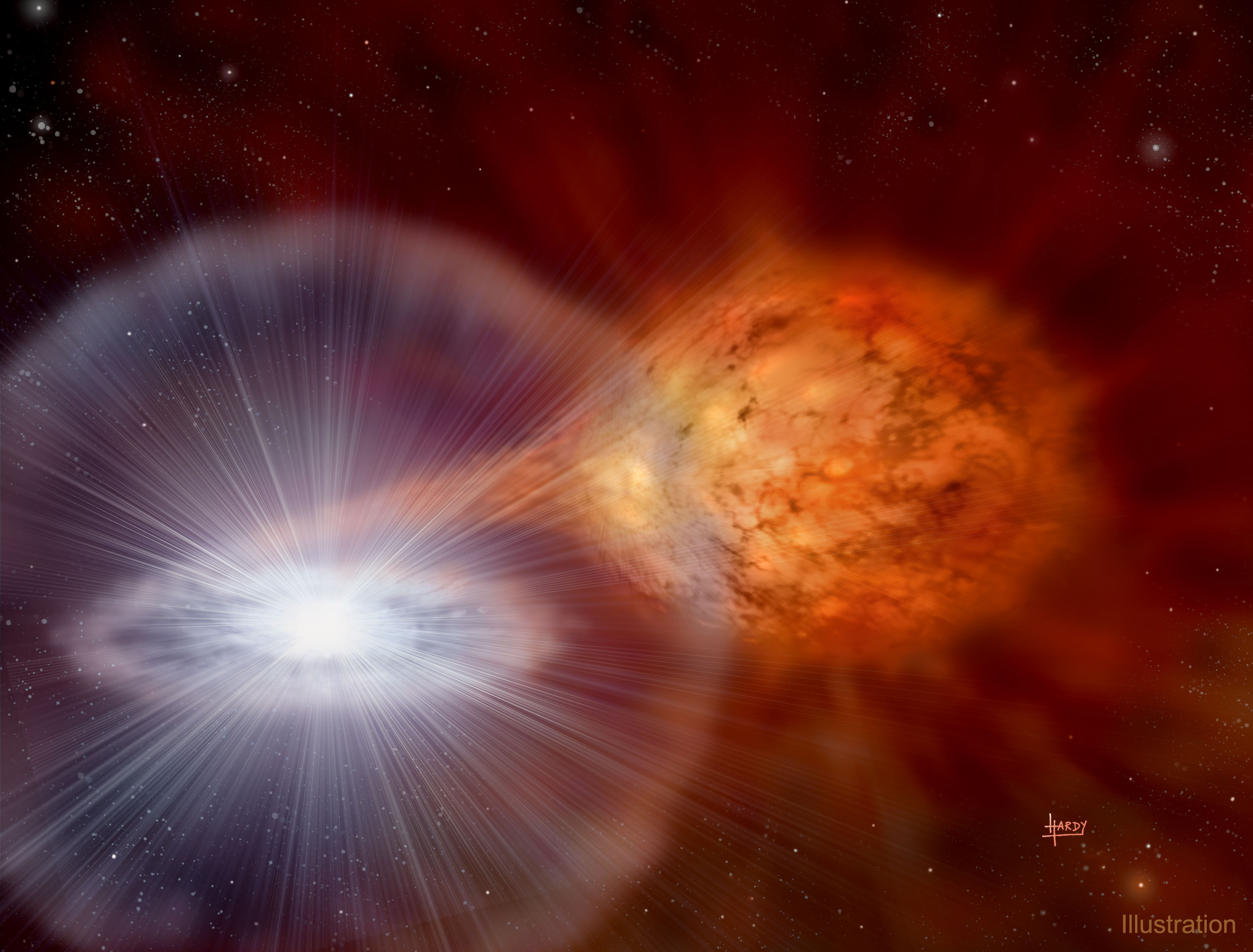
Explanation: Spectacular explosions keep occurring in the binary star system named RS Ophiuchi. Every 20 years or so, the red giant star dumps enough hydrogen gas onto its companion white dwarf star to set off a brilliant thermonuclear explosion on the white dwarf's surface. At about 5,000 light years distant, the resulting nova explosions cause the RS Oph system to brighten up by a huge factor and become visible to the unaided eye. The red giant star is depicted on the right of the above drawing, while the white dwarf is at the center of the bright accretion disk on the left. As the stars orbit each other, a stream of gas moves from the giant star to the white dwarf. Astronomers speculate that at some time in the next 100,000 years, enough matter will have accumulated on the white dwarf to push it over the Chandrasekhar Limit, causing a much more powerful and final explosion known as a supernova. Starting early this month, RS Oph was again seen exploding in a bright nova.
20/08/2021
021 August 20
Image Credit & Copyright: Balint Lengyel
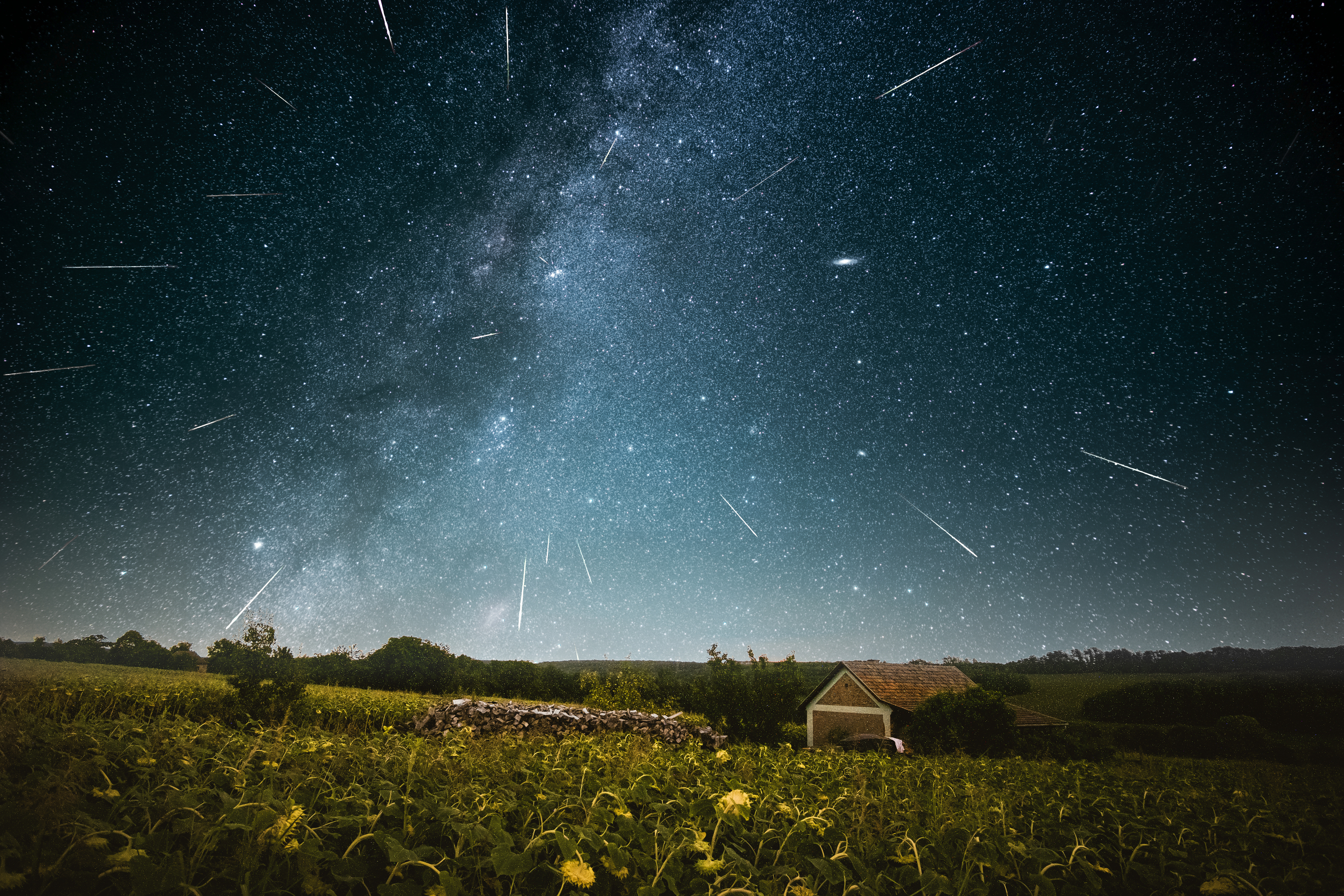
Explanation: Frames from a camera that spent three moonless nights under the stars create this composite night skyscape. They were recorded during August 11-13 while planet Earth was sweeping through the dusty trail of comet Swift-Tuttle. One long exposure, untracked for the foreground, and the many star tracking captures of Perseid shower meteors were taken from the village of Magyaregres, Hungary. Each aligned against the background stars, the meteor trails all point back to the annual shower's radiant in the constellation Perseus heroically standing above this rural horizon. Of course the comet dust particles are traveling along trajectories parallel to each other. The radiant effect is due only to perspective, as the parallel tracks appear to converge in the distance against the starry sky.
11/08/2021
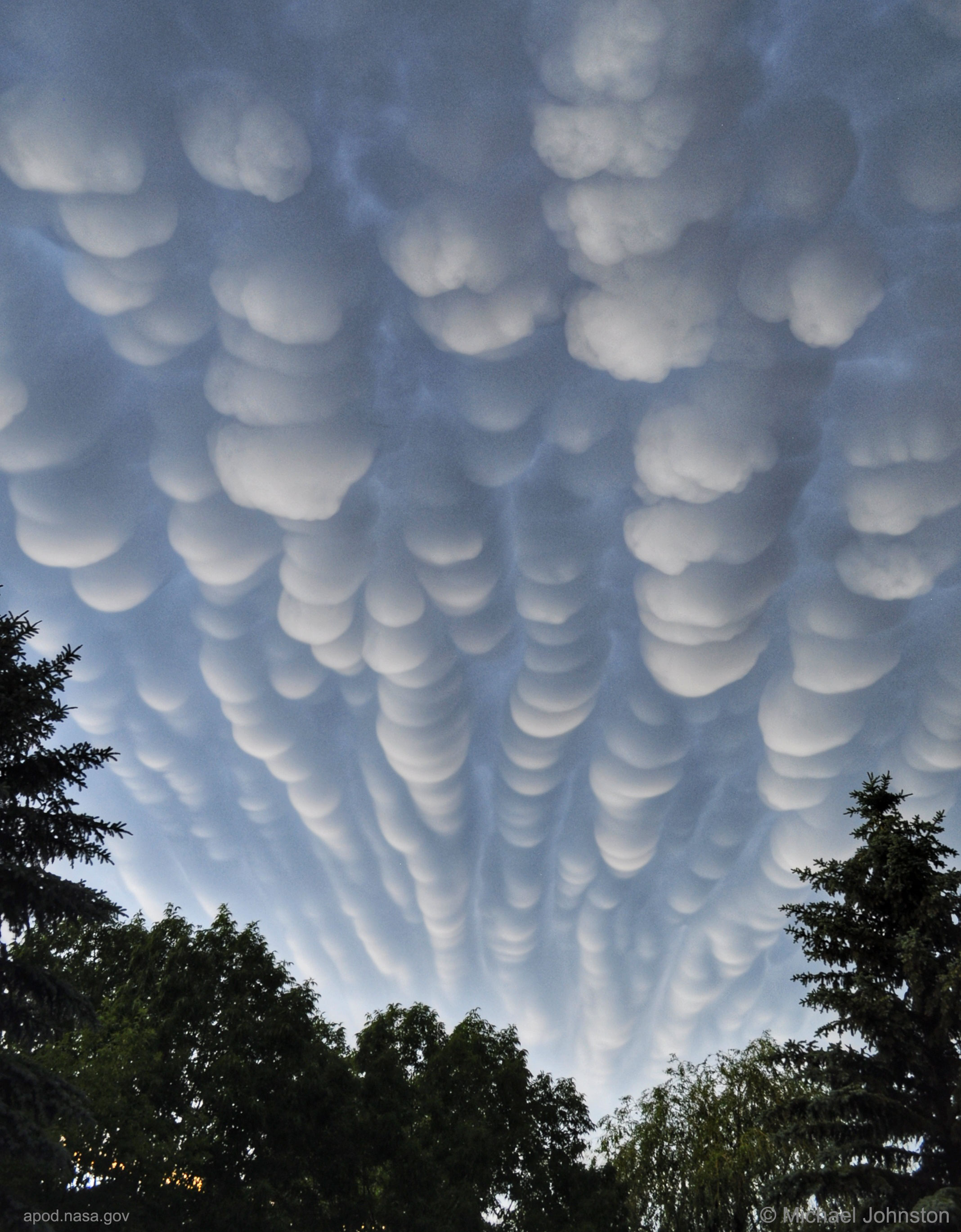
ASTRONOMY - Mammatus Clouds over Saskatchewan
2021 August 11
Image Credit & Copyright: Michael F Johnston
Explanation: When do cloud bottoms appear like bubbles? Normally, cloud bottoms are flat. This is because moist warm air that rises and cools will condense into water droplets at a specific temperature, which usually corresponds to a very specific height. As water droplets grow, an opaque cloud forms. Under some conditions, however, cloud pockets can develop that contain large droplets of water or ice that fall into clear air as they evaporate. Such pockets may occur in turbulent air near a thunderstorm. Resulting mammatus clouds can appear especially dramatic if sunlit from the side. The mammatus clouds pictured here, lasting only a few minutes, were photographed over Regina, Saskatchewan, Canada, just after a storm in 2012.
10/08/2021
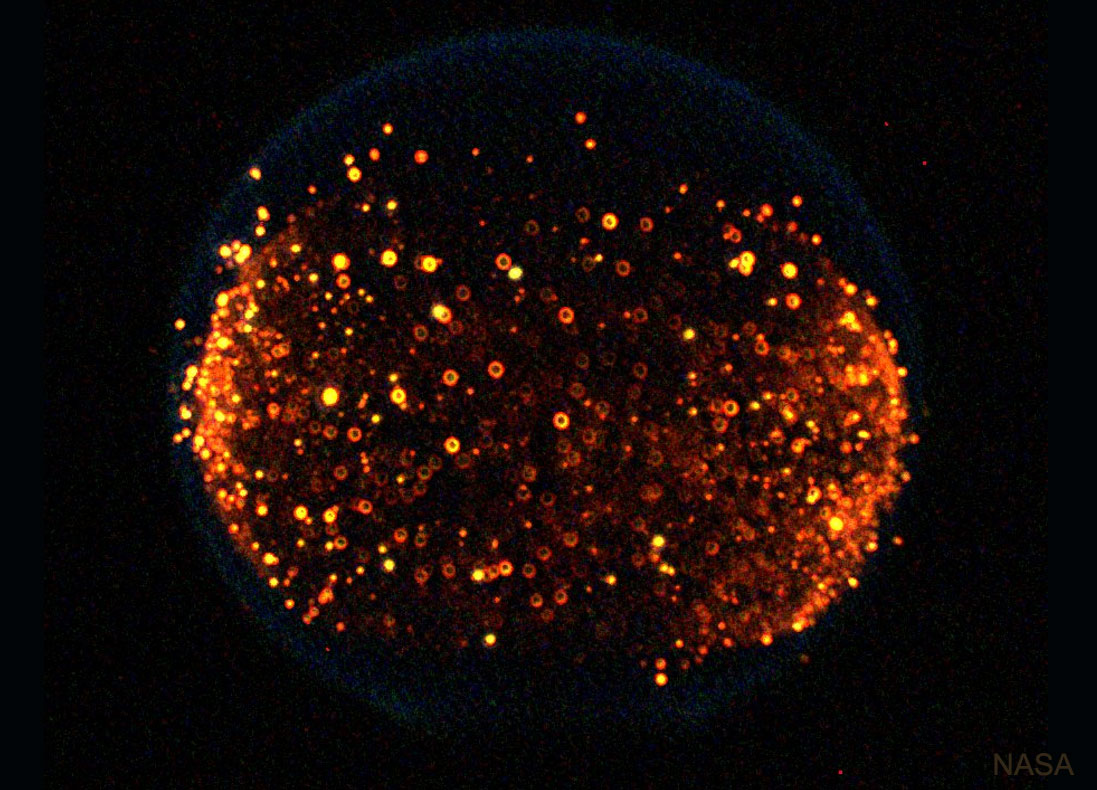
ASTRONOMY - Fire in Space
2021 August 10
Image Credit: NASA
Explanation: What does fire look like in space? In the gravity on Earth, heated air rises and expands, causing flames to be teardrop shaped. In the microgravity of the air-filled International Space Station (ISS), however, flames are spheres. Fire is the rapid acquisition of oxygen, and space flames meet new oxygen molecules when they float by randomly from all directions -- creating the enveloping sphere. In the featured image taken in the ISS's Combustion Integration Rack, a spherical flame envelopes clusters of hot glowing soot. Without oxygen, say in the vacuum of empty space, a fire would go out immediately. The many chemical reactions involved with fire are complex, and testing them in microgravity is helping humanity not only to better understand fire -- but how to put out fire, too.
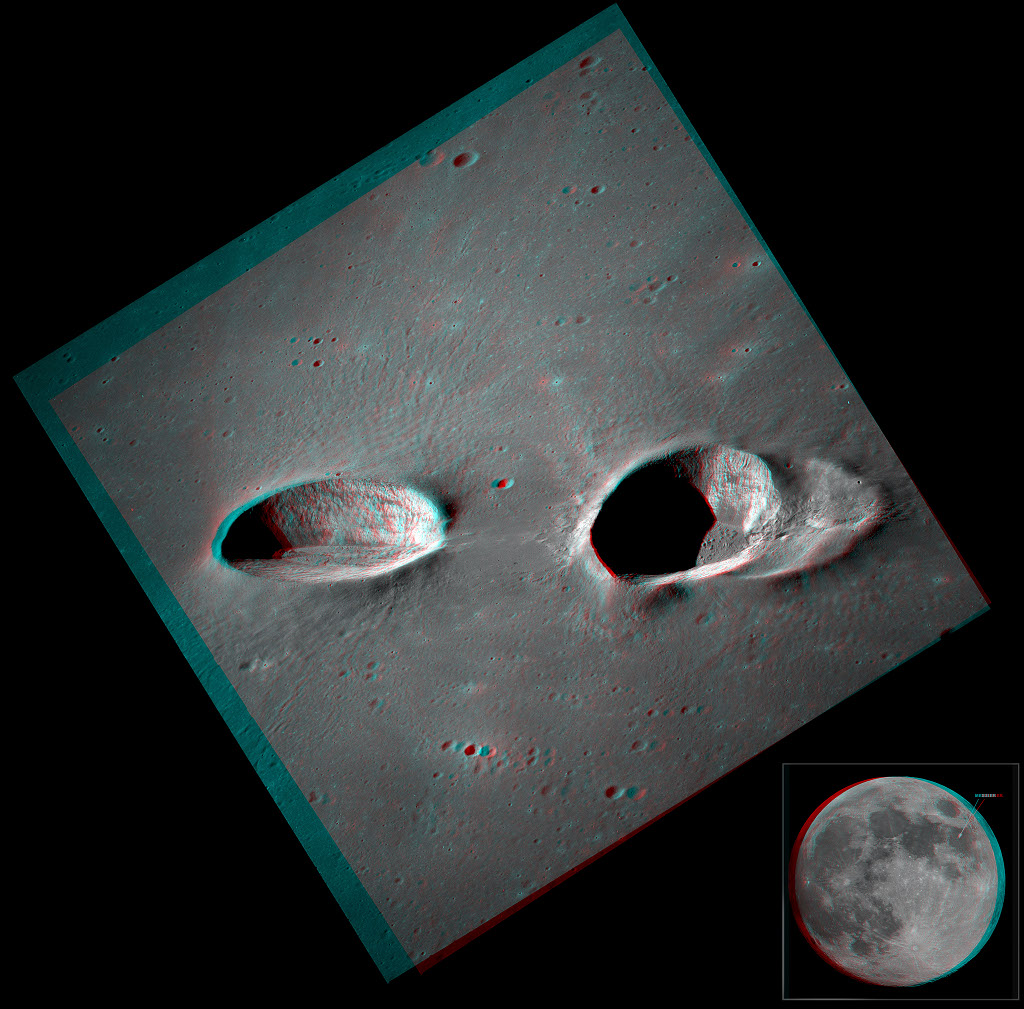
Astronomy - MESSIER CRATERS IN STEREO
2026 May 9 Messier Craters in Stereo Image Credit: Apollo 11 , NASA ; Stereo Image Copyright Patrick Vantuyne Explanation: Many bright ...
-
Imaginez un monde où le cancer n’est plus une sentence, mais une simple étape à franchir. Grâce à une découverte révolutionnaire, ce rêve es...
-
2026 January 1 Auroral Corona Image Credit & Copyright : Roi Levi Explanation: Cycle 25 solar maximum made 2025 a great year for ...