Nombre total de pages vues
21/01/2022
MICROPHOTOGRAPHIE - L'acide malique : le plein de goût
20/01/2022
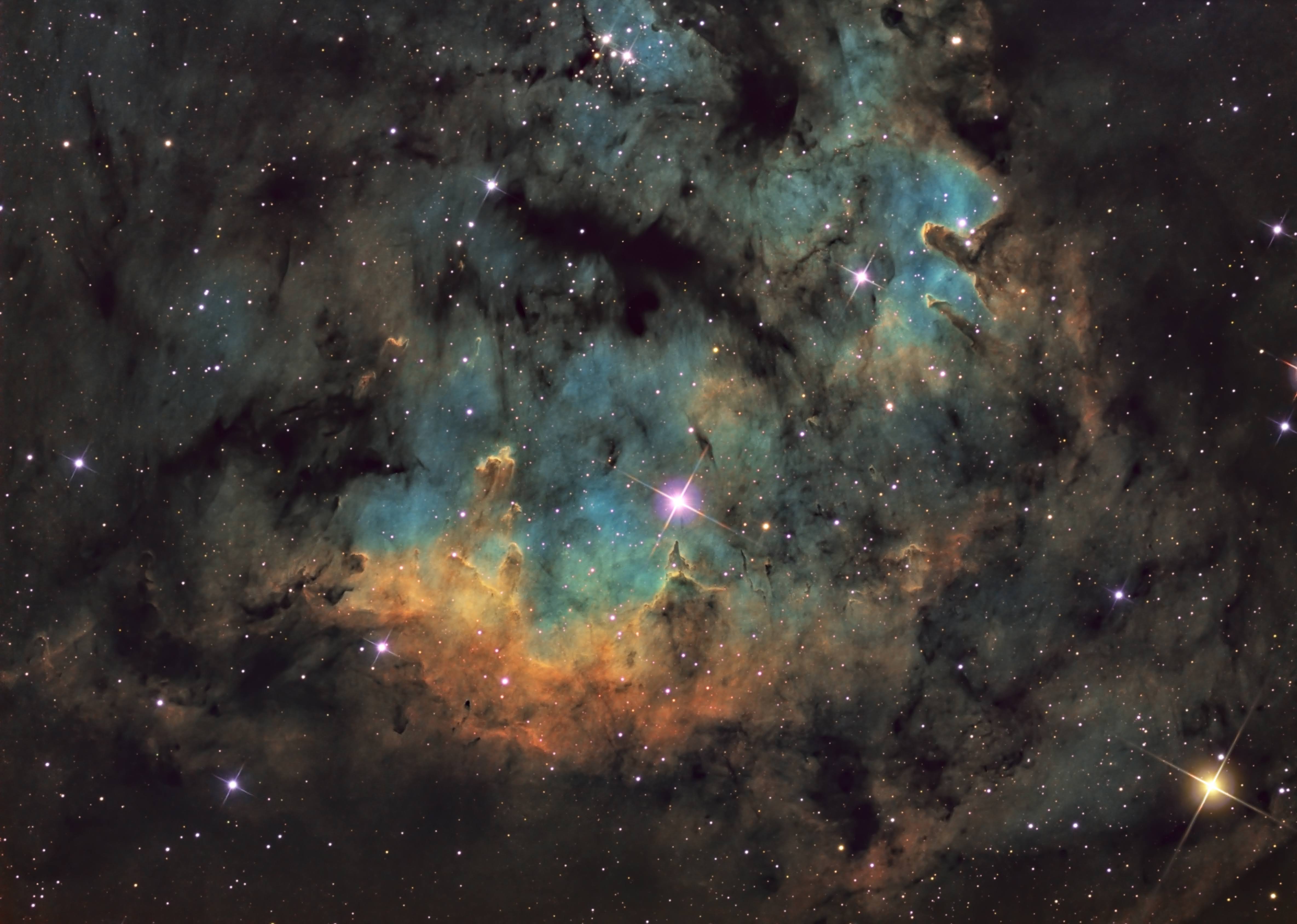
ASTRONOMY - NGC 7822 in Cepheus
2022 January 20
Image Credit & Copyright: Mark Carter
Explanation: Hot, young stars and cosmic pillars of gas and dust seem to crowd into NGC 7822. At the edge of a giant molecular cloud toward the northern constellation Cepheus, the glowing star forming region lies about 3,000 light-years away. Within the nebula, bright edges and dark shapes stand out in this colorful telescopic skyscape. The image includes data from narrowband filters, mapping emission from atomic oxygen, hydrogen, and sulfur into blue, green, and red hues. The emission line and color combination has become well-known as the Hubble palette. The atomic emission is powered by energetic radiation from the central hot stars. Their powerful winds and radiation sculpt and erode the denser pillar shapes and clear out a characteristic cavity light-years across the center of the natal cloud. Stars could still be forming inside the pillars by gravitational collapse but as the pillars are eroded away, any forming stars will ultimately be cutoff from their reservoir of star stuff. This field of view spans about 40 light-years at the estimated distance of NGC 7822.
18/01/2022
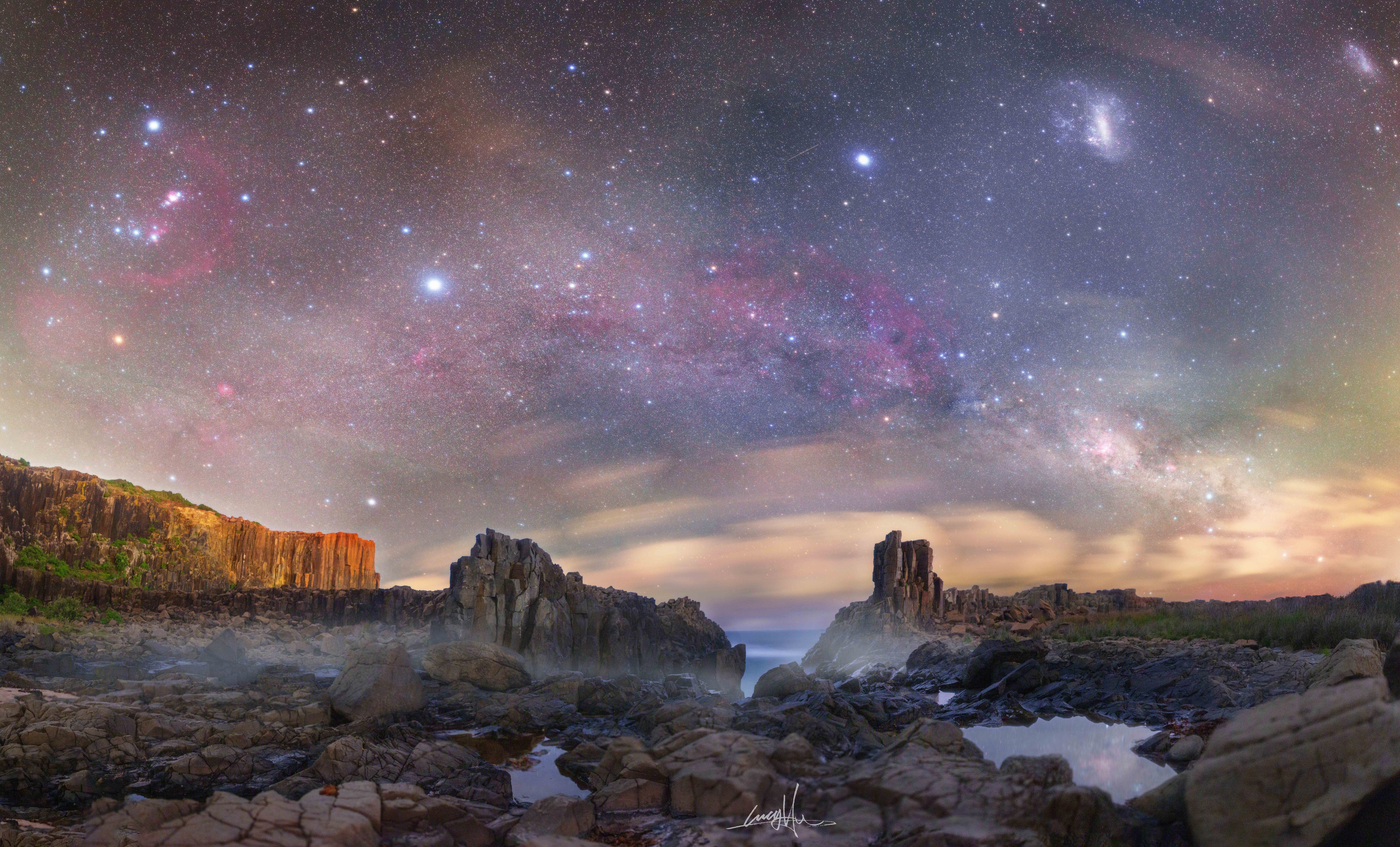
ASTRONOMY - From Orion to the Southern Cross
2022 January 18
Image Credit & Copyright: Lucy Yunxi Hu
Explanation: This is a sky filled with glowing icons. On the far left is the familiar constellation of Orion, divided by its iconic three-aligned belt stars and featuring the famous Orion Nebula, both partly encircled by Barnard's Loop. Just left of center in the featured image is the brightest star in the night: Sirius. Arching across the image center is the central band of our Milky Way Galaxy. On the far right, near the top, are the two brightest satellite galaxies of the Milky Way: the Large Magellanic Cloud (LMC), and the Small Magellanic Cloud (SMC). Also on the far right -- just above the cloudy horizon -- is the constellation of Crux, complete with the four stars that make the iconic Southern Cross. The featured image is a composite of 18 consecutive exposures taken by the same camera and from the same location in eastern Australia during the last days of last year. In the foreground, picturesque basalt columns of the Bombo Quarry part to reveal the vast Pacific
16/01/2022
ASTRONOMY - A Retreating Thunderstorm at Sunset
Image Credit & Copyright: Alan Dyer (The Amazing Sky)
Explanation: What type of cloud is that? This retreating cumulonimbus cloud, more commonly called a thundercloud, is somewhat unusual as it contains the unusual bumpiness of a mammatus cloud on the near end, while simultaneously producing falling rain on the far end. Taken in mid-2013 in southern Alberta, Canada, the cloud is moving to the east, into the distance, as the sun sets in the west, behind the camera. In the featured image, graphic sunset colors cross the sky to give the already photogenic cloud striking orange and pink hues. A darkening blue sky covers the background. Further in the distance, a rising, waxing, gibbous moon is visible on the far right.
AERONAUTIQUE - Le Blériot XI et la première traversée de la Manche en avion
15/01/2022
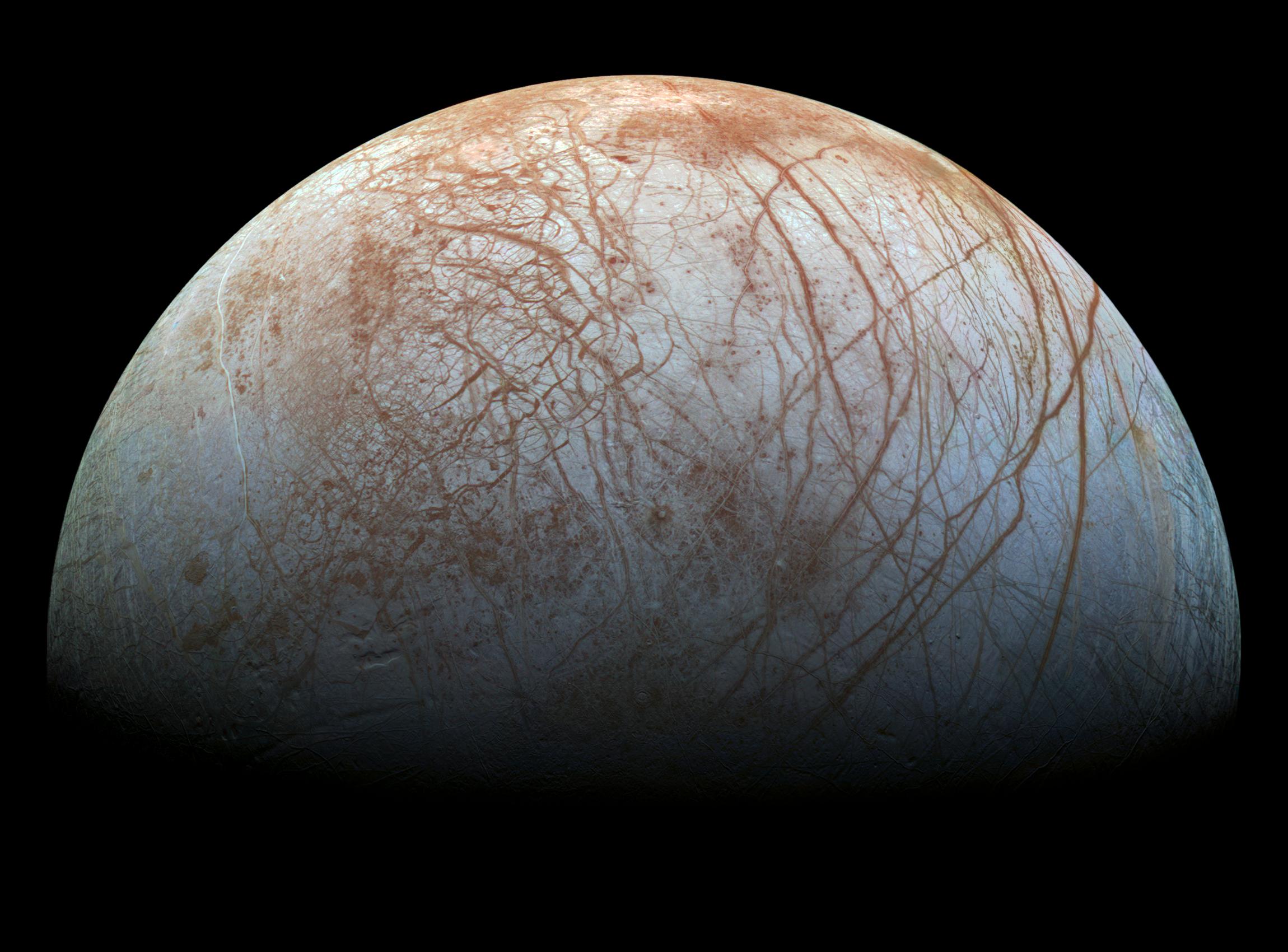
ASTRONOMY - Galileo's Europa
2022 January 15
Image Credit: NASA, JPL-Caltech, SETI Institute, Cynthia Phillips, Marty Valenti
Explanation: Looping through the Jovian system in the late 1990s, the Galileo spacecraft recorded stunning views of Europa and uncovered evidence that the moon's icy surface likely hides a deep, global ocean. Galileo's Europa image data has been remastered here, with improved calibrations to produce a color image approximating what the human eye might see. Europa's long curving fractures hint at the subsurface liquid water. The tidal flexing the large moon experiences in its elliptical orbit around Jupiter supplies the energy to keep the ocean liquid. But more tantalizing is the possibility that even in the absence of sunlight that process could also supply the energy to support life, making Europa one of the best places to look for life beyond Earth. What kind of life could thrive in a deep, dark, subsurface ocean? Consider planet Earth's own extreme shrimp.
13/01/2022
ART FRACTAL - Un joyau
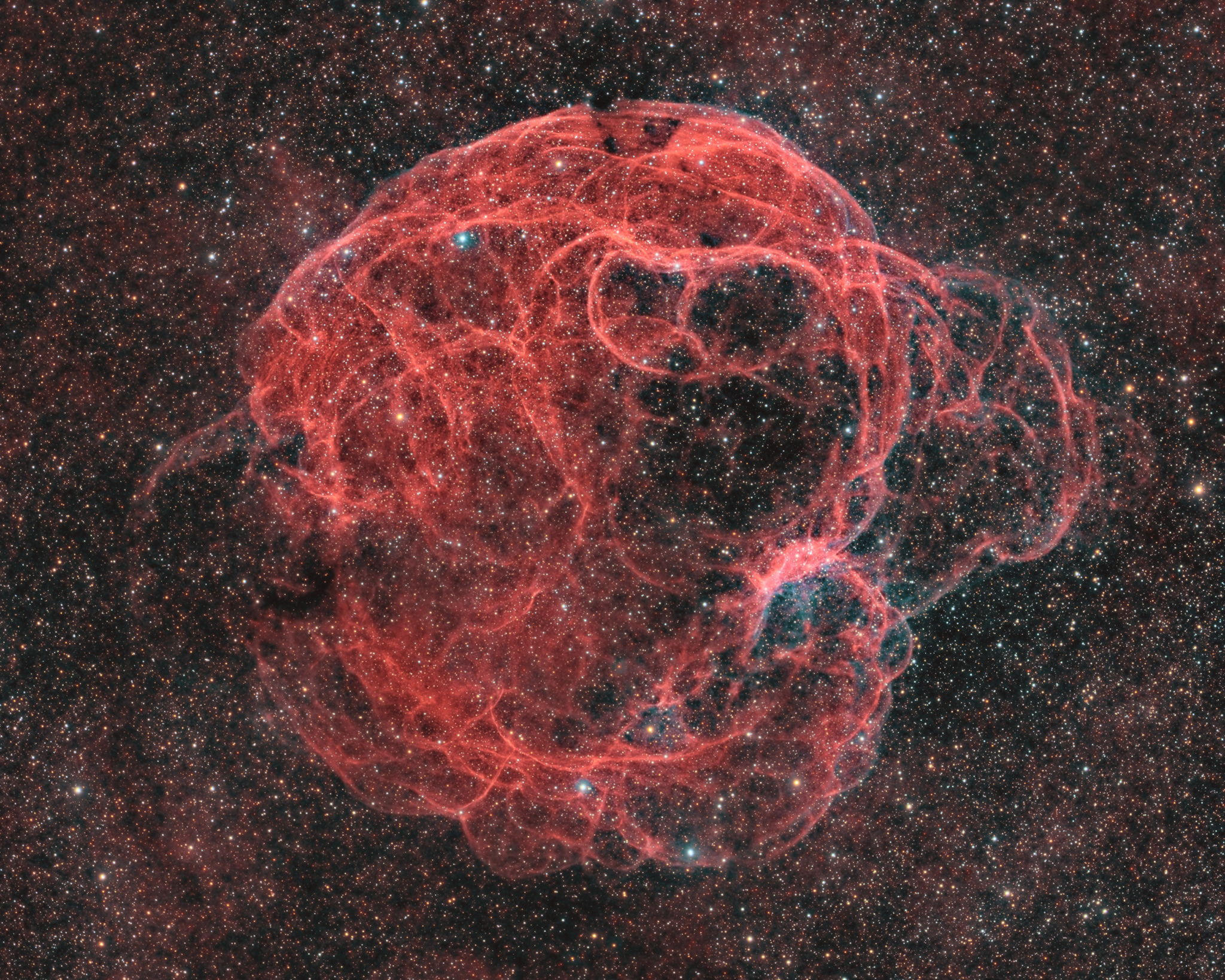
ASTRONOMY - Supernova Remnant Simeis 147
2022 January 13
Image Credit & Copyright: Jason Dain
Explanation: It's easy to get lost following the intricate, looping, twisting filaments in this detailed image of supernova remnant Simeis 147. Also cataloged as Sharpless 2-240 it goes by the popular nickname, the Spaghetti Nebula. Seen toward the boundary of the constellations Taurus and Auriga, it covers nearly 3 degrees or 6 full moons on the sky. That's about 150 light-years at the stellar debris cloud's estimated distance of 3,000 light-years. This composite includes image data taken through narrow-band filters where reddish emission from ionized hydrogen atoms and doubly ionized oxygen atoms in faint blue-green hues trace the shocked, glowing gas. The supernova remnant has an estimated age of about 40,000 years, meaning light from the massive stellar explosion first reached Earth 40,000 years ago. But the expanding remnant is not the only aftermath. The cosmic catastrophe also left behind a spinning neutron star or pulsar, all that remains of the original star's core.
12/01/2022
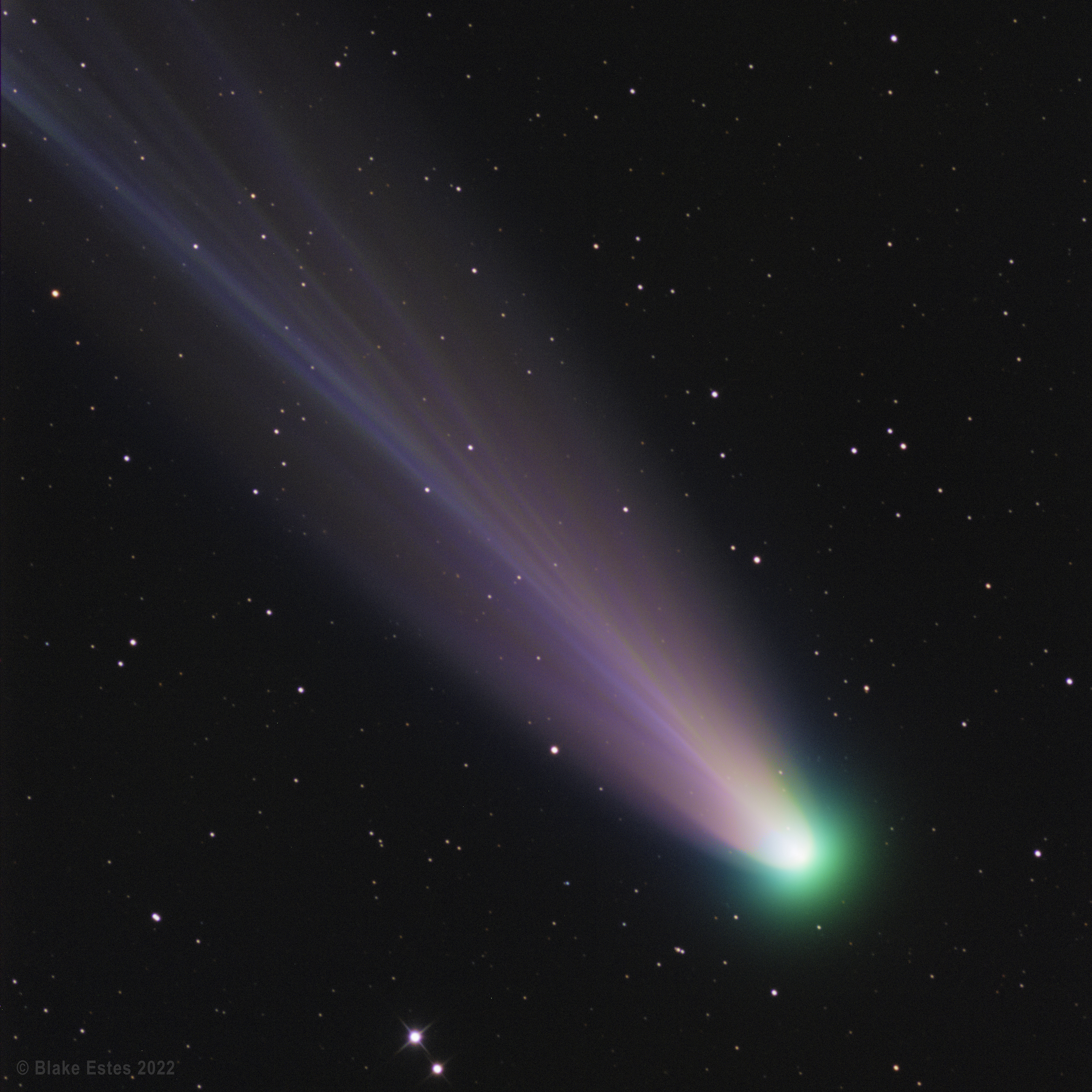
ASTRONOMY - Comet Leonard Closeup from Australia
2022 January 12
Image Credit & Copyright: Blake Estes (itelescope.net)
Explanation: What does Comet Leonard look like up close? Although we can't go there, imaging the comet's coma and inner tails through a small telescope gives us a good idea. As the name implies, the ion tail is made of ionized gas -- gas energized by ultraviolet light from the Sun and pushed outward by the solar wind. The solar wind is quite structured and sculpted by the Sun's complex and ever changing magnetic field. The effect of the variable solar wind combined with different gas jets venting from the comet's nucleus accounts for the tail's complex structure. Following the wind, structure in Comet Leonard's tail can be seen to move outward from the Sun even alter its wavy appearance over time. The blue color of the ion tail is dominated by recombining carbon monoxide molecules, while the green color of the coma surrounding the head of the comet is created mostly by a slight amount of recombining diatomic carbon molecules. Diatomic carbon is destroyed by sunlight in about 50 hours -- which is why its green glow does not make it far into the ion tail. The featured imagae was taken on January 2 from Siding Spring Observatory in Australia. Comet Leonard, presently best viewed from Earth's Southern Hemisphere, has rounded the Sun and is now headed out of the Solar System.
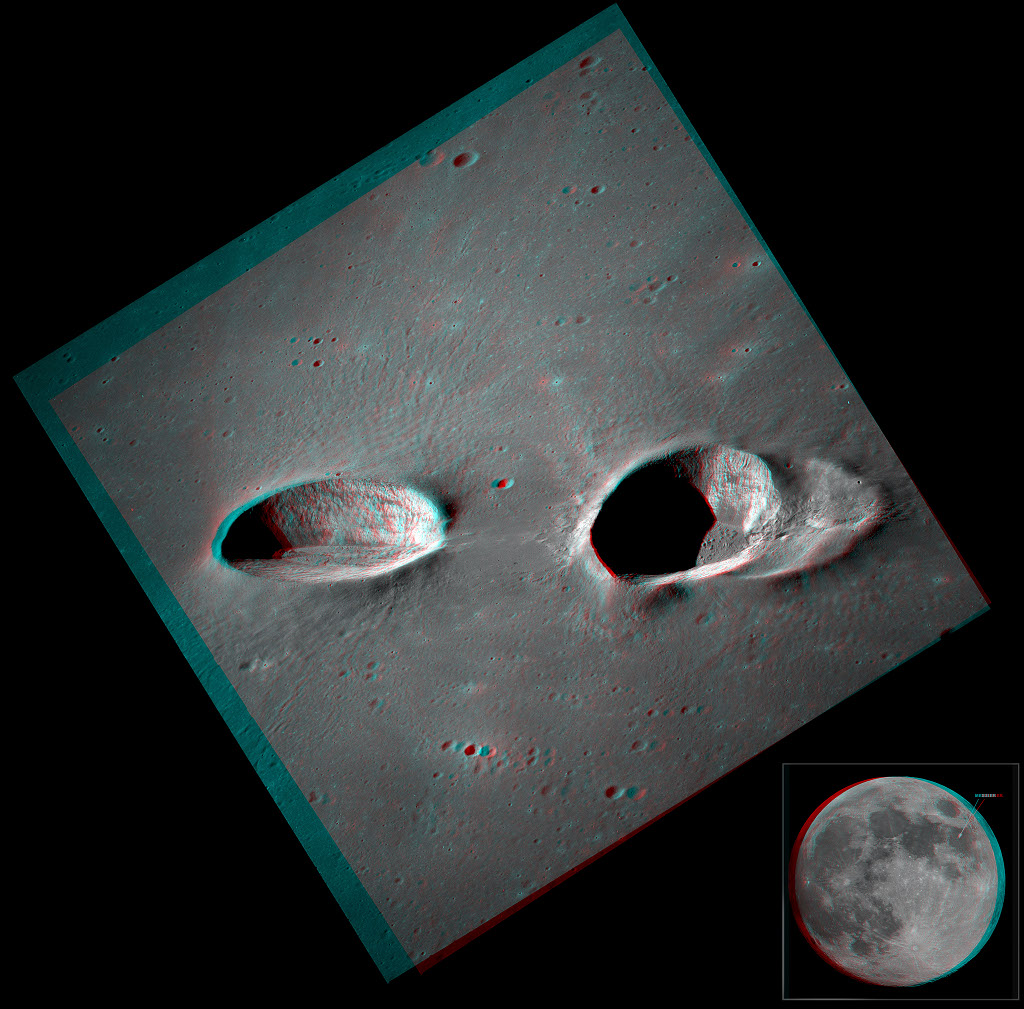
Astronomy - MESSIER CRATERS IN STEREO
2026 May 9 Messier Craters in Stereo Image Credit: Apollo 11 , NASA ; Stereo Image Copyright Patrick Vantuyne Explanation: Many bright ...
-
Imaginez un monde où le cancer n’est plus une sentence, mais une simple étape à franchir. Grâce à une découverte révolutionnaire, ce rêve es...
-
2026 January 1 Auroral Corona Image Credit & Copyright : Roi Levi Explanation: Cycle 25 solar maximum made 2025 a great year for ...