Nombre total de pages vues
02/03/2022
AERONAUTIQUE - Avions de légende - Le Canadair CL-415
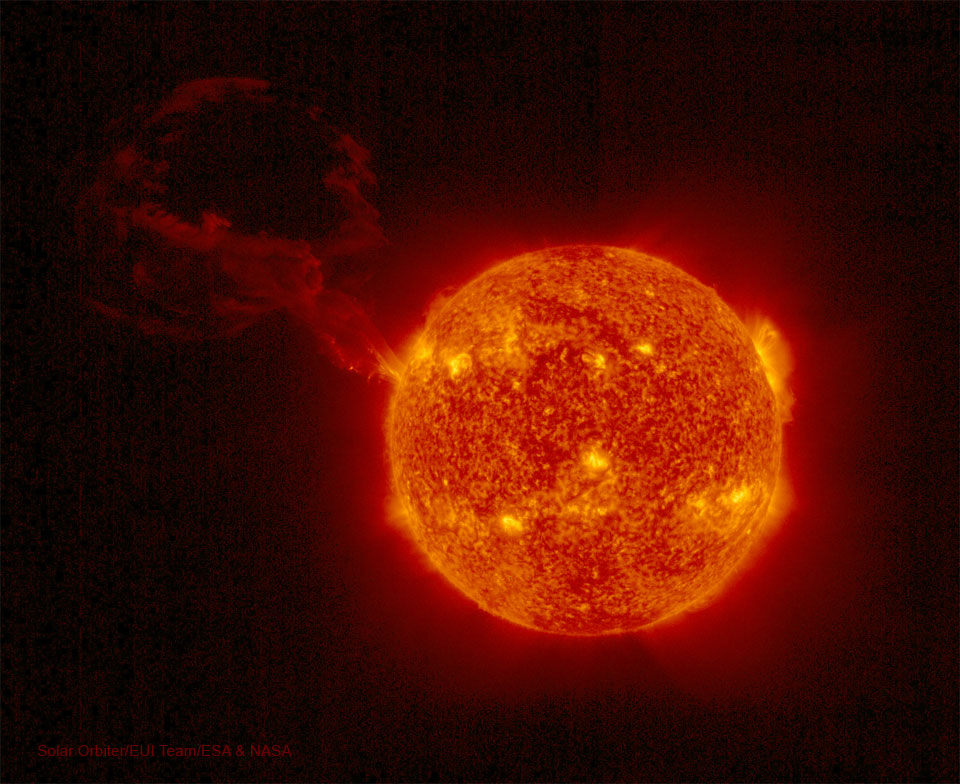
ASTRONOMY - Record Prominence Imaged by Solar Orbiter
2022 March 2
Image Credit: Solar Orbiter, EUI Team, ESA & NASA; h/t: Bum-Suk Yeom
Explanation: What's happened to our Sun? Last month, it produced the largest prominence ever imaged together with a complete solar disk. The record image, featured, was captured in ultraviolet light by the Sun-orbiting Solar Orbiter spacecraft. A quiescent solar prominence is a cloud of hot gas held above the Sun's surface by the Sun's magnetic field. This solar prominence was huge -- spanning a length rivaling the diameter of the Sun itself. Solar prominences may erupt unpredictably and expel hot gas into the Solar System via a Coronal Mass Ejection (CME). When a CME strikes the Earth and its magnetosphere, bright auroras may occur. This prominence did produce a CME, but it was directed well away from the Earth. Although surely related to the Sun's changing magnetic field, the energy mechanism that creates and sustains a solar prominence remains a topic of research.
01/03/2022
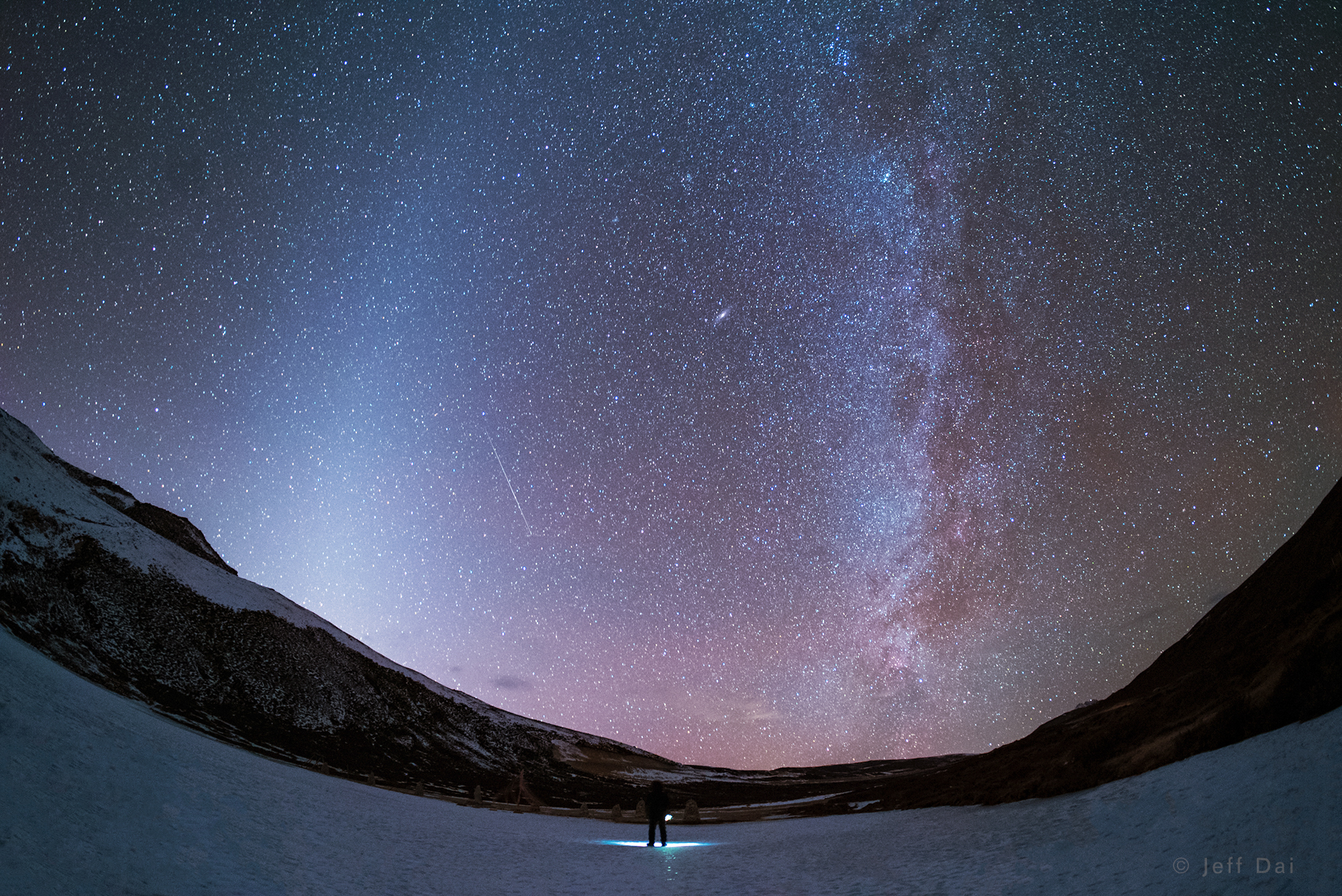
ASTRONOMY - Dueling Bands in the Night
2022 March 1
Image Credit & Copyright: Jeff Dai (TWAN)
Explanation: What are these two bands in the sky? The more commonly seen band is the one on the right and is the central band of our Milky Way galaxy. Our Sun orbits in the disk of this spiral galaxy, so that from inside, this disk appears as a band of comparable brightness all the way around the sky. The Milky Way band can also be seen all year -- if out away from city lights. The less commonly seem band, on the left, is zodiacal light -- sunlight reflected from dust orbiting the Sun in our Solar System. Zodiacal light is brightest near the Sun and so is best seen just before sunrise or just after sunset. On some evenings in the north, particularly during the months of March and April, this ribbon of zodiacal light can appear quite prominent after sunset. It was determined only this century that zodiacal dust was mostly expelled by comets that have passed near Jupiter. Only on certain times of the year will the two bands be seen side by side, in parts of the sky, like this. The featured image, including the Andromeda galaxy and a meteor, was captured in late January over a frozen lake in Kanding, Sichuan, China.
28/02/2022
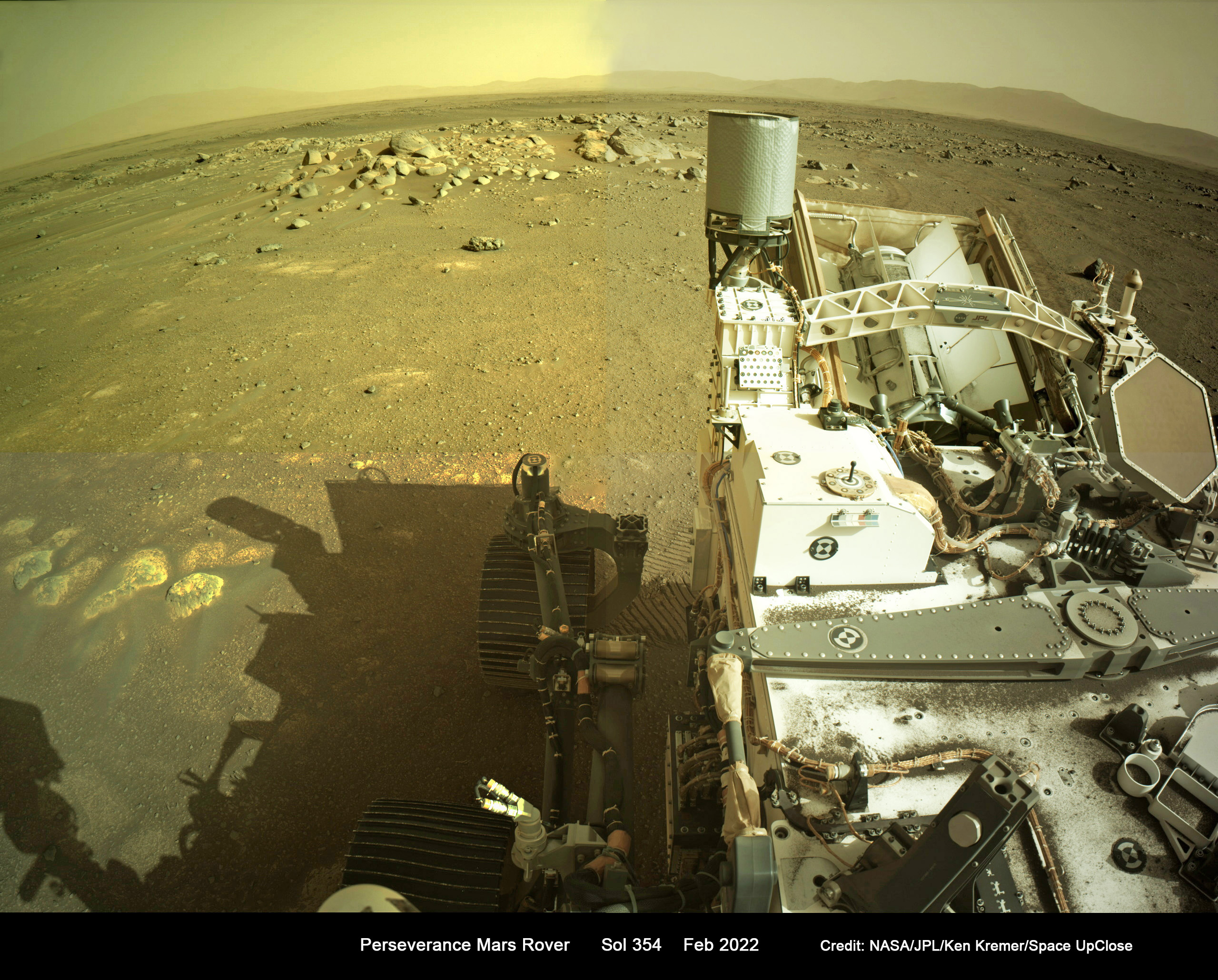
ASTRONOMY - Perseverance Sol 354
2022 February 28
Image Credit: NASA, JPL-Caltech, Processing; Kenneth Kremer
Explanation: This Navcam mosaic from Perseverance looks out over the car-sized rover's deck, across the floor of Jezero crater on Mars. Frames used to construct the mosaic view were captured on mission sol 354. That corresponds to Earth calendar date February 17, 2022, nearly one Earth year after the rover's landing. With a mass of over 1,000 kilograms, six-wheeled Perseverance is the heaviest rover to touch down on Mars. During its first year of exploration the rover has collected six (so far) rock core samples for later return to planet Earth, served as the base station for Ingenuity, the first helicopter on Mars, and tested MOXIE (Mars Oxygen In-Situ Resource Utilization Experiment), converting some of the Red Planet’s thin, carbon dioxide-rich atmosphere into oxygen.
27/02/2022
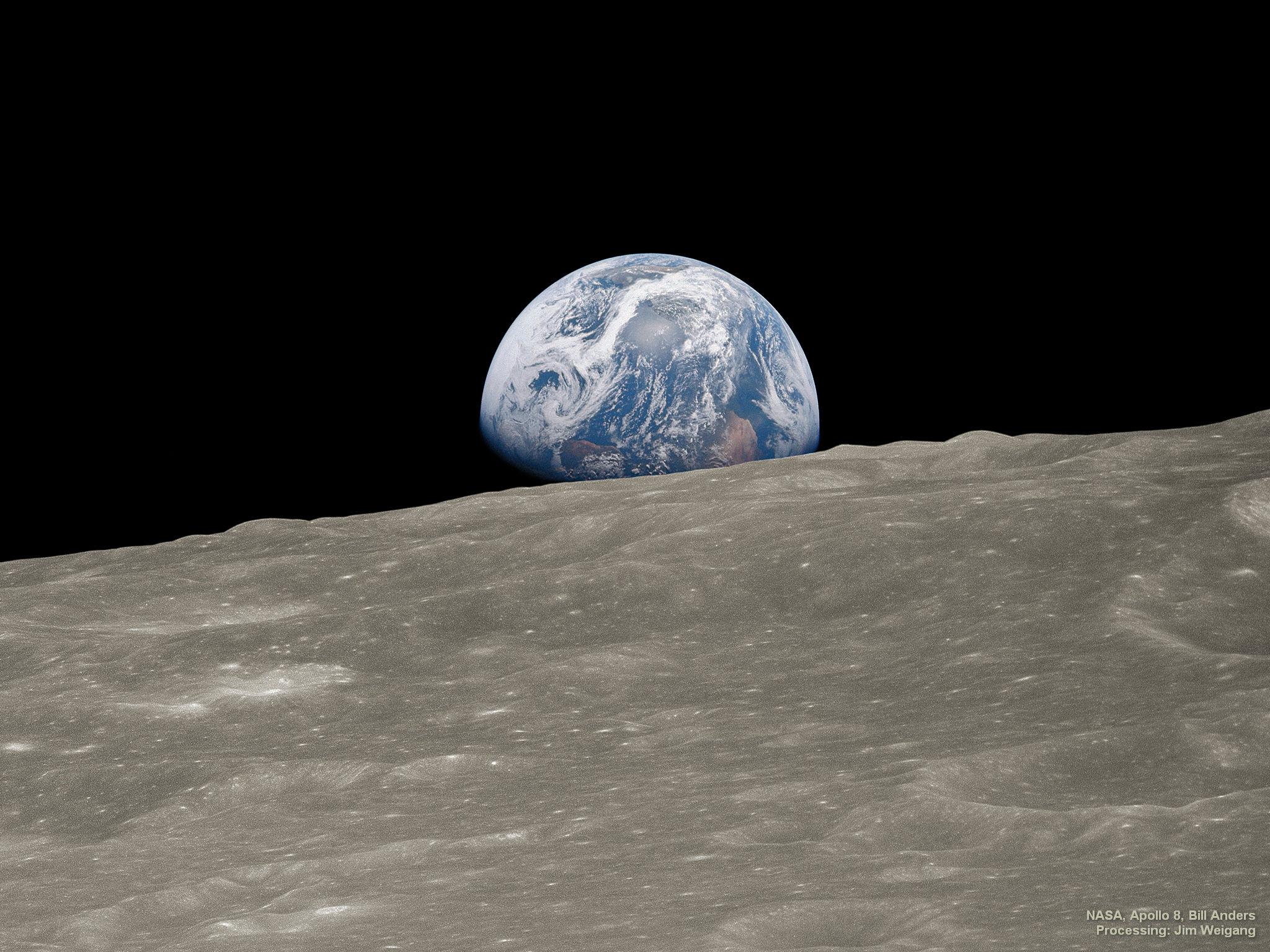
ASTRONOMY - Earthrise 1: Historic Image Remastered
2022 February 27
Image Credit: NASA, Apollo 8 Crew, Bill Anders; Processing and License: Jim Weigang
Explanation: "Oh my God! Look at that picture over there! Here's the Earth coming up. Wow is that pretty!" Soon after that pronouncement, about 53 years ago, one of the most famous images ever taken was snapped from the orbit of the Moon. Now known as "Earthrise", the iconic image shows the Earth rising above the limb of the Moon, as taken by the crew of Apollo 8. But the well-known Earthrise image was actually the second image taken of the Earth rising above the lunar limb -- it was just the first in color. With modern digital technology, however, the real first Earthrise image -- originally in black and white -- has now been remastered to have the combined resolution and color of the first three images. Behold! The featured image is a close-up of the picture that Apollo 8 astronaut Bill Anders was talking about. Thanks to modern technology and human ingenuity, now we can all see it. (Historical note: A different historic black & white image of the Earth setting behind the lunar limb was taken by the robotic Lunar Orbiter 1 two years earlier.)
26/02/2022
SANTé/MEDECINE - Quelques instants avant et après la mort
RTB
23/02/2022
ASTRONOMY - Aurora over White Dome Geyser
2022 February 23
Image Credit & Copyright: Robert Howell
Explanation: Sometimes both heaven and Earth erupt. Colorful auroras erupted unexpectedly a few years ago, with green aurora appearing near the horizon and brilliant bands of red aurora blooming high overhead. A bright Moon lit the foreground of this picturesque scene, while familiar stars could be seen far in the distance. With planning, the careful astrophotographer shot this image mosaic in the field of White Dome Geyser in Yellowstone National Park in the western USA. Sure enough, just after midnight, White Dome erupted -- spraying a stream of water and vapor many meters into the air. Geyser water is heated to steam by scalding magma several kilometers below, and rises through rock cracks to the surface. About half of all known geysers occur in Yellowstone National Park. Although the geomagnetic storm that caused the auroras subsided within a day, eruptions of White Dome Geyser continue about every 30 minutes.
22/02/2022
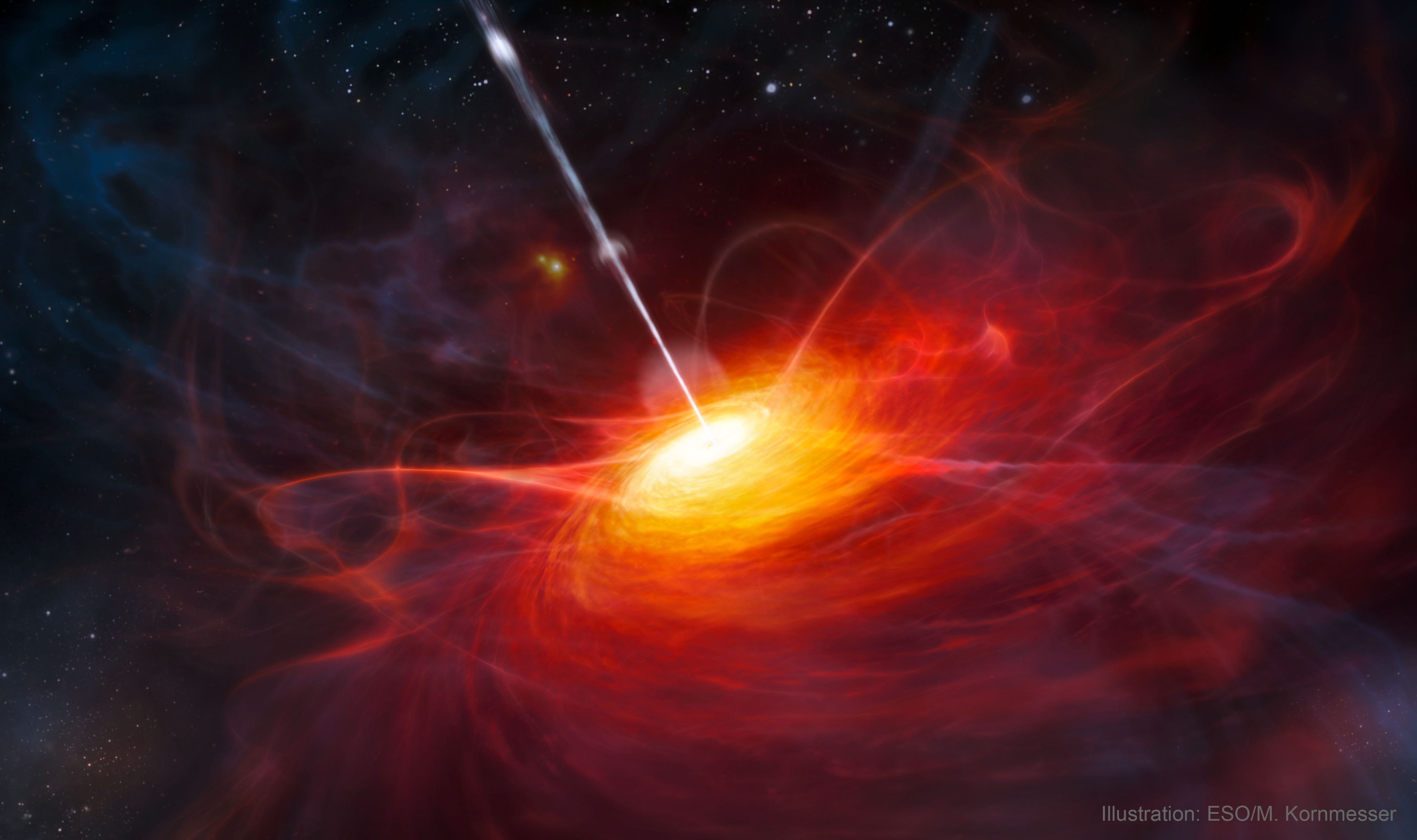
ASTRONOMY - Illustration: An Early Quasar
2022 February 22
Illustration Credit & License: ESO, M. Kornmesser
Explanation: What did the first quasars look like? The nearest quasars are now known to involve supermassive black holes in the centers of active galaxies. Gas and dust that falls toward a quasar glows brightly, sometimes outglowing the entire home galaxy. The quasars that formed in the first billion years of the universe are more mysterious, though. Featured, recent data has enabled an artist's impression of an early-universe quasar as it might have been: centered on a massive black hole, surrounded by sheets of gas and an accretion disk, and expelling a powerful jet. Quasars are among the most distant objects we see and give humanity unique information about the early and intervening universe. The oldest quasars currently known are seen at just short of redshift 8 -- only 700 million years after the Big Bang -- when the universe was only a few percent of its current age.
21/02/2022
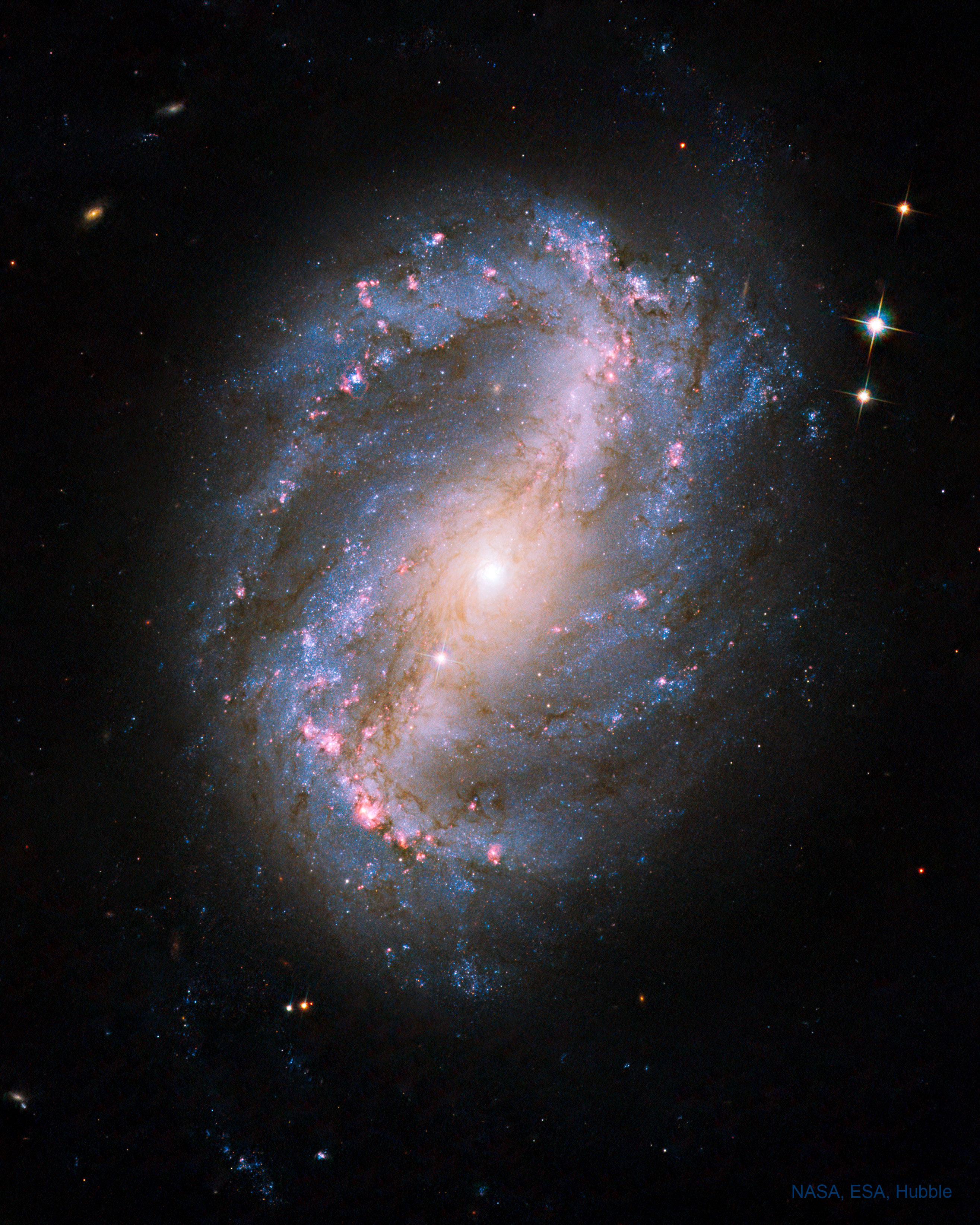
ASTRONOMY - Barred Spiral Galaxy NGC 6217
2022 February 21
Image Credit: NASA, ESA, and the Hubble SM4 ERO Team
Explanation: Many spiral galaxies have bars across their centers. Even our own Milky Way Galaxy is thought to have a modest central bar. Prominently barred spiral galaxy NGC 6217, featured here, was captured in spectacular detail in this image taken by the Advanced Camera for Surveys on the orbiting Hubble Space Telescope in 2009. Visible are dark filamentary dust lanes, young clusters of bright blue stars, red emission nebulas of glowing hydrogen gas, a long bar of stars across the center, and a bright active nucleus that likely houses a supermassive black hole. Light takes about 60 million years to reach us from NGC 6217, which spans about 30,000 light years across and can be found toward the constellation of the Little Bear (Ursa Minor).
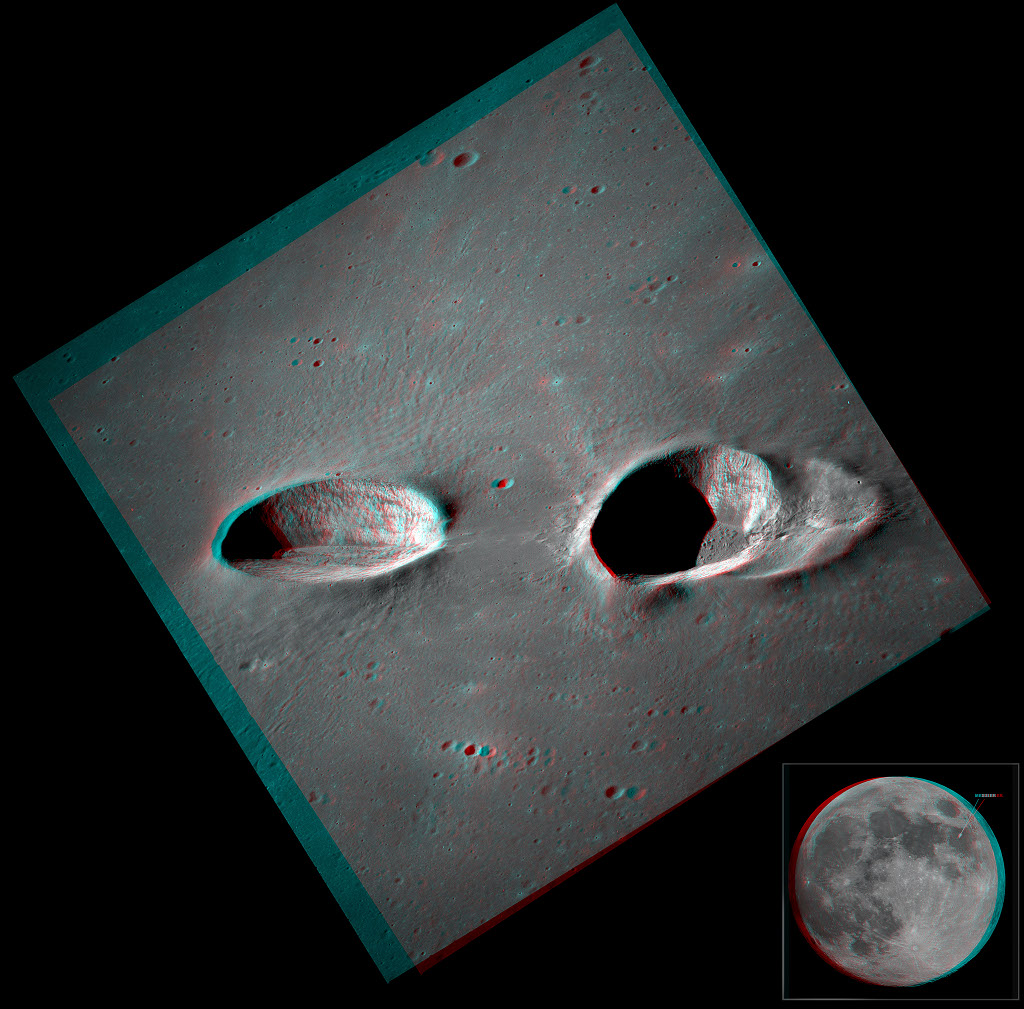
Astronomy - MESSIER CRATERS IN STEREO
2026 May 9 Messier Craters in Stereo Image Credit: Apollo 11 , NASA ; Stereo Image Copyright Patrick Vantuyne Explanation: Many bright ...
-
Imaginez un monde où le cancer n’est plus une sentence, mais une simple étape à franchir. Grâce à une découverte révolutionnaire, ce rêve es...
-
2026 January 1 Auroral Corona Image Credit & Copyright : Roi Levi Explanation: Cycle 25 solar maximum made 2025 a great year for ...