Nombre total de pages vues
15/01/2025
AERONAUTIQUE - La grande épopée des ballons dirigeables - 1944 - le ZNP-K-28 : pour la surveillance maritime
SANTé/MEDECINE - A la découverte de l'oreille - L'oreille moyenne
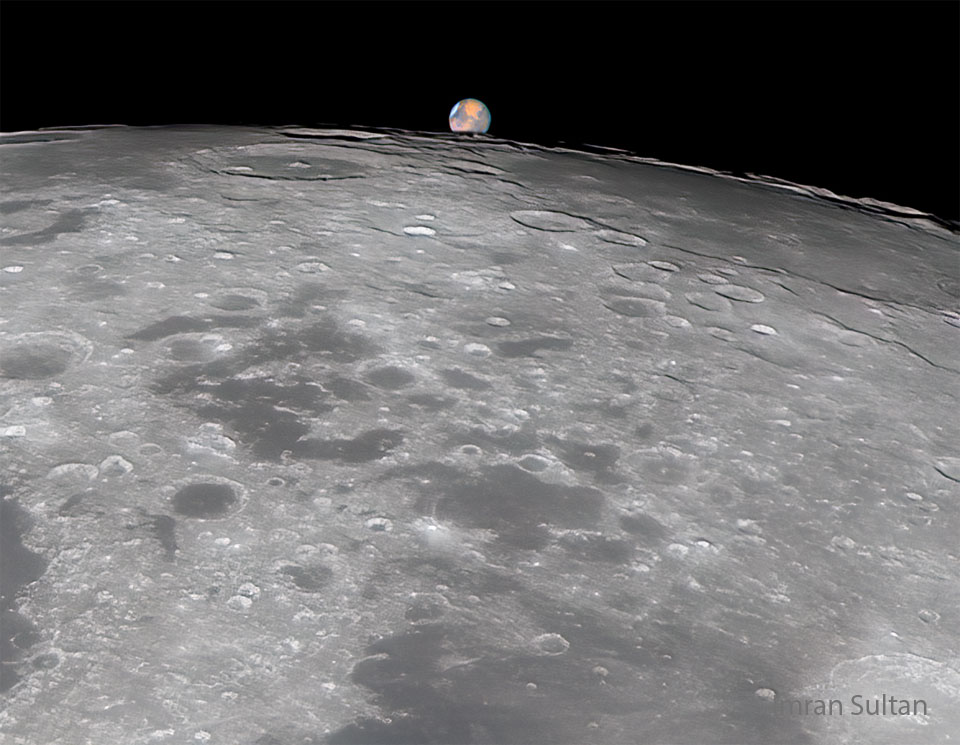
ASTRONOMY - Wolf Moon Engulfs Mars
2025 January 15
Image Credit & Copyright: Imran Sultan
Explanation: Does the Moon ever engulf Mars? Yes, but only in the sense that it moves in front, which happens on rare occasions. This happened just yesterday, though, as seen from some locations in North America and western Africa. This occultation was notable not only because the Moon was a fully lit Wolf Moon, but because Mars was near its largest and brightest, moving to opposition -- the closest to the Earth in its orbit -- only tomorrow. The engulfing, more formally called an occultation, typically lasting about an hour. The featured image was taken from near Chicago, Illinois, USA just as Earth's largest satellite was angularly moving away from the much more distant red planet. Our Moon occasionally moves in front of all of the Solar System's planets. Given the temporary alignment of orbital planes, the next time our Moon eclipses Mars will be a relatively soon February 9.
14/01/2025
AERONAUTIQUE - La grande épopée des ballons dirigeables - 1942 : le ballon barrage
SANTé/MEDECINE : Espoir - Cancer du poumon : les promesses de la radiothérapie stéréotaxique
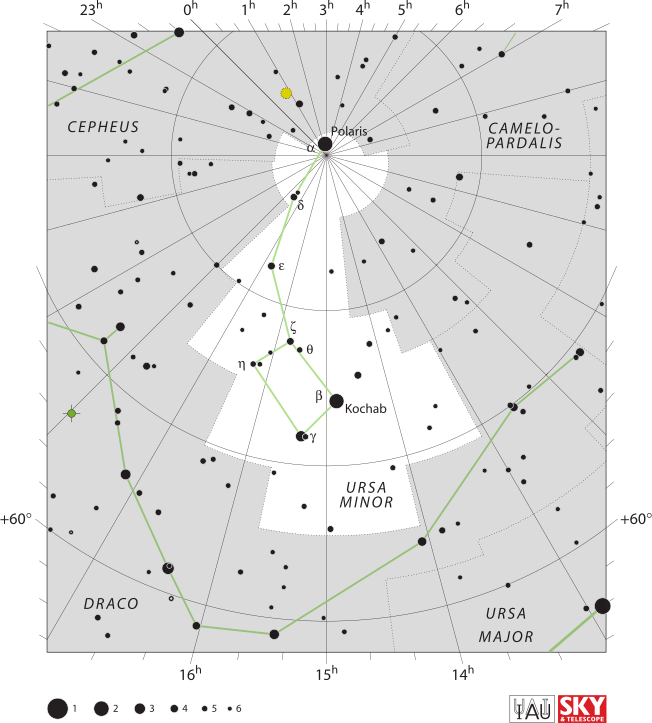
ASTRONOMY - North Star: Polaris and Surrounding Dust
2025 January 14
Image Credit & Copyright: Davide Coverta
Explanation: Why is Polaris called the North Star? First, Polaris is the nearest bright star toward the north spin axis of the Earth. Therefore, as the Earth turns, stars appear to revolve around Polaris, but Polaris itself always stays in the same northerly direction -- making it the North Star. Since no bright star is near the south spin axis of the Earth, there is currently no bright South Star. Thousands of years ago, Earth's spin axis pointed in a slightly different direction so that Vega was the North Star. Although Polaris is not the brightest star on the sky, it is easily located because it is nearly aligned with two stars in the cup of the Big Dipper. Polaris is near the center of the five-degree wide featured image, a digital composite of hundreds of exposures that brings out faint gas and dust of the Integrated Flux Nebula (IFN) all over the frame. The surface of Cepheid Polaris slowly pulsates, causing the famous star to change its brightness by a few percent over the course of a few days.
13/01/2025
SANTé/MEDECINE - A la découverte de l'oreille - Le pavillon
ASTRONOMY - Comet ATLAS Before Sunrise
2025 January 13
Image Credit & Copyright: Petr Horalek / Institute of Physics in Opava
Explanation: Comet ATLAS is really bright now, but also really close to the Sun. Outside the glow of the Sun, Comet C/2024 G3 (ATLAS) would be one of the more remarkable comet sights of recent years, reflecting about as much sunlight to Earth as Comet Tsuchinshan-ATLAS did in October, and now rivaling even planet Venus. But the giant snowball is now so close to the Sun that it can only be seen through the light of the early morning dawn or the early evening dusk. Today, Comet ATLAS is at perihelion -- its closest ever to the Sun. Although the future brightness of comets is notoriously hard to predict, there is hope that Comet ATLAS will survive its close pass near the Sun and remain bright enough to be seen with the unaided eye over the next few days -- and possibly a good camera comet for weeks. The featured image was taken early yesterday morning near Tornaľa, Slovakia.
12/01/2025
ASTRONOMY - Mimas: Small Moon with a Big Crater
2025 January 12
Image Credit: NASA, JPL-Caltech, Space Science Institute, Cassini
Explanation: Whatever hit Mimas nearly destroyed it. What remains is one of the largest impact craters on one of Saturn's smallest round moons. Analysis indicates that a slightly larger impact would have destroyed Mimas entirely. The huge crater, named Herschel after the 1789 discoverer of Mimas, Sir William Herschel, spans about 130 kilometers and is featured here. Mimas' low mass produces a surface gravity just strong enough to create a spherical body but weak enough to allow such relatively large surface features. Mimas is made of mostly water ice with a smattering of rock - so it is accurately described as a big dirty snowball. The featured image was taken during the closest-ever flyby of the robot spacecraft Cassini past Mimas in 2010 while in orbit around Saturn.
ASTRONOMY - Mystery: Little Red Dots in the Early Universe
2025 December 24 Mystery: Little Red Dots in the Early Universe Image Credit: NASA , ESA , CSA , STScI , JWST ; Dale Kocevski ( Colb...
-
2022 September 26 All the Water on Planet Earth Illustration Credit: Jack Cook, Adam Nieman, Woods Hole Oceanographic Institution ; Data ...
-
2025 May 11 The Surface of Venus from Venera 14 Image Credit: Soviet Planetary Exploration Program , Venera 14 ; Processing & Copyri...