Nombre total de pages vues
04/03/2025
SANTé/MEDECINE - Combien de temps une personne vit-elle après l’apparition du râle agonique ?
ASTRONOMY - A Quadruple Alignment over Italy
2025 March 4
Image Credit & Copyright: Valerio Minato
Explanation: Why does this Moon look so unusual? A key reason is its vivid red color. The color is caused by the deflection of blue light by Earth's atmosphere -- the same reason that the daytime sky appears blue. The Moon also appears unusually distorted. Its strange structuring is an optical effect arising from layers in the Earth's atmosphere that refract light differently due to sudden differences in temperature or pressure. A third reason the Moon looks so unusual is that there is, by chance, an airplane flying in front. The featured picturesque gibbous Moon was captured about two weeks ago above Turin, Italy. Our familiar hovering sky orb was part of an unusual quadruple alignment that included two historic ground structures: the Sacra di San Michele on the near hill and Basilica of Superga just beyond.
03/03/2025
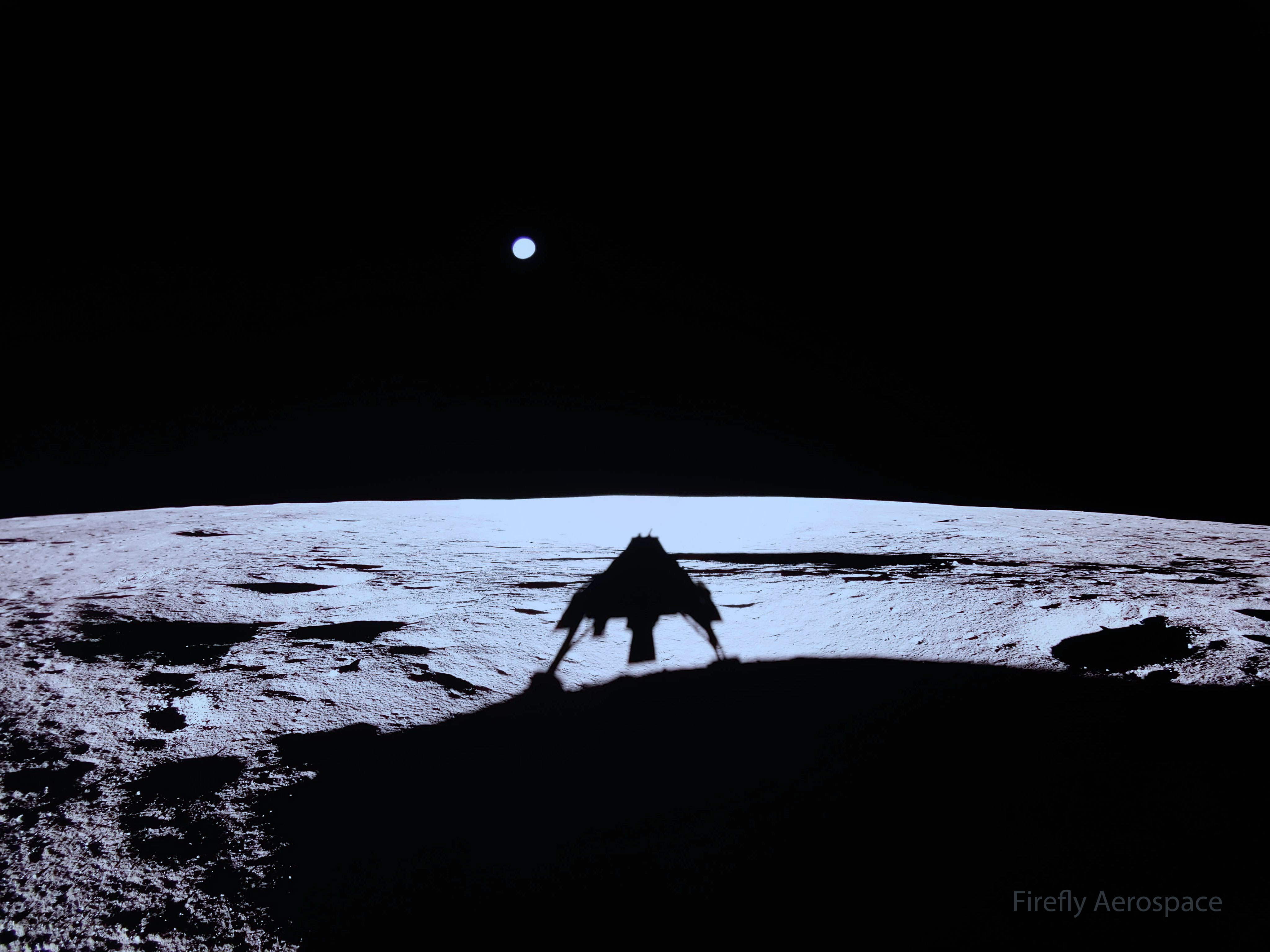
ASTRONOMY - Blue Ghost on the Moon
Image Credit: Firefly Aerospace
Explanation: There's a new lander on the Moon. Yesterday Firefly Aerospace's Blue Ghost executed the first-ever successful commercial lunar landing. During its planned 60-day mission, Blue Ghost will deploy several NASA-commissioned scientific instruments, including PlanetVac which captures lunar dust after creating a small whirlwind of gas. Blue Ghost will also host the telescope LEXI that captures X-ray images of the Earth's magnetosphere. LEXI data should enable a better understanding of how Earth's magnetic field protects the Earth from the Sun's wind and flares. Pictured, the shadow of the Blue Ghost lander is visible on the cratered lunar surface, while the glowing orb of the planet Earth hovers just over the horizon. Goals for future robotic Blue Ghost landers include supporting lunar astronauts in NASA's Artemis program, with Artemis III currently scheduled to land humans back on the Moon in 2027.
02/03/2025
ARCHEOLOGIE - Le trésor de Toutânkhamon - Est-ce vraiment le visage de Toutânkhamon ?
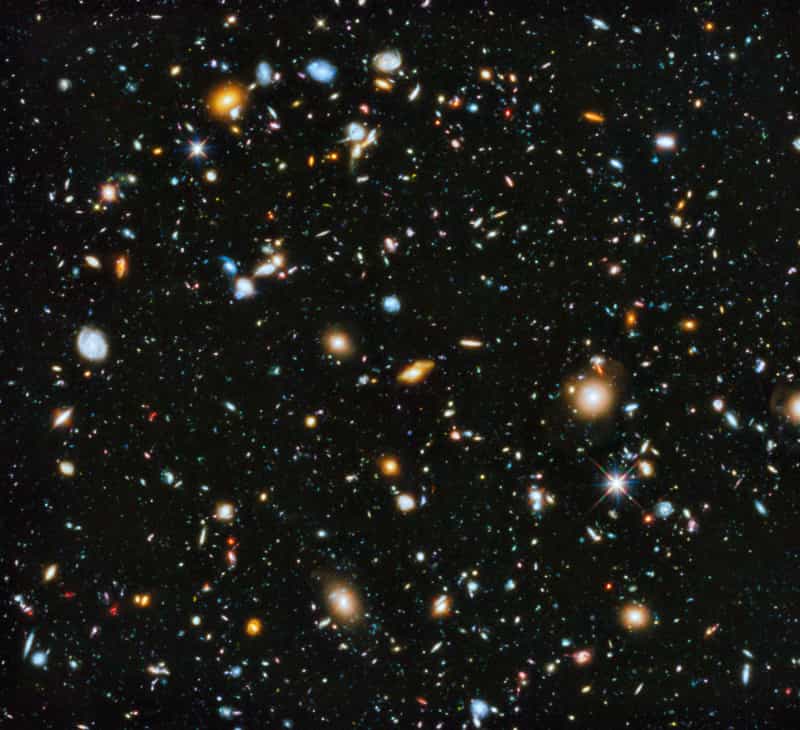
ASTRONOMY - The Hubble Ultra Deep Field in Light and Sound
Image Credit: NASA, ESA, Hubble; Sonification: G. Salvesen; Data: M. Rafelski et al.
Explanation: Have you heard about the Hubble Ultra-Deep Field? Either way, you've likely not heard about it like this -- please run your cursor over the featured image and listen! The Hubble Ultra-Deep Field (HUDF) was created in 2003-2004 with the Hubble Space Telescope staring for a long time toward near-empty space so that distant, faint galaxies would become visible. One of the most famous images in astronomy, the HUDF is featured here in a vibrant way -- with sonified distances. Pointing to a galaxy will play a note that indicates its approximate redshift. Because redshifts shift light toward the red end of the spectrum of light, they are depicted here by a shift of tone toward the low end of the spectrum of sound. The further the galaxy, the greater its cosmological redshift (even if it appears blue), and the lower the tone that will be played. The average galaxy in the HUDF is about 10.6 billion light years away and sounds like an F#. What's the most distant galaxy you can find?
01/03/2025
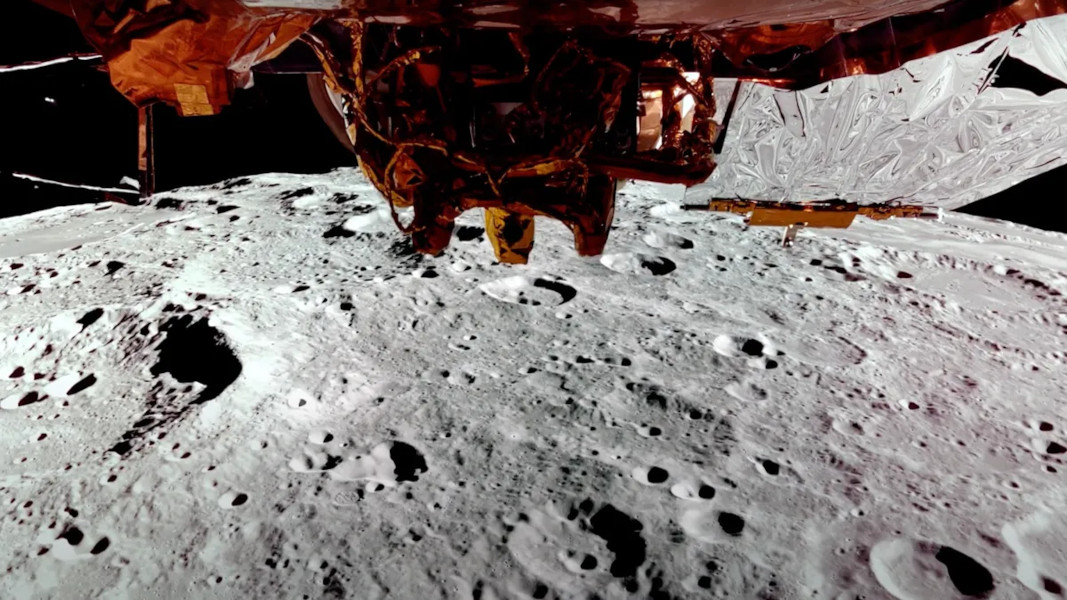
ASTRONOMY - Blue Ghost to the Moon
Image Credit: Firefly Aerospace
Explanation: With spacecraft thrusters at top center, the rugged surface of the Moon lies below the Blue Ghost lander in this space age video frame. The view of the lunar far side was captured by the Firefly Aerospace lunar lander on February 24, following a maneuver to circularize its orbit about 100 kilometers above the lunar surface. The robotic lunar lander is scheduled to touch down tomorrow, Sunday, March 2, at 3:34am Eastern Time in the Mare Crisium impact basin on the lunar near side. In support of the Artemis campaign, Blue Ghost is set to deliver science and technology experiments to the Moon, part of NASA's Commercial Lunar Payload Services program. Blue Ghost's mission on the surface is planned to operate during the lunar daylight hours at the landing site, about 14 Earth days.
28/02/2025
SANTé/MEDECINE - Pourquoi le râle agonique se produit-il ?
ASTRONOMY - Athena to the Moon
2025 February 28
Image Credit: Intuitive Machines
Explanation: Planet Earth hangs in the background of this space age selfie. The snapshot was captured by the IM-2 Nova-C lander Athena, just after stage separation following its February 26 launch to the Moon. A tall robotic lander, Athena is scheduled to touch down on Thursday, March 6, in Mons Mouton, a plateau near the Moon’s South Pole. The intended landing site is in the central portion of one of the Artemis 3 potential landing regions. Athena carries rovers and experiments as part of NASA's Commercial Lunar Payload Services program, including a drill intended to explore beneath the lunar surface in a search for evidence of frozen water. It also carries a propulsive drone dubbed the Micro Nova Hopper. After release to the lunar surface, the autonomous drone is intended to hop into a nearby crater and send science data back to the lander.
27/02/2025
ORNITHOLOGIE - Organiste à calotte jaune : un passereau très discret
ASTRONOMY - Open Star Clusters M35 and NGC 2158
2025 February 27
Image Credit & Copyright: Evan Tsai, LATTE: Lulin-ASIAA Telescope
Explanation: Framed in this single, starry, telescopic field of view are two open star clusters, M35 and NGC 2158. Located within the boundaries of the constellation Gemini, they do appear to be side by side. Its stars concentrated toward the upper right, M35 is relatively nearby, though. M35 (also cataloged as NGC 2168) is a mere 2800 light-years distant, with 400 or so stars spread out over a volume about 30 light-years across. Bright blue stars frequently distinguish younger open clusters like M35, whose age is estimated at 150 million years. At lower left, NGC 2158 is about four times more distant than M35 and much more compact, shining with the more yellowish light of a population of stars over 10 times older. In general, open star clusters are found along the plane of our Milky Way Galaxy. Loosely gravitationally bound, their member stars tend to be dispersed over billions of years as the open star clusters orbit the galactic center.
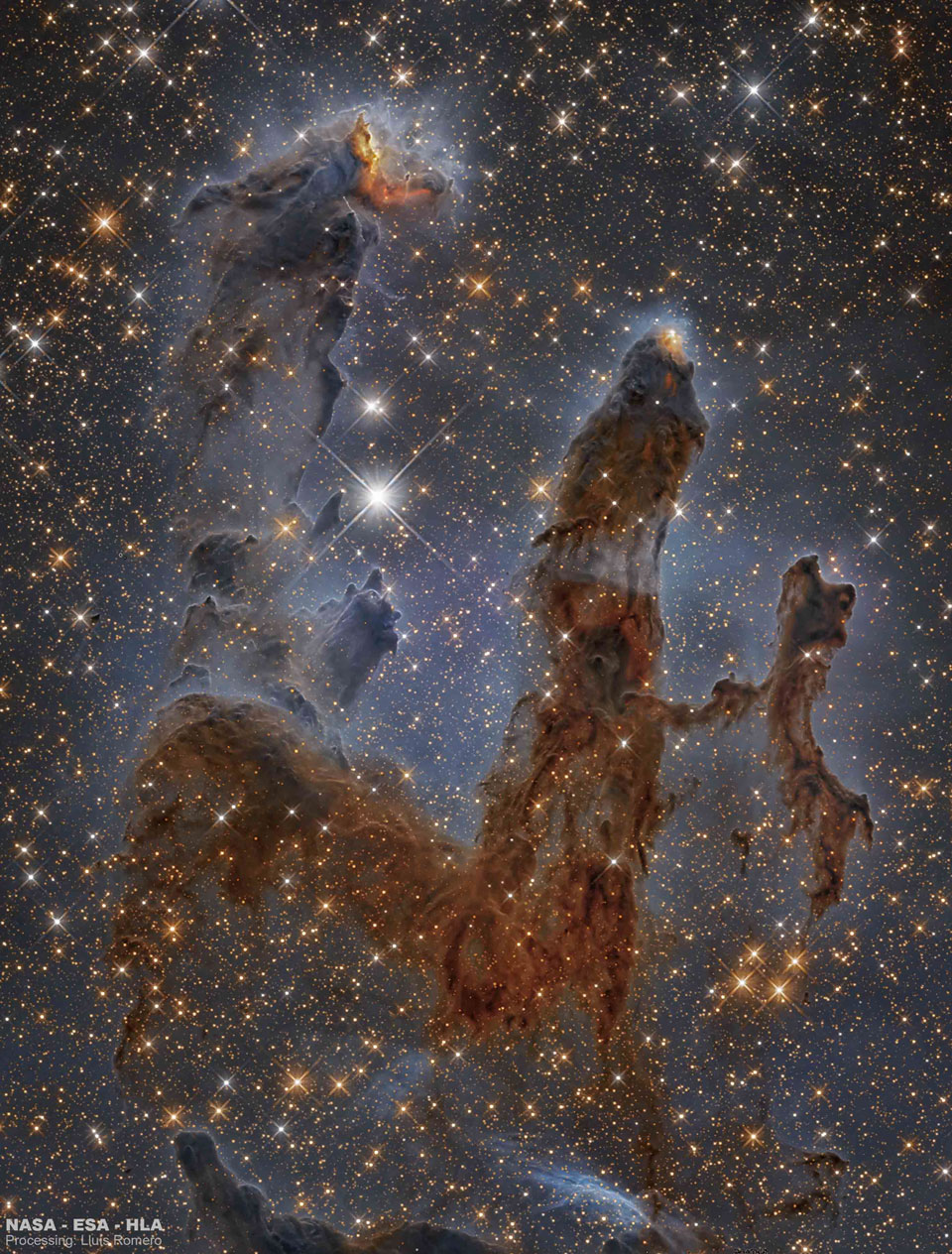
Astronomy - EAGLE NEBULA PILLARS IN INFRARED FROM HUBBLE
2026 May 31 Eagle Nebula Pillars in Infrared from Hubble Image Credit: NASA , ESA , Hubble , HLA ; Processing: Luis Romero Ventura Explanat...
-
2026 January 1 Auroral Corona Image Credit & Copyright : Roi Levi Explanation: Cycle 25 solar maximum made 2025 a great year for ...
-
Imaginez un monde où le cancer n’est plus une sentence, mais une simple étape à franchir. Grâce à une découverte révolutionnaire, ce rêve es...