Cette image de l'instrument Meris, du satellite Envisat, montre le typhon Kirogi passant en dessous du Japon.
© Esa


Explanation: This interstellar skyscape spans over 4 degrees across crowded starfields toward the constellation Sagittarius and the central Milky Way. A First Look image captured at the new NSF–DOE Vera C. Rubin Observatory, the bright nebulae and star clusters featured include famous stops on telescopic tours of the cosmos: Messier 8 and Messier 20. An expansive star-forming region over a hundred light-years across, Messier 8 is also known as the Lagoon Nebula. About 4,000 light-years away the Lagoon Nebula harbors a remarkable cluster of young, massive stars. Their intense radiation and stellar winds energize and agitate this cosmic lagoon's turbulent depths. Messier 20's popular moniker is the Trifid. Divided into three parts by dark interstellar dust lanes, the Trifid Nebula's glowing hydrogen gas creates its dominant red color. But contrasting blue hues in the colorful Trifid are due to dust reflected starlight. The Rubin Observatory visited the Trifid-Lagoon field to acquire all the image data during parts of four nights (May 1-4). At full resolution, Rubin's magnificent Sagittarius skyscape is 84,000 pixels wide and 51,500 pixels tall.


2025 June 24

Explanation: Is there a spiral galaxy in the center of this spiral galaxy? Sort of. Image data from the Hubble Space Telescope, the European Southern Observatory, and smaller telescopes on planet Earth are combined in this detailed portrait of face-on spiral galaxy Messier 61 (M61) and its bright center. A mere 55 million light-years away in the Virgo Cluster of Galaxies, M61 is also known as NGC 4303. It's considered to be an example of a barred spiral galaxy similar to our own Milky Way. Like other spiral galaxies, M61 also features sweeping spiral arms, cosmic dust lanes, pinkish star forming regions, and young blue star clusters. Its core houses an active supermassive black hole surrounded by a bright nuclear spiral -- infalling star-forming gas that itself looks like a separate spiral galaxy.


2025 June 23
Explanation: How do stars form? Images of the star forming region W5 like those in the infrared by NASA's Wide Field Infrared Survey Explorer (WISE, later NEOWISE) satellite provide clear clues with indications that massive stars near the center of empty cavities are older than stars near the edges. A likely reason for this is that the older stars in the center are actually triggering the formation of the younger edge stars. The triggered star formation occurs when hot outflowing gas compresses cooler gas into knots dense enough to gravitationally contract into stars. In the featured scientifically colored infrared image, spectacular pillars left slowly evaporating from the hot outflowing gas provide further visual clues. W5 is also known as Westerhout 5 (W5) and IC 1848. Together with IC 1805, the nebulas form a complex region of star formation popularly dubbed the Heart and Soul Nebulas. The featured image highlights a part of W5 spanning about 2,000 light years that is rich in star forming pillars. W5 lies about 6,500 light years away toward the constellation of Cassiopeia.

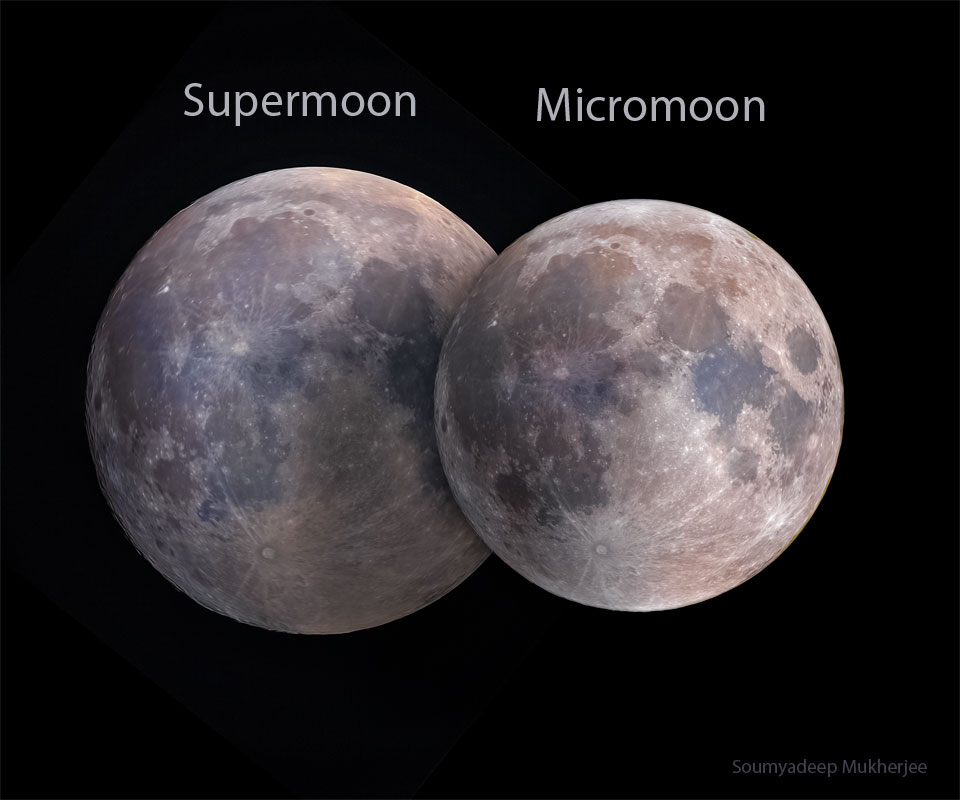
2026 May 30 Supermoon Versus Micromoon Image Credit: Soumyadeep Mukherjee Explanation: What is so micro about tonight's blue micromoon? ...