Des scientifiques sud-coréens reprogramment les cellules cancéreuses : révolution sans chimiothérapie.
©Adobe Stock
(à suivre)

2025 August 17

Explanation: What kind of clouds are these? Although their cause is presently unknown, such unusual atmospheric structures, as menacing as they might seem, do not appear to be harbingers of meteorological doom. Formally recognized as a distinct cloud type only last year, asperitas clouds can be stunning in appearance, unusual in occurrence, and are relatively unstudied. Whereas most low cloud decks are flat bottomed, asperitas clouds appear to have significant vertical structure underneath. Speculation therefore holds that asperitas clouds might be related to lenticular clouds that form near mountains, or mammatus clouds associated with thunderstorms, or perhaps a foehn -- a type of dry downward wind that flows off mountains. Clouds from such a wind called the Canterbury arch stream toward the east coast of New Zealand's South Island. The featured image, taken above Hanmer Springs in Canterbury, New Zealand in 2005, shows great detail partly because sunlight illuminates the undulating clouds from the side.
2025 August 16

Explanation: The camera battery died about 2am local time on August 12, while shooting in the bright moonlit skies from a garden in Chastre, Brabant Wallon, Belgium, planet Earth. But not before it captured the frames used to compose this cool animated gif of a brilliant Perseid meteor and a lingering visible trail known as a persistent train. The Perseid meteor, a fast moving speck of dust from the tail of large periodic Comet Swift-Tuttle, was heated to incandescence by ram pressure and vaporized as it flashed through the upper atmosphere at 60 kilometers per second. Compared to the brief flash of the meteor, its wraith-like trail really is persistent. A characteristic of bright meteors, a smoke-like persistent train can often be followed for many minutes wafting in the winds at altitudes of 60 to 90 kilometers.
2025 August 15

Explanation: In the predawn sky on August 13, two planets were close. And despite the glare of a waning gibbous Moon, bright Jupiter and even brighter Venus were hard to miss. Their brilliant close conjunction is posing above the eastern horizon in this early morning skyscape. The scene was captured in a single exposure from a site near Gansu, China, with light from both planets reflected in the still waters of a local pond. Also seen against the moonlight were flashes from the annual Perseid Meteor Shower, known for its bright, fast meteors. Near the much anticipated peak of activity, the shower meteors briefly combined with the two planets for a celestial spectacle even in moonlit skies.
2025 August 10
Explanation: What's that strange light down the road? Dust orbiting the Sun. At certain times of the year, a band of sun-reflecting dust from the inner Solar System appears prominently just after sunset -- or just before sunrise -- and is called zodiacal light. Although the origin of this dust is still being researched, a leading hypothesis holds that zodiacal dust originates mostly from faint Jupiter-family comets and slowly spirals into the Sun. Recent analysis of dust emitted by Comet 67P, visited by ESA's robotic Rosetta spacecraft, bolsters this hypothesis. Pictured when climbing a road up to Teide National Park in the Canary Islands of Spain, a bright triangle of zodiacal light appeared in the distance soon after sunset. Captured on June 21, 2019, the scene includes bright Regulus, the alpha star of the constellation Leo, standing above center toward the left. The Beehive Star Cluster (M44) can be spotted below center, closer to the horizon and also immersed in the zodiacal glow.
2025 August 12

Explanation: Where are all of these meteors coming from? In terms of direction on the sky, the pointed answer is the constellation of Perseus. That is why the meteor shower that peaks tonight is known as the Perseids -- the meteors all appear to come from a radiant toward Perseus. In terms of parent body, though, the sand-sized debris that makes up the Perseids meteors come from Comet Swift-Tuttle. The comet follows a well-defined orbit around our Sun, and the part of the orbit that approaches Earth is superposed in front of Perseus. Therefore, when Earth crosses this orbit, the radiant point of falling debris appears in Perseus. Featured here, a composite image taken over six nights and containing over 100 meteors from 2024 August Perseids meteor shower shows many bright meteors that streaked over the Bieszczady Mountains in Poland. This year's Perseids, usually one of the best meteor showers of the year, will compete with a bright moon that will rise, for many locations, soon after sunset.

2025 August 11
Closest Ever Images Near the Sun
Explanation: Everybody sees the Sun. Nobody's been there. Starting in 2018, though, NASA launched the robotic Parker Solar Probe (PSP) to investigate regions near to the Sun for the first time. The featured time-lapse video shows the view looking sideways from behind PSP's Sun shield in December during the closest approach of any human-made spacecraft to the Sun, looping down to only about five solar diameters above the Sun's hot surface. The PSP's Wide Field Imager for Solar Probe (WISPR) cameras took these images over seven hours, but they are digitally compressed here into about 5 seconds. The solar corona, including colliding coronal mass ejections (CMEs), is visible here in unprecedented detail, with stars passing far in the background. The Sun is not only Earth's dominant energy source, but its variable solar wind also compresses Earth's atmosphere, triggers auroras, affects power grids, and can even damage orbiting communication satellites.
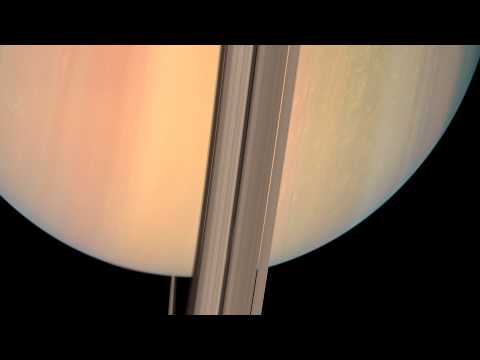
Cassini Approaches Saturn Video Credit & Copyright: Cassini Imaging Team , ISS , JPL , NASA , ESA , S. Van Vuuren et al.; Music: Ada...