Les progrès technologiques permettent aux scientifiques de cartographier les fonds marins, de surveiller les éruptions et d'étudier plus précisément le comportement du magma. Tout cela pourrait aider les scientifiques à comprendre notre monde et à protéger tous ceux qui y vivent.
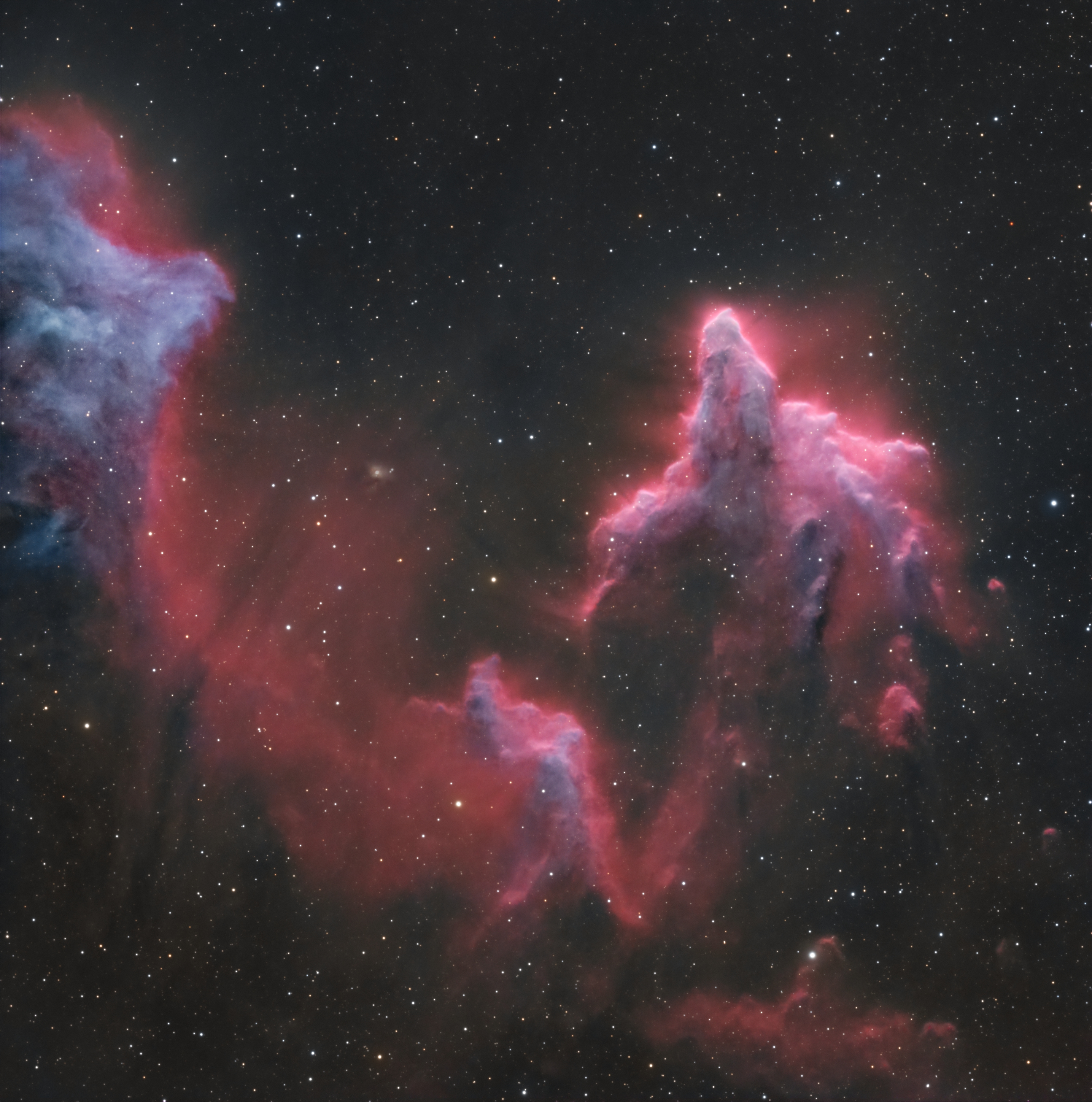
Explanation: These brightly outlined flowing shapes look ghostly on a cosmic scale. A telescopic view toward the constellation Cassiopeia, the colorful skyscape features the swept-back, comet-shaped clouds IC 59 (left) and IC 63. About 600 light-years distant, the clouds aren't actually ghosts. They are slowly disappearing though, under the influence of energetic radiation from hot, luminous star gamma Cas. Gamma Cas is physically located only 3 to 4 light-years from the nebulae and lies just above the right edge of the frame. Slightly closer to gamma Cas, IC 63 is dominated by red H-alpha light emitted as hydrogen atoms ionized by the hot star's ultraviolet radiation recombine with electrons. Farther from the star, IC 59 shows less H-alpha emission but more of the characteristic blue tint of dust reflected star light. The field of view spans over 1 degree or 10 light-years at the estimated distance of the interstellar apparitions.
Vous imaginez une vague plus haute que presque tous les gratte-ciel de New York ? C’est difficile à croire, et pourtant, c’est bien ce qui s’est passé dans un fjord isolé en Alaska. Le 10 août dernier, un pan entier de montagne a tout simplement glissé dans l’eau, provoquant une vague monstrueuse, un véritable mur d’eau. C’est le genre de chose qu’on voit dans les films catastrophes.
Heureusement, et c’est presque un miracle, personne n’a été blessé. Mais l’événement nous rappelle à quel point la nature peut être imprévisible et, disons-le, terrifiante.
Tout a commencé très tôt, vers 5h30 du matin, dans un endroit appelé Tracy Arm, à environ 130 kilomètres de la capitale de l’Alaska, Juneau. Ce n’est pas une petite poignée de cailloux qui est tombée. Non, on parle de 100 millions de mètres cubes de terre et de roche. Pour vous donner une idée, c’est un volume absolument colossal qui s’est effondré d’un seul coup.
La conséquence directe de ce plongeon ? Un mégatsunami. La première vague qui a déferlé sur le versant opposé du fjord a atteint une hauteur estimée entre 470 et 500 mètres. C’est simple, c’est plus haut que tous les gratte-ciel de New York, à l’exception du One World Trade Center. Une véritable montagne d’eau.
L’histoire aurait pu être tragique. Des kayakistes qui campaient sur une île à l’entrée du fjord ont vu tout leur matériel emporté par les flots. Par chance, ils s’en sont sortis sains et saufs. Une chance incroyable, quand on y pense.
De nombreux produits et matériaux se sont développés en jouant avec les effets de la couleur, s'accompagnant d'une activité de recherche importante. Il faut dire que la perception colorée, à travers le processus psychophysique qui est mis en œuvre, est l'objet de nombreuses interrogations.
Toutes les couleurs ont leur part de mystère. La pourpre, le kermès et le pastel sont notamment trois teintes mythiques entre toutes, profondément inscrites dans le patrimoine culturel des civilisations méditerranéennes.
On dit ainsi des empereurs byzantins qu'ils sont « nés dans la pourpre », on parle du rouge écarlate du manteau du Christ ou du fabuleux « pays de cocagne », où l'or bleu du pastel en coques assure indéfiniment la prospérité générale... Voilà pourquoi ces trois couleurs ont été choisies comme exemples pour illustrer les acquis de recherches pluridisciplinaires récentes sur l'histoire et l'archéologie de la production des colorants.
Depuis l'exposition internationale du Musée des beaux-arts de Carcassonne (1999-2000) et celle du Centre de documentació i Museu tèxtil de Terrassa, près de Barcelone (2000), portant sur l'importance culturelle et économique des colorants extraits du monde vivant, la thématique de la couleur a connu un nouveau souffle.
C'est la lecture d'un dossier du CNRS (CNRS Info 391) à propos de cette exposition et celle de l'ouvrage désormais incontournable intitulé Traité de la couleur (publication des Presses polytechniques et universitaires romandes, 2001), qui m'a incitée à vous proposer ce dossier sur les couleurs...
Explanation: How far can black hole jets extend? A new record was found just recently with the discovery of a 23-million light-year long jet pair from a black hole active billions of years ago. Dubbed Porphyrion for a mythological Greek giant, the impressive jets were created by a type of black hole that does not usually create long jets -- one that is busy creating radiation from infalling gas. The featured animated video depicts what it might look like to circle around this powerful black hole system. Porphyrion is shown as a fast stream of energetic particles, and the bright areas are where these particles are impacting surrounding gas. The discovery was made using data from the Keck and Mayall (DESI) optical observatories as well as LOFAR and the Giant Metrewave Radio Telescope. The existence of these jets demonstrates that black holes can affect not only their home galaxies but far out into the surrounding universe.
Connue sous le nom de vague Draupner, ou Vague du Nouvel-An, elle reste la plus haute vague jamais enregistrée à un endroit fixe, avec une hauteur de 25,6 mètres...
Situé près de Flagstaff, en Arizona, Meteor Crater, également connu sous le nom de Barringer Crater, est un grand cratère d'impact météoritique. Ce phénomène naturel remarquable est l'un des cratères de ce type les mieux préservés de notre planète. Il mesure environ 1 200 m de diamètre et 170 m de profondeur.
Des chercheurs ont déterminé la date précise à laquelle un astéroïde pourrait potentiellement percuter la Terre, criant dans cette collision une puissance équivalente à celle de 22 bombes atomiques. Cet objet céleste, baptisé Bénou, s'approche de notre planète tous les six ans. Cependant, les scientifiques estiment que le 24 septembre 2182 pourrait être la date à laquelle le risque de collision entre la Terre et l'astéroïde pourrait être réel.
Bien que la date potentielle de l'événement apocalyptique soit encore lointaine, la NASA déploie actuellement d'intenses efforts pour dévier l'astéroïde Bénou et se trouve dans la phase finale de sa mission. Il y a sept ans, l'agence spatiale américaine a lancé une sonde vers l'astéroïde dans le but de collecter des échantillons, dans l'espoir que les informations recueillies puissent aider à prévenir une éventuelle rencontre catastrophique.
Colorful Aurora over New Zealand Image Credit & Copyright: Tristian McDonald
Explanation: Sometimes the night sky is full of surprises. Take the sky over Lindis Pass, South Island, New Zealand one-night last week. Instead of a typically calm night sky filled with constant stars, a busy and dynamic night sky appeared. Suddenly visible were pervasive red aurora, green picket-fence aurora, a red SAR arc, a STEVE, a meteor, and the Moon. These outshone the center of our Milky Way Galaxy and both of its two satellite galaxies: the LMC and SMC. All of these were captured together on 28 exposures in five minutes, from which this panorama was composed. Auroras lit up many skies last week, as a Coronal Mass Ejection from the Sun unleashed a burst of particles toward our Earth that created colorful skies over latitudes usually too far from the Earth's poles to see them. More generally, night skies this month have other surprises, showing not only auroras -- but comets.