Nombre total de pages vues
05/12/2025
SANTé/MEDECINE - CANCER - 12 AVANCéES REVOLUTIONNAIRES - 11. Une thérapie qui utilise les propres cellules du patient
30/11/2025
ASTRONOMY - The Surface of Titan from Huygens
2025 November 30
Image Credit: ESA, NASA, JPL, U. Arizona, Huygens Lander
Explanation: If you could stand on Titan -- what would you see? The featured color view from Titan gazes across an unfamiliar and distant landscape on Saturn's largest moon. The scene was recorded by ESA's Huygens probe in 2005 after a 2.5-hour descent through a thick atmosphere of nitrogen laced with methane. Bathed in an eerie orange light at ground level, rocks strewn about the scene could well be composed of water and hydrocarbons frozen solid at an inhospitable temperature of negative 179 degrees C. The large light-toned rock below and left of center is only about 15 centimeters across and lies 85 centimeters away. The saucer-shaped spacecraft is believed to have penetrated about 15 centimeters into a place on Titan's surface that had the consistency of wet sand or clay. Huygen's batteries enabled the probe to take and transmit data for more than 90 minutes after landing. Titan's bizarre chemical environment may bear similarities to planet Earth's before life evolved.
29/11/2025
LES BELLES INVENTIONS DE LEONARD DE VINCI - La mitrailleuse ou ribaudequin
ASTRONOMY - Moon Games
Image Credit & Copyright: Giorgia Hofer
Explanation: This is not a screen from a video game. Nestled below the tree-line, the small mountain church does look like it might be hiding from Moon though. In the well-composed telephoto snapshot, taken on November 23, the church walls are partly reflecting light from terrestrial flood lights. Of course, the Moon is reflecting light from the Sun. At any given time the Sun illuminates fully half of the Moon's surface, also known as the lunar dayside, but on that night only a sliver of its sunlit surface was visible. About three days after New Moon, the Moon was in a waxing crescent phase. The single exposure was captured shortly after sunset in skies near Danta di Cadore, northern Italy, planet Earth.
27/11/2025
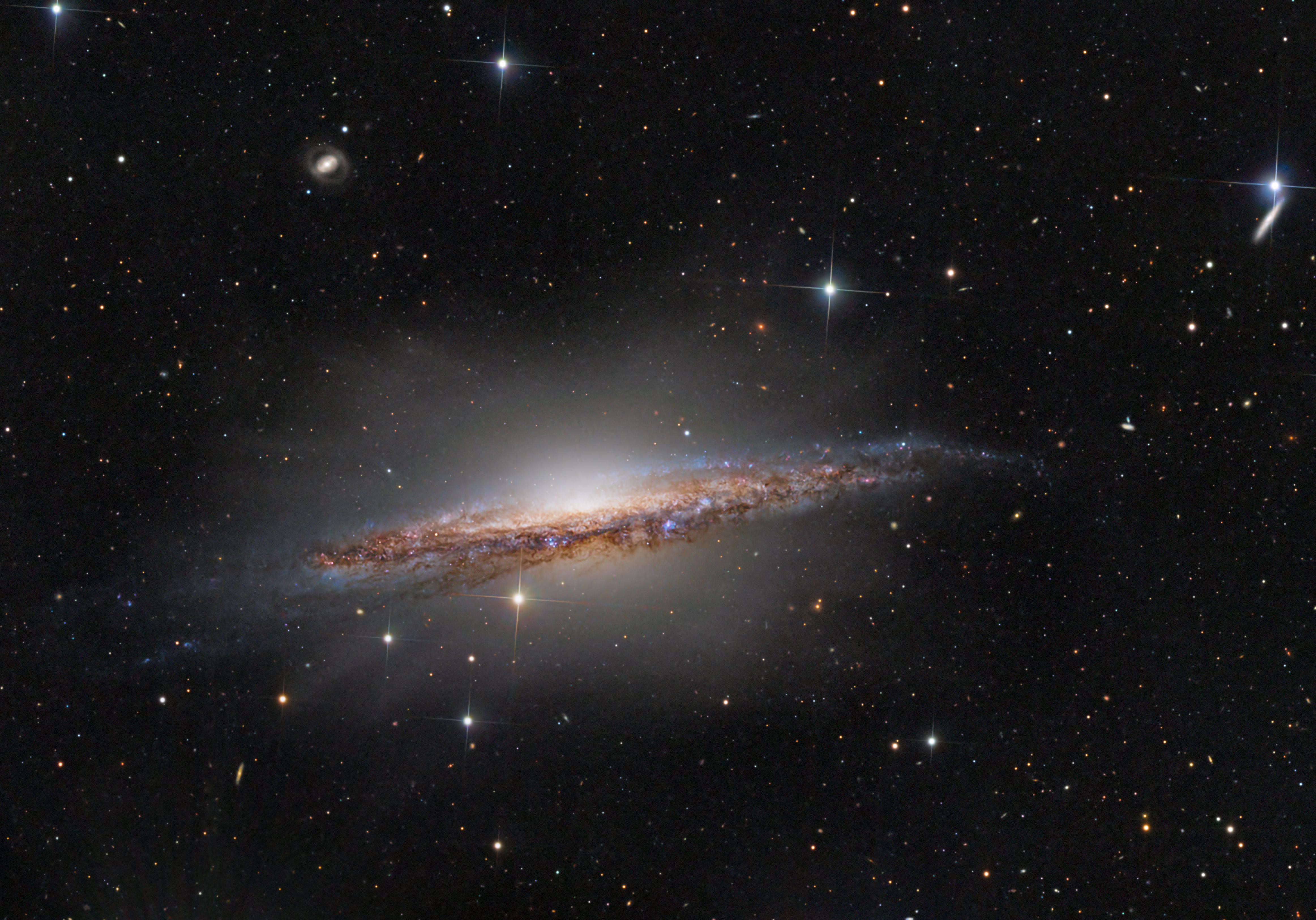
ASTRONOMY - Portrait of NGC 1055
2025 November 27
Image Credit & Copyright: John Hayes
Explanation: Big, beautiful spiral galaxy NGC 1055 is a dominant member of a small galaxy group a mere 60 million light-years away toward the aquatically intimidating constellation Cetus. Seen edge-on, the island universe spans over 100,000 light-years, a little larger than our own Milky Way galaxy. The colorful, spiky stars decorating this cosmic portrait of NGC 1055 are in the foreground, well within the Milky Way. But telltale pinkish star forming regions and young blue star clusters are scattered through winding dust lanes along the distant galaxy's thin disk. With a smattering of even more distant background galaxies, the deep image also reveals a boxy halo that extends far above and below the central bulge and disk of NGC 1055. The halo itself is laced with faint, narrow structures, and could represent the mixed and spread out debris from a satellite galaxy disrupted by the larger spiral some 10 billion years ago.
SANTé/MEDECINE - CANCER - 12 AVANCEES REVOLUTIONNAIRES - 10. Une goutte de sang pour détecter le cancer du pancréas
26/11/2025
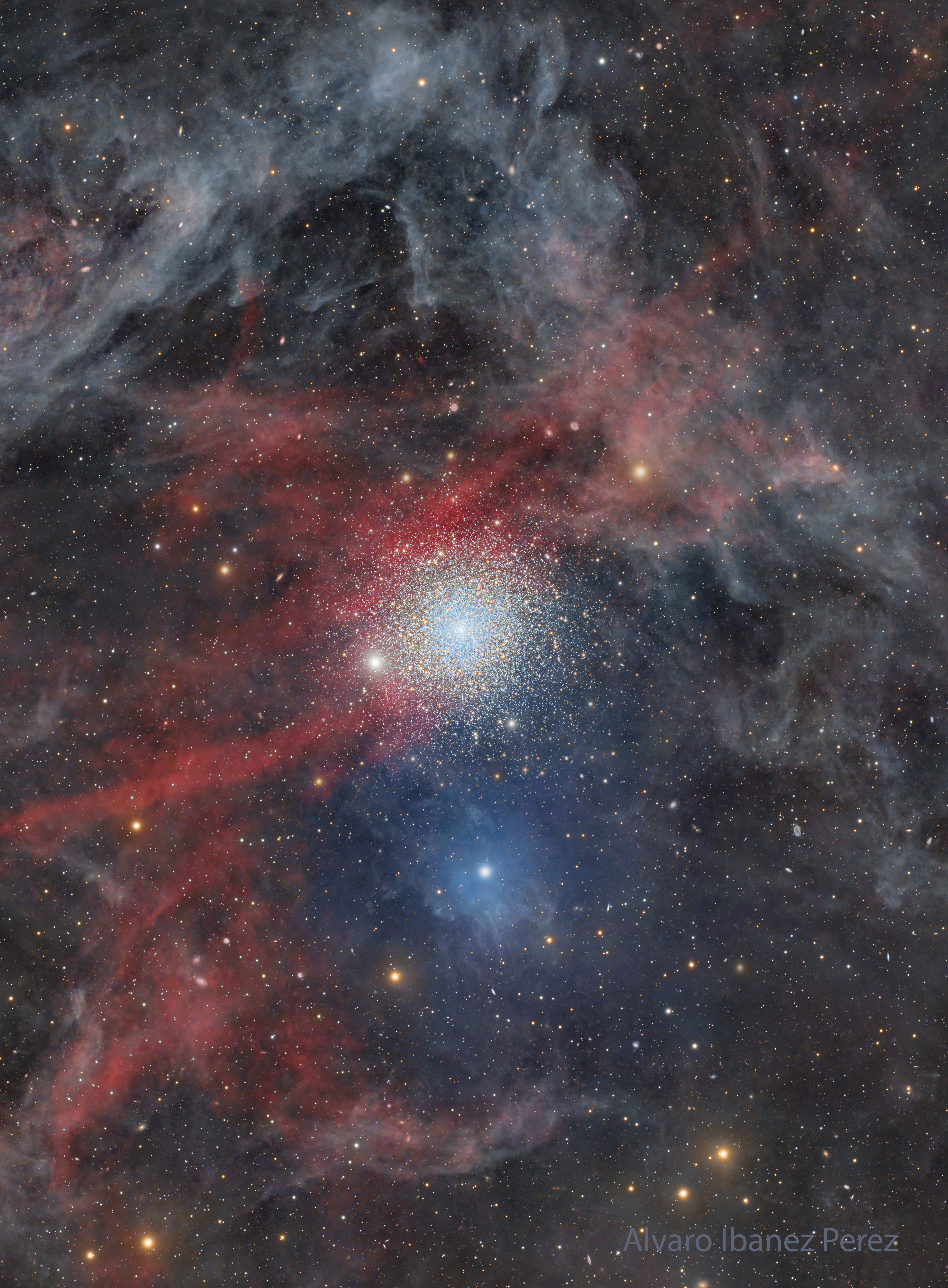
ASTRONOMY - Globular Cluster M15 Deep Field
2025 November 26
Image Credit & Copyright: Alvaro Ibanez Perez
Explanation: Stars, like bees, swarm around the center of bright globular cluster M15. The central ball of over 100,000 stars is a relic from the early years of our Galaxy, and continues to orbit the Milky Way's center. M15, one of about 150 globular clusters remaining, is noted for being easily visible with only binoculars, having at its center one of the densest concentrations of stars known, and containing a high abundance of variable stars and pulsars. The featured image of M15 was taken by combining very long exposures -- 122 hours in all -- and so brings up faint wisps of gas and dust in front of the giant ball of stars. M15 lies about 35,000 light years away toward the constellation of the Winged Horse (Pegasus).
25/11/2025
SANTé/MEDECINE - CANCER - 12 AVANCEES REVOLUTIONNAIRES - 9. Un traitement du cancer du col de l’utérus qui réduit drastiquement la mortalité
ASTRONOMY - Comet Lemmon and the Milky Way
2025 November 25
Image Credit & Copyright: Lin Zixuan (Tsinghua U.)
Explanation: What did Comet Lemmon look like when it was at its best? One example is pictured here, featuring three celestial spectacles all at different distances. The closest spectacle is the snowcapped Meili Mountains, part of the Himalayas in China. The middle marvel is Comet Lemmon near its picturesque best early this month, showing not only a white dust tail trailing off to the right but its blue solar wind-distorted ion tail trailing off to the left. Far in the distance on the left is the magnificent central plane of our Milky Way Galaxy, featuring dark dust, red nebula, and including billions of Sun-like stars. Comet C/2025 A6 (Lemmon) is already fading as it heads back into the outer Solar System, while the Himalayan mountains will gradually erode over the next billion years. The Milky Way Galaxy, though, will live on -- forming new mountains and comets -- for many billions of years into the future.
24/11/2025
ASTRONOMY - Apep: Unusual Dust Shells from Webb
2025 November 24
Image Credit: NASA, ESA, CSA, STScI, JWST; Science: Y. Han (Caltech), R. White (Macquarie U.); Image Processing: A. Pagan (STScI)
Explanation: What created this unusual space sculpture? Stars. This unusual system of swirls and shells, known as Apep, was observed in unprecedented detail by NASA’s James Webb Space Telescope in infrared light in 2024. Observations indicate that the unusual shape originates from two massive Wolf-Rayet stars orbiting each other every 190 years with each close passes causing a new shell of dust and gas to be expelled. Holes in these shells are thought to be caused by a third orbiting star. This stellar dust dance will likely continue for hundreds of thousands of years, possibly ending only when one of the massive stars runs out of internal nuclear fuel and explodes in a supernova punctuated by a burst of gamma-rays.
ASTRONOMY - Earthset from Orion
2026 January 24 Earthset from Orion Image Credit: NASA , Artemis 1 Explanation: Eight billion people are about to disappear in this sn...
-
2022 September 26 All the Water on Planet Earth Illustration Credit: Jack Cook, Adam Nieman, Woods Hole Oceanographic Institution ; Data ...
-
2025 May 11 The Surface of Venus from Venera 14 Image Credit: Soviet Planetary Exploration Program , Venera 14 ; Processing & Copyri...


/https%3A%2F%2Flanature.ca%2Fapp%2Fuploads%2F2025%2F04%2Ffreepik__adjust__26120.jpeg)