Explanation: Jinkies, look at all those ghosts! It took 100 hours of observation and a special oxygen filter for today’s image to capture three faint nebulas hidden in the Cassiopeia constellation. IC 59 and IC 63, the original Ghosts of Cassiopeia, haunt the region near multi-star system γ Cassiopeia. Energetic light from γ Cassiopeia causes the hydrogen gas in IC 59 and 63 to glow red. Their dust reflects and scatters some blue-ish white starlight. Newly discovered Objects 1, 2, and 3 appear as blue phantoms, revealing the presence of ionized oxygen. But ionized by what? Like at the bow of a speeding boat, γ Cassiopeia may be piling up material as the system moves through interstellar gas and dust. It follows that Object 3 may be the compressed and heated oxygen of that bow shock. Object 1 could be a planetary nebula if a central white dwarf is identified. The origins of these astronomical apparitions remain a mystery to be solved.
Epxlanation: Put on your red/blue glasses and float next to the jagged and double-lobed nucleus of Churyumov-Gerasimenko, also known as Comet 67P . The stereo anaglyph was created by combining two images from the Rosetta spacecraft's narrow angle OSIRIS camera taken on July 25, 2015 from a distance of 184 kilometers. Numerous jets are emanating from the small solar system world's active surface near its closest approach to the Sun. The larger lobe is around 4 kilometers in diameter, joined to a smaller, 2.5 kilometer diameter lobe by a narrow neck. Rosetta's mission to the comet ended in September 2016 when the spacecraft was commanded to a controlled impact with the comet's surface . Keep those 3D glasses on though. You can check out a catalog of nearly 1400 stereo anaglyphs created from Rosetta image data on this website.
Explanation: Blasting into the predawn sky on Tuesday, October 13, a Falcon 9 rocket and Dragon spacecraft are headed for low Earth orbit in this stunning timelapse video captured from Indian Harbour Beach, Florida. Starting with a launch from Space Launch Complex 40 at Cape Canaveral Space Force Station, Falcon and Dragon are chasing the International Space Station on NASA's 35th Commercial Resupply Services mission. On cue, the space station itself enters the frame from the top. Almost 8 seconds into the 30 second timelapse. the bright streak of the ISS appears heading "down" toward the horizon. The first and second stages of the Falcon 9 are separating as the spectacular exhaust plume jellyfish grows, already catching the light of the rising Sun. The visible sequence of first stage boost back, re-entry, and landing burns begins around 20 seconds into the video. With the second stage following the ISS toward the distant horizon, the jellyfish plume continues to drift in the predawn sky, even after the successful first stage landing at planet Earth's Landing Zone 40.
Le concombre des mers Psychropotes longicauda se nourrit des sédiments qu'il trouve autour des nodules de manganèse qui tapissent le fond océanique. Pour économiser de l'énergie, il utilise sa « voile » comme moyen de locomotion. Cet individu a été photographié à 5.000 mètres de profondeur dans les abysses de l'océan Pacifique.
La fusée Falcon 9 de SpaceX, qui transporte la mission CRS-35 de la NASA, crée le célèbre effet « méduse spatiale » lors de son décollage depuis Cap Canaveral, en Floride. Le panache d’échappement de la fusée se dilate à haute altitude et est éclairé par la lumière du soleil, tandis que le site de lancement reste plongé dans l’obscurité, créant ainsi ce spectaculaire effet. Selon la NASA, cette mission achemine plus de 3 tonnes de matériel destiné à des recherches scientifiques.
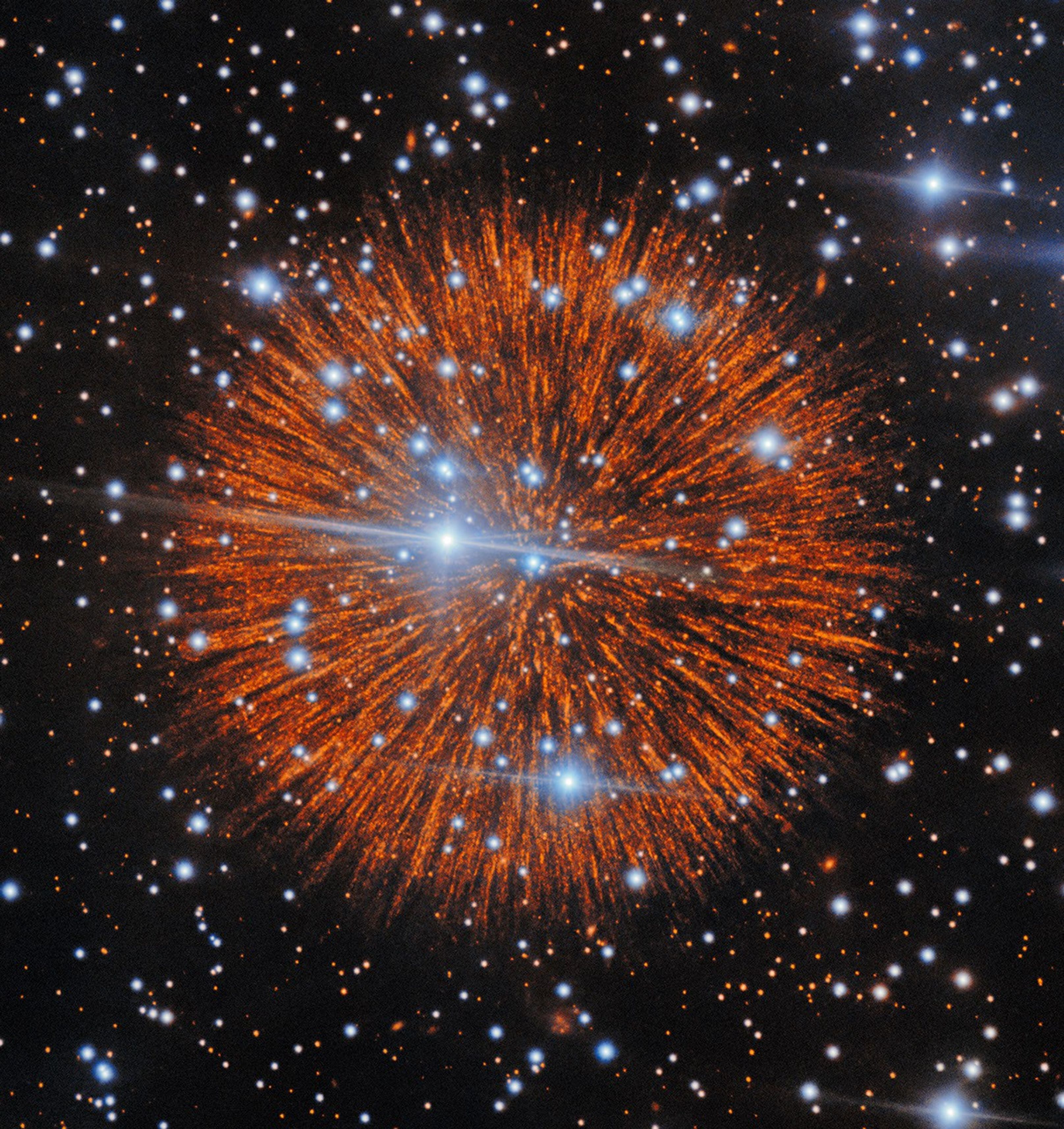
Explanation: "Happy New Year!" No, wait, this is not a fireworks display. This image shows Nebula Pa 30, observed with the Gemini North Telescope in Hawai'i. It is likely the remnant of an old supernova explosion: separate historical records by Chinese, Japanese and Arabic astronomers tell of a "guest star" that appeared in the sky for 185 days in the year 1181. It is believed that this bright new point of light came from the supernova that caused the fireworks in Pa 30. Astronomers don't know exactly what happened in this unusual explosion, classified as a Type Iax supernova, but it is thought to be caused by the merger of two white dwarfs. The mysterious central star in the image is extremely hot and produces a strong wind, possibly forming the radial filaments. Look closely at them: those pearl-like knots stringing the filaments are 4 light-days in diameter. Understanding how a supernova created this amazing nebula continues an 845-year old mystery (and counting).
Du genre Psychrolutes, ce poisson téléostéen n'est pas à son avantage vu de face. Il a été observé au cours de l'expédition Norfanz à une profondeur de plus de 1.000 mètres, au nord-ouest de la Nouvelle-Zélande.
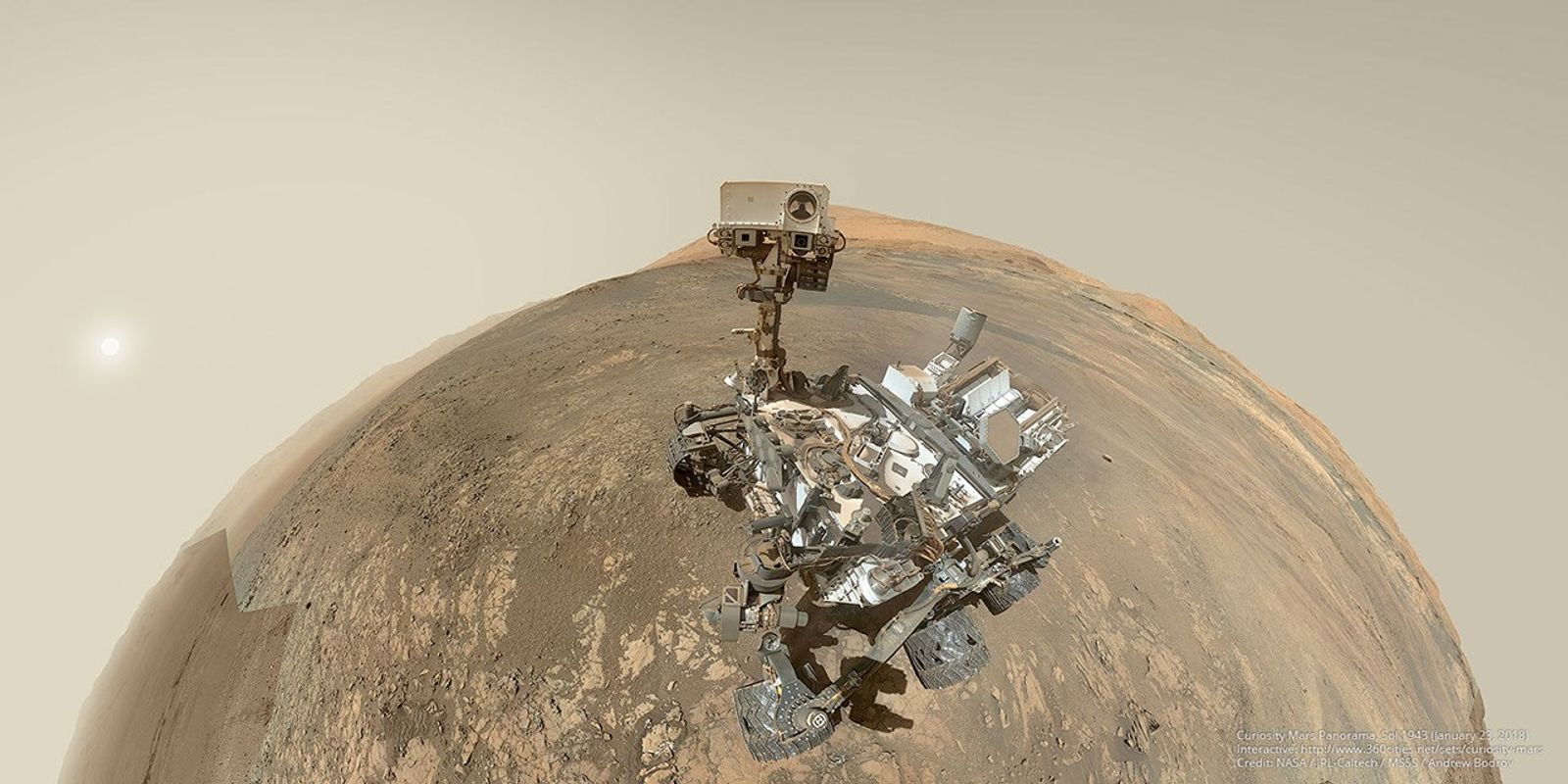
Explanation: On sol 1943 of its journey of exploration across the surface of Mars, the Curiosity Rover recorded this selfie at the south rim of Vera Rubin Ridge. Of course a sol is a Martian solar day, about 40 minutes longer than an Earth day. Curiosity's sol 1943 corresponds to Earth date January 23, 2018. Also composed as an interactive 360 degree VR, the mosaicked panorama combines 61 exposures taken by the small car-sized rover's Mars Hand Lens Imager (MAHLI). Frames containing the imager's arm have been edited out while the extended background used was taken by the rover's Mastcam on sol 1903. At the top of the rover's mast, sitting above the Mastcam, the laser-firing ChemCam housing blocks out the distant, 5 kilometer high peak of Mount Sharp. On Earth date August 26, 2026, Curiosity marked an total elevation gain of 1 kilometer in its trek from the floor of Gale Crater up the slope of Mount Sharp.
Plus grosse planète du Système solaire, Jupiter est brillante et très facile à repérer à l’œil nu. Elle permet des observations variées et passionnantes au télescope (et même aux jumelles). Découvrez-la !
Une planète passionnante et facile à repérer
Jupiter est un astre brillant qui se repère facilement à l’œil nu car son éclat domine celui des étoiles environnantes. Un débutant peut même la confondre avec Vénus, « l’étoile du Berger » même si elle n’est pas aussi brillante à cause de son éloignement.
C’est une planète gazeuse géante (11 fois la Terre en diamètre) qui peut être admirée facilement avec un petit télescope. Vous ne verrez pas autant de détails que sur les photos prises par les sondes d’exploration. En revanche, vous pouvez découvrir ses bandes nuageuses… et ses quatre principaux satellites !
Comment trouver Jupiter dans le ciel ?
Il suffit de savoir que la planète Jupiter est très brillante et de connaître ses périodes de visibilité. Vous devriez la trouver sans difficulté en balayant le ciel du regard. Au besoin, affinez votre recherche en consultant notre Carte du ciel en ligne qui vous montrera dans quelle direction se trouve la planète.
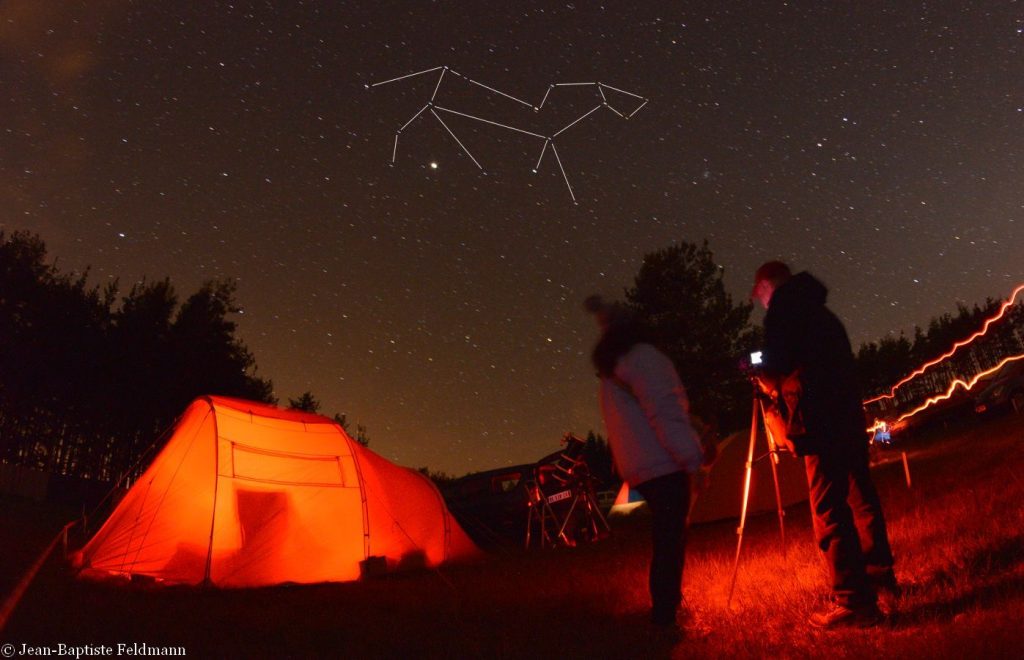
Jupiter est très brillante. Sur cette image, la planète géante s’était glissée entre les pattes de la constellation du Lion. Photo : Jean-Baptiste Feldmann.
Que peut-on voir avec un télescope ou une lunette ?
Le disque et les quatre principaux satellites
Jupiter est une cible de choix même si votre équipement est modeste. La moindre lunette astronomique révèle le globe jovien sous la forme d’un petit disque brillant. Cette vision confirme que vous avez bien affaire à une planète de notre Système solaire et pas à une étoile (les étoiles sont trop lointaines pour apparaître autrement que sous forme de point, même dans un télescope puissant).
On remarque immédiatement que ce petit disque est entouré de plusieurs petits points lumineux plus ou moins alignés de part et d’autre : ce sont les principaux satellites de Jupiter, découverts par Galilée il y a quatre siècles avec une lunette rudimentaire. Ces quatre satellites dits galiléens se nomment Io, Europe, Ganymède et Callisto. On ne les voit pas toujours tous les quatre, car certains sont parfois cachés derrière la planète, ou passent devant.
Ces satellites faisant le tour de Jupiter en quelques jours, il est très intéressant d’observer leur évolution soir après soir.
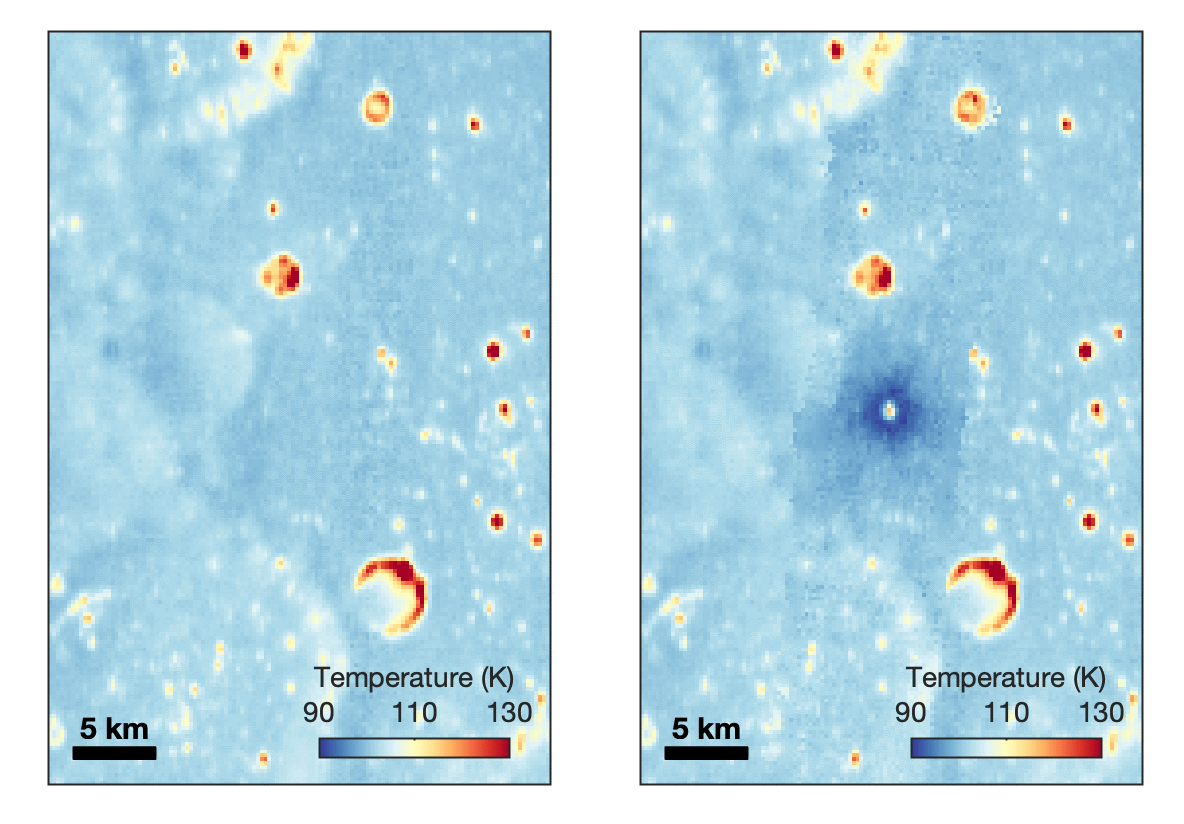
Explanation: A once-in-a-lifetime crater has appeared on the Moon! A comet or asteroid roughly the size of a humpback whale (approximately 10-20 meters, 30-60 feet) crashed into the Moon sometime between April and May of 2024. The Lunar Reconnaissance Orbiter (LRO), with its monthly monitoring of the Moon, captured today’s images of the lunar surface before and after the event. The resulting crater, named after Apollo-era lunar scientist McGetchin, is two soccer fields across. Craters of this size are only expected once every 132 years! Follow up thermal imaging revealed a large cold spot that surrounds the warm crater. Surface impacts will puff up the loose lunar sediment, or regolith, making it less dense and harder to retain heat. This event affected an area much larger than the visible crater, which will inform humanity’s understanding of surface impacts and the evolution of the Moon’s surface. It also reminds us all to be thankful for Earth's atmosphere.
Date:
September 23, 2026
Credit:
NASA/GSFC/Intuitive Machines
Authors & editors:
Keighley Rockcliffe, Robert Nemiroff, Jerry Bonnell, Cecilia Chirenti
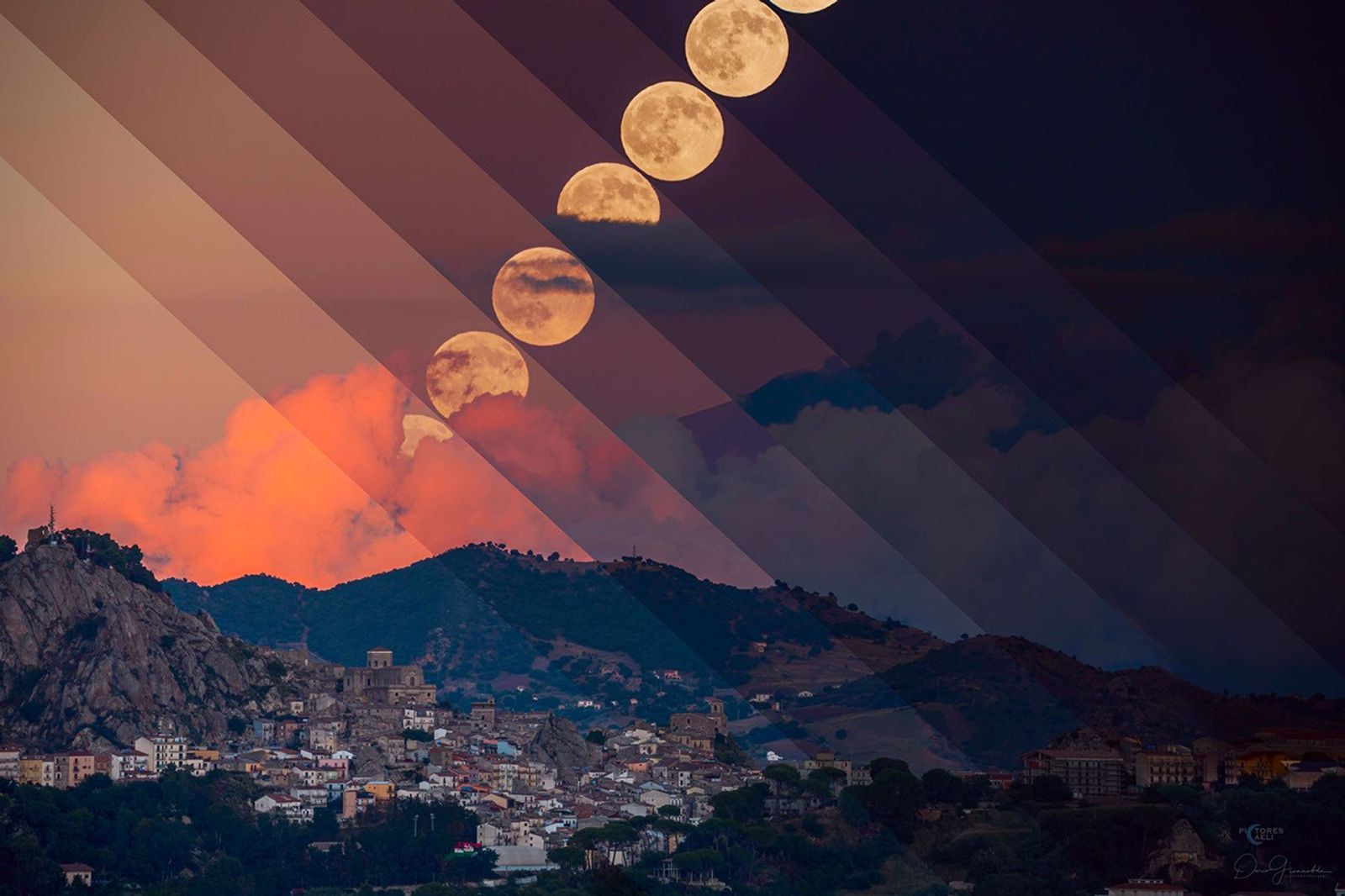
Explanation: Have you ever seen the full moon rise? This colorful image was photographed last weekend in Sicily, just outside the town of Nicosia, in Italy. It is a composite photograph that shows the Moon rising as the sky turns darker. Lower clouds are reflecting the colors of antitwilight, while ash and gas from Mount Etna are seen higher in the background. The pink band lower in the sky is called the Belt of Venus. During a full moon, the Moon and the Sun are in opposition in the sky: the moon rises as the sun sets. The lunar phase cycle lasts approximately 29.5 days (but the Moon takes approximately 27 days to orbit the Earth). In some cultures of the Northern Hemisphere, the September full moon is called the Harvest Moon. Does your culture have a special name for it? (A full moon by any other name would shine as bright.)
Cet escargot de mer aux allures de léopard, communément appelé Monnaie caraïbe (Cyphoma gibbosum), a été photographié dans le golfe du Mexique, près de l'île de Grand Cayman (des îles Cayman). Sa belle couleur se trouve uniquement sur les parties molles de son corps ; la carapace, quant à elle, est blanche.
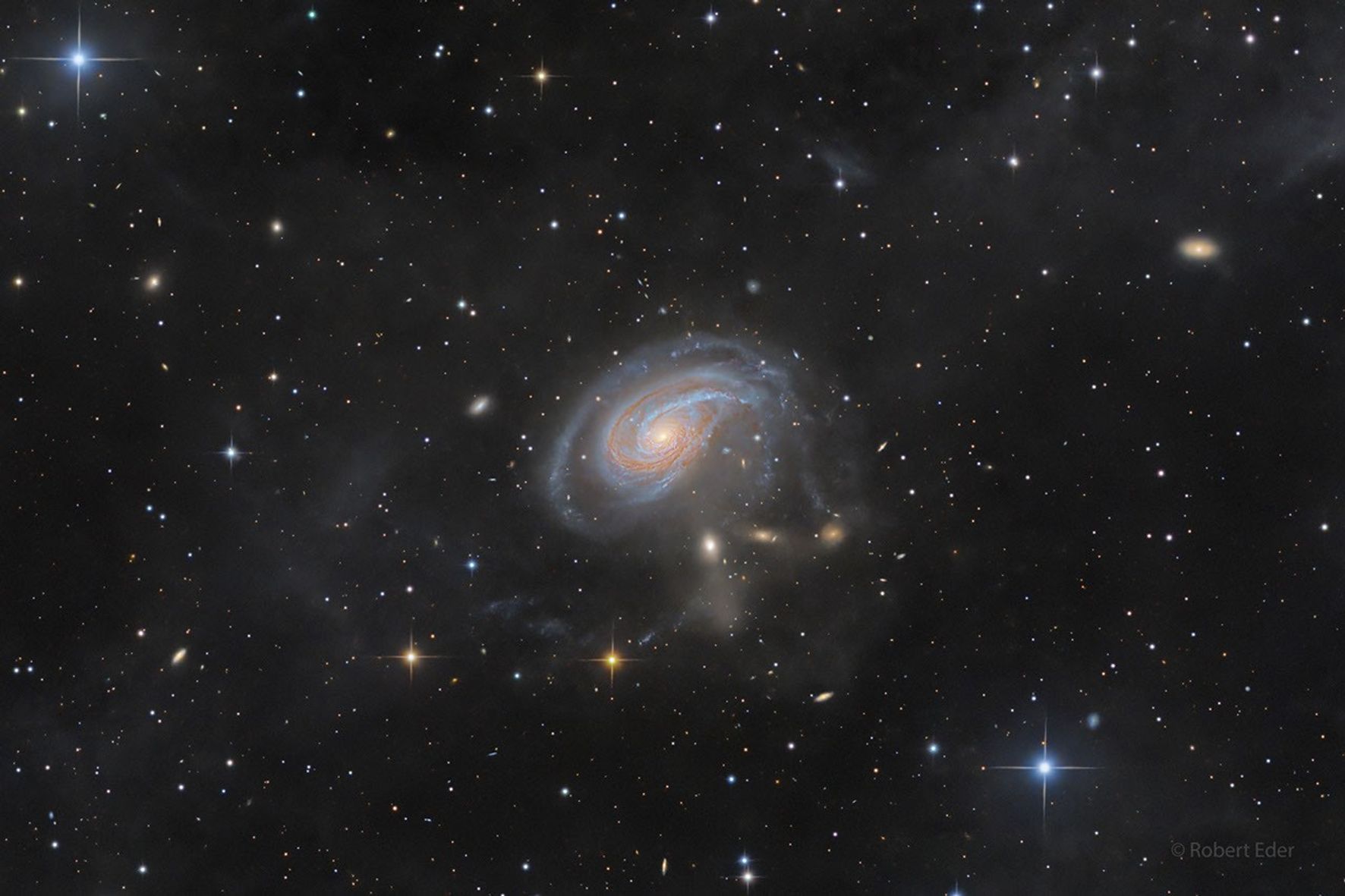
Explanation:Peculiar spiral galaxy Arp 78 is found within the boundaries of the head strong constellation Aries. Some 100 million light-years beyond the stars and nebulae of our Milky Way galaxy, the island universe is an enormous 200,000 light-years across. Also known as NGC 772, it sports a prominent, outer spiral arm in this detailed cosmic portrait. Tracking along sweeping dust lanes and lined with young blue star clusters, Arp 78's overdeveloped spiral arm is pumped-up by galactic-scale gravitational tides. Interactions with its brightest companion galaxy, the more compact NGC 770 seen directly below the larger spiral, are likely responsible. Embedded in faint star streams revealed in the deep telescopic exposure, NGC 770's fuzzy, elliptical appearance contrasts nicely with spiky foreground Milky Way stars.
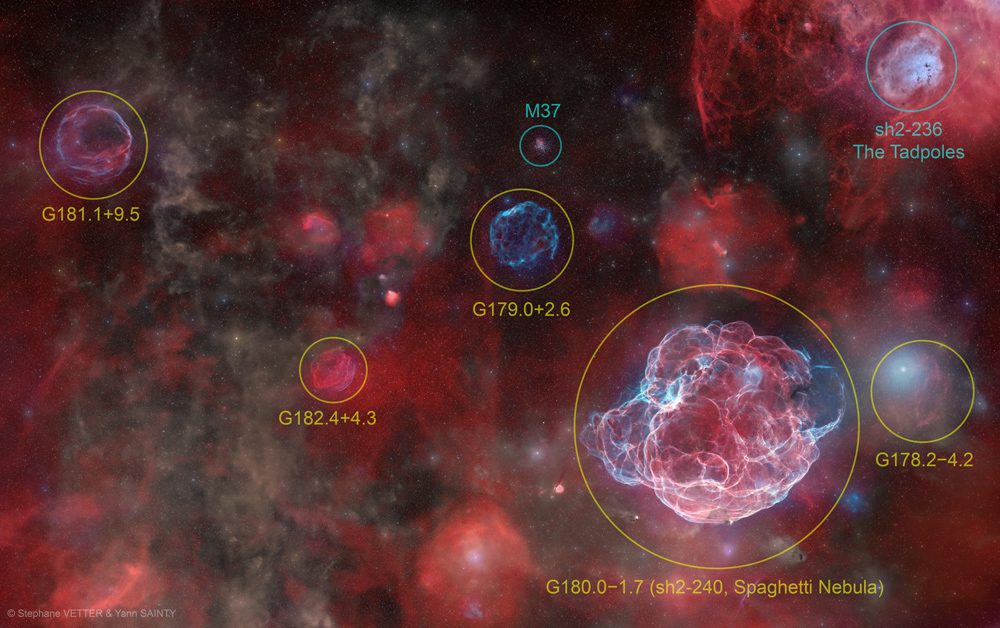
Explanation: The ghosts of five supernovas haunt this extraordinary image. It was acquired at Oukaïmeden Observatory in Morocco with approximately 200 hours of observations and shows a large patch of the sky, equivalent to the area of one thousand full moons tiled together, in the constellation of Auriga (the Charioteer). From left to right, the five supernova remnants visible across the field are G181.1+9.5, G182.4+4.3, G179.0+2.6, G180.0−1.7 (Sh2-240, the Spaghetti Nebula), and G178.2−4.2. They are highlighted in the annotated image, together with open clusterM37 and the Tadpole Nebula. As each explosion expanded into space, it created a growing shell of shocked gas and delicate filamentary structures shown in red (hydrogen) and blue (oxygen), respectively. These ancient stellar explosions happened independently; they are at various distances up to about several thousands of light-years away from Earth and have estimated ages up to tens of thousands of years old. Early humans may have witnessed them as bright new stars, fading over weeks or months
Ce qui ressemble ici à quelques pierres précieuses égarées sur le tapis bleu saphir d'un bijoutier n'est en réalité autre qu'une collection de bactéries. Des bactéries baptisées JCVI-syn3.0 obtenues par l'équipe du docteur Clyde A. Hutchinson, de l'Institut J. Craig Venter, à partir d'une bactérie répondant au doux nom de Mycoplasma mycoides. Des bactéries dont l'intérêt est qu'elles ne contiennent que des gènes nécessaires à la vie. Des bactéries minimales, comme les appellent les chercheurs. Et qui leur permettent de mieux étudier les fonctions essentielles des êtres vivants.
JCVI-syn3.0 est la bactérie de synthèse avec le plus petit génome jamais décrit pour un organisme indépendant. Selon les experts, « une étape importante dans la conception et la construction d'un organisme synthétique avec des résultats prévisibles ».
Les bactéries ont été balayées par un microscope électronique à balayage à émission de champ Tescan Mira3 et colorisées à la volée avec un système d'imagerie multidétecteur à quatre canaux développé par Point electronic Halle.
Les fonds marins recèlent des merveilles que Gabriel Jensen magnifie derrière son objectif macro et de puissants flashs sous-marins. Installé en Floride du Sud, le photographe plonge dans les profondeurs les plus obscures du Gulf Stream pour tirer ces portraits de créatures étranges et bigarrées, enveloppées d’un noir profond. Ce poisson est une larve de trépied arc-en-ciel, arborant de larges nageoires arrondies et colorées qui lui permettent d’imiter les méduses afin d’éviter les prédateurs. Chaque nuit, il prend part à la migration verticale nycthémérale, la plus grande migration animale quotidienne sur Terre.
Plus de 2 mètres de long et 200 kilogrammes : voici les mensurations de rêve du napoléon (Cheilinus undulatus) qui font de lui le plus grand poisson corallien des eaux chaudes des océans Indien et Pacifique. Sa belle couleur bleu-vert rappelle celle des peintures corporelles maoris (l'adjectif maori permet d'ailleurs de le surnommer). Deux caractéristiques supplémentaires : les dessins sur son corps sont uniques, comme des empreintes digitales, et il peut changer de sexe au cours de sa vie.
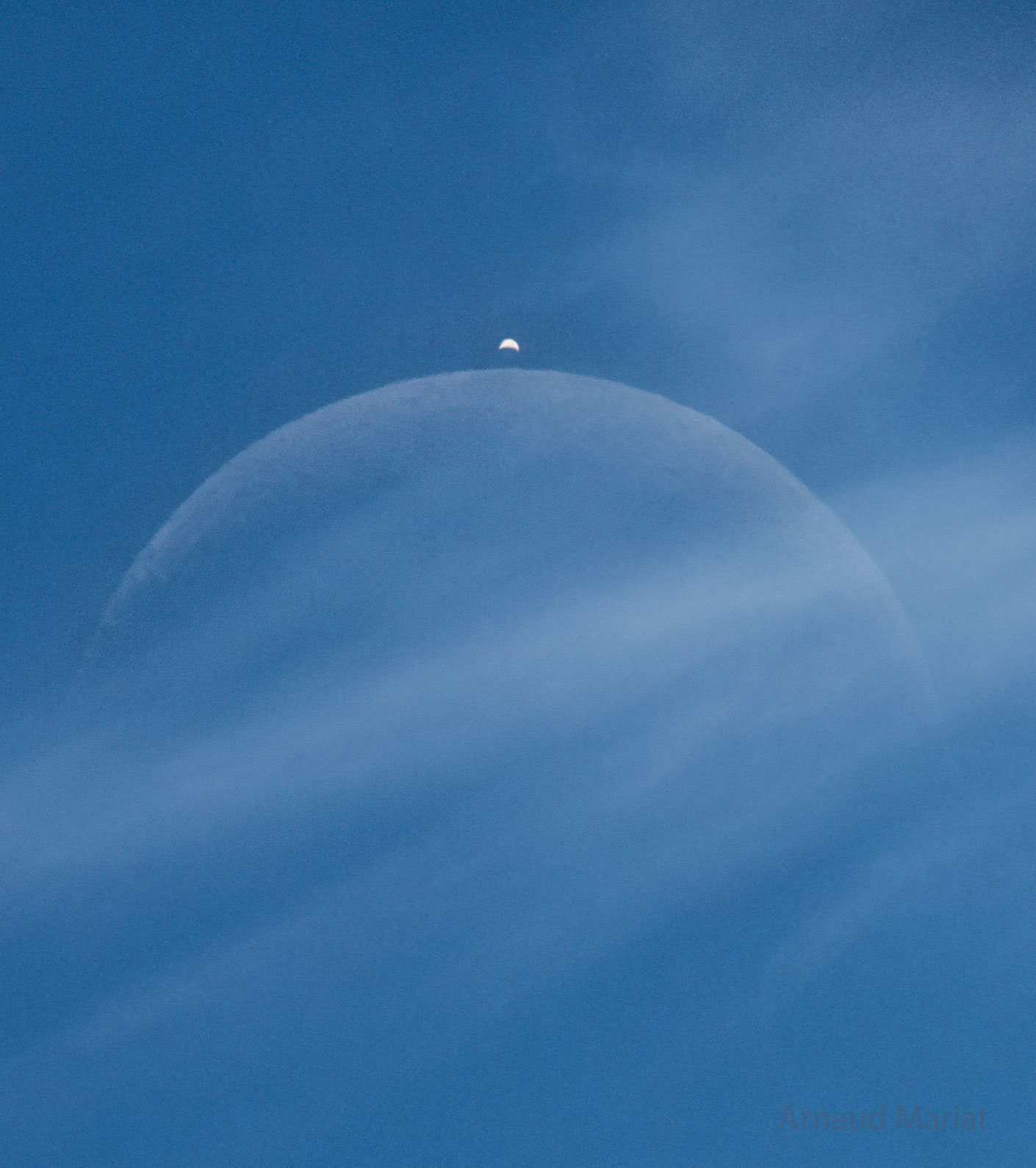
Explanation: There was something behind the clouds. Upon close inspection, it was the Moon, which was hard to see yesterday around noon above the small village of Cessy, France. But soon, it was not only the Moon. As expected, a bright dot suddenly appeared from behind the Moon -- the planet Venus far in the distance. Captured in the single featured exposure, both appeared to show a crescent phase. The Moon's crescent was quite slight -- with only about 10 percent of its face illuminated by the Sun. In contrast, Venus's crescent was more full -- showing about 25 percent illumination. Venus appeared brighter because it is nearer the Sun and because its clouds are more reflective than the dark lunar surface. An occultation of Venus by the Moon is visible to only about 10 percent of the Earth, but in yesterday's event even most of that was experiencing daytime.










#/media/File:Pink_Panther.png)
#/media/File:PIA15279_3rovers-stand_D2011_1215_D521.jpg)