Nombre total de pages vues

Affichage des articles dont le libellé est ASTRONOMY - Seeing Titan. Afficher tous les articles

02/05/2026

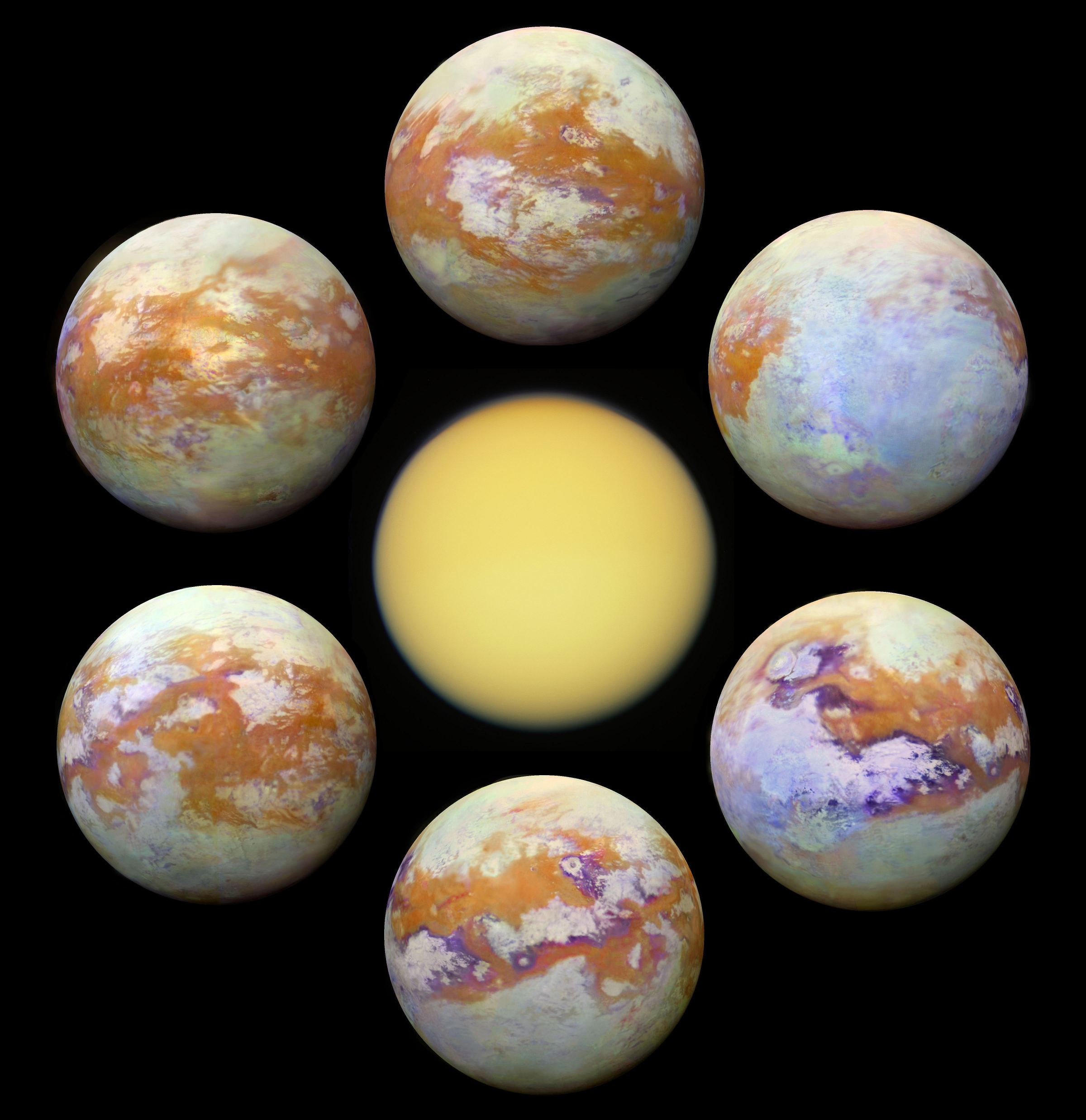
Astronomy - SEEING TITAN

 2026 May 2

See Explanation.  Clicking on the picture will download
the highest resolution version available.

Seeing Titan
Image Credit: VIMS Team, Univ. ArizonaU. NantesESANASA

Explanation: Shrouded in a thick atmosphere, the surface of Saturn's largest moon, Titan, is really hard to see. Small particles suspended in Titan's upper atmosphere cause an almost impenetrable haze, strongly scattering light at visible wavelengths and hiding surface features from prying eyes. Still, Titan's surface is better imaged at infrared wavelengths, where scattering is weaker and atmospheric absorption is reduced. Arrayed around this visible light image (center) of Titan are some of the clearest global infrared views of the tantalizing moon so far. In false color, the six panels present a consistent processing of 13 years of infrared image data from the Visual and Infrared Mapping Spectrometer (VIMS) on board the Cassini spacecraft orbiting Saturn from 2004 to 2017. They offer a stunning comparison with Cassini's visible light view. NASA's revolutionary rotorcraft mission to Titan's surface is due to launch no earlier than July, 2028.

31/03/2023

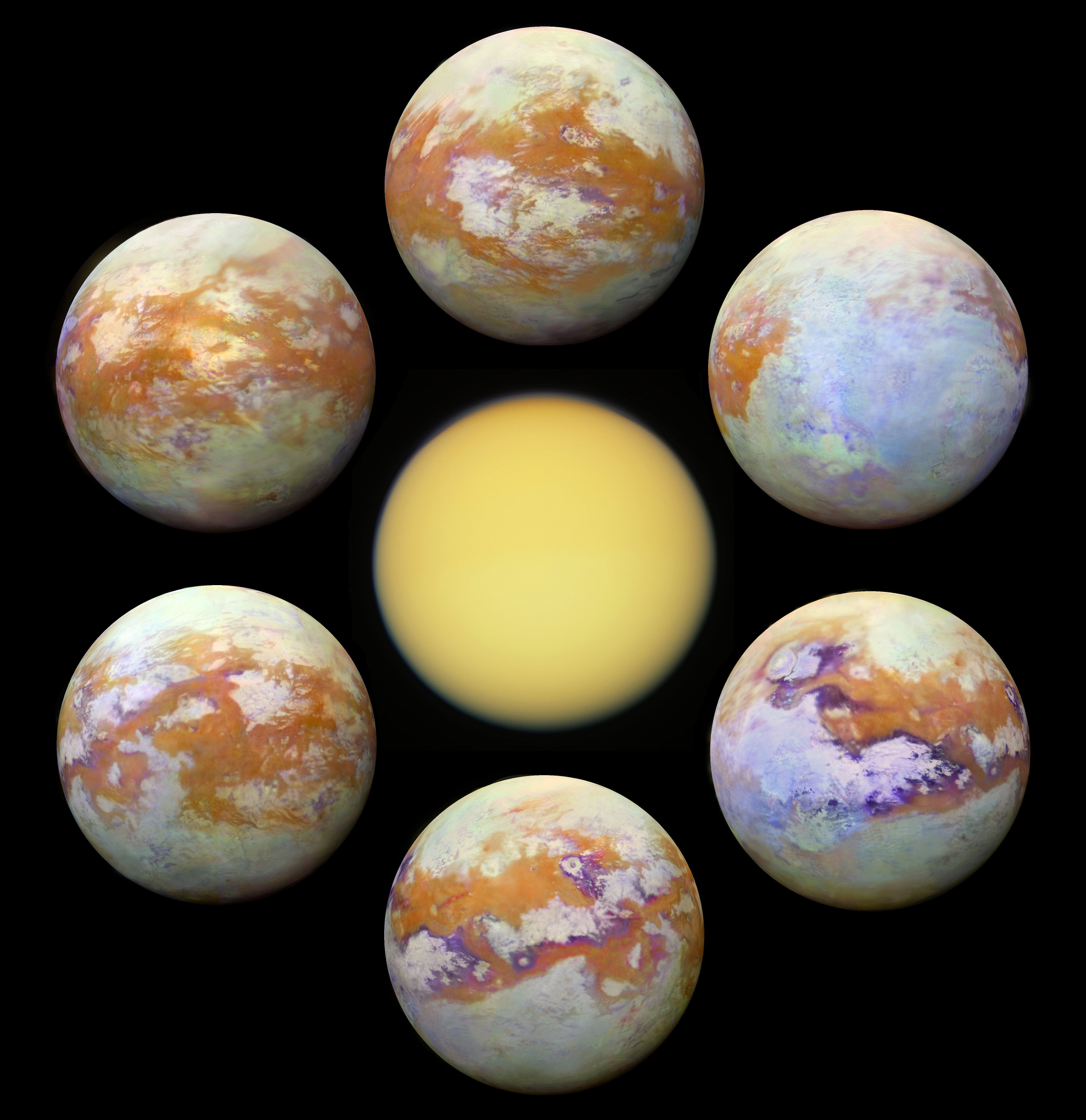
ASTRONOMY - Seeing Titan

 2023 March 31

See Explanation.  Clicking on the picture will download
the highest resolution version available.

Seeing Titan
Image Credit: VIMS TeamU. ArizonaU. NantesESANASA

Explanation: Shrouded in a thick atmosphere, Saturn's largest moon Titan really is hard to see. Small particles suspended in the upper atmosphere cause an almost impenetrable haze, strongly scattering light at visible wavelengths and hiding Titan's surface features from prying eyes. But Titan's surface is better imaged at infrared wavelengths where scattering is weaker and atmospheric absorption is reduced. Arrayed around this visible light image (center) of Titan are some of the clearest global infrared views of the tantalizing moon so far. In false color, the six panels present a consistent processing of 13 years of infrared image data from the Visual and Infrared Mapping Spectrometer (VIMS) on board the Cassini spacecraft orbiting Saturn from 2004 to 2017. They offer a stunning comparison with Cassini's visible light view. NASA's revolutionary rotorcraft mission to Titan is due to launch in 2027.

Astronomy - COMET R3 PanSTARRS BEFORE RIGEL

 2026 May 8 Comet R3 PanSTARRS Before Rigel Image Credit & Copyright:  Jakub Kuřák  &  Martin Mašek  ( FZU of the Czech Academy of S...