Nombre total de pages vues

05/05/2019

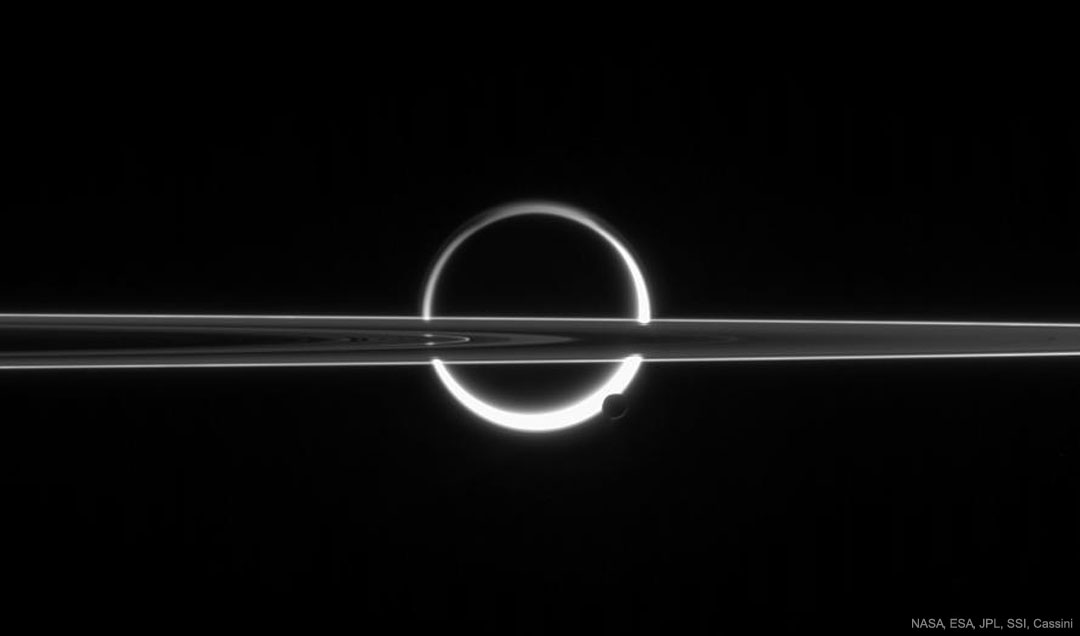
Science & Technology - Astronomy picture of the day - Saturn, Titan, Rings, and Haze

2019 May 5
See Explanation.  Clicking on the picture will download
 the highest resolution version available.
Saturn, Titan, Rings, and Haze 
Image Credit: NASAESAJPLSSICassini Imaging Team
Explanation: This is not a solar eclipsePictured here is a busy vista of moons and rings taken at Saturn. The large circular object in the center of the image is Titan, the largest moon of Saturn and one of the most intriguing objects in the entire Solar System. The dark spot in the center is the main solid part of the moon. The bright surrounding ring is atmospheric haze above Titan, gas that is scattering sunlight to a camera operating onboard the robotic Cassini spacecraft. Cutting horizontally across the image are the rings of Saturn, seen nearly edge on. At the lower right of Titan is Enceladus, a small moon of Saturn. Since the image was taken pointing nearly at the Sun, the surfaces of Titan and Enceladus appear in silhouette, and the rings of Saturn appear similar to a photographic negative. Now if you look really really closely at Enceladus, you can see a hint of icy jets shooting out toward the bottom of the image. It is these jets that inspired future proposals to land on Enceladus, burrow into the ice, and search for signs of extraterrestrial life.

04/05/2019

Science & Technologie - Le monde des requins : "Le requin longimane"

Le requin longimane : un requin aux grandes ailes

Ces longues nageoires semblables à des pagaies ou à des ailes d'avion sont à l'origine de son nom scientifique, requin longimane (Carcharhinus longimanus), et de ses noms vernaculaires. En France, on l'appelle également rameur, mais aussi requin canal, requin à aileron blanc, ou requin à pointes blanches du large, car la plupart de ses nageoires se terminent pas des pointes blanches. Très agressif, le requin longimane est considéré comme un des requins les plus dangereux pour l'Homme. Il est rarement impliqué dans des incidents sur des nageurs ou des surfeurs, car il vit loin des côtes. En revanche, on sait qu'il est responsable d'attaques sur les survivants de naufrages ou de crashs aériens en mer. 

L'UICN le considère comme une espèce vulnérable. Il est pêché pour sa viande et ses ailerons, et pris accidentellement dans les filets.

© Alexander Vasenin CC By-SA 4.0

03/05/2019

Photographie haute vitesse : le monde explosif d'Alan Sailer : Du plomb qui fait perdre la boule

Du plomb qui fait perdre la boule
Cette photo montre ce qui se passe quand on tire avec une carabine à air comprimé un plomb à travers un globe de verre rempli de gélatine rouge. La vitesse du plomb, de 4,5 mm, est d'environ 200 mètres / seconde. 

© Alan Sailer

Science & Technologie - Le monde des requins - Le requin bordé

Le requin bordé : un grand timide
Le requin bordé (Carcharhinus limbatus) est appelé ainsi car presque toutes ses nageoires présentent des bords noirs. Pouvant atteindre jusqu'à 2,50 m de long, mais mesurant plus généralement 1,50 m, il est considéré comme timide. Il est pourtant impliqué dans plusieurs « attaques » sur l'Homme, qui peuvent s'expliquer par sa tendance à chercher de la nourriture près de la surface, où les risques de rencontrer des plongeurs ou des nageurs sont plus nombreux, et par une confusion entre les victimes et ses proies.

Cible de la pêche commerciale, mais aussi de la chasse sportive, il est considéré comme quasi-menacé par l'UICN.

© Amada44 CC BY 3.0

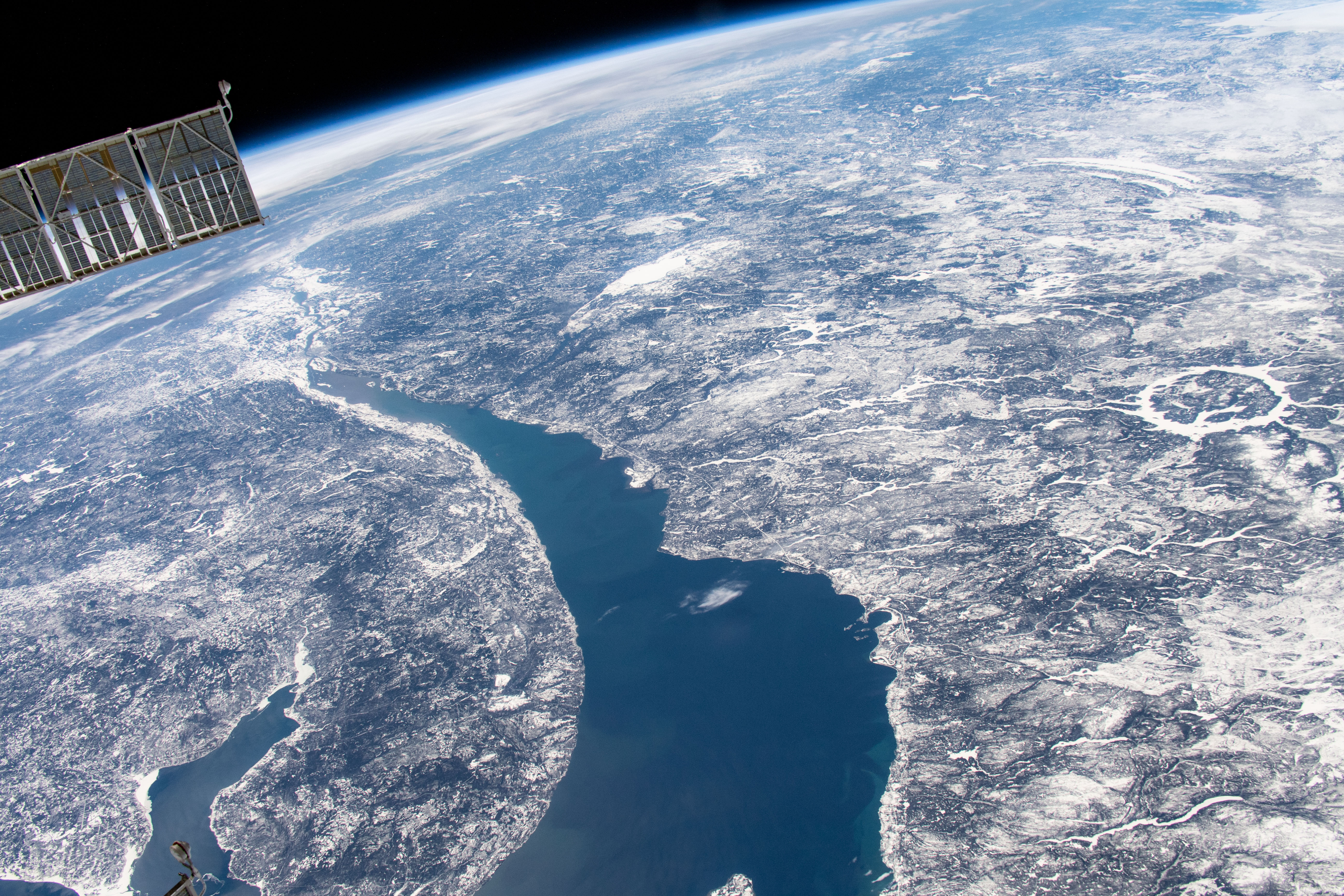
Science & Technology - Astronomy picture of the day : Manicouagan Impact Crater from Space

2019 May 2
See Explanation.  Clicking on the picture will download
 the highest resolution version available.
M anicouagan Impact Crater from Space 
Image Credit: NASA, International Space Station Expedition 59
Explanation: Orbiting 400 kilometers above Quebec, Canada, planet Earth, the International Space Station Expedition 59 crew captured this snapshot of the broad St. Lawrence River and curiously circular Lake Manicouagan on April 11. Right of center, the ring-shaped lake is a modern reservoir within the eroded remnant of an ancient 100 kilometer diameter impact crater. The ancient crater is very conspicuous from orbit, a visible reminder that Earth is vulnerable to rocks from space. Over 200 million years old, the Manicouagan crater was likely caused by the impact of a rocky body about 5 kilometers in diameter. Currently, there is no known asteroid with a significant probability of impacting Earth in the next century. But a fictional scenario to help practice for an asteroid impact is on going at the 2019 IAA Planetary Defense Conference.

01/05/2019

Music - Video - Paganini - Alexander Markov : "Caprice nr. 24"

"Caprice nr. 24"

Science & Technology - Astronomy picture of the day : Meteor Misses Galaxy

2019 April 30
See Explanation.  Clicking on the picture will download
 the highest resolution version available.
Meteor Misses Galaxy Image Credit: Aman Chokshi
Explanation: The galaxy was never in danger. For one thing, the Triangulum galaxy (M33), pictured, is much bigger than the tiny grain of rock at the head of the meteor. For another, the galaxy is much farther away -- in this instance 3 million light years as opposed to only about 0.0003 light seconds. Even so, the meteor's path took it angularly below the galaxy. Also the wind high in Earth's atmosphere blew the meteor's glowing evaporative molecule train away from the galaxy, in angular projection. Still, the astrophotographer was quite lucky to capture both a meteor and a galaxy in a single exposure -- which was subsequently added to two other images of M33 to bring up the spiral galaxy's colors. At the end, the meteor was gone in a second, but the galaxy will last billions of years.

29/04/2019

Sciences & technologie - Santé et médecine :Un coeur imprimé en 3D à partir de cellules humaines

Un coeur imprimé en 3D à partir de cellules humaines
Une équipe de chercheurs est parvenue à mettre au point un prototype de coeur imprimé en 3D, à partir de cellules humaines. Un bel espoir pour le traitement des maladies cardiovasculaires, cause principale de décès dans les pays industrialisés, et notamment pour les greffes cardiaques.

Si la greffe de coeur est aujourd’hui de plus en plus souvent pratiquée, les risques de rejets du greffon restent une préoccupation majeure, en plus du manque de donneurs. Cette prouesse réalisée par une équipe de chercheurs israélienne de l’université de Tel-Aviv et publiée le 15 avril dernier dans la revue Advanced Science, représente donc une « avancée majeure » dans ce domaine : ils sont en effet parvenus à mettre au point un prototype de coeur imprimé en 3D à partir de cellules prélevées sur le tissu du patient malade. 

« Nous imprimons un coeur entier qui est complètement biocompatible avec le patient et ne provoquera pas de réponse immunitaire » explique ainsi le Professeur Tal Dvir, l’un des chercheurs. Mais pour l’instant, le coeur imprimé reste minuscule, « de la taille d’un coeur de lapin », 20 mm de hauteur pour 14 mm de diamètre, et ne peut pas encore battre comme un vrai coeur. Ils devraient être dans un premier temps greffés sur des animaux.

PassportSanté - France

28/04/2019

Science & Technologie - Pyrotechnie militaire, par l'A400M d'Airbus (video)

Un Airbus A400 M effectue un largage de leurres. Cet avion européen, conçu par Airbus Military, est destiné au transport militaire. Il est entré en service en 2013.
Son système de largage de leurres infrarouges a été conçu par MBDA.

L'Usine Nouvelle - France

Science & Technology - Astronomy picture of the day (video) : All of Mercury

2019 April 28
All of Mercury Image Credit: NASA/JHU Applied Physics Lab/Carnegie Inst. Washington
Explanation: Only six years ago, the entire surface of planet Mercury was finally mapped. Detailed observations of the innermost planet's surprising crust began when the robotic have been ongoing since the robotic MESSENGER spacecraft first passed Mercury in 2008 and continued until its controlled crash landing in 2015. Previously, much of the Mercury's surface was unknown as it is too far for Earth-bound telescopes to see clearly, while the Mariner 10flybys in the 1970s observed only about half. The featured video is a compilation of thousands of images of Mercury rendered in exaggerated colors to better contrast different surface features. Visible on the rotating world are rays emanating from a northern impact that stretch across much of the planet, while about half-way through the video the light colored Caloris Basin rotates into view, a northern ancient impact feature that filled with lavaRecent analysis of MESSENGER data indicates that Mercury has a solid inner core.

ASTRONOMY - Apollo 17's Moonship

 2025 December 27 Apollo 17's Moonship Image Credit:  Apollo 17 ,  NASA , (Image Reprocessing:  Andy Saunders ) Explanation:  Awkward an...