Nombre total de pages vues

21/08/2019

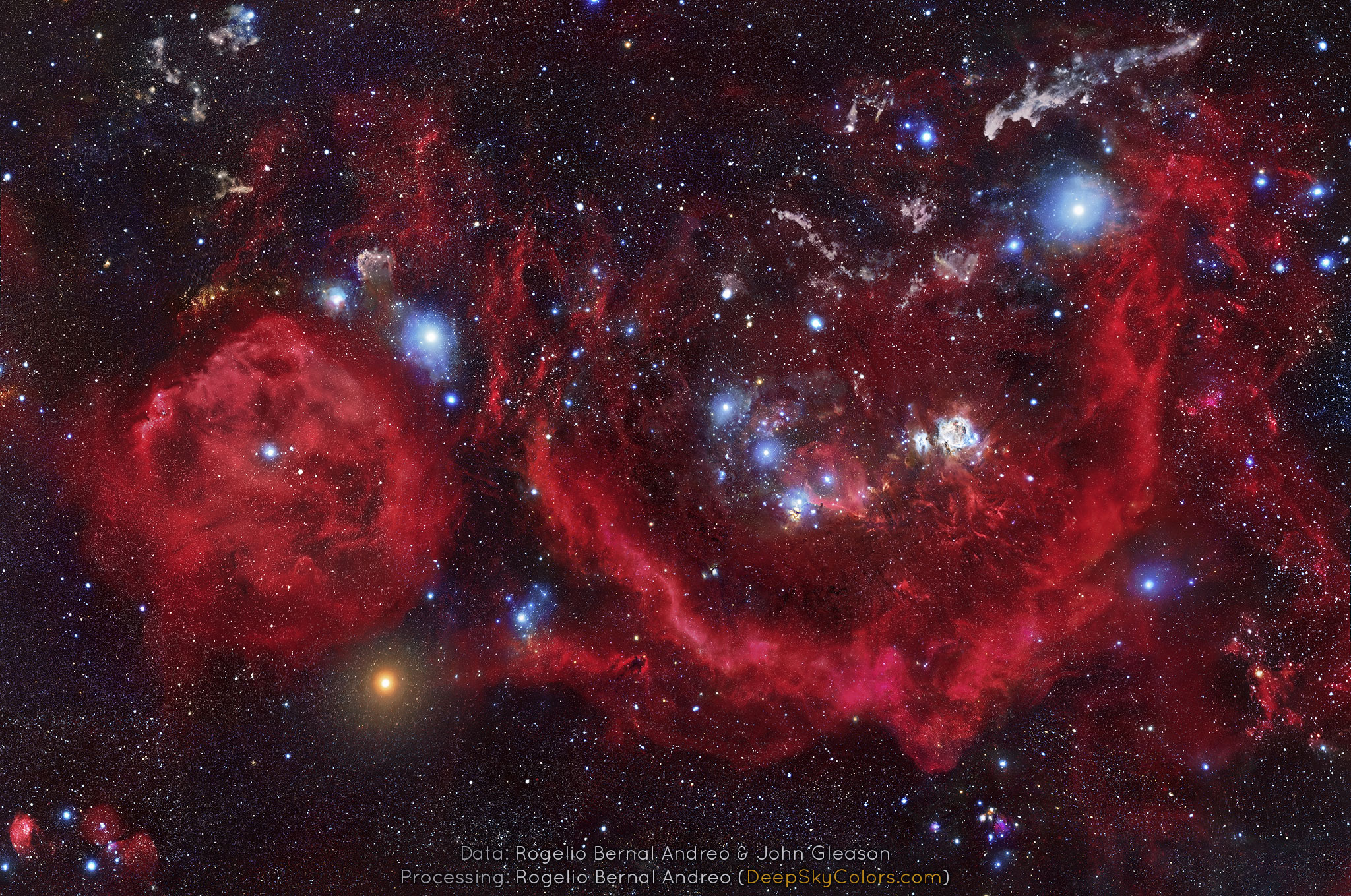
Science & Technology - Astronomy picture of the day : The Orion You Can Almost See

2019 August 21
See Explanation.
Moving the cursor over the image will bring up an annotated version.
Clicking on the image will bring up the highest resolution version
available.
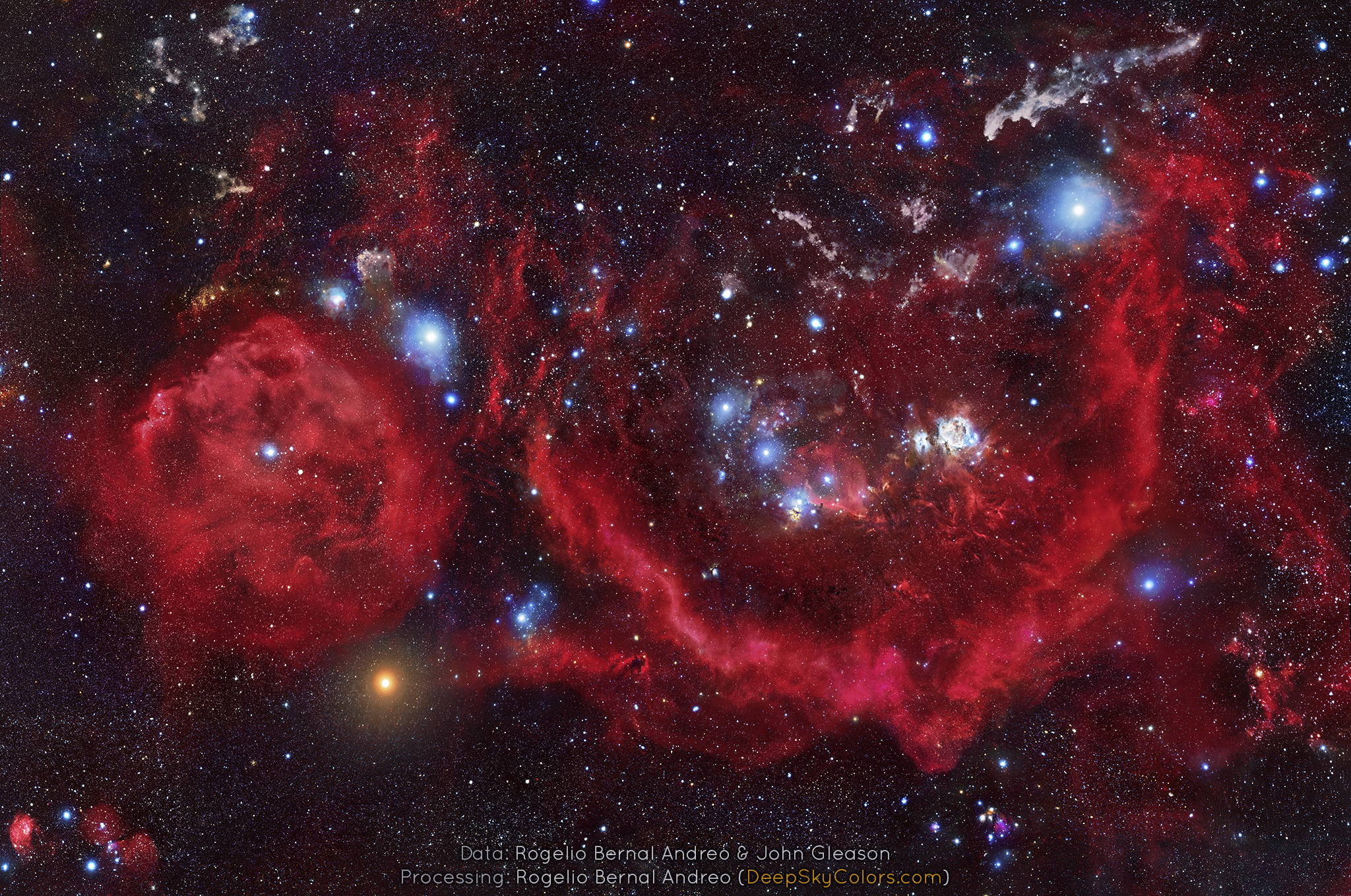
The Orion You Can Almost See 
Image Credit & Copyright: John Gleason & Rogelio Bernal Andreo
Explanation: Do you recognize this constellation? Although it is one of the most recognizable star groupings on the sky, this is a more full Orion than you can see -- an Orion only revealed with long exposure digital camera imaging andpost-processing. Here the cool red giant Betelgeuse takes on a strong orange tint as the brightest star at the lower left. Orion's hot blue stars are numerous, with supergiant Rigel balancing Betelgeuse on the upper right, and Bellatrix at the upper left. Lined up in Orion's belt are three stars all about 1,500 light-years away, born from the constellation's well-studied interstellar clouds. To the right of Orion's belt is a bright but fuzzy patch that might also look familiar -- the stellar nursery known as Orion's Nebula. Finally, just barely visible to the unaided eye but quite striking here is Barnard's Loop -- a huge gaseous emission nebula surrounding Orion's Belt and Nebula discovered over 100 years ago by the pioneering Orion photographer E. E. Barnard.

20/08/2019

Science & Technology - Astronomy picture of the day : Animation: Spiral Disk around a Black Hole

2019 August 20
Animation: Spiral Disk around a Black Hole Illustrated Animation Credit: ESANASAHubbleM. Kornmesser
Explanation: What would it look like to orbit a black hole? Many black holes are surrounded by swirling pools of gas known as accretion disks. These disks can be extremely hot, and much of the orbiting gas will eventually fall through the black hole's event horizon -- where it will never been seen again. The featured animation is an artist's rendering of the curious disk spiraling around the supermassive black hole at the center of spiral galaxy NGC 3147. Gas at the inner edge of this disk is so close to the black hole that it moves unusually fast -- at 10 percent of the speed of light. Gas this fast shows relativistic beaming, making the side of the disk heading toward us appear significantly brighter than the side moving away. The animation is based on images of NGC 3147 made recently with the Hubble Space Telescope.

19/08/2019

Science & Technology - Astronomy picture of the day : Lenticular Clouds over Mount Etna

2019 August 19
See Explanation.  Clicking on the picture will download
 the highest resolution version available.
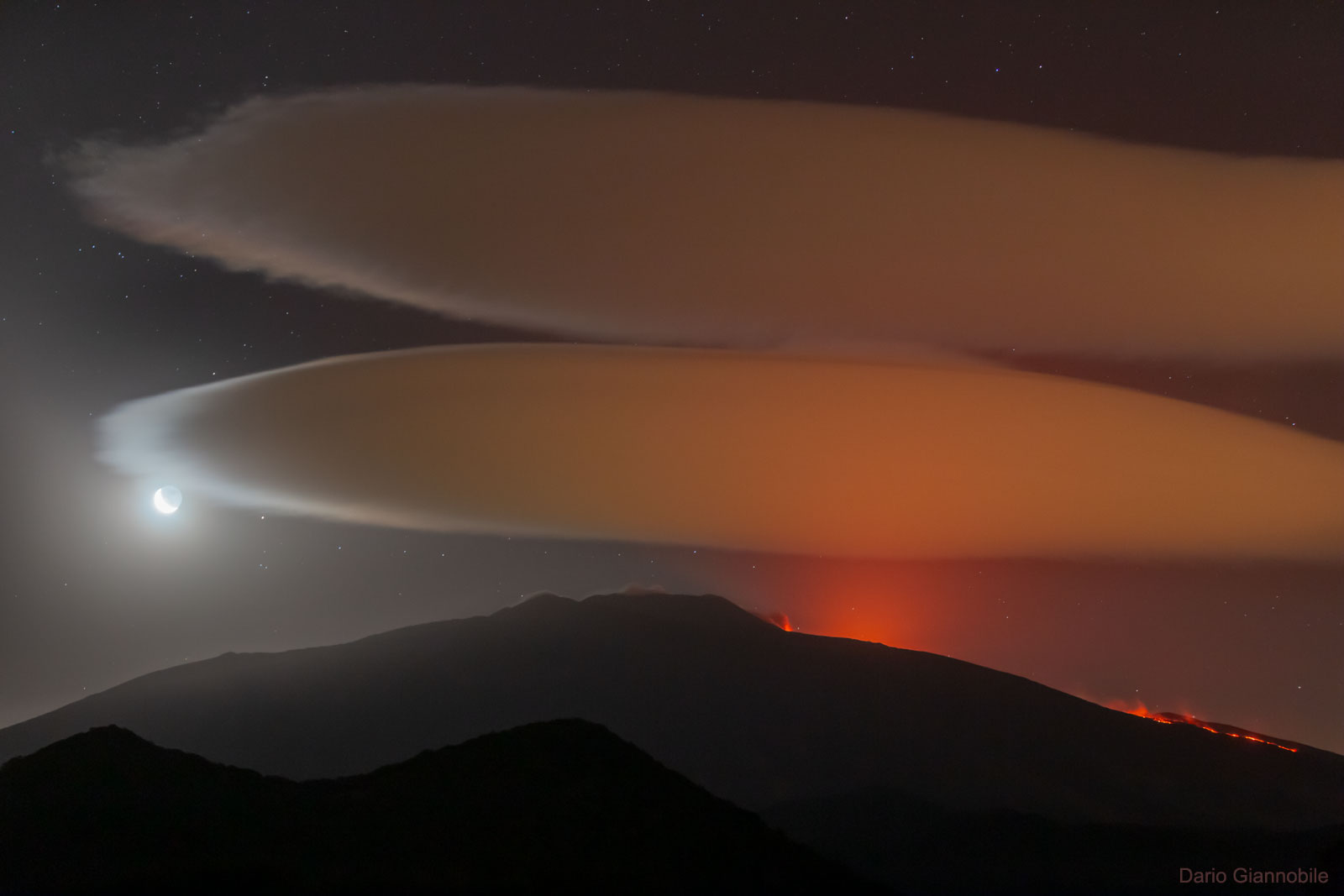
Lenticular Clouds over Mount Etna 
Image Credit & Copyright: Dario Giannobile
Explanation: What's happening above that volcano? Although Mount Etna is seen erupting, the clouds are not related to the eruption. They are lenticular clouds formed when moist air is forced upwards near a mountain or volcano. The surreal scene was captured by chance late last month when the astrophotographer went to Mount Etna, a UNESCO World Heritage Site in SicilyItaly, to photograph the conjunction between the Moon and the star Aldebaran. The Moon appears in a bright crescent phase, illuminating an edge of the lower lenticular cloud. Red hot lava flows on the right. Besides some breathtaking stills, a companion time-lapse video of the scene shows the lenticular clouds forming and wavering as stars trail far in the distance.

18/08/2019

Science & Technology - Astronomy picture of the day : Human as Spaceship

2019 August 18
See Explanation.  Clicking on the picture will download
 the highest resolution version available.
Human as Spaceship 
Space Image Credit: NASAESAHubble, and J. Maiz- Apellániz (IAA); Acknowledgement: D. De Martin;
Human Image Copyright: Charis TsevisComposition: R. J. Nemiroff
Explanation: You are a spaceship soaring through the universe. So is your dog. We all carry with us trillions of microorganisms as we go through life. These multitudes of bacteriafungi, and archaea have different DNA than you. Collectively called your microbiome, your shipmates outnumber your own cells. Your crew members form communities, help digest food, engage in battles against intruders, and sometimes commute on a liquid superhighway from one end of your body to the other. Much of what your microbiome does, however, remains unknown. You are the captain, but being nice to your crew may allow you to explore more of your local cosmos.

17/08/2019

Science & Technologie - Santé/Médecine - Alimentation : Pomme, thé et modération : les trois ingrédients pour une longue vie ?

Plus d’aliments riches en flavonoïdes pour vivre plus longtemps
Consommer régulièrement des aliments riches en flavonoïdes (antioxydants), tels que les pommes et le thé, et faire preuve de modération voire d’abstinence en matière d’alcool et de tabac. Voilà peut-être la clé d’une vie plus longue et en meilleure santé.

C’est en tout cas ce que suggère une nouvelle étude, publiée dans la revue Nature Communications et menée par des chercheurs australiens, de l’Université Edith Cowan. Une alimentation riche en flavonoïdes protègerait en effet des cancers et des maladies cardiovasculaires.

L’équipe s’est ici penchée sur les données d’une cohorte danoise sur l’alimentation, le cancer et la santé, comprenant 56 048 Danois, suivis pendant 23 ans. Les chercheurs ont alors constaté qu’une consommation modérée à élevée d’aliments riches en flavonoïdes (raisin, pommes, poires, thé, cacao…) était associée à un moindre risque de cancer ou de problèmes cardiaques.

“Ces résultats sont importants car ils mettent en évidence la possibilité de prévenir le cancer et les maladies cardiaques en encourageant la consommation d'aliments riches en flavonoïdes, en particulier chez les personnes à haut risque de contracter ces maladies chroniques”, à savoir les fumeurs et buveurs réguliers, a commenté le Dr Nicola Bondonno, principale auteure de l’étude. La chercheuse précise cependant que “ la consommation de flavonoïdes ne résout pas tout le risque accru de décès dû au tabagisme et à la consommation excessive d'alcool”. “La meilleure chose à faire pour sa santé est de loin de cesser de fumer et de réduire sa consommation d'alcool”, a-t-elle ajouté. Cela étant, comme le sevrage tabagique ou alcoolique peut être difficile, la scientifique estime qu’encourager la consommation de flavonoïdes pourrait être un moyen novateur d’atténuer ce sur-risque.

Dans leur étude, les chercheurs ont précisé que les participants consommant environ 500 mg de flavonoïdes par jour présentaient le risque le plus faible de décès par cancer ou problème cardiaque. Cette quantité serait assez facilement atteignable, avec par exemple : une tasse de thé, une pomme, une orange, 100 g de myrtilles et 100 g de brocolis.

Pour les auteurs, qui comptent poursuivre leurs recherches, c’est le caractère anti-inflammatoire des flavonoïdes et leur capacité à améliorer la fonction des vaisseaux sanguins qui expliqueraient leurs effets protecteurs.

Santé Magazine - France

Science & Technologie - Avions du futur : Icon-II, le Boeing supersonique silencieux

Icon-II, le Boeing supersonique silencieux
Icon-II est une étude de Boeing pour un supersonique silencieux, du moins à peu près exempt de bang supersonique. Il pourrait voler plus vite que le son au-dessus des terres habitées, contrairement au Concorde auquel certaines contraintes sont imposées. On remarque les réacteurs placés au-dessus des ailes. © Nasa, Boeing

Science & Technology - Astronomy picture of the day : 1901 Photograph: The Orion Nebula

2019 August 17
See Explanation.  Clicking on the picture will download
the highest resolution version available.
1901 Photograph: The Orion Nebula 
Image Credit: George Ritchey, Yerkes Observatory - Digitization Project: W. Cerny,
R. Kron, Y. Liang, J. Lin, M. Martinez, E. Medina, B. Moss, B. Ogonor, M. Ransom, J. Sanchez (Univ. of Chicago)
Explanation: By the turn of the 20th century advances in photography contributed an important tool for astronomers. Improving photographic materials, long exposures, and new telescope designs produced astronomical images with details not visible at the telescopic eyepiece alone. Remarkably recognizable to astrophotographers today, this stunning image of the star forming Orion Nebula was captured in 1901 by American astronomer and telescope designerGeorge Ritchey. The original glass photographic plate, sensitive to green and blue wavelengths, has been digitized and light-to-dark inverted to produce a positive image. His hand written notes indicate a 50 minute long exposure that ended at dawn and a reflecting telescope aperture of 24 inches masked to 18 inches to improve the sharpness of the recorded image. Ritchey's plates from over a hundred years ago preserve astronomical data and can still be used forexploring astrophysical processes.

16/08/2019

Science & Technology - Astronomy picture of the day : The Elephant's Trunk Nebula in Cepheus

2019 August 16
See Explanation.  Clicking on the picture will download
the highest resolution version available.
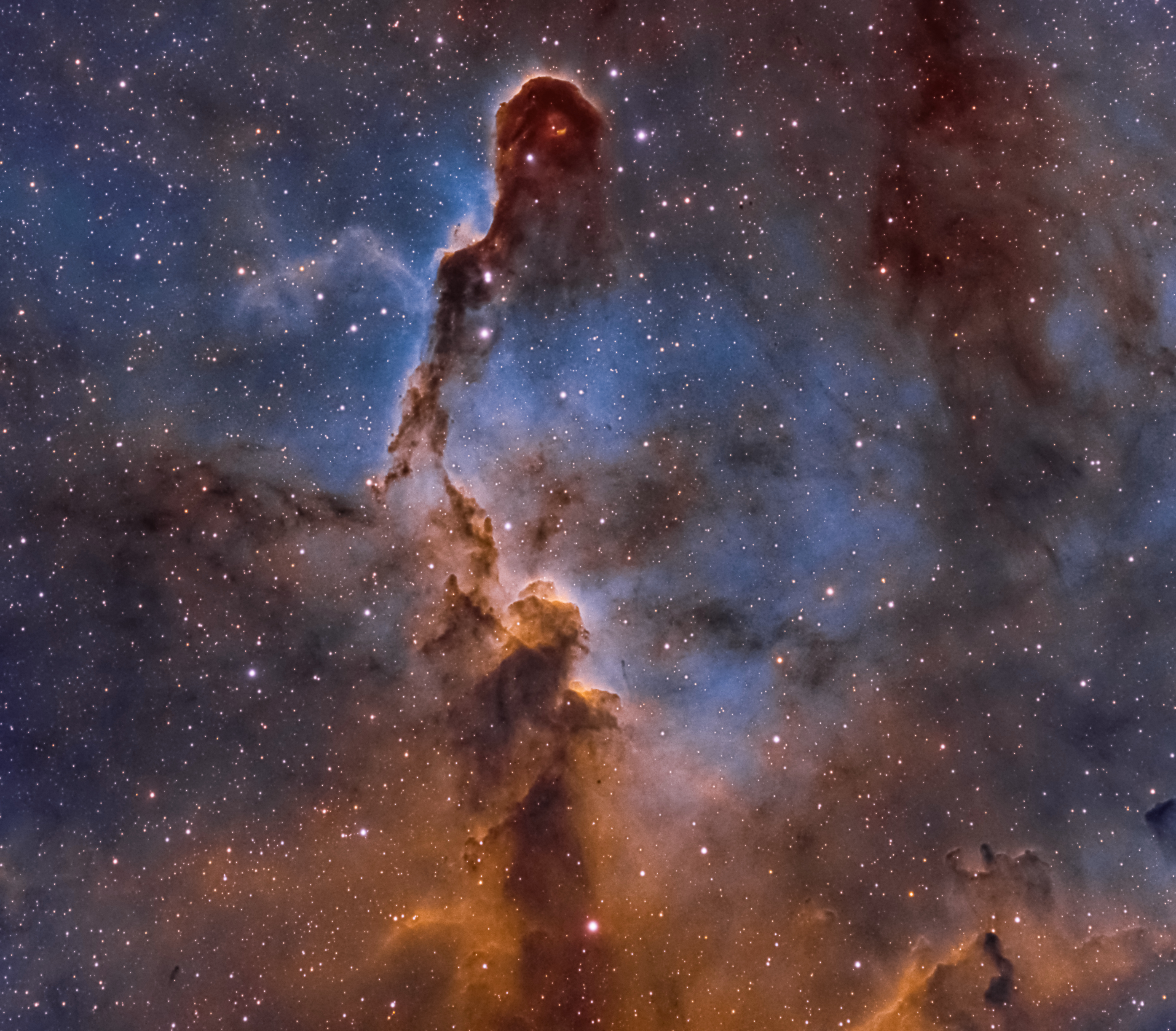
The Elephant's Trunk Nebula in Cepheus 
Image Credit & Copyright: Chuck Ayoub
Explanation: Like an illustration in a galactic Just So Story, the Elephant's Trunk Nebula winds through the emission nebula and young star cluster complex IC 1396, in the high and far off constellation of Cepheus. Also known as vdB 142, the cosmic elephant's trunk is over 20 light-years long. This colorful close-up view was recorded through narrow band filters that transmit the light from ionized hydrogen, sulfur, and oxygen atoms in the region. The resulting composite highlights the bright swept-back ridges that outline pockets of cool interstellar dust and gas. Such embedded, dark, tendril-shaped clouds contain the raw material for star formation and hide protostars within. Nearly 3,000light-years distant, the relatively faint IC 1396 complex covers a large region on the sky, spanning over 5 degrees. The dramatic scene spans a 1 degree wide field, about the size of 2 Full Moons.

Science & Technologie - Avions du futur : La soucoupe volante

Projet CleanEra : pourquoi pas une soucoupe volante ?
L’équipe du projet CleanEra, menée par Etnel Straatsma, de l’université technologique de Delft (Hollande), a imaginé une gigantesque soucoupe volante, une forme censée réduire la consommation. Cette équipe hollandaise étudie différentes solutions pour des avions plus économes, notamment le retour à l’hélice. © CleanEra, Delft University of Technology

15/08/2019

Science & Technology - Astronomy picture of the day : The Perseids and the Plough

2019 August 15
See Explanation.  Clicking on the picture will download
the highest resolution version available.
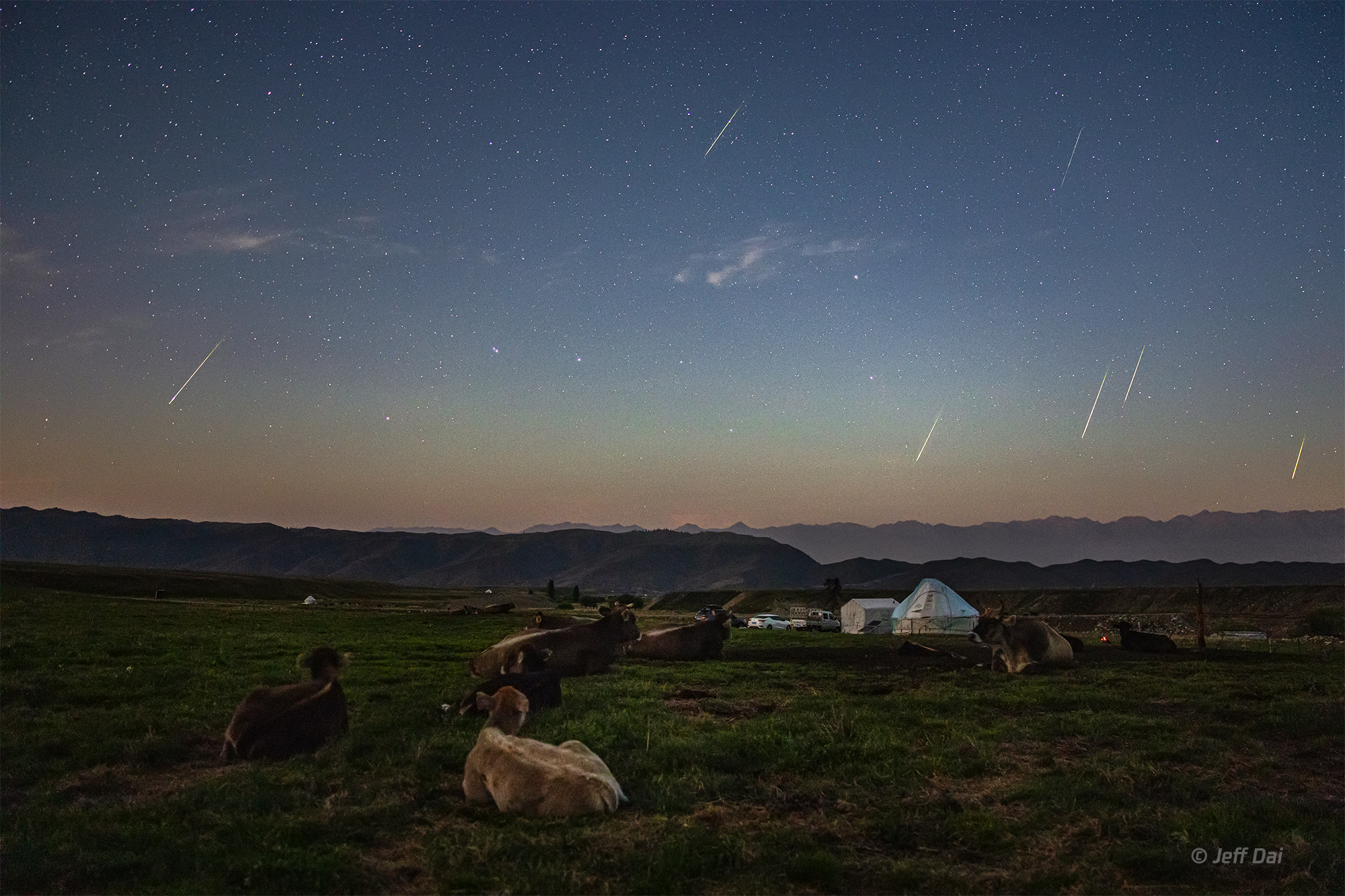
The Perseids and the Plough 
Image Credit & CopyrightJeff Dai (TWAN)
Explanation: Despite interfering moonlight, many denizens of planet Earth were able to watch this year's Perseid meteor shower. This pastoral scene includes local skygazers admiring the shower's brief, heavenly flashes in predawn hours near peak activity on August 13 from Nalati Grassland in Xinjiang, China. A composite, the image registers seven frames taken during a two hour span recording Perseid meteor streaks against a starry sky. Centered along the horizon is the Plough, the north's most famous asterism, though some might see the familiar celestial kitchen utensil known as the Big Dipper. Perhaps the year's most easily enjoyed meteor shower, Perseid meteors are produced as Earth itself sweeps through dust from periodic comet Swift-Tuttle. The dust particles are vaporized at altitudes of 100 kilometers or so as they plow through the atmosphere at 60 kilometers per second.

ASTRONOMY - Mystery: Little Red Dots in the Early Universe

 2025 December 24 Mystery: Little Red Dots in the Early Universe Image Credit:  NASA ,  ESA ,  CSA ,  STScI ,  JWST ;  Dale Kocevski  ( Colb...