Nombre total de pages vues
29/10/2020
Covid : en ville ou à la campagne, évaluez le risque de croiser une personne infectée
28/10/2020
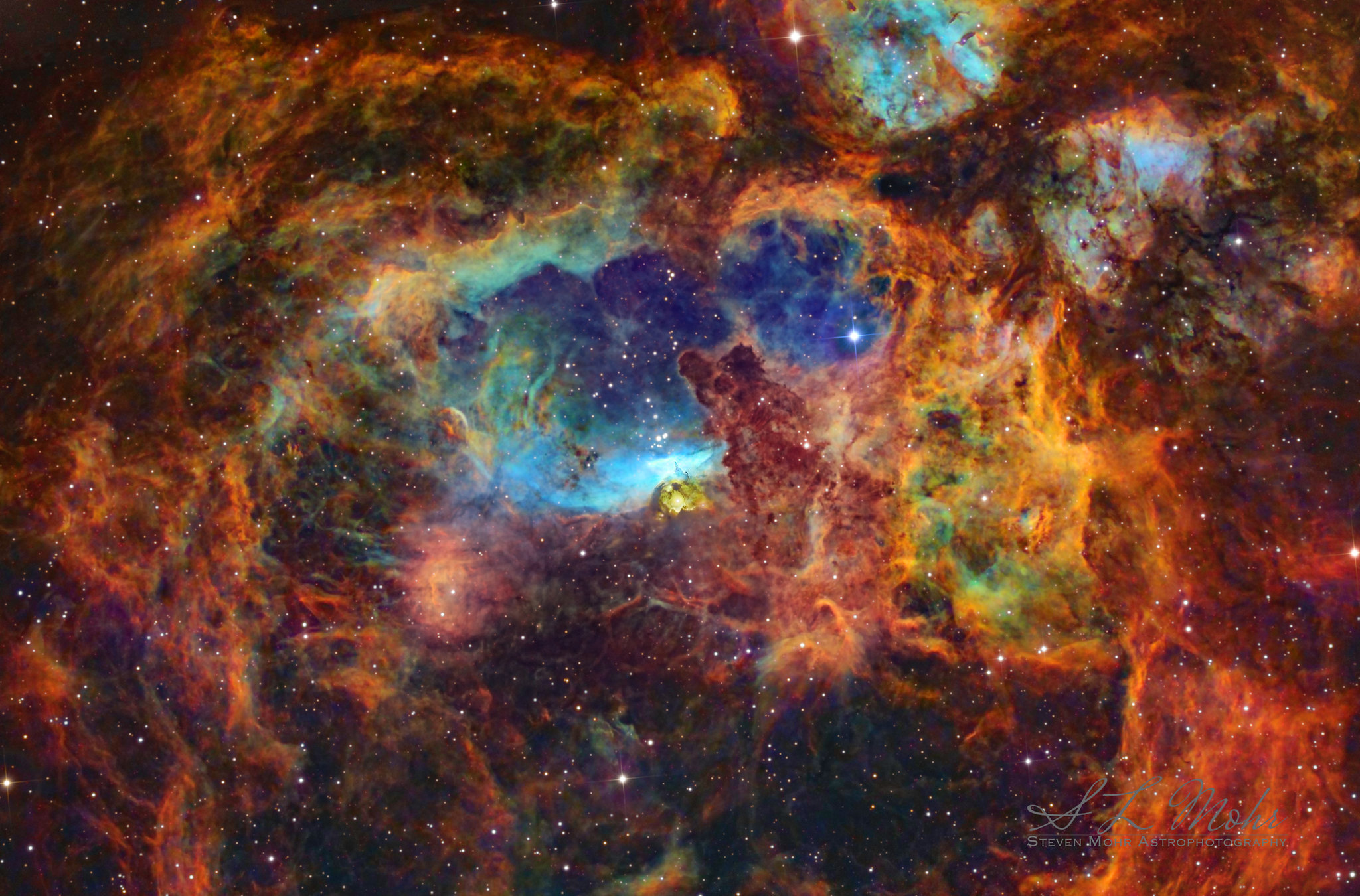
Astronomy picture of the day - NGC 6357: The Lobster Nebula
2020 October 28
Image Credit & Copyright: Steven Mohr
Explanation: Why is the Lobster Nebula forming some of the most massive stars known? No one is yet sure. Cataloged as NGC 6357, the Lobster Nebula houses the open star cluster Pismis 24 near its center -- a home to unusually bright and massive stars. The overall blue glow near the inner star forming region results from the emission of ionized hydrogen gas. The surrounding nebula, featured here, holds a complex tapestry of gas, dark dust, stars still forming, and newly born stars. The intricate patterns are caused by complex interactions between interstellar winds, radiation pressures, magnetic fields, and gravity. NGC 6357 spans about 400 light years and lies about 8,000 light years away toward the constellation of the Scorpion.
26/10/2020
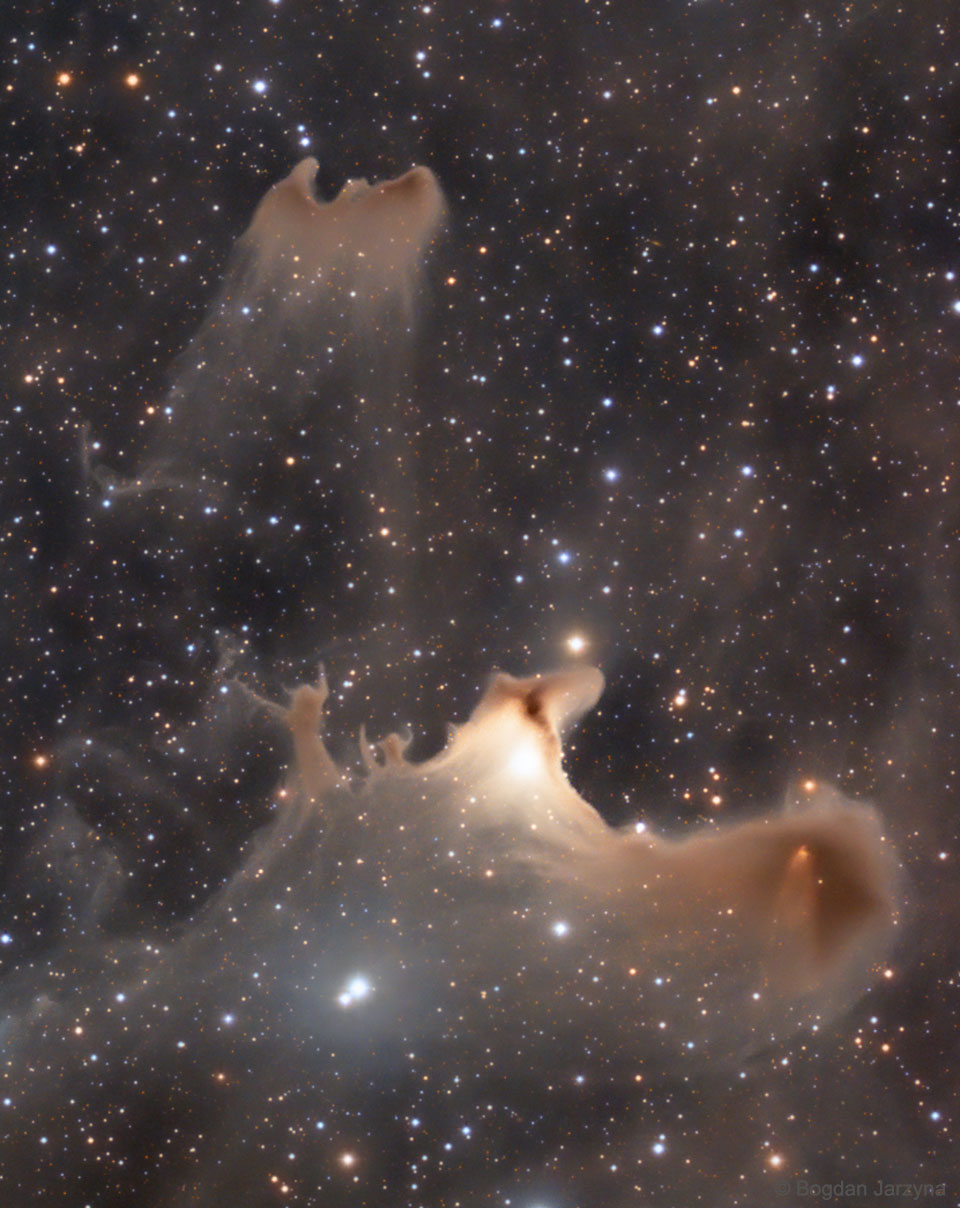
Astronomy picture of the day : Reflections of the Ghost Nebula
Image Credit & Copyright: Bogdan Jarzyna
Explanation: Do any shapes seem to jump out at you from this interstellar field of stars and dust? The jeweled expanse, filled with faint, starlight-reflecting clouds, drifts through the night in the royal constellation of Cepheus. Far from your own neighborhood on planet Earth, these ghostly apparitions lurk along the plane of the Milky Way at the edge of the Cepheus Flare molecular cloud complex some 1,200 light-years away. Over two light-years across and brighter than the other spooky chimeras, VdB 141 or Sh2-136 is also known as the Ghost Nebula, seen at toward the bottom of the featured image. Within the reflection nebula are the telltale signs of dense cores collapsing in the early stages of star formation.
25/10/2020
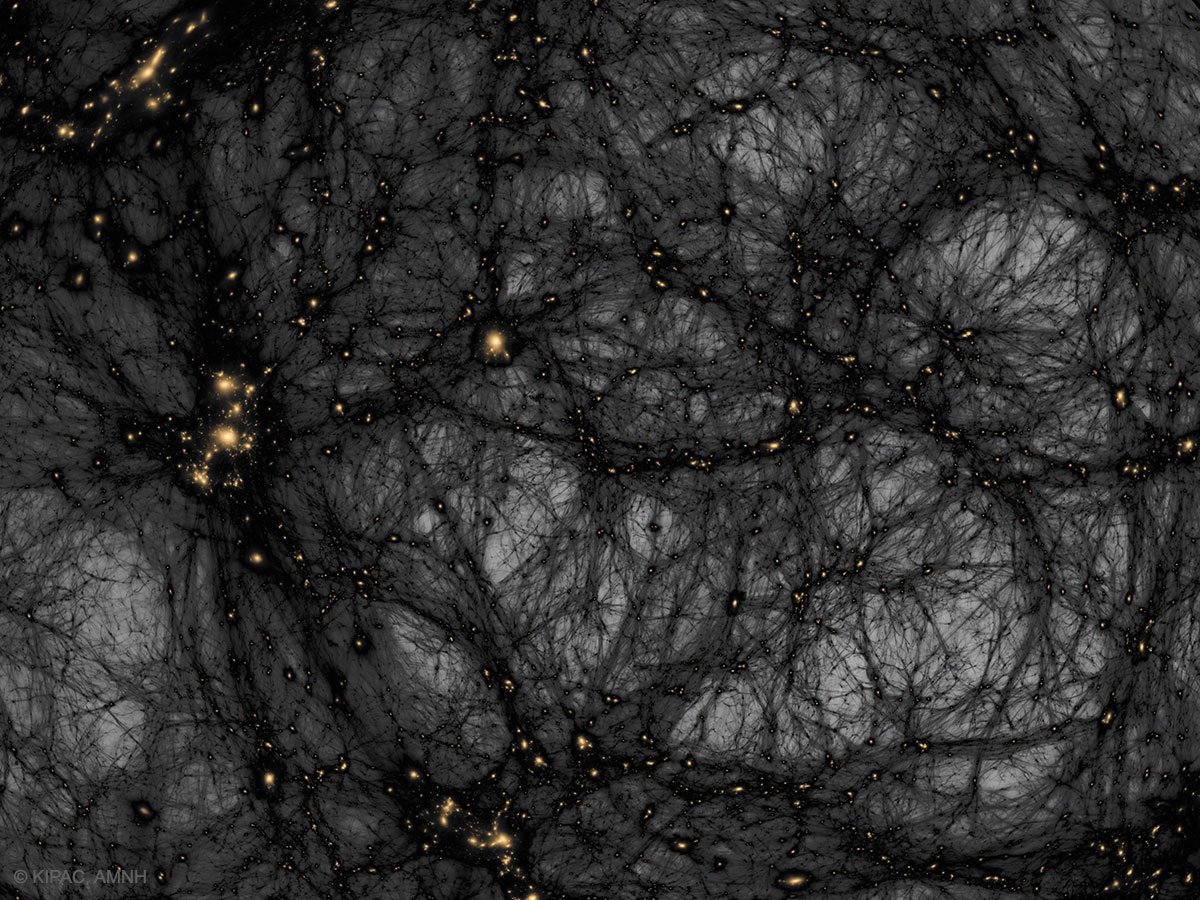
Astronomy picture of the day : Dark Matter in a Simulated Universe
2020 October 25
Illustration Credit & Copyright: Tom Abel & Ralf Kaehler (KIPAC, SLAC), AMNH
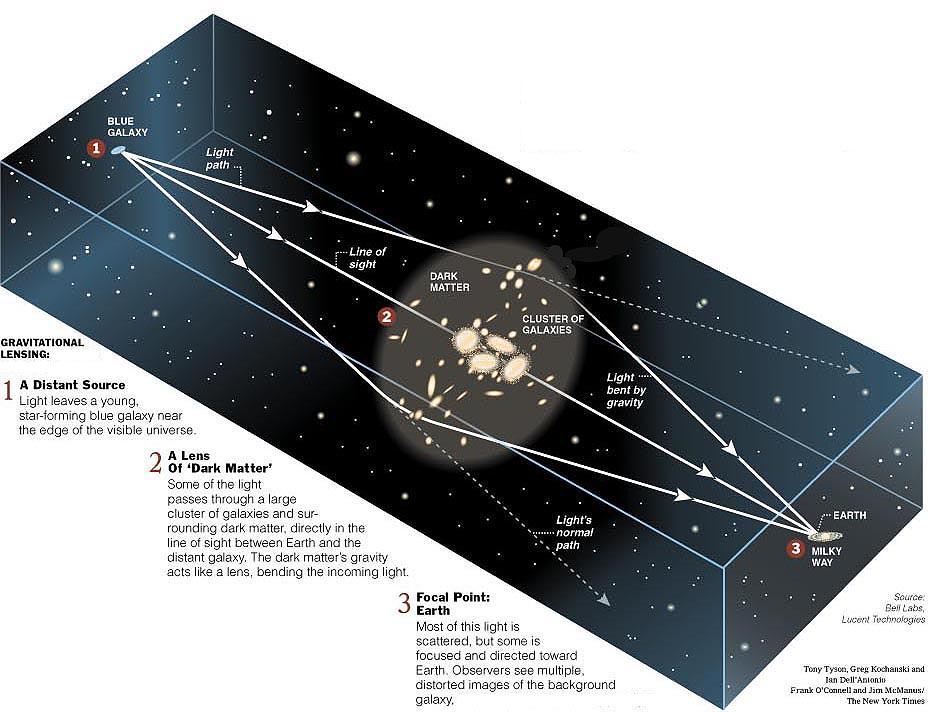
Explanation: Is our universe haunted? It might look that way on this dark matter map. The gravity of unseen dark matter is the leading explanation for why galaxies rotate so fast, why galaxies orbit clusters so fast, why gravitational lenses so strongly deflect light, and why visible matter is distributed as it is both in the local universe and on the cosmic microwave background. The featured image from the American Museum of Natural History's Hayden Planetarium previous Space Show Dark Universe highlights one example of how pervasive dark matter might haunt our universe. In this frame from a detailed computer simulation, complex filaments of dark matter, shown in black, are strewn about the universe like spider webs, while the relatively rare clumps of familiar baryonic matter are colored orange. These simulations are good statistical matches to astronomical observations. In what is perhaps a scarier turn of events, dark matter -- although quite strange and in an unknown form -- is no longer thought to be the strangest source of gravity in the universe. That honor now falls to dark energy, a more uniform source of repulsive gravity that seems to now dominate the expansion of the entire universe.
18/10/2020
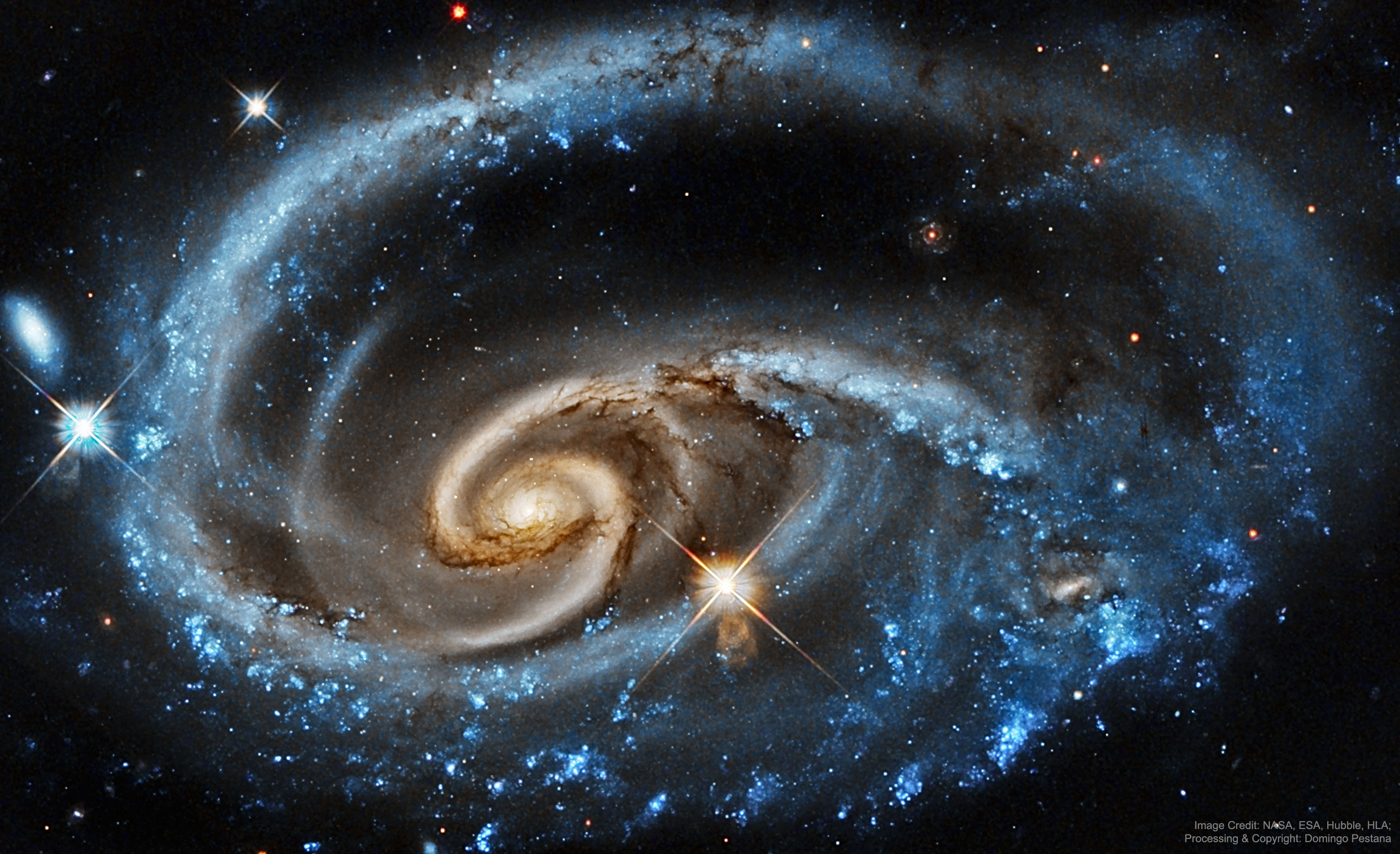
UGC 1810: Wildly Interacting Galaxy from Hubble - Science & Technology
2020 October 18
Image Credit: NASA, ESA, Hubble, HLA; Processing & Copyright: Domingo Pestana
Explanation: What's happening to this spiral galaxy? Although details remain uncertain, it surely has to do with an ongoing battle with its smaller galactic neighbor. The featured galaxy is labelled UGC 1810 by itself, but together with its collisional partner is known as Arp 273. The overall shape of UGC 1810 -- in particular its blue outer ring -- is likely a result of wild and violent gravitational interactions. This ring's blue color is caused by massive stars that are blue hot and have formed only in the past few million years. The inner galaxy appears older, redder, and threaded with cool filamentary dust. A few bright stars appear well in the foreground, unrelated to UGC 1810, while several galaxies are visible well in the background. Arp 273 lies about 300 million light years away toward the constellation of Andromeda. Quite likely, UGC 1810 will devour its galactic sidekick over the next billion years and settle into a classic spiral form.
16/10/2020
Science & Technology - Astronomy picture of the day : Planetary Nebula Abell 78
2020 October 16
Image Credit & Copyright: Bernhard Hubl
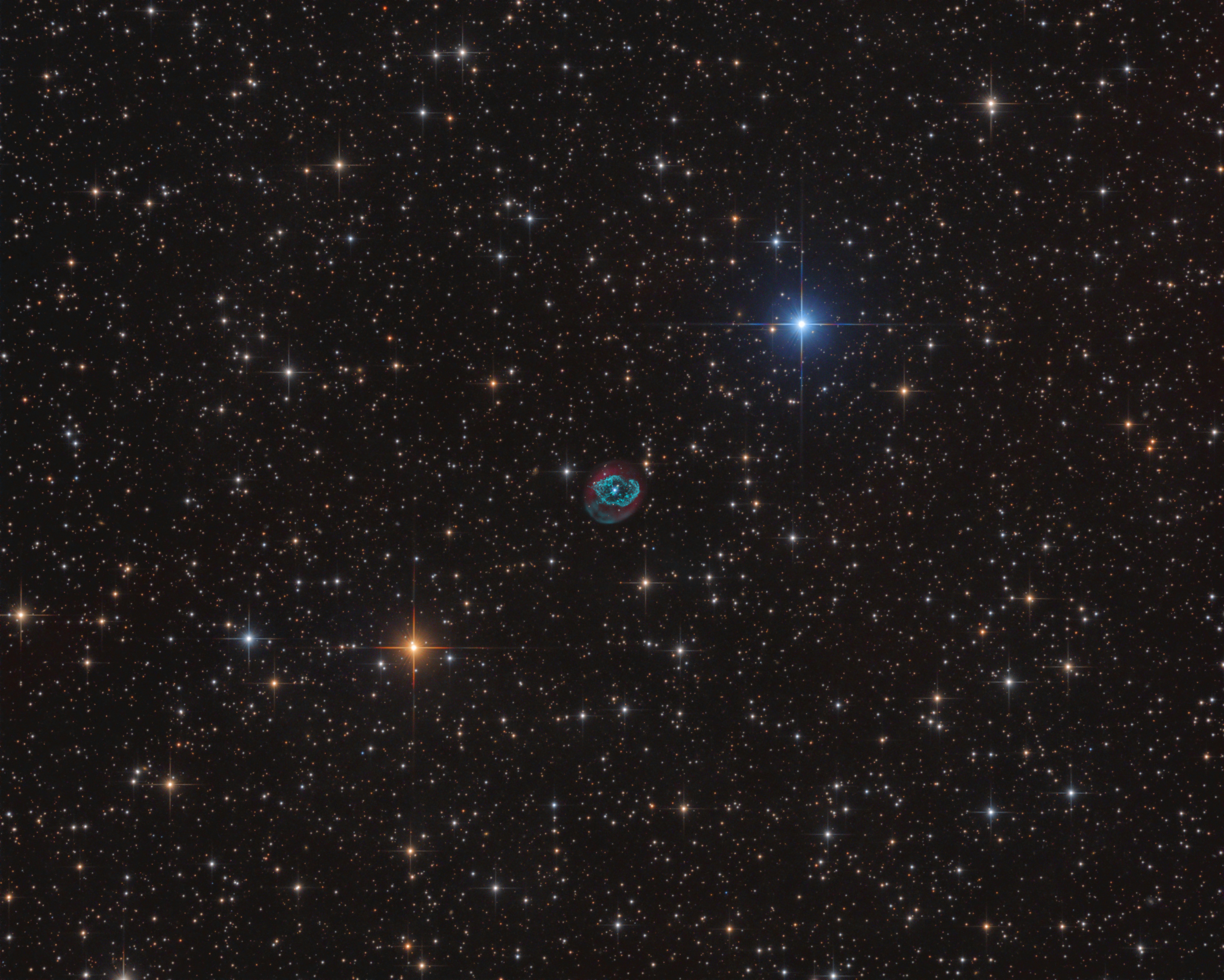
Explanation: Planetary nebula Abell 78 stands out in this colorful telescopic skyscape. In fact the colors of the spiky Milky Way stars depend on their surface temperatures, both cooler (yellowish) and hotter (bluish) than the Sun. But Abell 78 shines by the characteristic emission of ionized atoms in the tenuous shroud of material shrugged off from an intensely hot central star. The atoms are ionized, their electrons stripped away, by the central star's energetic but otherwise invisible ultraviolet light. The visible blue-green glow of loops and filaments in the nebula's central region corresponds to emission from doubly ionized oxygen atoms, surrounded by strong red emission from ionized hydrogen. Some 5,000 light-years distant toward the constellation Cygnus, Abell 78 is about three light-years across. A planetary nebula like Abell 78 represents a very brief final phase in stellar evolution that our own Sun will experience ... in about 5 billion years.
15/10/2020
Science & Technology - Astronomy picture of the day : Galaxies in Pegasus
2020 October 15
Image Credit & Copyright: Robert Eder
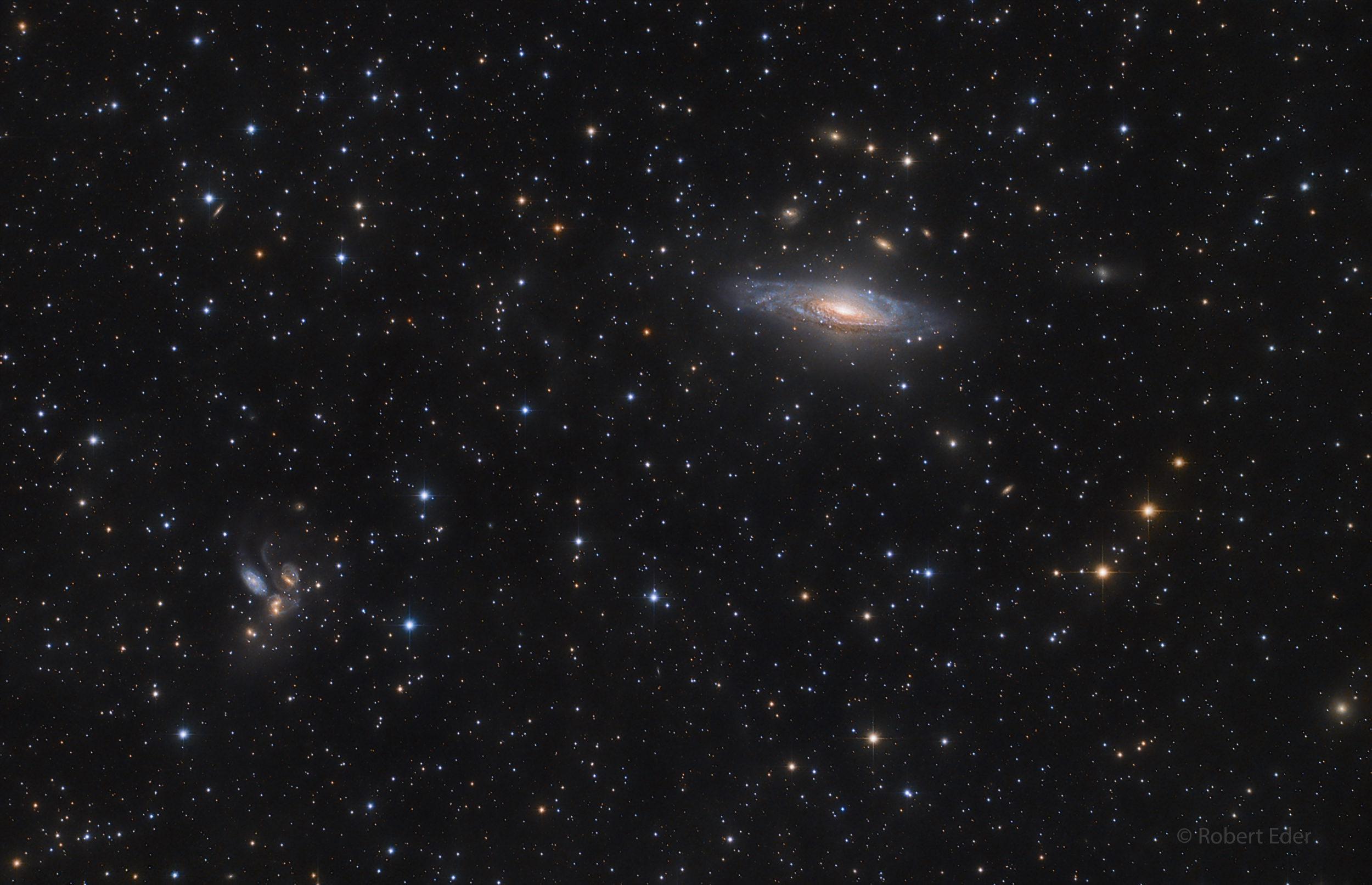
Explanation: This sharp telescopic view reveals galaxies scattered beyond the stars of the Milky Way, at the northern boundary of the high-flying constellation Pegasus. Prominent at the upper right is NGC 7331. A mere 50 million light-years away, the large spiral is one of the brighter galaxies not included in Charles Messier's famous 18th century catalog. The disturbed looking group of galaxies at the lower left is well-known as Stephan's Quintet. About 300 million light-years distant, the quintet dramatically illustrates a multiple galaxy collision, its powerful, ongoing interactions posed for a brief cosmic snapshot. On the sky, the quintet and NGC 7331 are separated by about half a degree.
14/10/2020
Science & Technology - Astronomy picture of the day : The Colorful Clouds of Rho Ophiuchi
2020 October 14
Image Credit & Copyright: Amir H. Abolfath
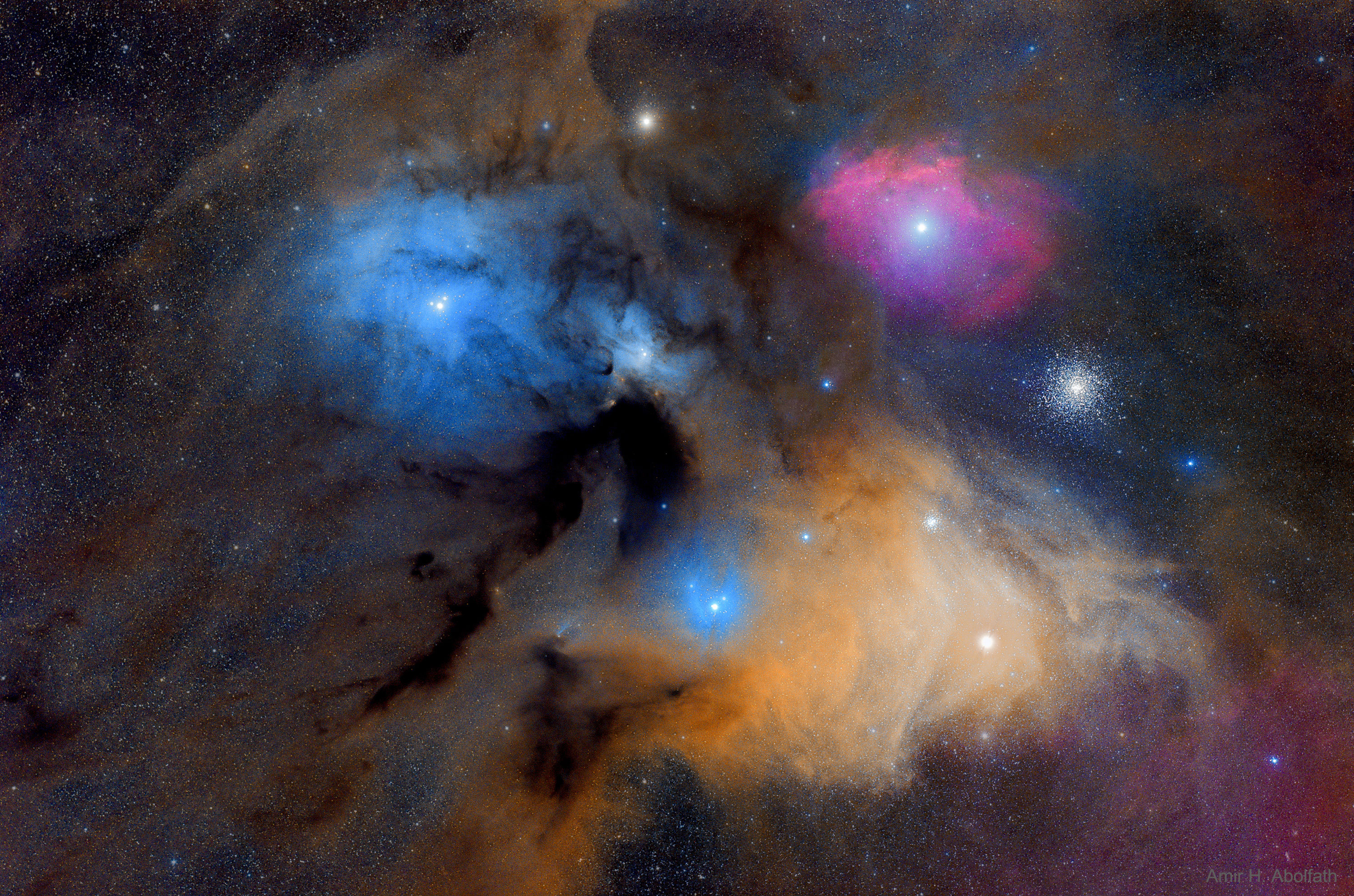
Explanation: The many spectacular colors of the Rho Ophiuchi (oh'-fee-yu-kee) clouds highlight the many processes that occur there. The blue regions shine primarily by reflected light. Blue light from the Rho Ophiuchi star system and nearby stars reflects more efficiently off this portion of the nebula than red light. The Earth's daytime sky appears blue for the same reason. The red and yellow regions shine primarily because of emission from the nebula's atomic and molecular gas. Light from nearby blue stars - more energetic than the bright star Antares - knocks electrons away from the gas, which then shines when the electrons recombine with the gas. The dark brown regions are caused by dust grains - born in young stellar atmospheres - which effectively block light emitted behind them. The Rho Ophiuchi star clouds, well in front of the globular cluster M4 visible here on the upper right, are even more colorful than humans can see - the clouds emits light in every wavelength band from the radio to the gamma-ray.
13/10/2020
Ciência e Tecnologia - Morte por 'esparguetificação'. Como um buraco negro engoliu uma estrela - Video
Quando uma estrela infeliz se aproxima demasiado de um buraco negro supermassivo situado no centro de uma galáxia, a extrema atração gravitacional exercida pelo buraco negro desfaz a estrela em finas correntes de matéria,” explica Thomas Wevers, autor do estudo e bolseiro do ESO em Santiago do Chile, em comunicado de imprensa.
Santé/Médecine - LES SYMPTOMES DE LA FIBROMYALGIE: 2. UNE GRANDE SENSIBILITE A LA DOULEUR - (4/12)
La fibromyalgie peut aussi augmenter la sensibilité à la douleur. Dans les cas les plus sévères, un simple toucher ou même un effleurement p...
-
2025 May 11 The Surface of Venus from Venera 14 Image Credit: Soviet Planetary Exploration Program , Venera 14 ; Processing & Copyri...
-
Imaginez un monde où le cancer n’est plus une sentence, mais une simple étape à franchir. Grâce à une découverte révolutionnaire, ce rêve es...