04/12/2020

03/12/2020
ASTRONOMY - The Antennae Galaxies in Collision
2020 December 3

Image Credit: ESA/Hubble NASA
Explanation: Sixty million light-years away toward the southerly constellation Corvus, these two large galaxies are colliding. The cosmic train wreck captured in stunning detail in this Hubble Space Telescope snapshot takes hundreds of millions of years to play out. Cataloged as NGC 4038 and NGC 4039, the galaxies' individual stars don't often collide though. Their large clouds of molecular gas and dust do, triggering furious episodes of star formation near the center of the wreckage. New star clusters and interstellar matter are jumbled and flung far from the scene of the accident by gravitational forces. This Hubble close-up frame is about 50,000 light-years across at the estimated distance of the colliding galaxies. In wider-field views their suggestive visual appearance, with extended structures arcing for hundreds of thousands of light-years, gives the galaxy pair its popular name, The Antennae Galaxies.
02/12/2020

AERONAUTIQUE - La Mongolfière familiale

Dans les années 1900, certaines personnes avaient imaginé des engins volants de différentes tailles (un peu comme le principe des voitures berlines familiales d'aujourd'hui) largement calqués sur les montgolfières. En effet, un peu plus d'un siècle plus tôt, les frères Montgolfier (Joseph-Michel et Jacques-Étienne) avaient fait voler le premier ballon gonflé d'air chaud. Dans l'imaginaire populaire, le ballon était donc l'une des seules formes d'objets volants connues.
Futura Sciences
ASTRONOMY - Eye of moon
2020 December 2
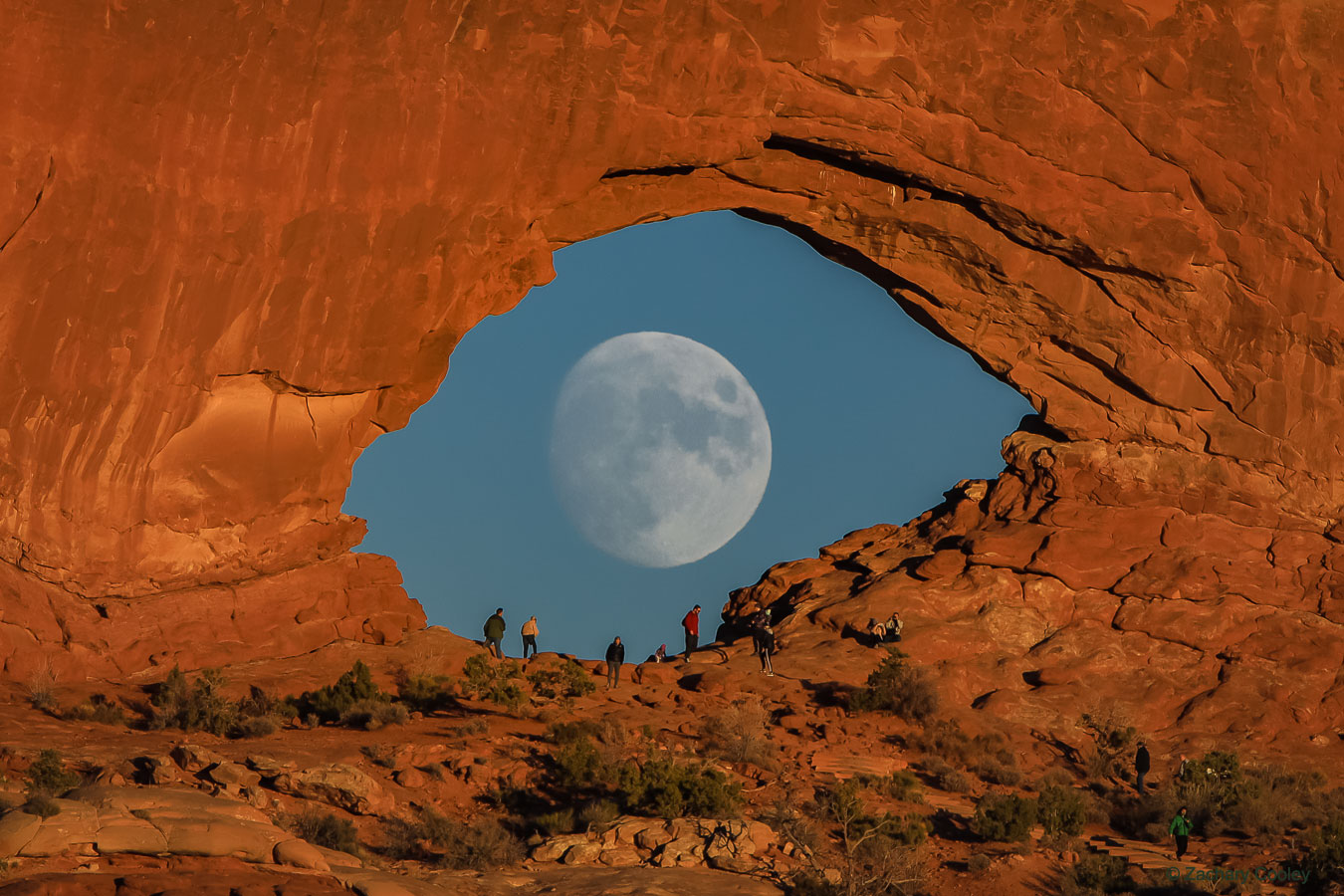
Image Credit & Copyright: Zachery Cooley
Explanation: Who's watching who? The featured image of the Moon through a gap in a wall of rock may appear like a giant eye looking back at you. Although, in late October, it took only a single exposure to capture this visual double, it also took a lot of planning. The photographic goal was achieved by precise timing -- needed for a nearly full moon to appear through the eye-shaped arch, by precise locating -- needed for the angular size of the Moon to fit iconically inside the rock arch, and by good luck -- needed for a clear sky and for the entire scheme to work. The seemingly coincidental juxtaposition was actually engineered with the help of three smartphone apps. The pictured sandstone arch, carved by erosion, is millions of years old and just one of thousands of natural rock arches that have been found in Arches National Park near Moab, Utah, US
01/12/2020


ASTRONOMY - NGC 346: Star Forming Cluster in the SMC
2020 December 1
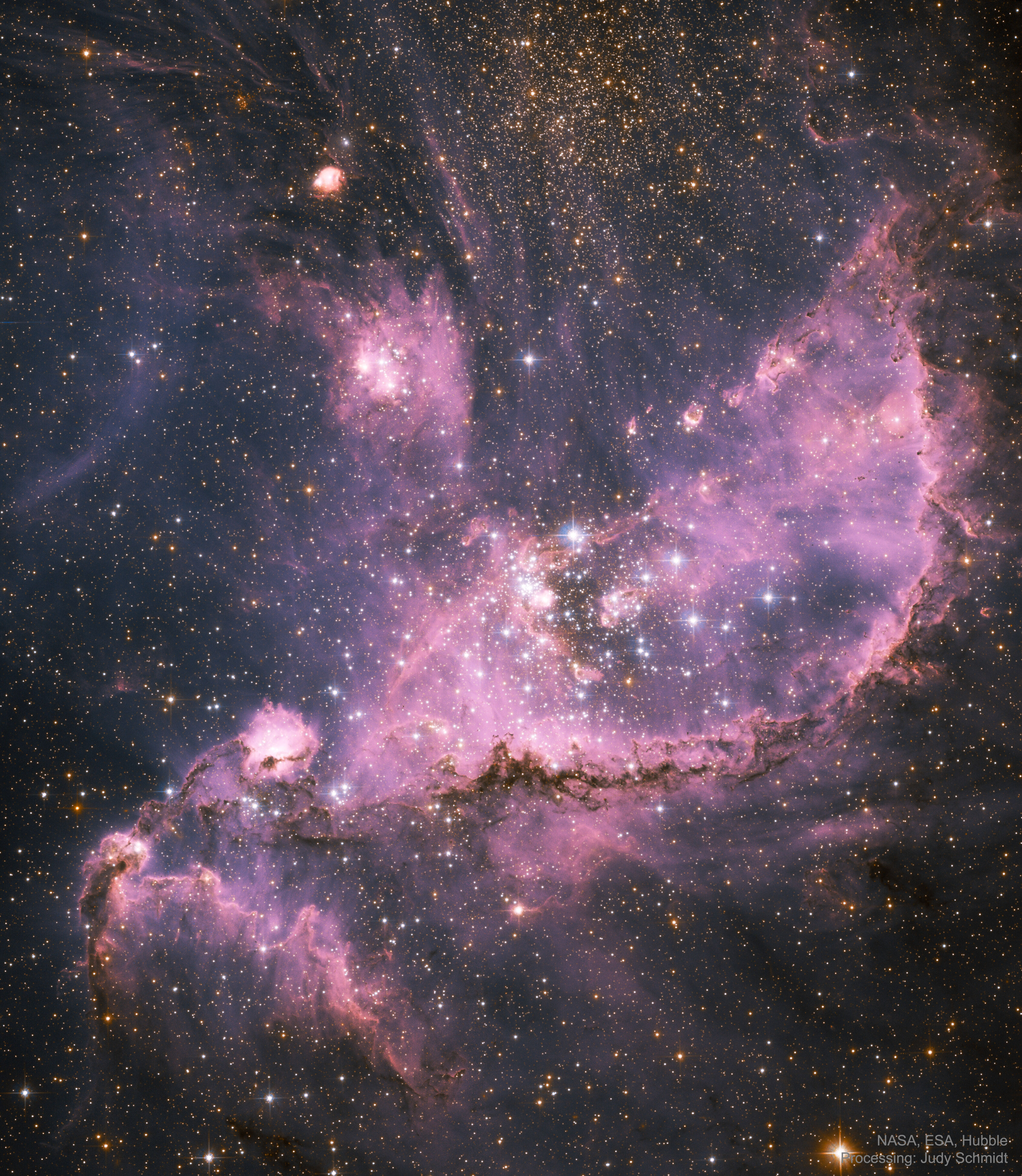
Image Credit & License: NASA, ESA, Hubble; Processing: Judy Schmidt
Explanation: Are stars still forming in the Milky Way's satellite galaxies? Found among the Small Magellanic Cloud's (SMC's) clusters and nebulas, NGC 346 is a star forming region about 200 light-years across, pictured here in the center of a Hubble Space Telescope image. A satellite galaxy of the Milky Way, the Small Magellanic Cloud (SMC) is a wonder of the southern sky, a mere 210,000 light-years distant in the constellation of the Toucan (Tucana). Exploring NGC 346, astronomers have identified a population of embryonic stars strung along the dark, intersecting dust lanes visible here on the right. Still collapsing within their natal clouds, the stellar infants' light is reddened by the intervening dust. Toward the top of the frame is another star cluster with intrinsically older and redder stars. A small, irregular galaxy, the SMC itself represents a type of galaxy more common in the early Universe. These small galaxies, though, are thought to be building blocks for the larger galaxies present today.
30/11/2020
ASTRONOMY - Cygnus Without Stars
2020 November 30

Image Credit & Copyright: Bowen James Cameron
Explanation: The sky is filled with faintly glowing gas, though it can take a sensitive camera and telescope to see it. For example, this twelve-degree-wide view of the northern part of the constellation Cygnus reveals a complex array of cosmic clouds of gas along the plane of our Milky Way galaxy. The featured mosaic of telescopic images was recorded through two filters: an H-alpha filter that transmits only visible red light from glowing hydrogen atoms, and a blue filter that transmits primarily light emitted by the slight amount of energized oxygen. Therefore, in this 18-hour exposure image, blue areas are hotter than red. Further digital processing has removed the myriad of point-like Milky Way stars from the scene. Recognizable bright nebulas include NGC 7000 (North America Nebula), and IC 5070 (Pelican Nebula) on the left with IC 1318 (Butterfly Nebula) and NGC 6888 (Crescent Nebula) on the right -- but others can be found throughout the wide field.
Inscription à :
Articles (Atom)
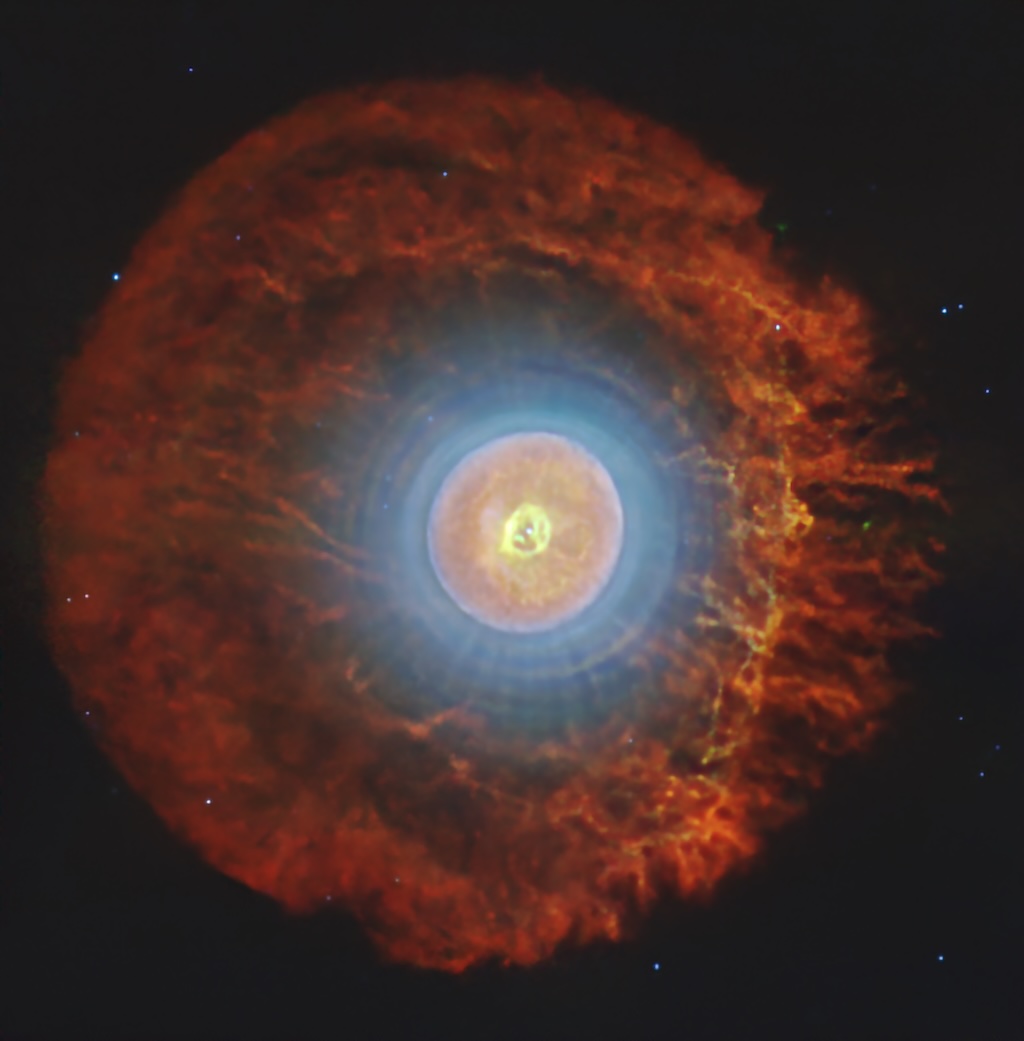
Astronomy - A PLANETARY NEBULA WITH COSMIC BUCKYBALLS
2026 June 4 A Planetary Nebula with Cosmic Buckyballs Image Credit: NASA / ESA / CSA / J. Cami ( Western University ); Image Processing: K...
-
2026 January 1 Auroral Corona Image Credit & Copyright : Roi Levi Explanation: Cycle 25 solar maximum made 2025 a great year for ...
-
Imaginez un monde où le cancer n’est plus une sentence, mais une simple étape à franchir. Grâce à une découverte révolutionnaire, ce rêve es...