04/03/2021

ASTRONOMY - Mars in Taurus
2021 March 4
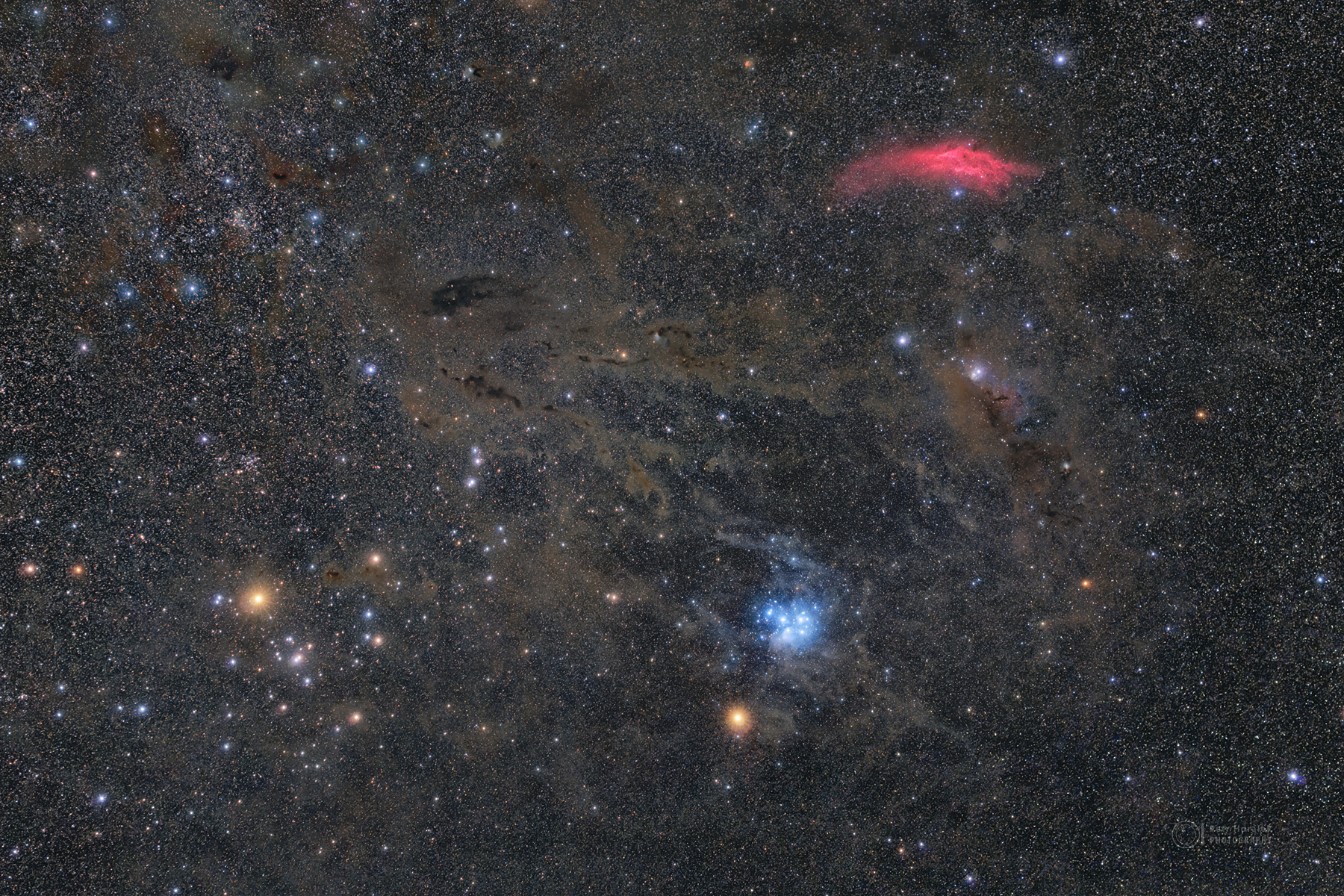
Image Credit & Copyright: Petr Horalek / Institute of Physics in Opava
Explanation: You can spot Mars in the evening sky tonight. Now home to the Perseverance rover, the Red Planet is presently wandering through the constellation Taurus, close on the sky to the Seven Sisters or Pleiades star cluster. In fact this deep, widefield view of the region captures Mars near its closest conjunction to the Pleiades on March 3. Below center, Mars is the bright yellowish celestial beacon only about 3 degrees from the pretty blue star cluster. Competing with Mars in color and brightness, Aldebaran is the alpha star of Taurus. The red giant star is toward the lower left edge of the frame, a foreground star along the line-of-sight to the more distant Hyades star cluster. Otherwise too faint for your eye to see, the dark, dusty nebulae lie along the edge of the massive Perseus molecular cloud, with the striking reddish glow of NGC 1499, the California Nebula, at the upper right.
03/03/2021
ASTRONOMY - Stars over an Erupting Volcano
2021 March 3
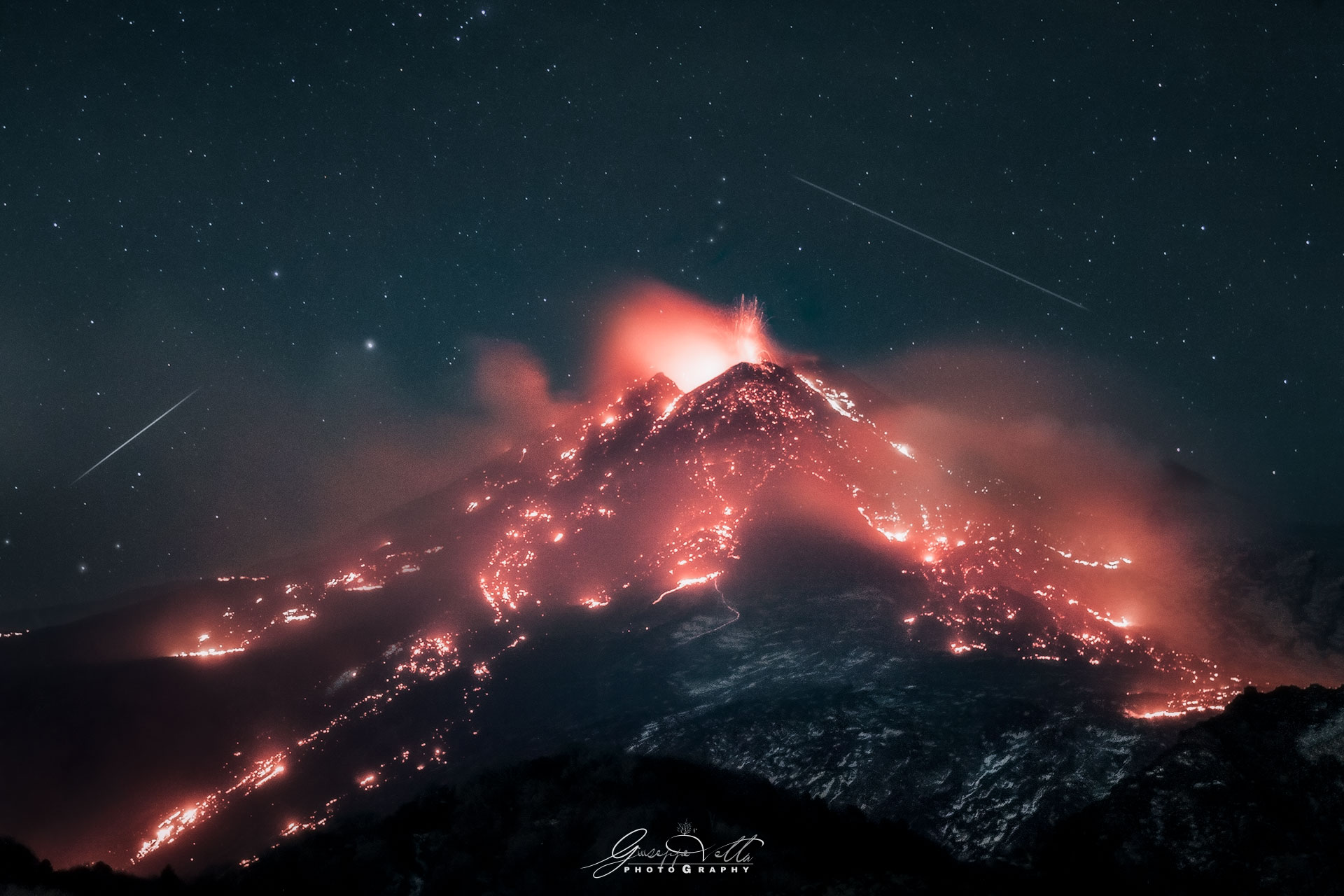
Image Credit & Copyright: Giuseppe Vella
Explanation: Mt. Etna has been erupting for hundreds of thousands of years. Located in Sicily, Italy, the volcano produces lava fountains over one kilometer high. Mt. Etna is not only one of the most active volcanoes on Earth, it is one of the largest, measuring over 50 kilometers at its base and rising nearly 3 kilometers high. Pictured erupting last month, a lava plume shoots upwards, while hot lava flows down the volcano's exterior. Likely satellite trails appear above, while ancient stars dot the sky far in the distance. This volcanic eruption was so strong that nearby airports were closed to keep planes from flying through the dangerous plume. The image foreground and background were captured consecutively by the same camera and from the same location.
02/03/2021

ASTRONOMY - Ingenuity: A Mini-Helicopter Now on Mars
2021 March 2
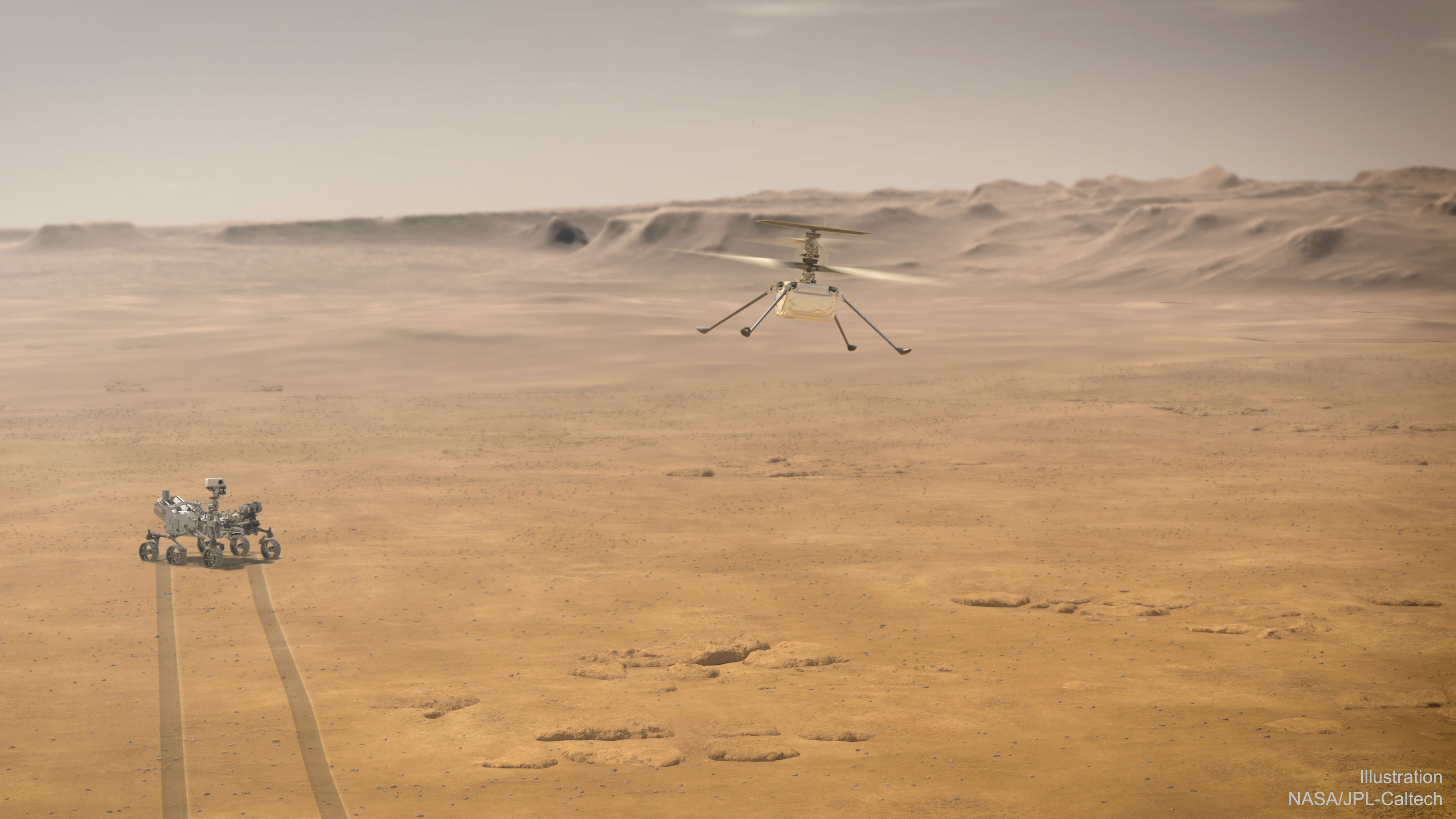
Illustration Credit: NASA, JPL-Caltech, Mars 2020 - Perseverance
Explanation: What if you could fly around Mars? NASA may have achieved that capability last month with the landing of Perseverance, a rover which included a small flight-worthy companion called Ingenuity, nicknamed Ginny. Even though Ginny is small -- a toaster-sized helicopter with four long legs and two even-longer (1.2-meter) rotors, she is the first of her kind -- there has never been anything like her before. After being deployed, possibly in April, the car-sized Perseverance ("Percy") will back away to give Ginny ample room to attempt her unprecedented first flight. In the featured artistic illustration, Ginny's long rotors are depicted giving her the lift she needs to fly into the thin Martian atmosphere and explore the area near Perseverance. Although Ingenuity herself will not fly very far, she is a prototype for all future airborne Solar-System robots that may fly far across not only Mars, but Titan.
01/03/2021
ASTRONOMY - The Pelican Nebula in Red and Blue
2021 March 1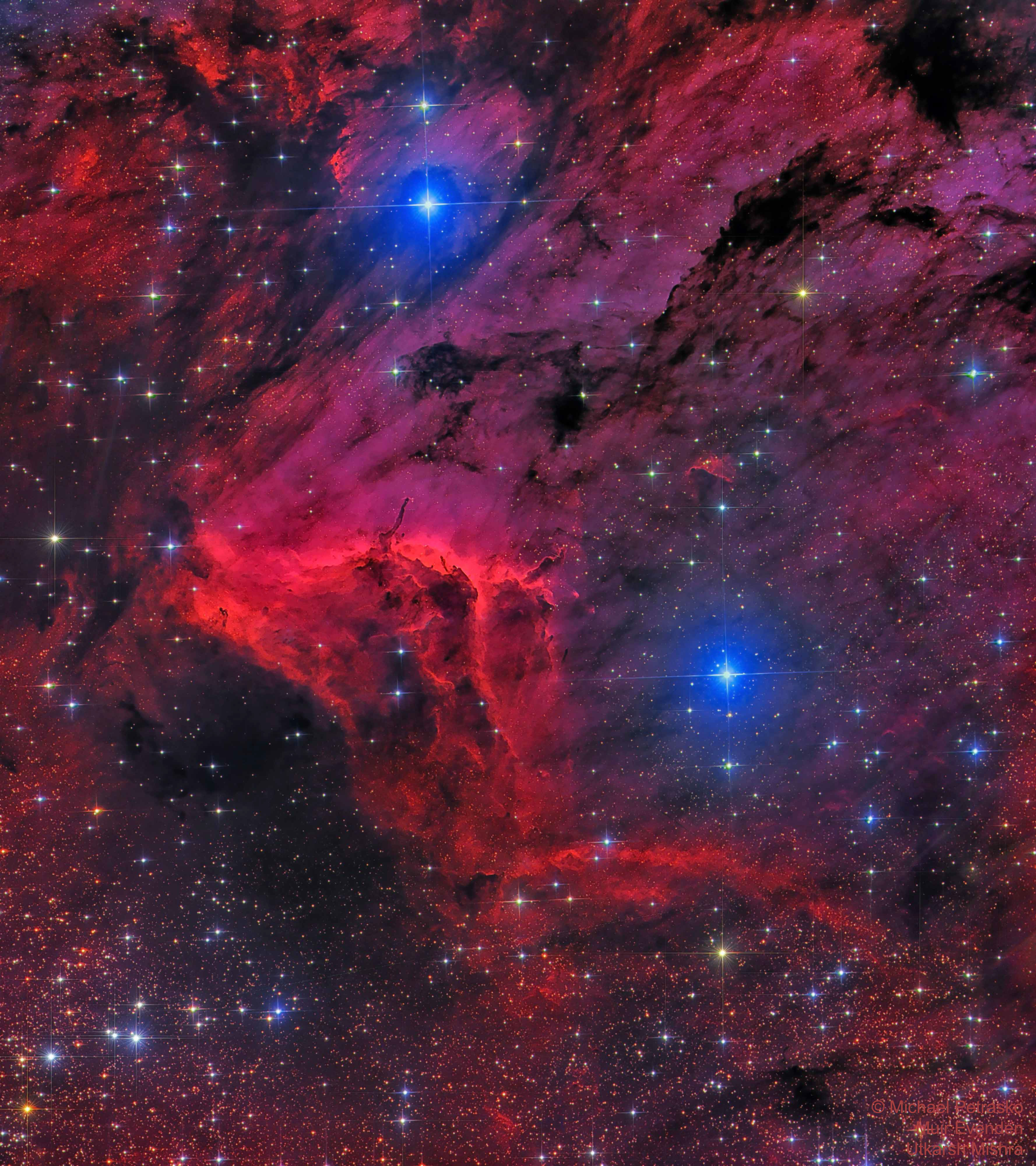
Image Credit & Copyright: M. Petrasko, M. Evenden, U. Mishra (Insight Obs.)
Explanation: The Pelican Nebula is changing. The entire nebula, officially designated IC 5070, is divided from the larger North America Nebula by a molecular cloud filled with dark dust. The Pelican, however, is particularly interesting because it is an unusually active mix of star formation and evolving gas clouds. The featured picture was processed to bring out two main colors, red and blue, with the red dominated by light emitted by interstellar hydrogen. Ultraviolet light emitted by young energetic stars is slowly transforming cold gas in the nebula to hot gas, with the advancing boundary between the two, known as an ionization front, visible in bright red across the image center. Particularly dense tentacles of cold gas remain. Millions of years from now this nebula might no longer be known as the Pelican, as the balance and placement of stars and gas will surely leave something that appears completely different.
28/02/2021

ASTRONOMY - The Aurora Tree
2021 February 28
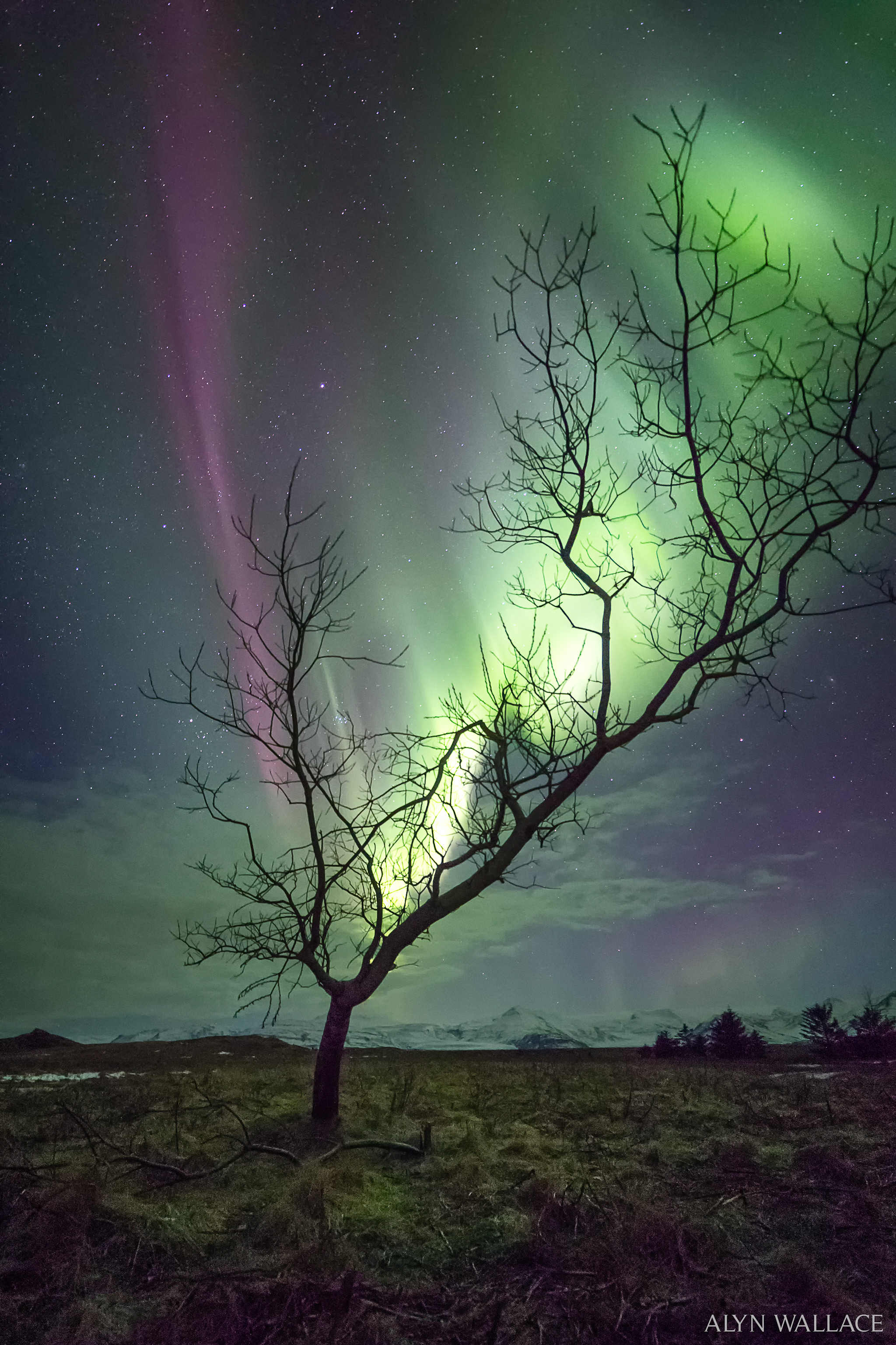
Image Credit & Copyright: Alyn Wallace
Explanation: Yes, but can your tree do this? Pictured is a visual coincidence between the dark branches of a nearby tree and bright glow of a distant aurora. The beauty of the aurora -- combined with how it seemed to mimic a tree right nearby -- mesmerized the photographer to such a degree that he momentarily forgot to take pictures. When viewed at the right angle, it seemed that this tree had aurora for leaves. Fortunately, before the aurora morphed into a different overall shape, he came to his senses and capture the awe-inspiring momentary coincidence. Typically triggered by solar explosions, aurora are caused by high energy electrons impacting the Earth's atmosphere around 150 kilometers up. The unusual Earth-sky collaboration was witnessed in March of 2017 in Iceland.
26/02/2021
DESCOBERTAS CIÊNCIA - A pilha voltaica

Em 1779, o cientista italiano Alessandro Volta (1745 - 1827) apresenta a pilha voltaica, o primeiro gerador estático de energia elétrica a ser criado.
Descobertas posteriores, como a decomposição elétrica (eletrólise) da água em oxigénio e hidrogénio e o isolamento de elementos químicos como o sódio, o potássio, o cálcio, o boro, o bário, o estrôncio e o magnésio, deu origem, nos nossos dias, a diversos tipos de baterias recarregáveis.
Se não fosse essa invenção, dificilmente teríamos hoje aparelhos portáteis como os tablets e os smartphones que podem funcionar sem estarem ligados a uma tomada elétrica.
ASTRONOMIE - Un cratère géant rempli de glasse immortalisé sur Mars
Un cratère géant rempli de glasse immortalisé sur Mars
Inscription à :
Articles (Atom)
La vie et la mort - Y-A-T-IL UNE VIE APRèS LA MORT ? (3/5)
Sept jours de coma… et une expérience consciente Durant sept jours, le neurochirurgien reste plongé dans un état végétatif. Les examens neur...

-
2026 January 1 Auroral Corona Image Credit & Copyright : Roi Levi Explanation: Cycle 25 solar maximum made 2025 a great year for ...
-
Imaginez un monde où le cancer n’est plus une sentence, mais une simple étape à franchir. Grâce à une découverte révolutionnaire, ce rêve es...


#/media/File:Anatomy_of_the_Mars_Helicopter.png)