Nombre total de pages vues

08/03/2021

ASTRONOMY - Three Tails of Comet NEOWISE

 2021 March 8

See Explanation.
Moving the cursor over the image will bring up an annotated version.
Clicking on the picture will download
the highest resolution version available.

Three Tails of Comet NEOWISE
Image Credit & Copyright: Nicolas Lefaudeux

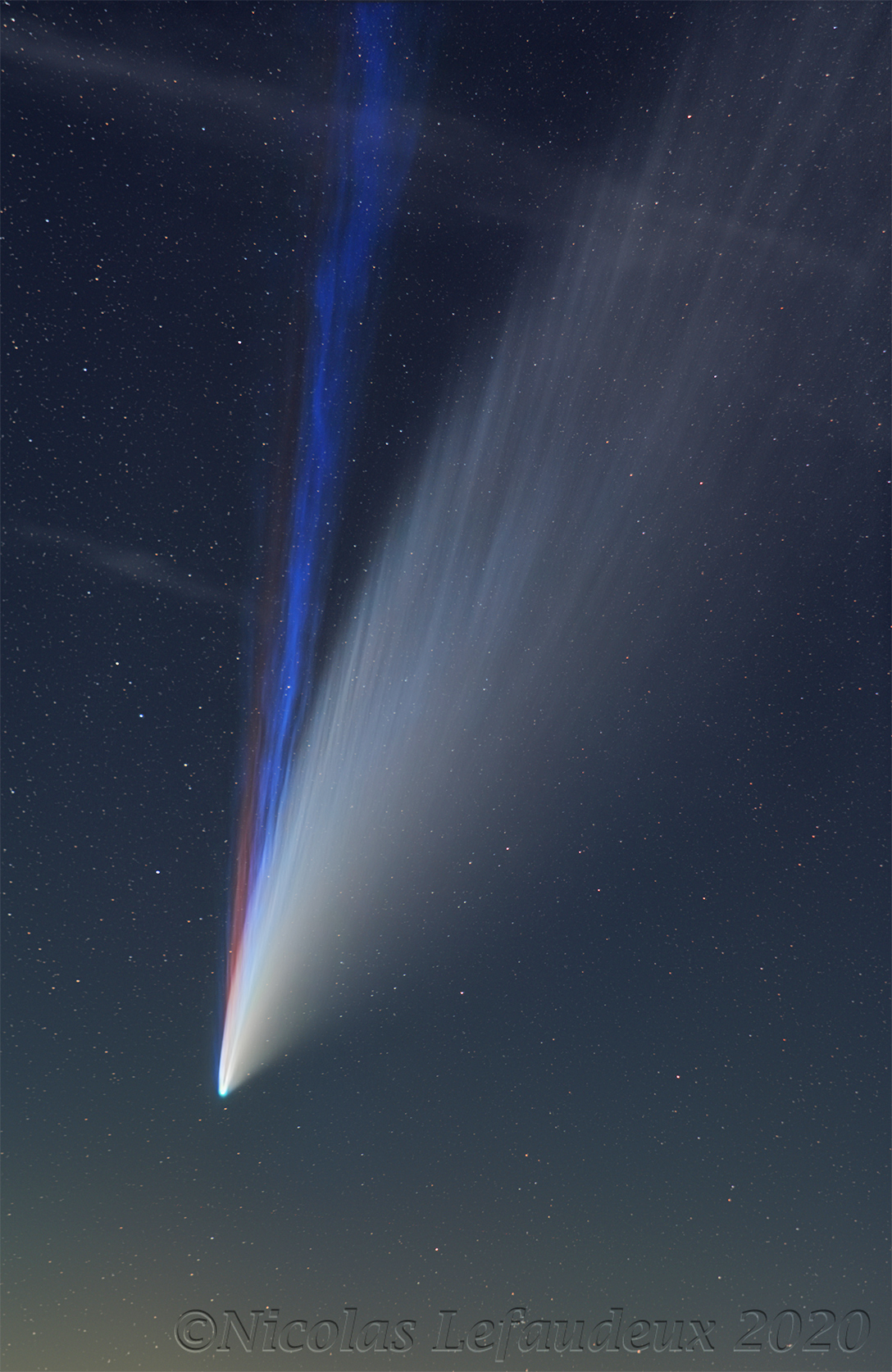
Explanation: What created the unusual red tail in Comet NEOWISE? Sodium. A spectacular sight back in the summer of 2020, Comet NEOWISE, at times, displayed something more than just a surprisingly striated white dust tail and a pleasingly patchy blue ion tail. Some color sensitive images showed an unusual red tail, and analysis showed much of this third tail's color was emitted by sodium. Gas rich in sodium atoms might have been liberated from Comet NEOWISE's warming nucleus in early July by bright sunlight, electrically charged by ultraviolet sunlight, and then pushed out by the solar wind. The featured image was captured in mid-July from BrittanyFrance and shows the real colors. Sodium comet tails have been seen before but are rare -- this one disappeared by late July. Comet C/2020 F3 (NEOWISE) has since faded, lost all of its bright tails, and now approaches the orbit of Jupiter as it heads back to the outer Solar System, to return only in about 7,000 years.

07/03/2021

PRATIQUE - Repasser facilement une chemise


PEINTURE SPACE ART - Tempête martienne


Tempête martienne 

Crédit : Luděk Pešek

ASTRONOMY - Pillars of the Eagle Nebula in Infrared

 2021 March 7

See Explanation.  Clicking on the picture will download
the highest resolution version available.

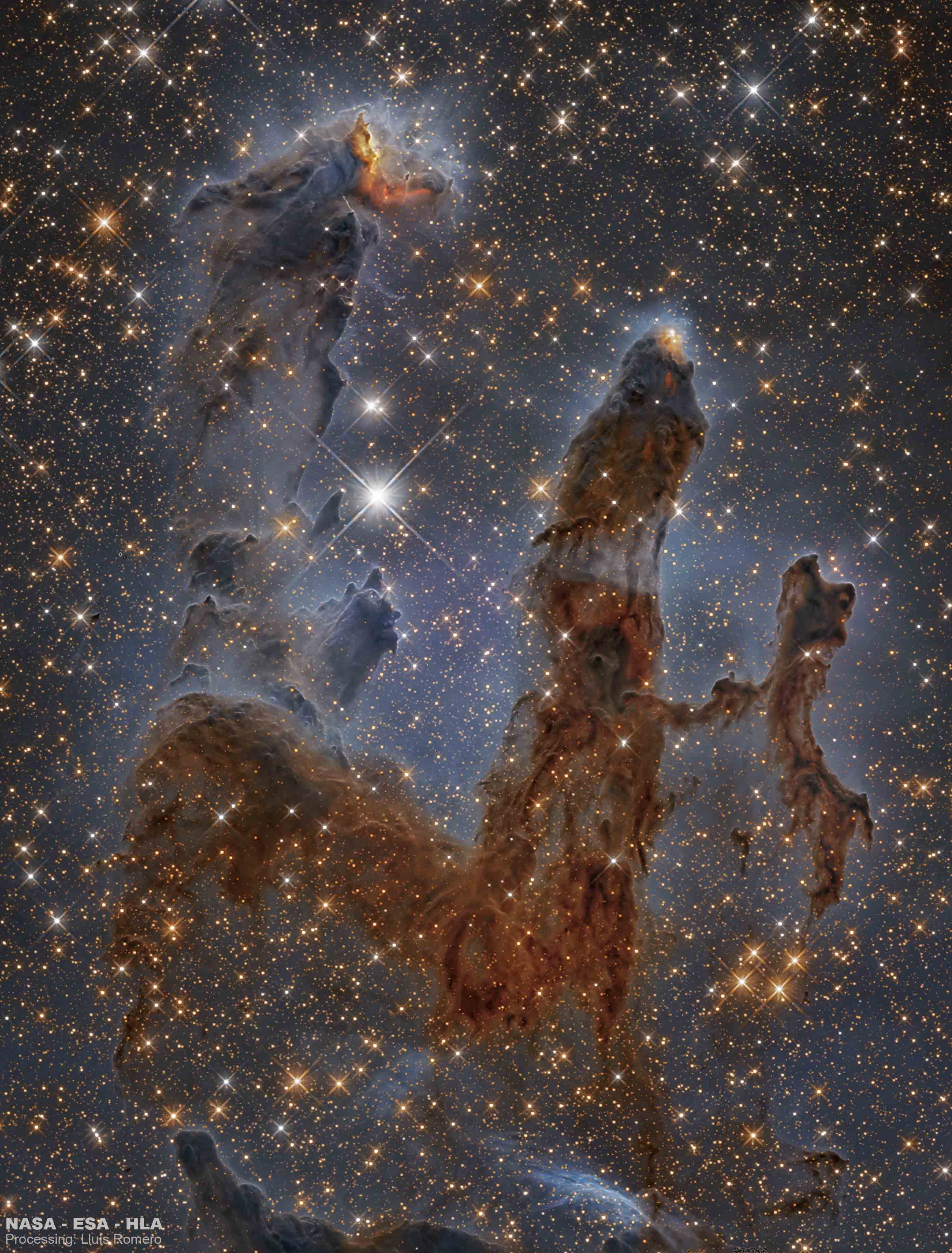
Pillars of the Eagle Nebula in Infrared
Image Credit: NASAESAHubbleHLAProcessing: Luis Romero

Explanation: Newborn stars are forming in the Eagle Nebula. Gravitationally contracting in pillars of dense gas and dust, the intense radiation of these newly-formed bright stars is causing surrounding material to boil away. This image, taken with the Hubble Space Telescope in near infrared light, allows the viewer to see through much of the thick dust that makes the pillars opaque in visible light. The giant structures are light years in length and dubbed informally the Pillars of Creation. Associated with the open star cluster M16, the Eagle Nebula lies about 6,500 light years away. The Eagle Nebula is an easy target for small telescopes in a nebula-rich part of the sky toward the split constellation Serpens Cauda (the tail of the snake).

05/03/2021

ASTRONOMY - A Little Like Mars

 2021 March 5

See Explanation.
Moving the cursor over the image will bring up an annotated version.
Clicking on the picture will download
the highest resolution version available.

A Little Like Mars
Image Credit & Copyright: Robert Barsa

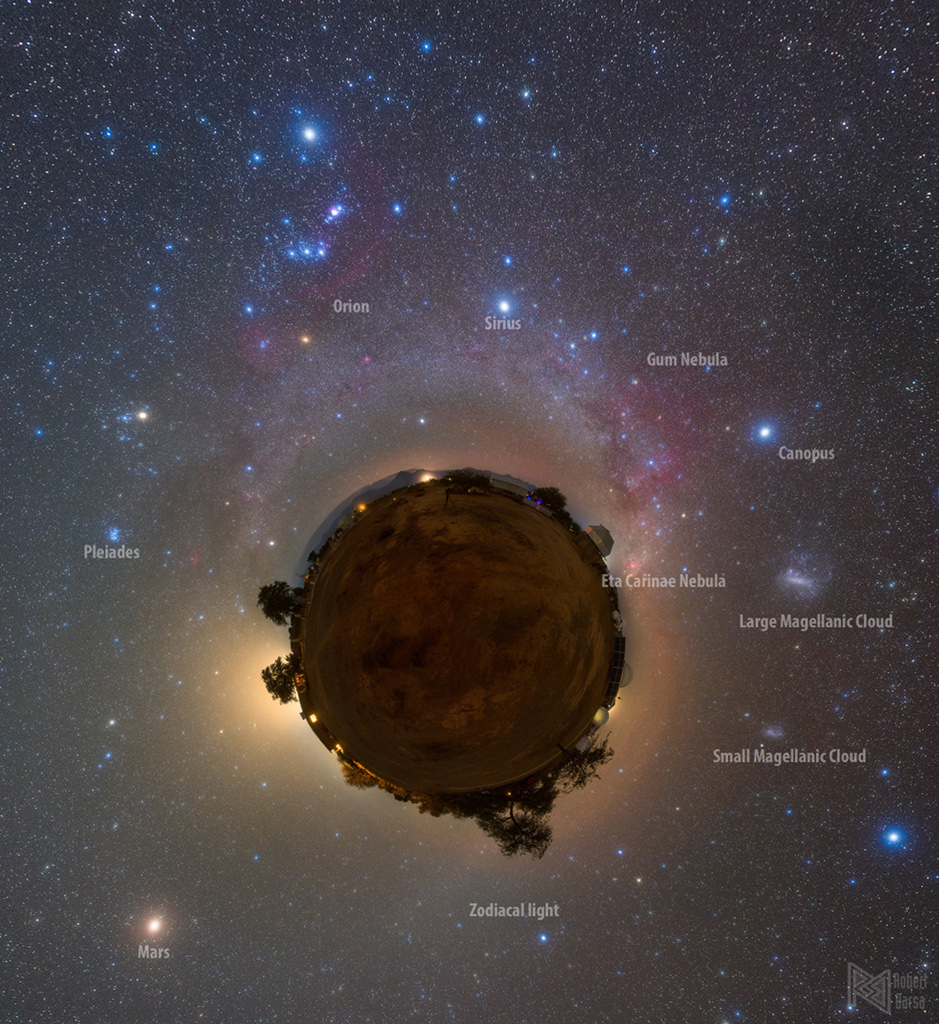
Explanation: The surface of this planet looks a little like Mars. It's really planet Earth though. In a digitally stitched little planet projection, the 360 degree mosaic was captured near San Pedro in the Chilean Atacama desert. Telescopes in domes on the horizon are taking advantage of the region's famously dark, clear nights. Taken in early December, a magnificent Milky Way arcs above the horizon for almost 180 degrees around the little planet with Orion prominent in the southern sky. A familiar constellation upside down for northern hemisphere skygazers, Orion shares that southern December night almost opposite the Large and Small Magellanic clouds. But the Red Planet itself is the brightest yellowish celestial beacon in this little planet sky.

04/03/2021

PRATIQUE - Comment faire les symboles sur un clavier


ASTRONOMY - Mars in Taurus

 2021 March 4

See Explanation.  Clicking on the picture will download
the highest resolution version available.

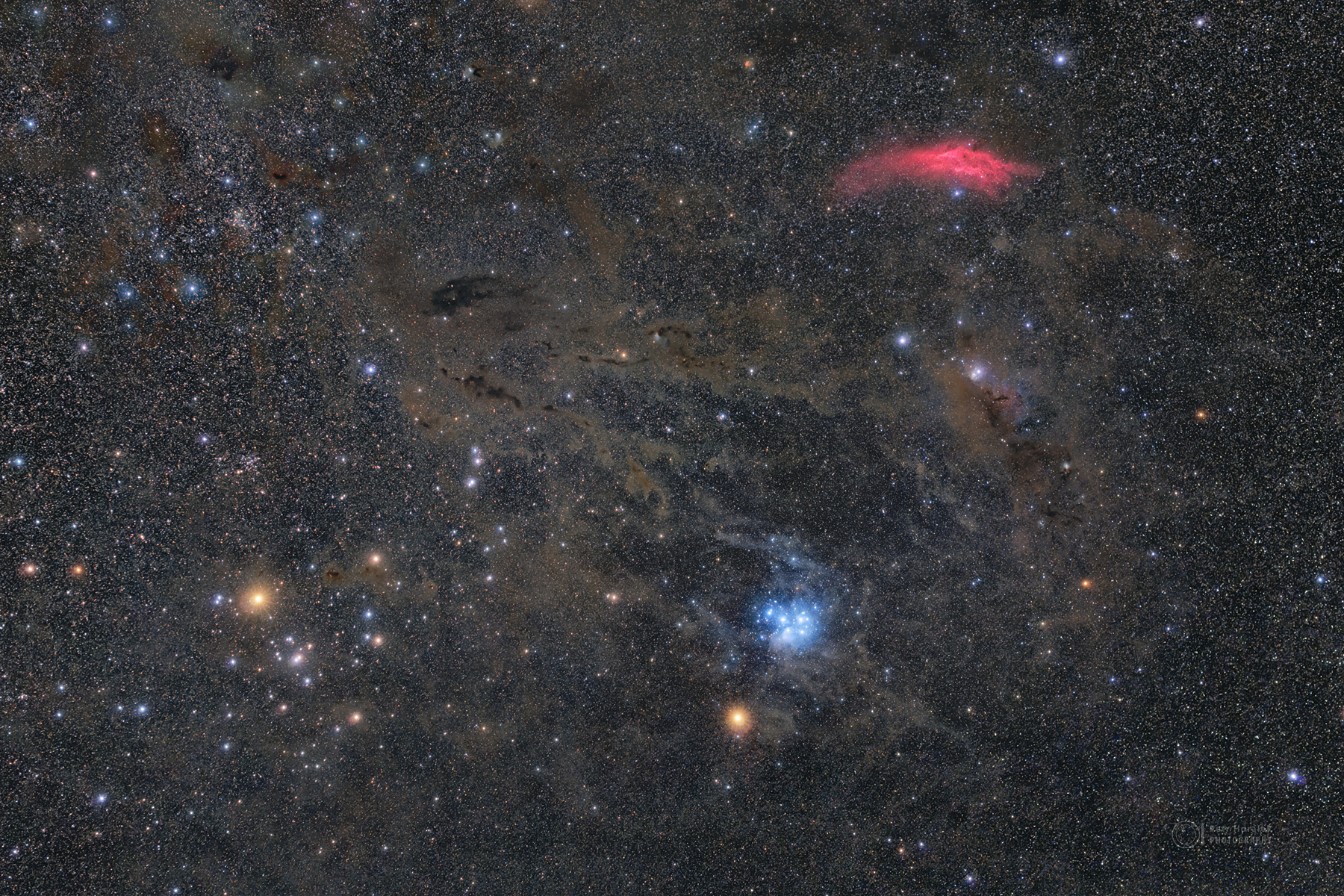
Mars in Taurus
Image Credit & Copyright: Petr Horalek / Institute of Physics in Opava

Explanation: You can spot Mars in the evening sky tonight. Now home to the Perseverance rover, the Red Planet is presently wandering through the constellation Taurus, close on the sky to the Seven Sisters or Pleiades star cluster. In fact this deep, widefield view of the region captures Mars near its closest conjunction to the Pleiades on March 3. Below center, Mars is the bright yellowish celestial beacon only about 3 degrees from the pretty blue star cluster. Competing with Mars in color and brightness, Aldebaran is the alpha star of Taurus. The red giant star is toward the lower left edge of the frame, a foreground star along the line-of-sight to the more distant Hyades star cluster. Otherwise too faint for your eye to see, the dark, dusty nebulae lie along the edge of the massive Perseus molecular cloud, with the striking reddish glow of NGC 1499, the California Nebula, at the upper right.

03/03/2021

ASTRONOMY - Stars over an Erupting Volcano

 2021 March 3

See Explanation.  Clicking on the picture will download
the highest resolution version available.

Stars over an Erupting Volcano
Image Credit & Copyright: Giuseppe Vella

Explanation: Mt. Etna has been erupting for hundreds of thousands of years. Located in SicilyItalythe volcano produces lava fountains over one kilometer high. Mt. Etna is not only one of the most active volcanoes on Earth, it is one of the largest, measuring over 50 kilometers at its base and rising nearly 3 kilometers high. Pictured erupting last month, a lava plume shoots upwards, while hot lava flows down the volcano's exterior. Likely satellite trails appear above, while ancient stars dot the sky far in the distance. This volcanic eruption was so strong that nearby airports were closed to keep planes from flying through the dangerous plume. The image foreground and background were captured consecutively by the same camera and from the same location.

02/03/2021

PRATIQUE - La magie du calcul !


ASTRONOMY - Ingenuity: A Mini-Helicopter Now on Mars

 2021 March 2

See Explanation.  Clicking on the picture will download
the highest resolution version available.

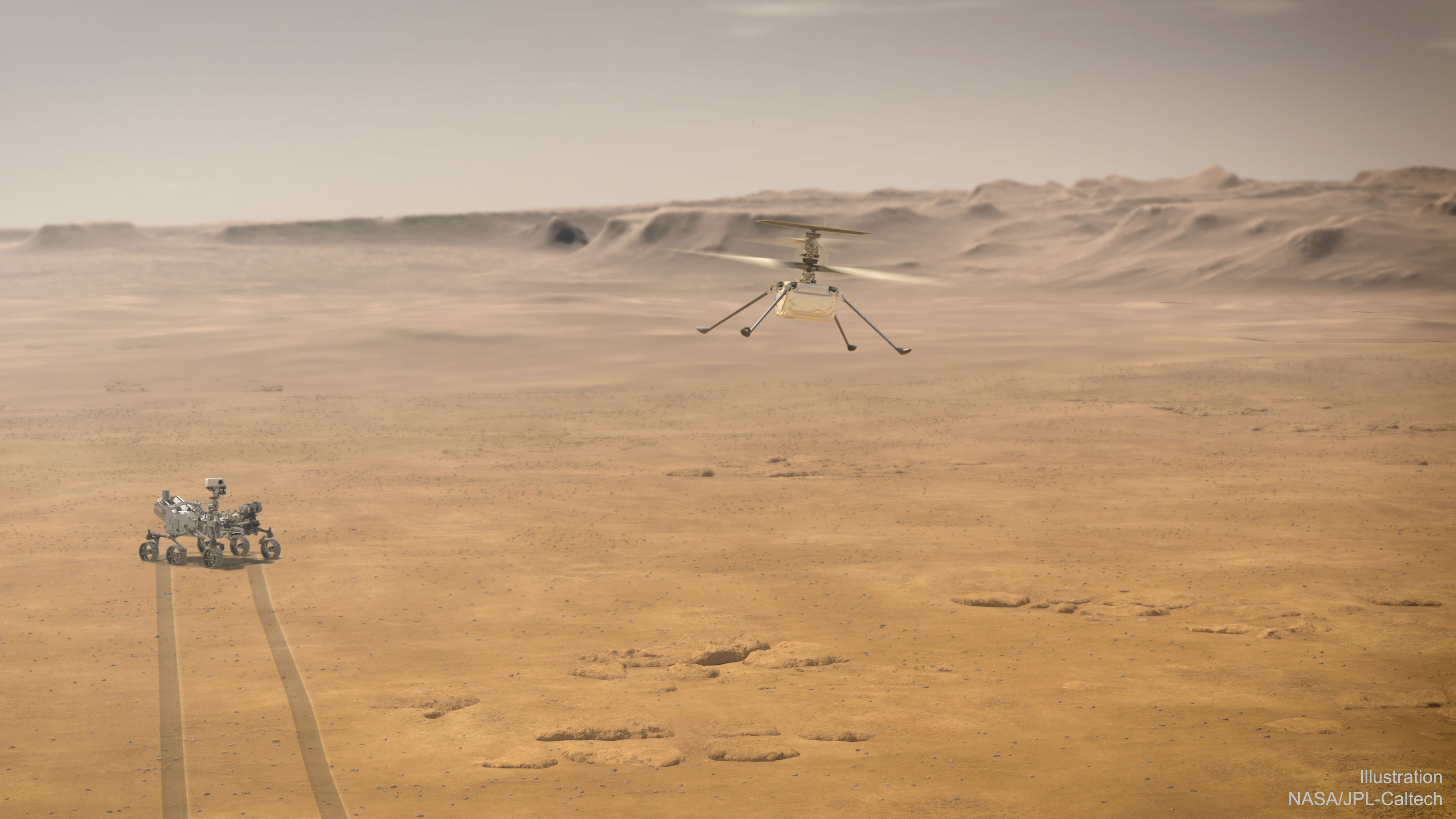
Ingenuity: A Mini-Helicopter Now on Mars
Illustration Credit: NASAJPL-CaltechMars 2020 - Perseverance

Explanation: What if you could fly around Mars? NASA may have achieved that capability last month with the landing of Perseverance, a rover which included a small flight-worthy companion called Ingenuity, nicknamed Ginny. Even though Ginny is small -- a toaster-sized helicopter with four long legs and two even-longer (1.2-meter) rotors, she is the first of her kind -- there has never been anything like her before. After being deployed, possibly in April, the car-sized Perseverance ("Percy") will back away to give Ginny ample room to attempt her unprecedented first flight. In the featured artistic illustration, Ginny's long rotors are depicted giving her the lift she needs to fly into the thin Martian atmosphere and explore the area near Perseverance. Although Ingenuity herself will not fly very far, she is a prototype for all future airborne Solar-System robots that may fly far across not only Mars, but Titan.

ASTRONOMY - M51: The Whirlpool Galaxy

 2026 January 14 M51: The Whirlpool Galaxy Image Credit & Copyright:  Michael Sleeman Explanation:  The Whirlpool Galaxy is a classic sp...