RTB
Nombre total de pages vues
26/02/2022
SANTé/MEDECINE - Quelques instants avant et après la mort
23/02/2022
ASTRONOMY - Aurora over White Dome Geyser
2022 February 23
Image Credit & Copyright: Robert Howell
Explanation: Sometimes both heaven and Earth erupt. Colorful auroras erupted unexpectedly a few years ago, with green aurora appearing near the horizon and brilliant bands of red aurora blooming high overhead. A bright Moon lit the foreground of this picturesque scene, while familiar stars could be seen far in the distance. With planning, the careful astrophotographer shot this image mosaic in the field of White Dome Geyser in Yellowstone National Park in the western USA. Sure enough, just after midnight, White Dome erupted -- spraying a stream of water and vapor many meters into the air. Geyser water is heated to steam by scalding magma several kilometers below, and rises through rock cracks to the surface. About half of all known geysers occur in Yellowstone National Park. Although the geomagnetic storm that caused the auroras subsided within a day, eruptions of White Dome Geyser continue about every 30 minutes.
22/02/2022
ASTRONOMY - Illustration: An Early Quasar
2022 February 22
Illustration Credit & License: ESO, M. Kornmesser
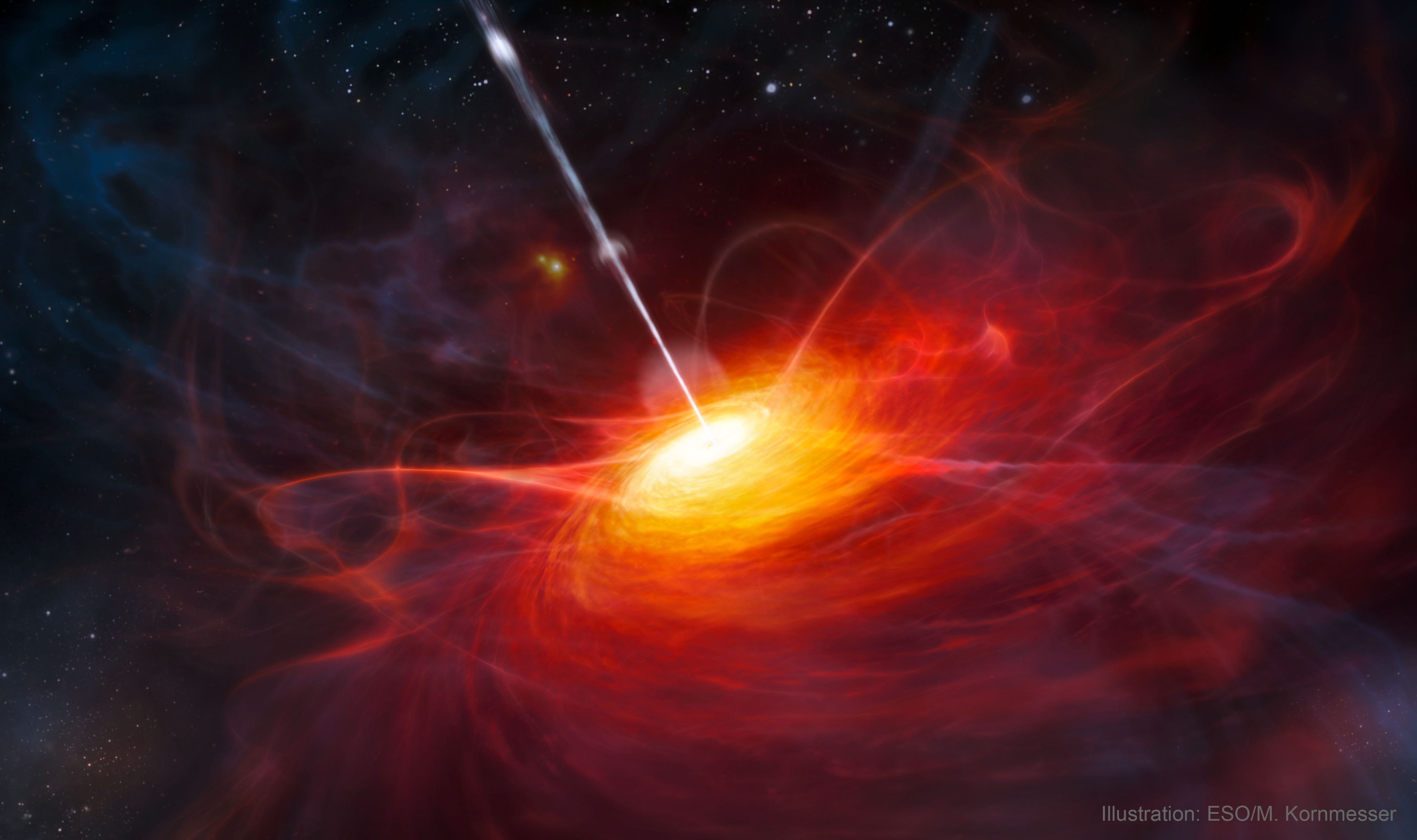
Explanation: What did the first quasars look like? The nearest quasars are now known to involve supermassive black holes in the centers of active galaxies. Gas and dust that falls toward a quasar glows brightly, sometimes outglowing the entire home galaxy. The quasars that formed in the first billion years of the universe are more mysterious, though. Featured, recent data has enabled an artist's impression of an early-universe quasar as it might have been: centered on a massive black hole, surrounded by sheets of gas and an accretion disk, and expelling a powerful jet. Quasars are among the most distant objects we see and give humanity unique information about the early and intervening universe. The oldest quasars currently known are seen at just short of redshift 8 -- only 700 million years after the Big Bang -- when the universe was only a few percent of its current age.
21/02/2022
ASTRONOMY - Barred Spiral Galaxy NGC 6217
2022 February 21
Image Credit: NASA, ESA, and the Hubble SM4 ERO Team
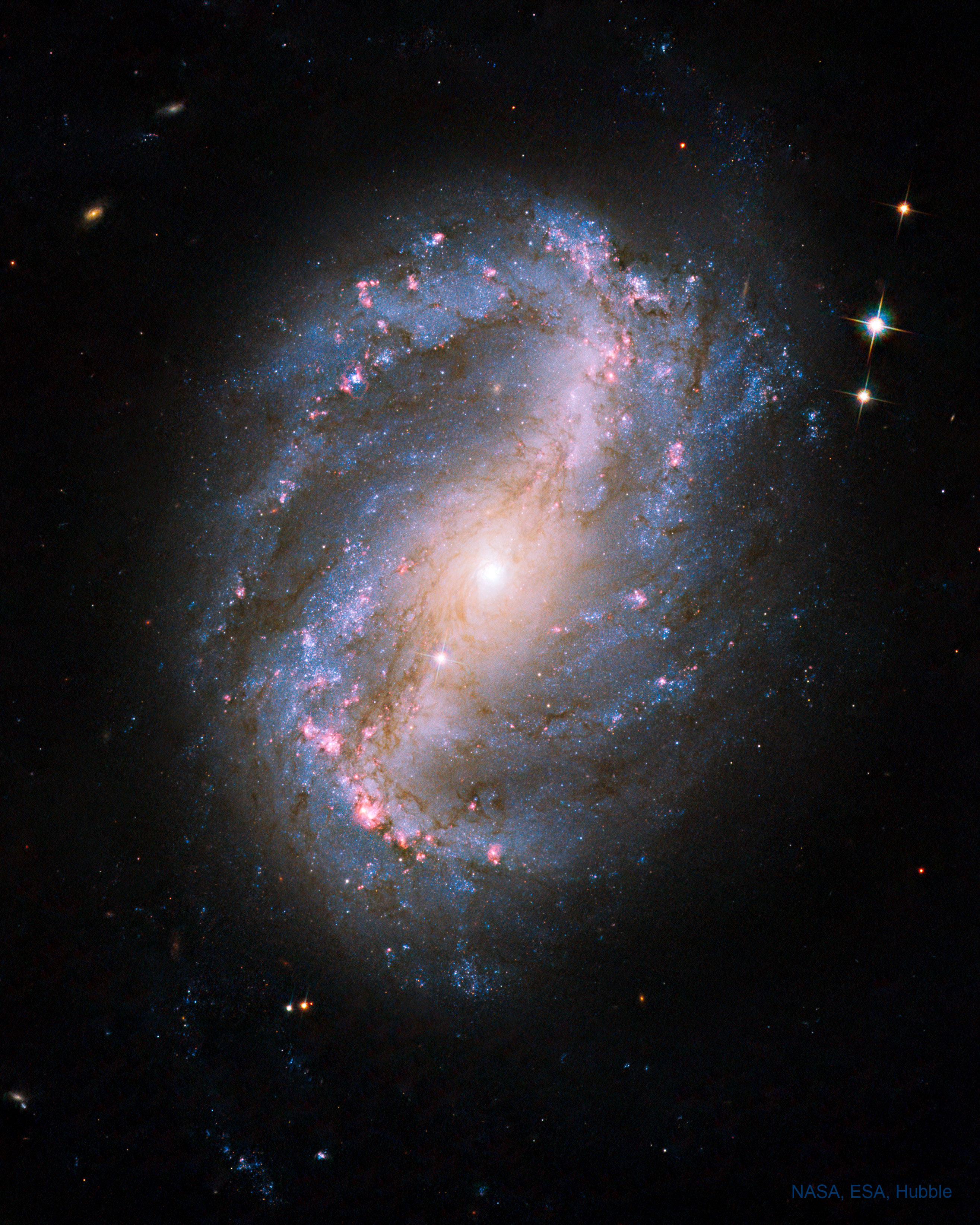
Explanation: Many spiral galaxies have bars across their centers. Even our own Milky Way Galaxy is thought to have a modest central bar. Prominently barred spiral galaxy NGC 6217, featured here, was captured in spectacular detail in this image taken by the Advanced Camera for Surveys on the orbiting Hubble Space Telescope in 2009. Visible are dark filamentary dust lanes, young clusters of bright blue stars, red emission nebulas of glowing hydrogen gas, a long bar of stars across the center, and a bright active nucleus that likely houses a supermassive black hole. Light takes about 60 million years to reach us from NGC 6217, which spans about 30,000 light years across and can be found toward the constellation of the Little Bear (Ursa Minor).
19/02/2022
ASTRONOMY - Peculiar Galaxies of Arp 273
2022 February 19
Image Credit & Copyright: Jason Guenzel
Explanation: The spiky stars in the foreground of this backyard telescopic frame are well within our own Milky Way Galaxy. But the two eye-catching galaxies lie far beyond the Milky Way, at a distance of over 300 million light-years. Their distorted appearance is due to gravitational tides as the pair engage in close encounters. Cataloged as Arp 273 (also as UGC 1810), the galaxies do look peculiar, but interacting galaxies are now understood to be common in the universe. Nearby, the large spiral Andromeda Galaxy is known to be some 2 million light-years away and approaching the Milky Way. The peculiar galaxies of Arp 273 may offer an analog of their far future encounter. Repeated galaxy encounters on a cosmic timescale can ultimately result in a merger into a single galaxy of stars. From our perspective, the bright cores of the Arp 273 galaxies are separated by only a little over 100,000 light-years.
18/02/2022
AERONAUTIQUE - AirFish 8
ASTRONOMY - Chamaeleon I Molecular Cloud
2022 February 18
Image Credit & Copyright: Acquisition: Stas Volskiy (Chilescope.com), Processing: Robert Eder
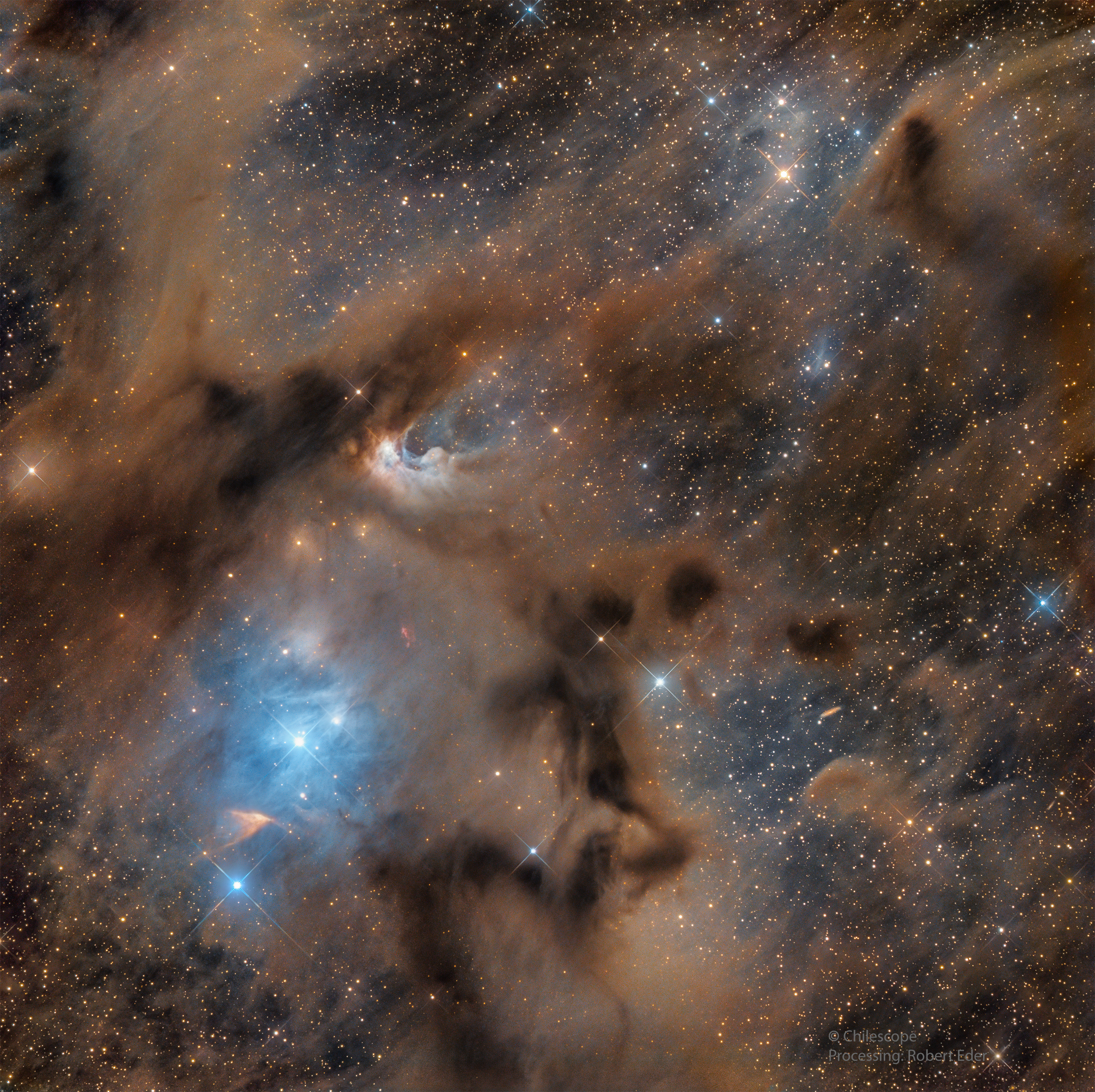
Explanation: Dark markings and bright nebulae in this telescopic southern sky view are telltale signs of young stars and active star formation. They lie a mere 650 light-years away, at the boundary of the local bubble and the Chamaeleon molecular cloud complex. Regions with young stars identified as dusty reflection nebulae from the 1946 Cederblad catalog include the C-shaped Ced 110 just above and left of center, and bluish Ced 111 below it. Also a standout in the frame, the orange tinted V-shape of the Chamaeleon Infrared Nebula (Cha IRN) was carved by material streaming from a newly formed low-mass star. The well-composed image spans 1.5 degrees. That's about 17 light-years at the estimated distance of the nearby Chamaeleon I molecular cloud.
16/02/2022
POURQUOI - SANTé/MéDECINE - Pourquoi a-t-on soif quand on mange un aliment salé ?
Le sel est essentiel à la vie, mais l'organisme n'en a besoin que d'une petite quantité. Quand le corps reçoit trop de sel, que la concentration de sel devient trop élevée dans son sang, il doit faire en sorte de s'en débarrasser. Le corps élimine le surplus de sel dans l'urine, via les reins.Mais en éliminant le sel, ils éliminent aussi de l'eau, parce que le sel entraîne naturellement l'eau avec lui. Il y a alors un déséquilibre dans le sang. Le sang manque d'eau. Quand la quantité d'eau diminue dans le sang, le sang en informe le cerveau.
La vie et la mort - Y-A-T-IL UNE VIE APRèS LA MORT ? (3/5)
Sept jours de coma… et une expérience consciente Durant sept jours, le neurochirurgien reste plongé dans un état végétatif. Les examens neur...
-
2026 January 1 Auroral Corona Image Credit & Copyright : Roi Levi Explanation: Cycle 25 solar maximum made 2025 a great year for ...
-
Imaginez un monde où le cancer n’est plus une sentence, mais une simple étape à franchir. Grâce à une découverte révolutionnaire, ce rêve es...