Nombre total de pages vues
26/08/2022
MERVEILLEUX MONDE SOUS-MARIN - La gorgone rouge et le gorgonocéphale
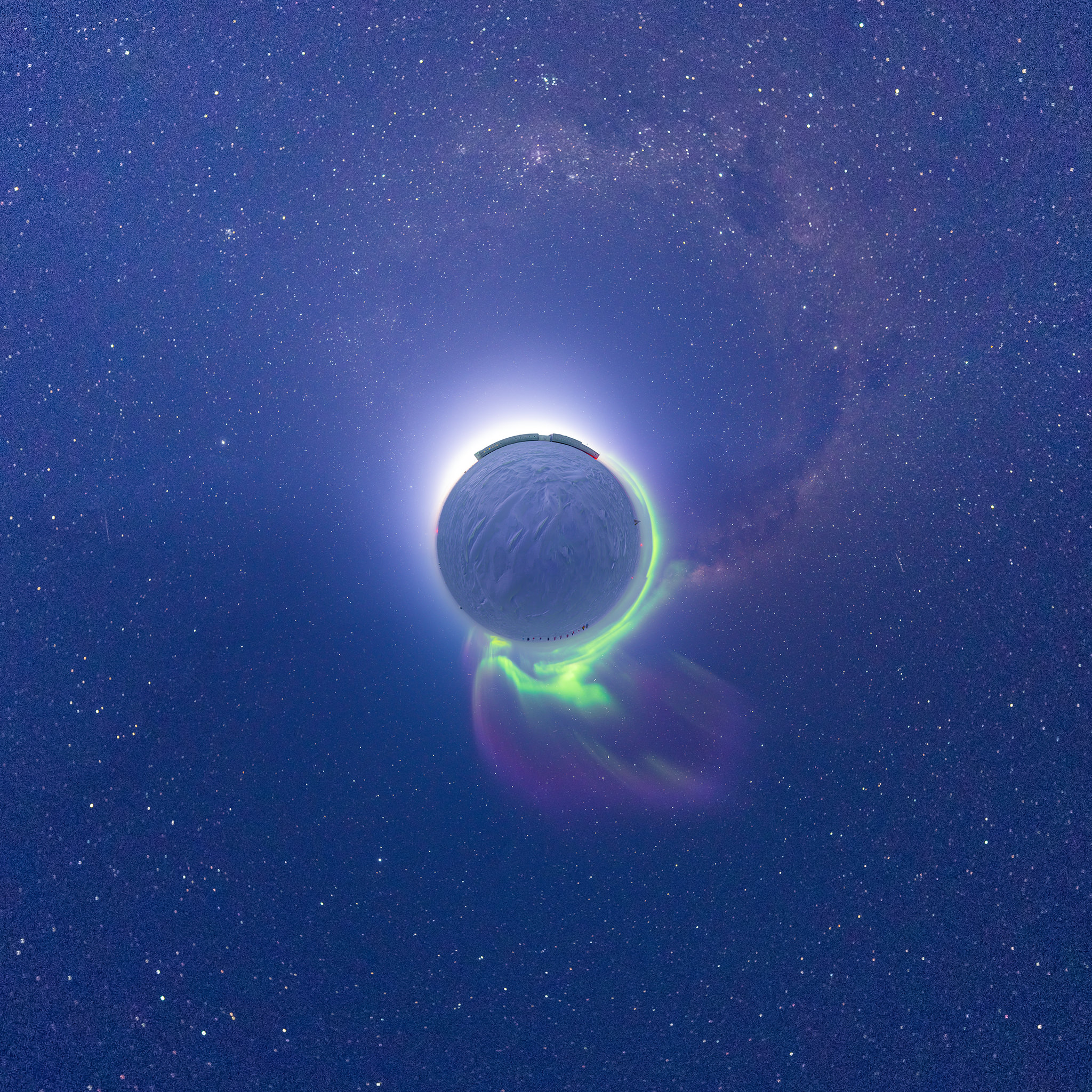
ASTRONOMY - Little Planet South Pole
2022 August 26
Image Credit & Copyright: Aman Chokshi
Explanation: Lights play around the horizon of this snowy little planet as it drifts through a starry night sky. Of course the little planet is actually planet Earth. Recorded on August 21, the digitally warped, nadir centered panorama covers nearly 360x180 degrees outside the Amundsen-Scott South Pole Station, Antarctica. The southernmost research outpost is near the horizon at the top where the light of dawn is approaching after nearly six months of darkness. Along the bottom is the ceremonial pole marker surrounded by the 12 flags of the original signatories of the Antarctic treaty, with a wild display of the aurora australis above.
25/08/2022
ASTRONOMY - Tiangong Space Station Transits the Moon
2022 August 25
Image Credit & Copyright: Lucy Yunxi Hu
Explanation: The rugged lunar south polar region lies at the top of this colorful portrait of a last quarter Moon made on August 20. Constructed from video frames and still images taken at Springrange, New South Wales, Australia it also captures a transit of China's Tiangong Space Station. The transit itself was fleeting, taking the space station less than a second to cross the shadowed and sunlit lunar disk. The low Earth orbiting Tiangong is at an altitude of about 400 kilometers, while the Moon is some 400,000 kilometers away. Subtle color differences along the bright lunar surface are revealed in the multiple stacked frames. Not visible to the eye, they indicate real differences in chemical makeup across the lunar surface.
24/08/2022
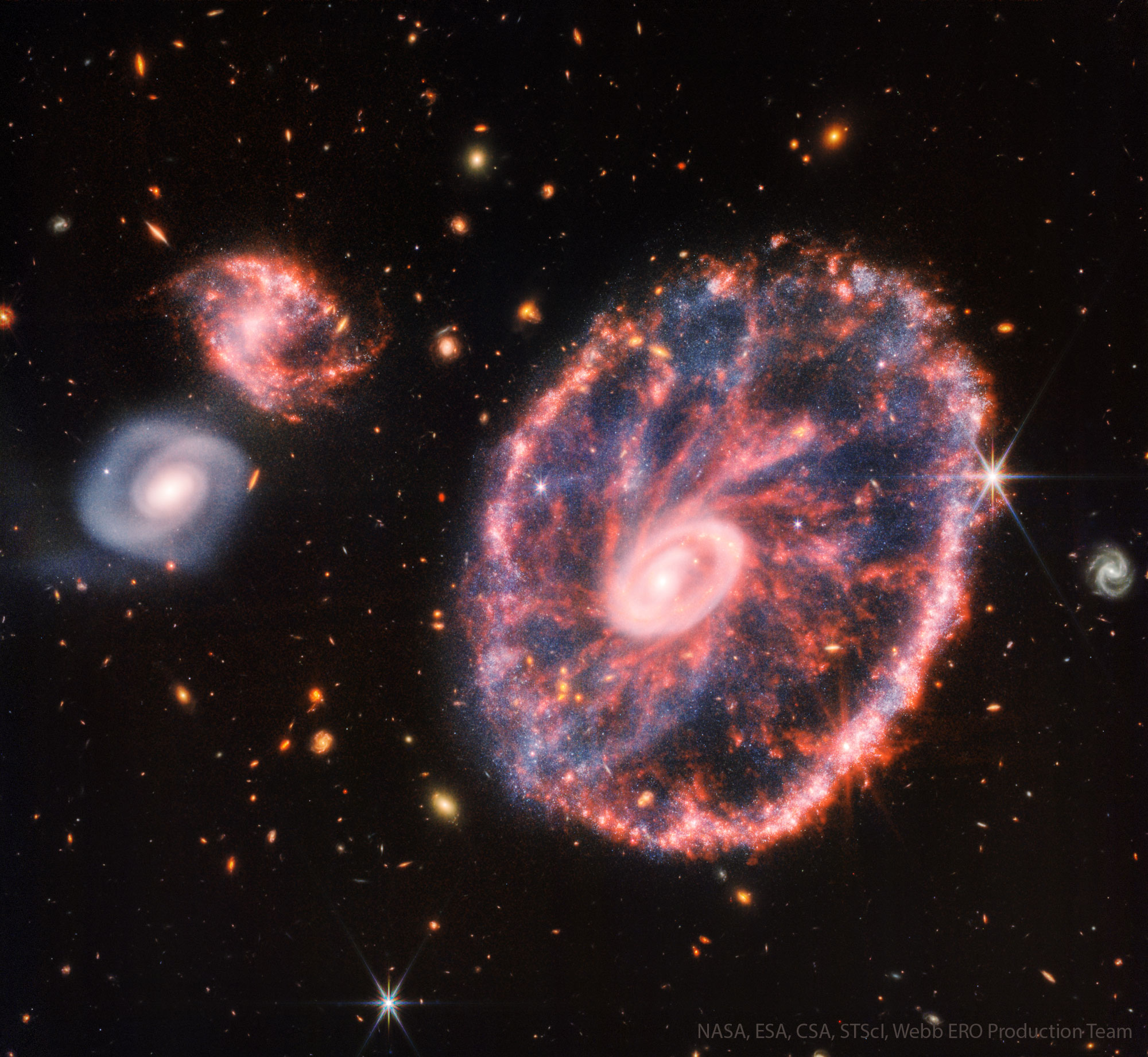
ASTRONOMY - The Cartwheel Galaxy from Webb
2022 August 24
Image Credit: NASA, ESA, CSA, STScI, Webb ERO Production Team
Explanation: To some, it looks like a wheel of a cart. In fact, because of its outward appearance, the presence of a central galaxy, and its connection with what looks like the spokes of a wheel, the galaxy on the right is known as the Cartwheel Galaxy. To others, however, it looks like a complicated interaction between galaxies awaiting explanation. Along with the two galaxies on the left, the Cartwheel is part of a group of galaxies about 500 million light years away in the constellation Sculptor. The large galaxy's rim spans over 100,000 light years and is composed of star forming regions filled with extremely bright and massive stars. The Cartwheel's ring-like shape is the result of gravitational disruption caused by a smaller galaxy passing through a large one, compressing the interstellar gas and dust and causing a star formation wave to move out like a ripple across the surface of a pond. The featured recent image of the Cartwheel Galaxy by the Webb Space Telescope reveals new details not only about where stars are forming, but also about activity near the galaxy's central black hole.
23/08/2022
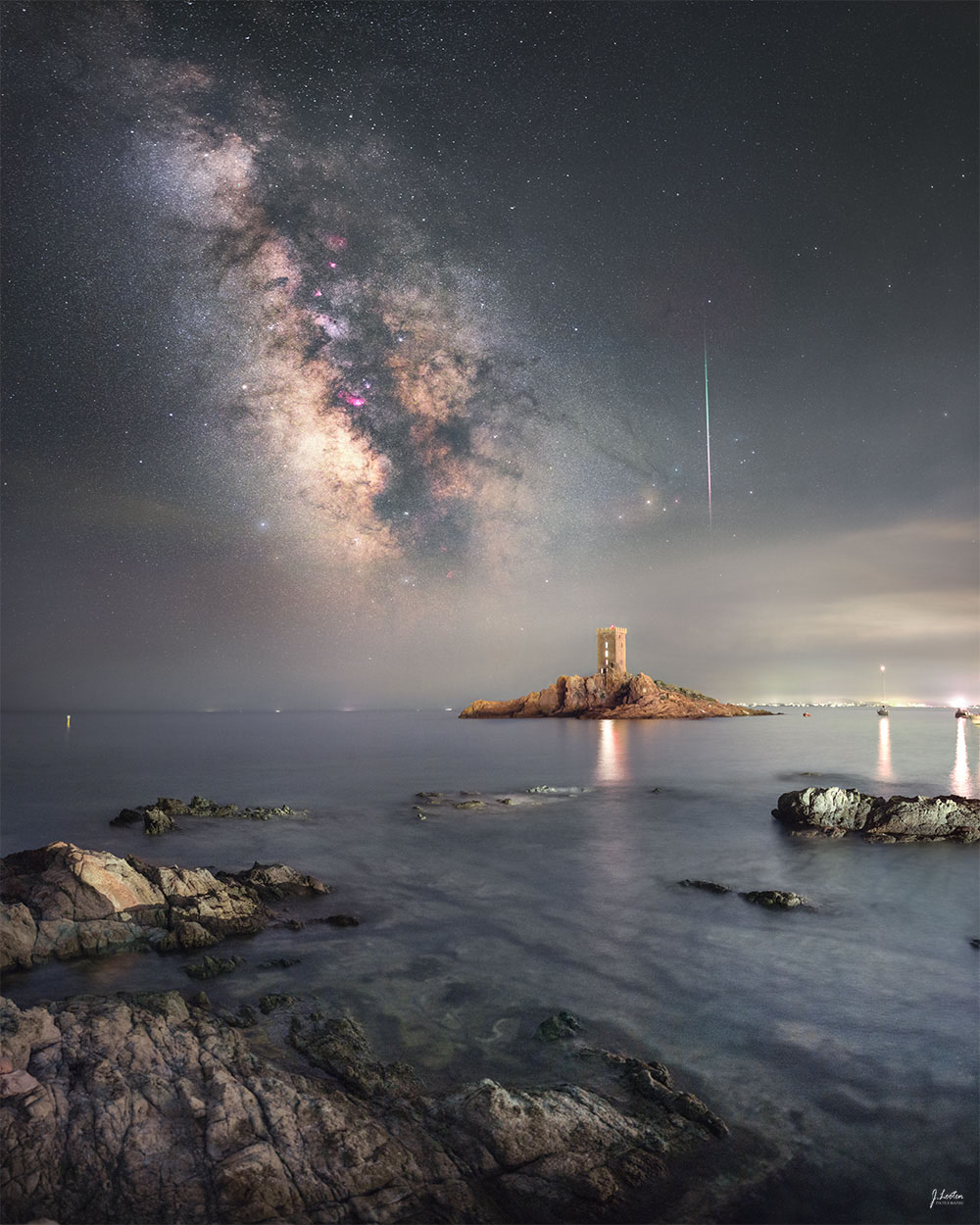
ASTRONOMY - Meteor & Milky Way over the Mediterranean
2022 August 23
Image Credit & Copyright: Julien Looten
Explanation: Careful planning made this a nightscape to remember. First, the night itself was chosen to occur during the beginning of this year's Perseid Meteor Shower. Next, the time of night was chosen to be before the bright Moon would rise and dominate the night sky's brightness. The picturesque foreground was selected to be a rocky beach of the Mediterranean Sea in Le Dramont, France, with, at the time, île d’Or island situated near the ominously descending central band of our Milky Way Galaxy. Once everything was set and with the weather cooperating, all of the frames for this seemingly surreal nightscape were acquired within 15 minutes. What you can't see is that, on this night, the astrophotographer brought along his father who, although unskilled in modern sky-capture techniques, once made it a point to teach his child about the sky.
22/08/2022
MERVEILLEUX MONDE SOUS-MARIN - Poissons-clowns de Clark dans leur anémone
ASTRONOMY - Earth's Recent Climate Spiral
2022 August 22
Video Credit: NASA's Scientific Visualization Studio
Explanation: Is our Earth warming? Compared to the past 250 million years, the Earth is currently enduring a relative cold spell, possibly about four degrees Celsius below average. Over the past 120 years, though, data indicate that the average global temperature of the Earth has increased by nearly one degree Celsius. The featured visualization video depicts Earth's recent global warming in graphic terms. The depicted temperatures are taken from the Goddard Institute for Space Studies' Surface Temperature Analysis. Already noticeable by many, Earth's recent warming trend is causing sea levels to rise, precipitation patterns to change, and pole ice to melt. Few now disagree that recent global warming is occurring, and the Intergovernmental Panel on Climate Change (IPCC) has concluded that we humans have created a warming surge that is likely to continue. A continuation could impact many local agricultures and even the global economy. Although there seems to be no simple solutions, geoengineering projects that might help include artificial cloud creation to reduce the amount of sunlight heating the Earth's surface.
21/08/2022
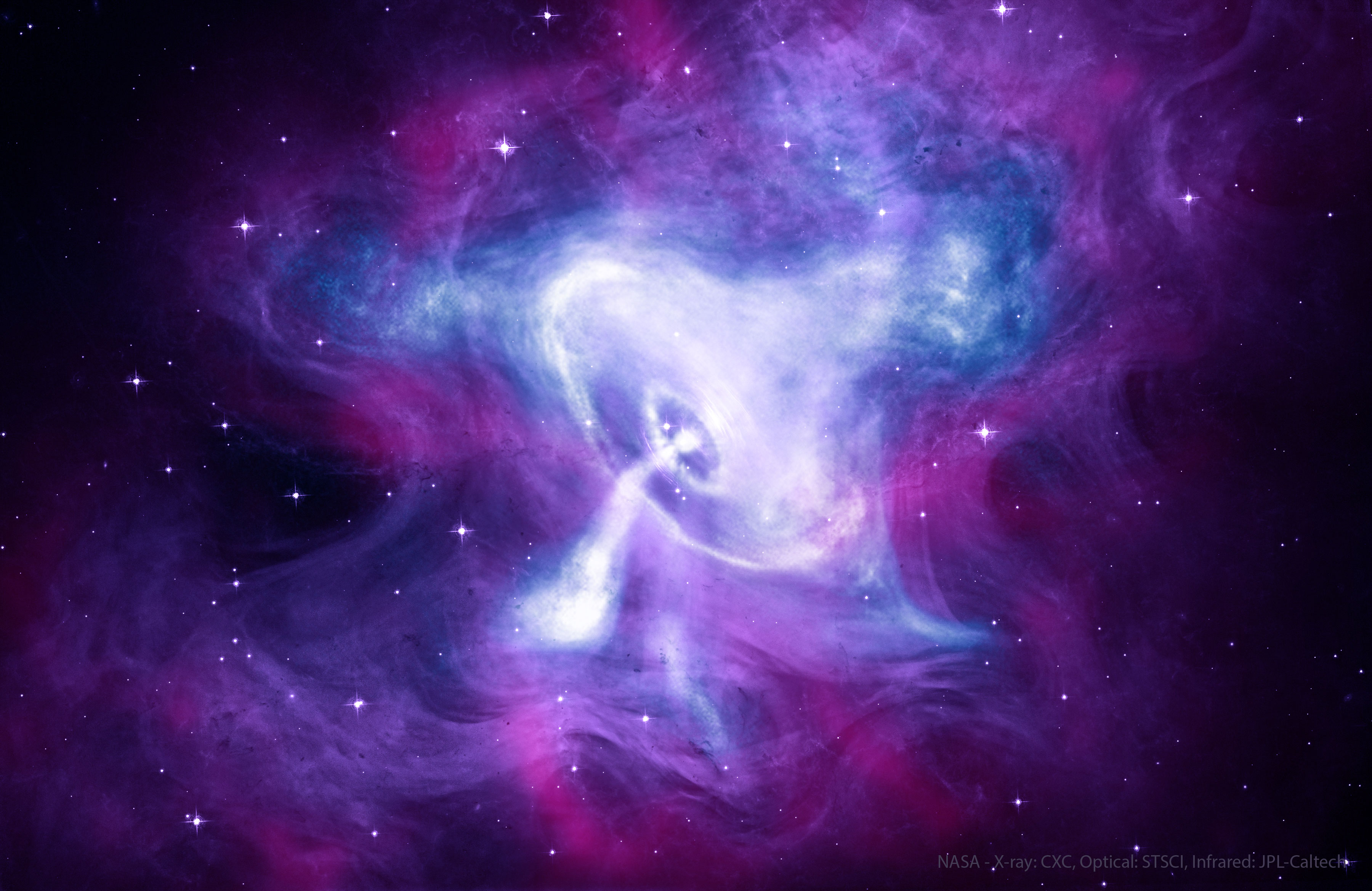
ASTRONOMY - The Spinning Pulsar of the Crab Nebula
2022 August 21
Image Credit: NASA: X-ray: Chandra (CXC), Optical: Hubble (STScI), Infrared: Spitzer (JPL-Caltech)
Explanation: At the core of the Crab Nebula lies a city-sized, magnetized neutron star spinning 30 times a second. Known as the Crab Pulsar, it is the bright spot in the center of the gaseous swirl at the nebula's core. About twelve light-years across, the spectacular picture frames the glowing gas, cavities and swirling filaments near the Crab Nebula's center. The featured picture combines visible light from the Hubble Space Telescope in purple, X-ray light from the Chandra X-ray Observatory in blue, and infrared light from the Spitzer Space Telescope in red. Like a cosmic dynamo the Crab pulsar powers the emission from the nebula, driving a shock wave through surrounding material and accelerating the spiraling electrons. With more mass than the Sun and the density of an atomic nucleus,the spinning pulsar is the collapsed core of a massive star that exploded. The outer parts of the Crab Nebula are the expanding remnants of the star's component gasses. The supernova explosion was witnessed on planet Earth in the year 1054.
20/08/2022
MACROPHOTOGRAPHIE - Le pissenlit jamais imaginé
La vie et la mort - Y-A-T-IL UNE VIE APRèS LA MORT ? (3/5)
Sept jours de coma… et une expérience consciente Durant sept jours, le neurochirurgien reste plongé dans un état végétatif. Les examens neur...
-
2026 January 1 Auroral Corona Image Credit & Copyright : Roi Levi Explanation: Cycle 25 solar maximum made 2025 a great year for ...
-
Imaginez un monde où le cancer n’est plus une sentence, mais une simple étape à franchir. Grâce à une découverte révolutionnaire, ce rêve es...