Nombre total de pages vues
22/12/2022
BIOMIMETISME - LA SCIENCE S'INSPIRE DE LA NATURE - De la peau de requin sur des avions
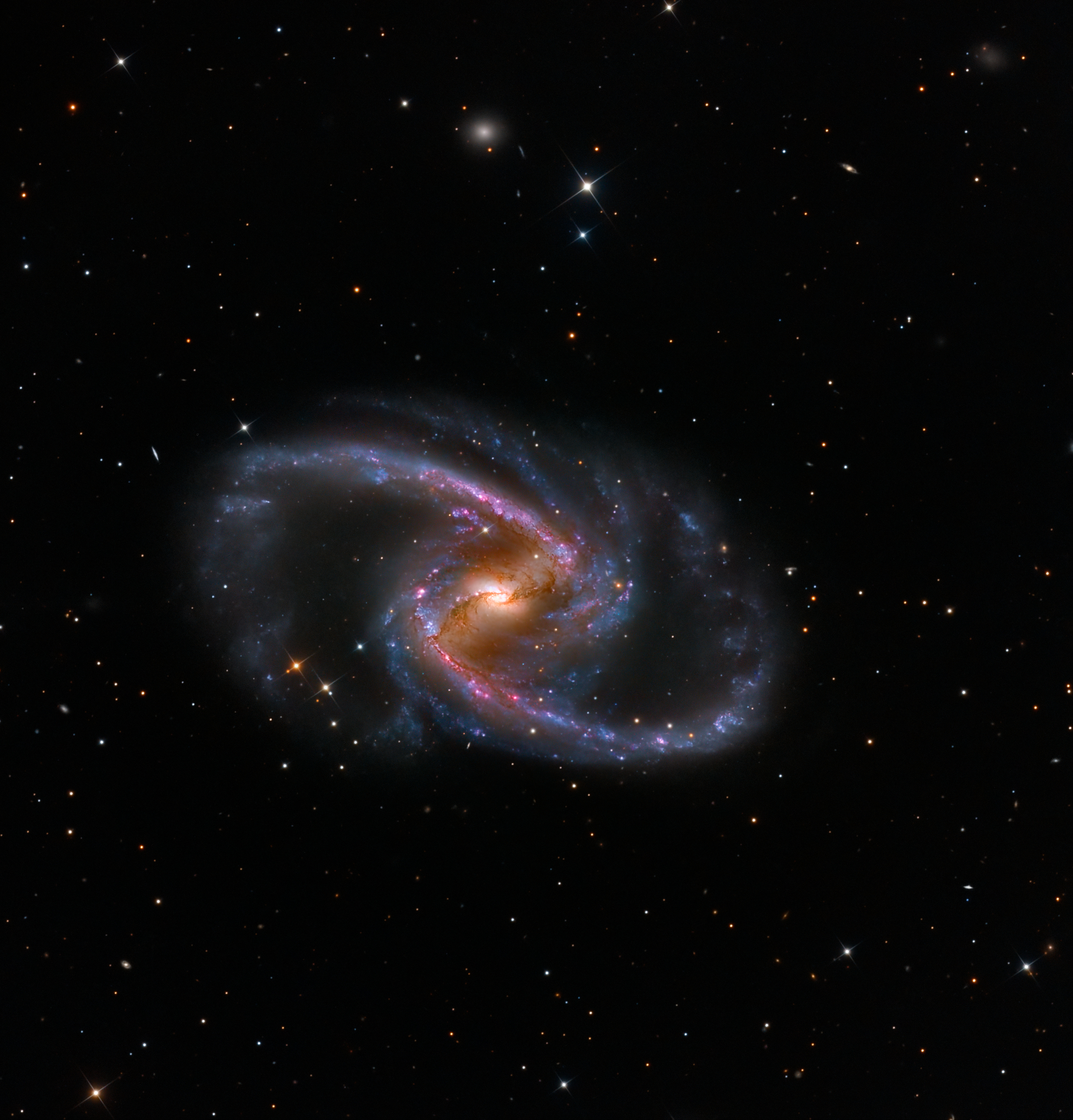
ASTRONOMY - NGC 1365: Majestic Island Universe
2022 December 22
Image Credit & Copyright: Martin Pugh
Explanation: Barred spiral galaxy NGC 1365 is truly a majestic island universe some 200,000 light-years across. Located a mere 60 million light-years away toward the faint but heated constellation Fornax, NGC 1365 is a dominant member of the well-studied Fornax Cluster of galaxies. This impressively sharp color image shows the intense, reddish star forming regions near the ends of central bar and along the spiral arms, with details of the obscuring dust lanes cutting across the galaxy's bright core. At the core lies a supermassive black hole. Astronomers think NGC 1365's prominent bar plays a crucial role in the galaxy's evolution, drawing gas and dust into a star-forming maelstrom and ultimately feeding material into the central black hole.
21/12/2022
MERVEILLES SOUS-MARINES - Héracléion, Egypte

Crédit photo: Ancient Explorers
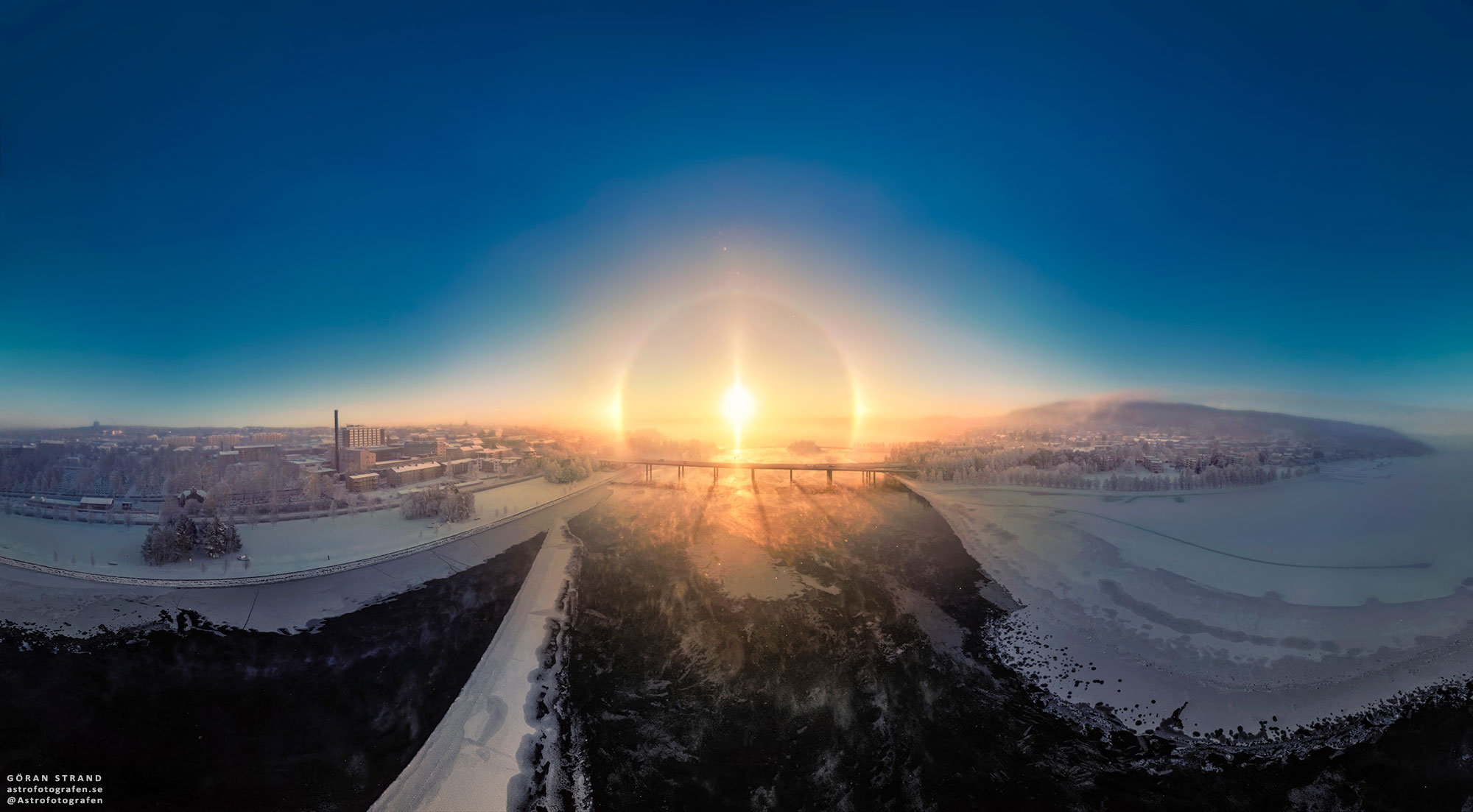
ASTRONOMY - Sun Halo at Sixty-three Degrees North
2022 December 21
Image Credit & Copyright: Goran Strand
Explanation: Happy Solstice! Today is the December solstice, marking an astronomical beginning of summer in the southern hemisphere and winter in the north. On its yearly trek through planet Earth's skies, at this solstice the Sun reaches its southern most declination, 23.5 degrees south, at 21:48 UTC. About 4 days ago the Sun was near this seasonal southern limit and so only just above the horizon at local noon over Ostersund in central Sweden. This view looking over the far northern lakeside city finds the midday Sun with a beautiful solar ice halo. Naturally occurring atmospheric ice crystals can produce the tantalizing halo displays, refracting and reflecting the sunlight through their hexagonal geometry. Still, with the Sun low and near the horizon in the clear sky, likely sources of the ice crystals producing this intense halo are snow cannons. Operating at a local ski area, the snowmaking machines create a visible plume at the top of the nearby island Froson toward the right side of the panorama.
20/12/2022
MERVEILLES SOUS-MARINES - Grande barrière de corail, Australie

Crédit photo: Flickr – Toby Hudson
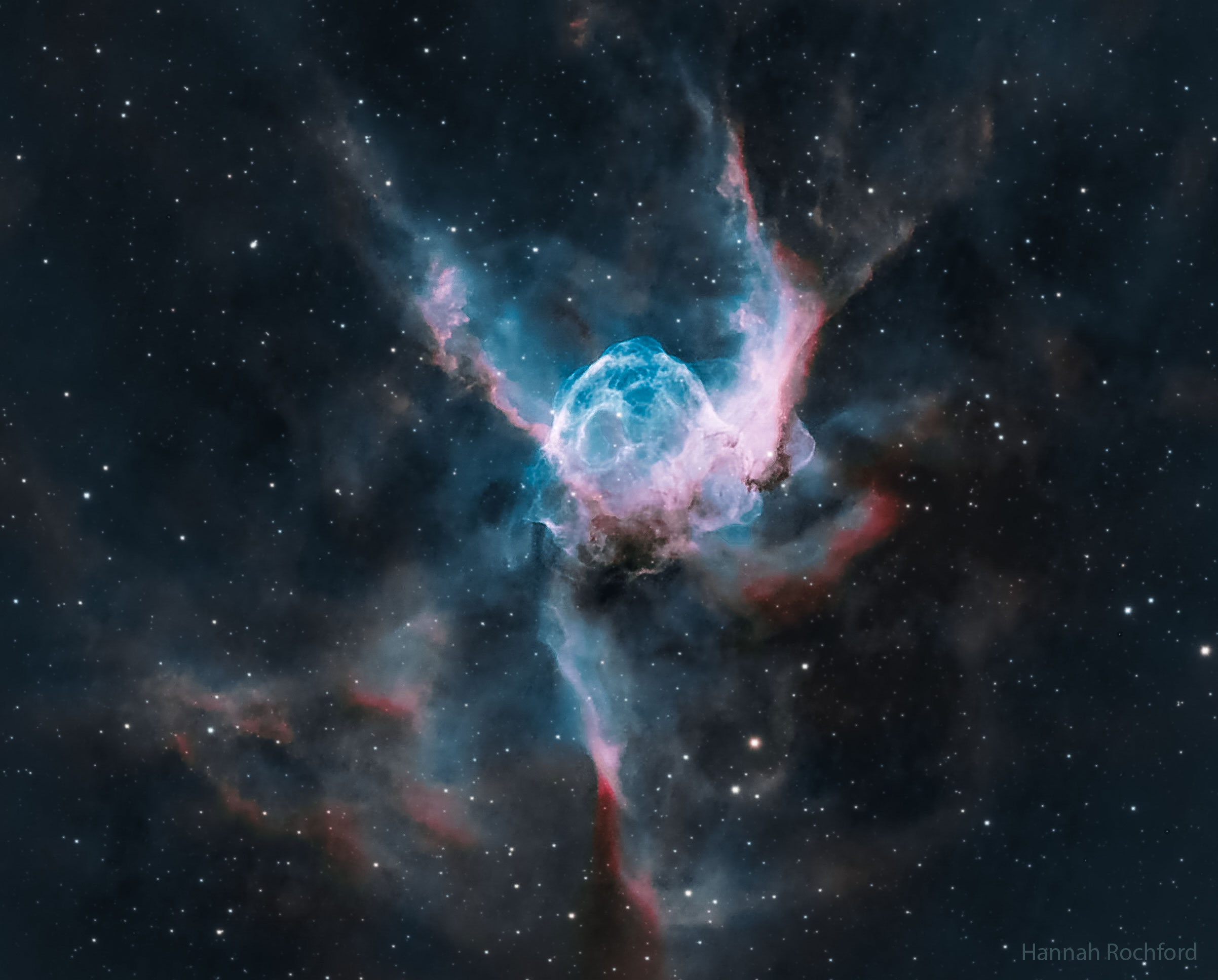
ASTRONOMY - Thor's Helmet
2022 December 20
Image Credit & Copyright: Hannah Rochford
Explanation: Thor not only has his own day (Thursday), but a helmet in the heavens. Popularly called Thor's Helmet, NGC 2359 is a hat-shaped cosmic cloud with wing-like appendages. Heroically sized even for a Norse god, Thor's Helmet is about 30 light-years across. In fact, the cosmic head-covering is more like an interstellar bubble, blown with a fast wind from the bright, massive star near the bubble's center. Known as a Wolf-Rayet star, the central star is an extremely hot giant thought to be in a brief, pre-supernova stage of evolution. NGC 2359 is located about 15,000 light-years away toward the constellation of the Great Overdog. This remarkably sharp image is a mixed cocktail of data from narrowband filters, capturing not only natural looking stars but details of the nebula's filamentary structures. The star in the center of Thor's Helmet is expected to explode in a spectacular supernova sometime within the next few thousand years.
19/12/2022
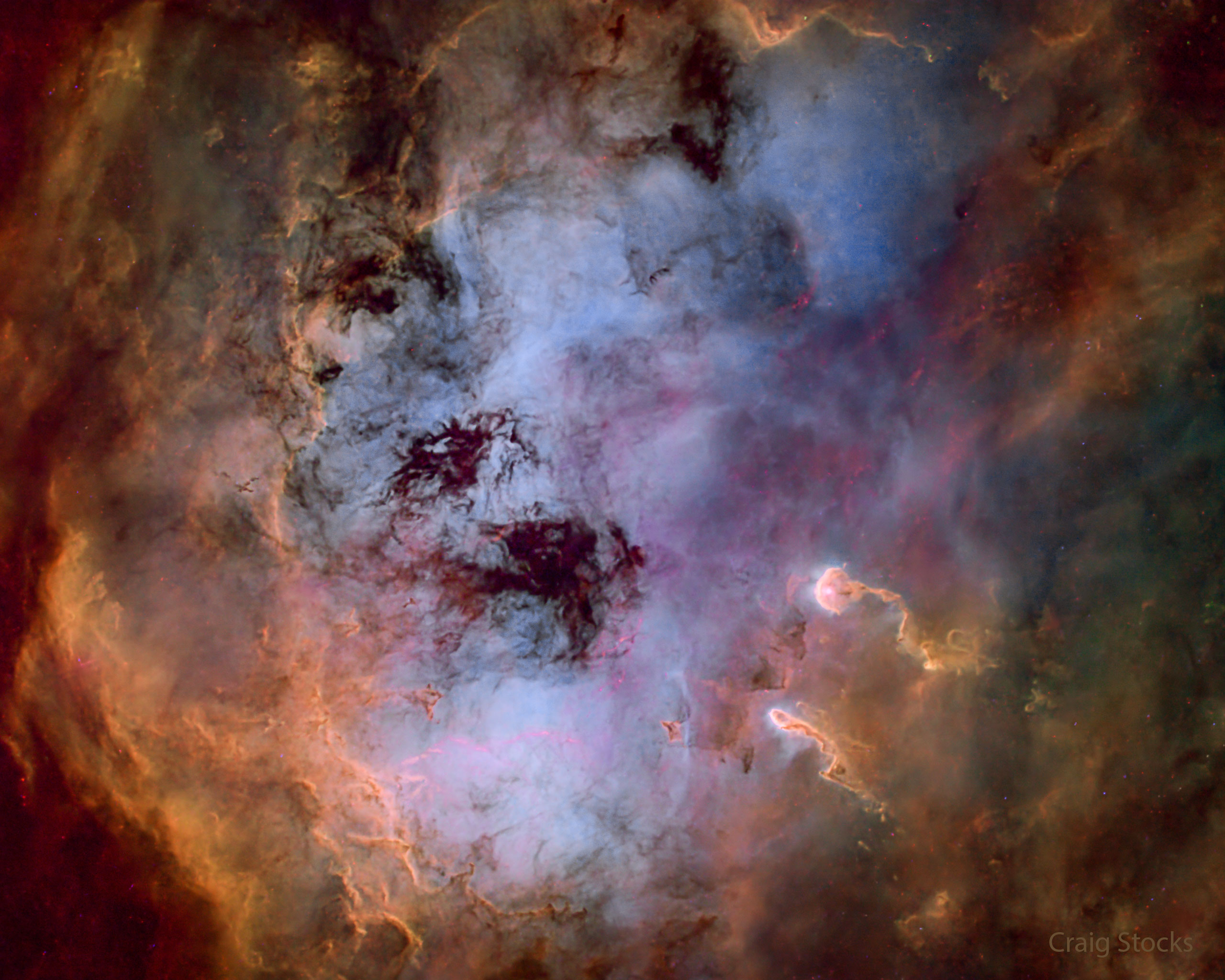
ASTRONOMY - The Tadpole Nebula in Gas and Dust
2022 December 19
Image Credit & Copyright: Craig Stocks (Utah Desert Remote Observatories)
Explanation: What's causing the commotion in the Tadpole Nebula? Star formation. Dusty emission in the Tadpole Nebula, IC 410, lies about 12,000 light-years away in the northern constellation of the Charioteer (Auriga). The cloud of glowing gas is over 100 light-years across, sculpted by stellar winds and radiation from embedded open star cluster NGC 1893. Formed in the interstellar cloud a mere 4 million years ago, bright newly formed cluster stars are seen all around the star-forming nebula. Notable on the lower-right of the featured image are two relatively dense streamers of material trailing away from the nebula's central regions. Potentially sites of ongoing star formation in IC 410, these cosmic tadpole shapes are about 10 light-years long. The image was processed highlighting the emission from sulfur (red), hydrogen (green), and oxygen (blue) gas -- but with the stars digitally removed.
18/12/2022
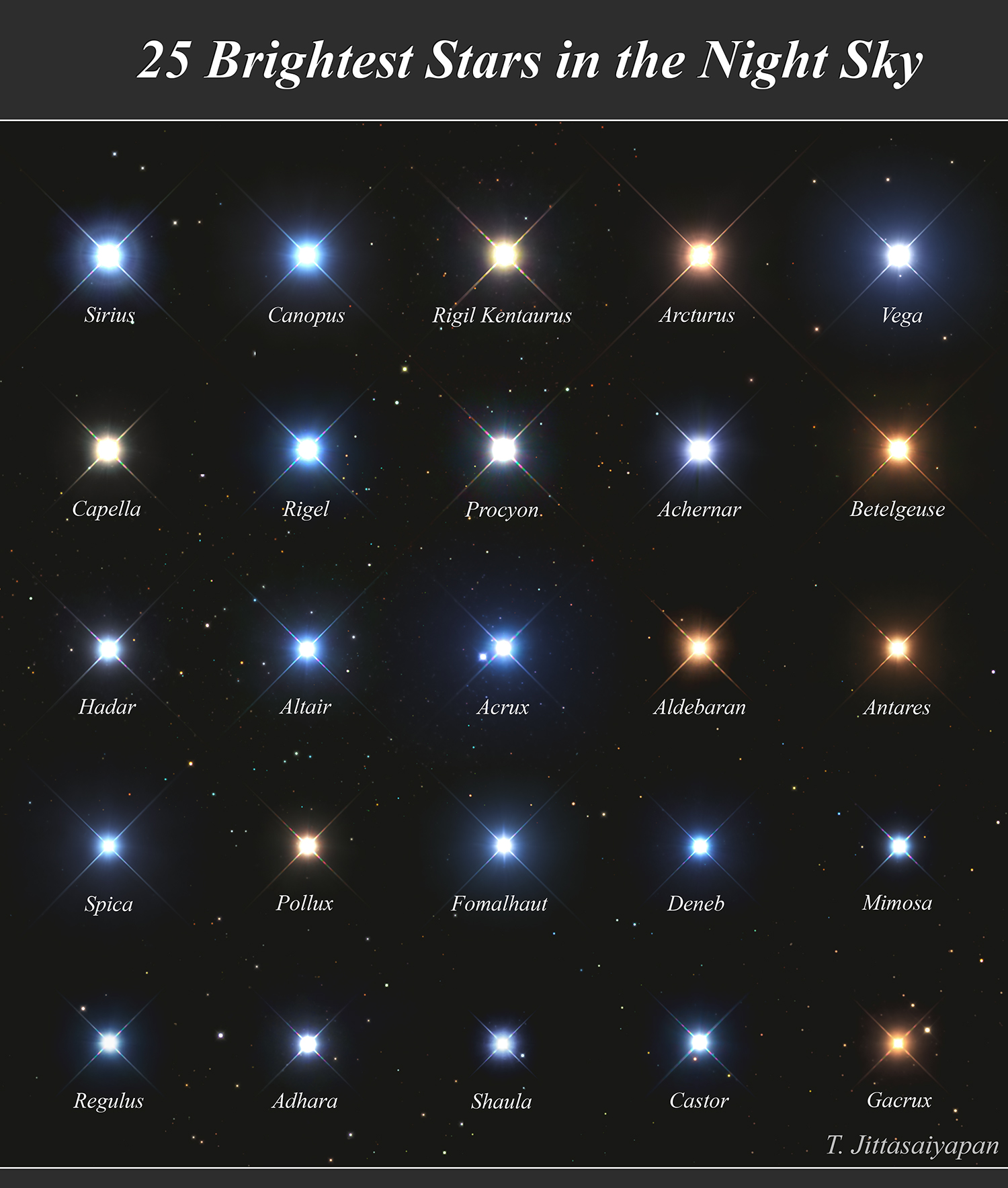
ASTRONOMY - 25 Brightest Stars in the Night Sky
2022 December 18
Image Credit & Copyright: Tragoolchitr Jittasaiyapan
Explanation: Do you know the names of some of the brightest stars? It's likely that you do, even though some bright stars have names so old they date back to near the beginning of written language. Many world cultures have their own names for the brightest stars, and it is culturally and historically important to remember them. In the interest of clear global communication, however, the International Astronomical Union (IAU) has begun to designate standardized star names. Featured here in true color are the 25 brightest stars in the night sky, currently as seen by humans, coupled with their IAU-recognized names. Some star names have interesting meanings, including Sirius ("the scorcher" in Latin), Vega ("falling" in Arabic), and Antares ("rival to Mars" in Greek). You are likely even familiar with the name of at least one star too dim to make this list: Polaris.
17/12/2022
MERVEILLES SOUS-MARINES - Mont hydrothermal (Equateur)

Crédit photo: Wikimedia – NOAA
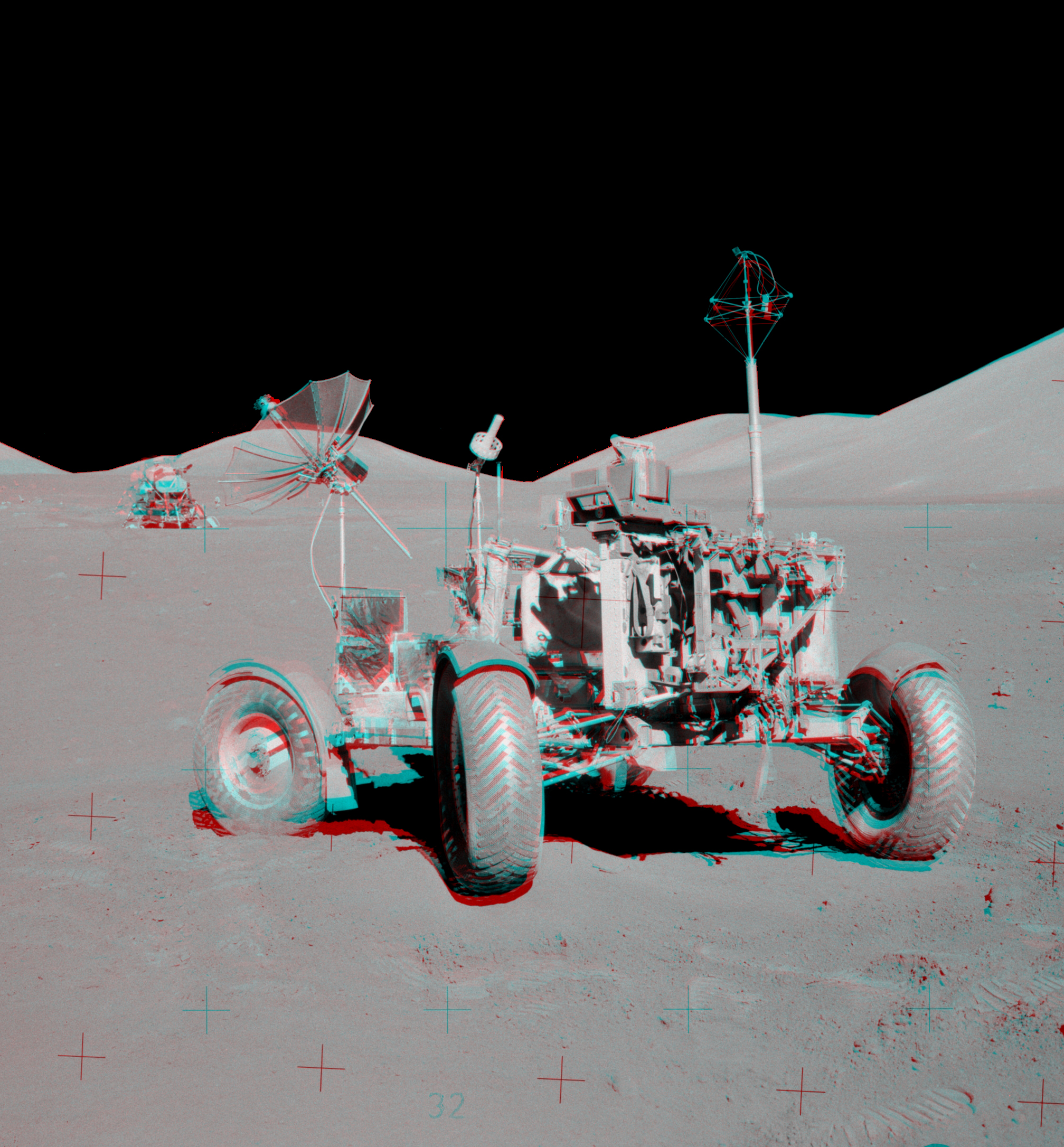
ASTRONOMY - Apollo 17 VIP Site Anaglyph
2022 December 17
Image Credit: Gene Cernan, Apollo 17, NASA; Anaglyph by Erik van Meijgaarden
Explanation: Get out your red/blue glasses and check out this stereo scene from Taurus-Littrow valley on the Moon! The color anaglyph features a detailed 3D view of Apollo 17's Lunar Rover in the foreground -- behind it lies the Lunar Module and distant lunar hills. Because the world was going to be able to watch the Lunar Module's ascent stage liftoff via the rover's TV camera, this parking place was also known as the VIP Site. Fifty years ago, in December of 1972, Apollo 17 astronauts Eugene Cernan and Harrison Schmitt spent about 75 hours on the Moon, while colleague Ronald Evans orbited overhead. The crew returned with 110 kilograms of rock and soil samples, more than from any of the other lunar landing sites. Cernan and Schmitt are still the last to walk (or drive) on the Moon.
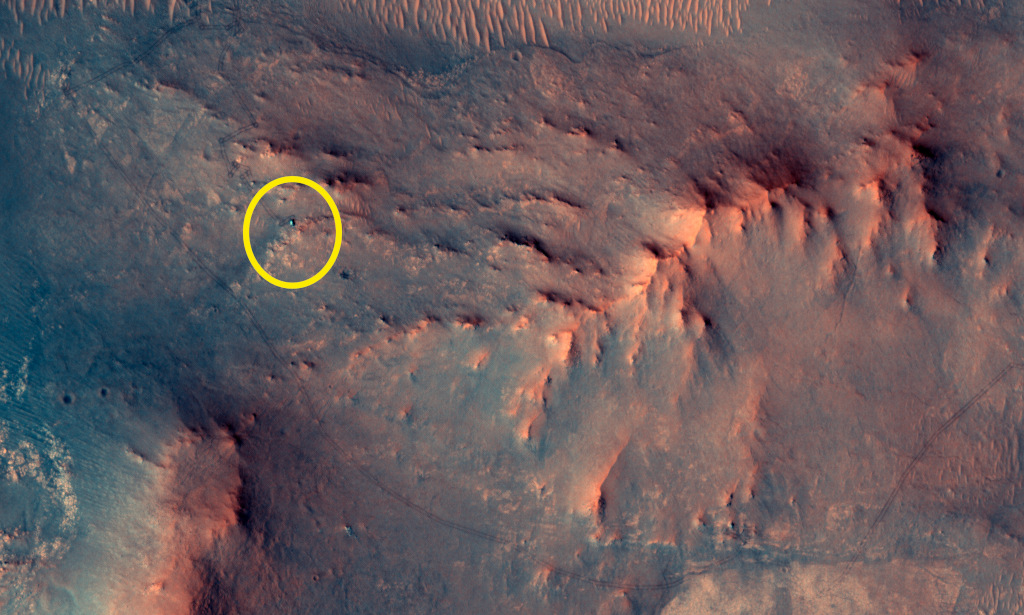
Astronomy - MARS MARATHON BY PERSEVERANCE
2026 June 27 Mars Marathon by Perseverance Image Credit: NASA , LPL (U. Arizona) , MRO , HiRISE Explanation: In this recent HiRISE view fro...
-
Imaginez un monde où le cancer n’est plus une sentence, mais une simple étape à franchir. Grâce à une découverte révolutionnaire, ce rêve es...
-
2026 January 1 Auroral Corona Image Credit & Copyright : Roi Levi Explanation: Cycle 25 solar maximum made 2025 a great year for ...