Crédit photo: ILTWMT
Nombre total de pages vues
16/01/2023
MERVEILLEUX MONDE SOUS-MARIN - Lagon de Truk, îles de Chuuk, Micronésie
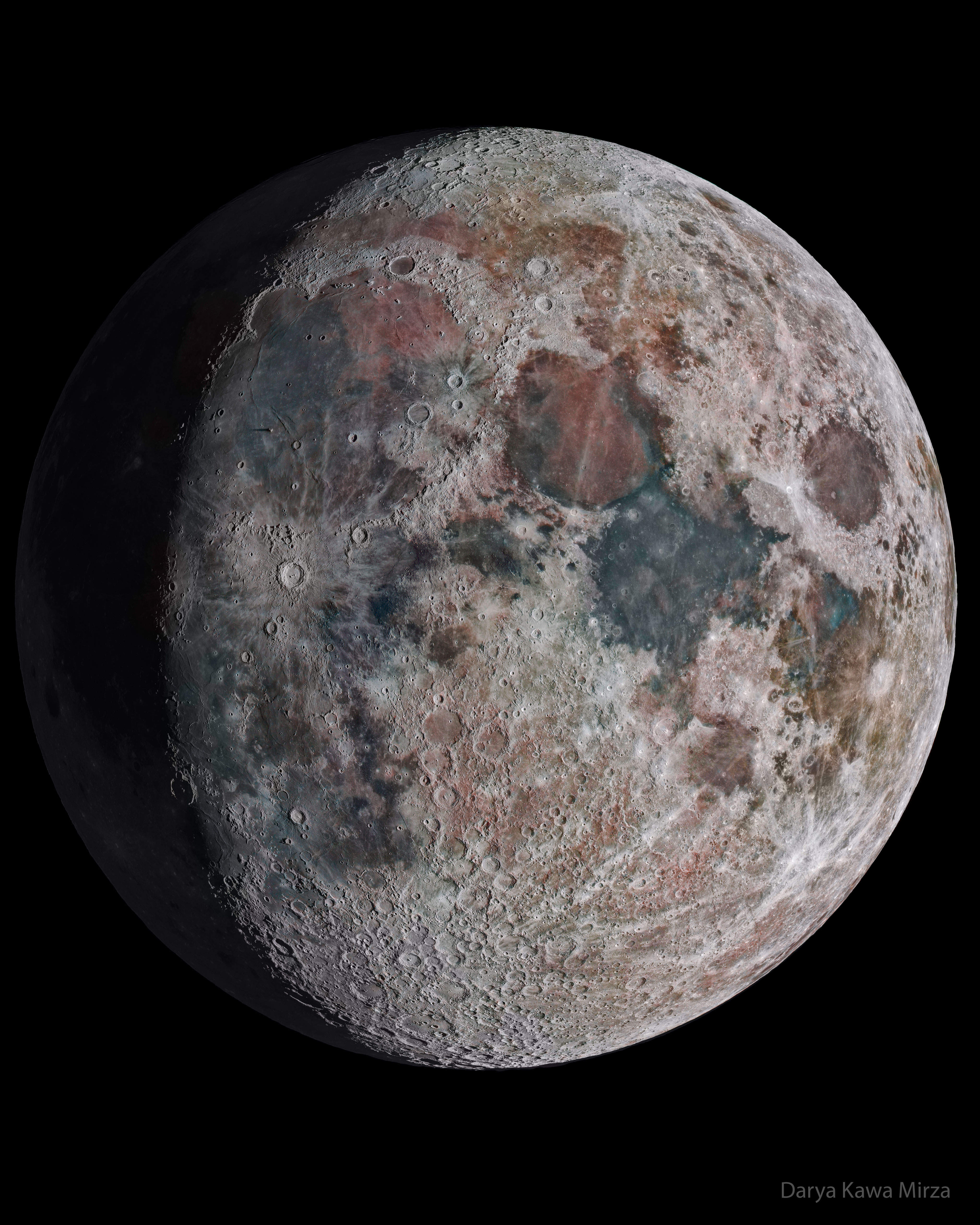
ASTRONOMY - Moon Enhanced
2023 January 16
Image Credit & Copyright: Darya Kawa Mirza
Explanation: Our Moon doesn't really look like this. Earth's Moon, Luna, doesn't naturally show this rich texture, and its colors are more subtle. But this digital creation is based on reality. The featured image is a composite of multiple images and enhanced to bring up real surface features. The enhancements, for example, show more clearly craters that illustrate the tremendous bombardment our Moon has been through during its 4.6-billion-year history. The dark areas, called maria, have fewer craters and were once seas of molten lava. Additionally, the image colors, although based on the moon's real composition, are changed and exaggerated. Here, a blue hue indicates a region that is iron rich, while orange indicates a slight excess of aluminum. Although the Moon has shown the same side to the Earth for billions of years, modern technology is allowing humanity to learn much more about it -- and how it affects the Earth.
15/01/2023
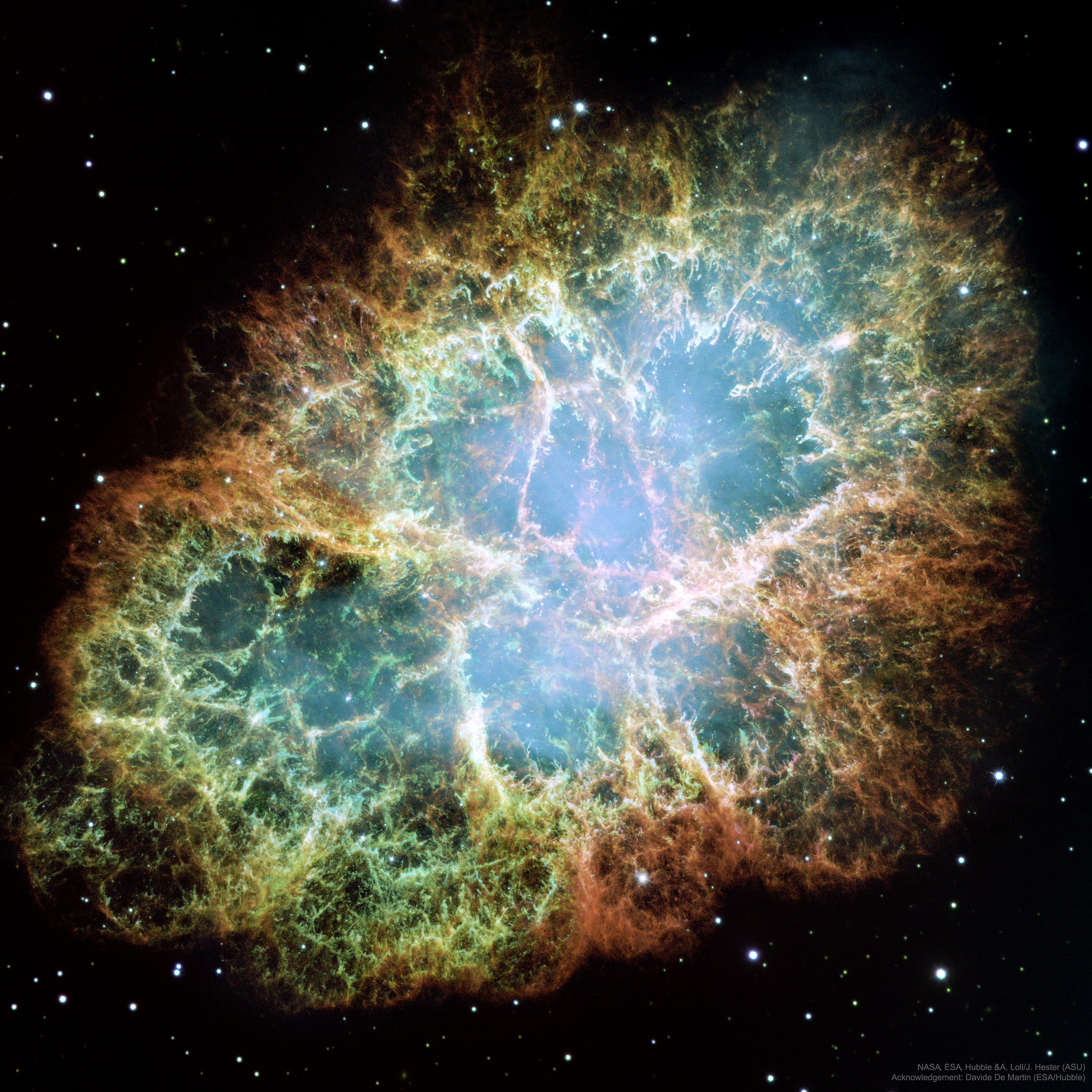
ASTRONOMY - M1: The Crab Nebula from Hubble
2023 January 15
Image Credit: NASA, ESA, Hubble, J. Hester, A. Loll (ASU)
Explanation: This is the mess that is left when a star explodes. The Crab Nebula, the result of a supernova seen in 1054 AD, is filled with mysterious filaments. The filaments are not only tremendously complex, but appear to have less mass than expelled in the original supernova and a higher speed than expected from a free explosion. The featured image, taken by the Hubble Space Telescope, is presented in three colors chosen for scientific interest. The Crab Nebula spans about 10 light-years. In the nebula's very center lies a pulsar: a neutron star as massive as the Sun but with only the size of a small town. The Crab Pulsar rotates about 30 times each second.
14/01/2023
MERVEILLEUX MONDE SOUS-MARIN - Trou bleu de Dean - Bahamas

Crédit photo: YouTube – Guillaume Néry
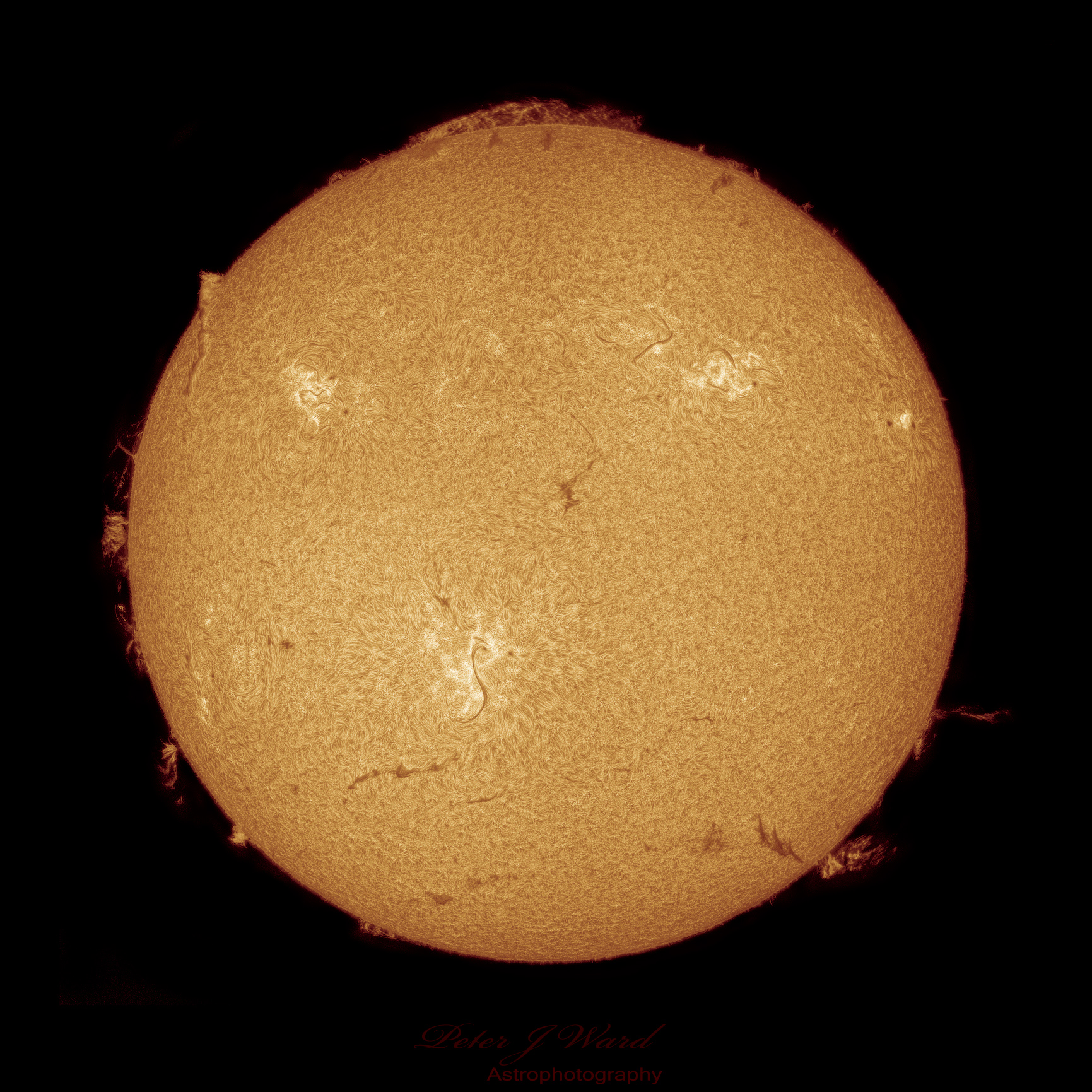
ASTRONOMY - Perihelion Sun 2023
2023 January 14
Image Credit & Copyright: Peter Ward (Barden Ridge Observatory)
Explanation: Perihelion for 2023, Earth's closest approach to the Sun, was on January 4 at 16:17 UTC. That was less than 24 hours after this sharp image of the Sun's disk was recorded with telescope and H-alpha filter from Sidney, Australia, planet Earth. An H-alpha filter transmits a characteristic red light from hydrogen atoms. In views of the Sun it emphasizes the Sun's chromosphere, a region just above the solar photosphere or normally visible solar surface. In this H-alpha image of the increasingly active Sun planet-sized sunspot regions are dominated by bright splotches called plages. Dark filaments of plasma snaking across the solar disk transition to bright prominences when seen above the solar limb.
13/01/2023
ASTRONOMY - Young Star Cluster NGC 346
2023 January 13
Image Credit: Science - NASA, ESA, CSA, Olivia C. Jones (UK ATC), Guido De Marchi (ESTEC), Margaret Meixner (USRA)
Processing - Alyssa Pagan (STScI), Nolan Habel (USRA), Laura Lenkić (USRA), Laurie E. U. Chu (NASA Ames)
Explanation: The most massive young star cluster in the Small Magellanic Cloud is NGC 346, embedded in our small satellite galaxy's largest star forming region some 210,000 light-years distant. Of course the massive stars of NGC 346 are short lived, but very energetic. Their winds and radiation sculpt the edges of the region's dusty molecular cloud triggering star-formation within. The star forming region also appears to contain a large population of infant stars. A mere 3 to 5 million years old and not yet burning hydrogen in their cores, the infant stars are strewn about the embedded star cluster. This spectacular infrared view of NGC 346 is from the James Webb Space Telescope's NIRcam. Emission from atomic hydrogen ionized by the massive stars' energetic radiation as well as and molecular hydrogen and dust in the star-forming molecular cloud is detailed in pink and orange hues. Webb's sharp image of the young star-forming region spans 240 light-years at the distance of the Small Magellanic Cloud.
12/01/2023
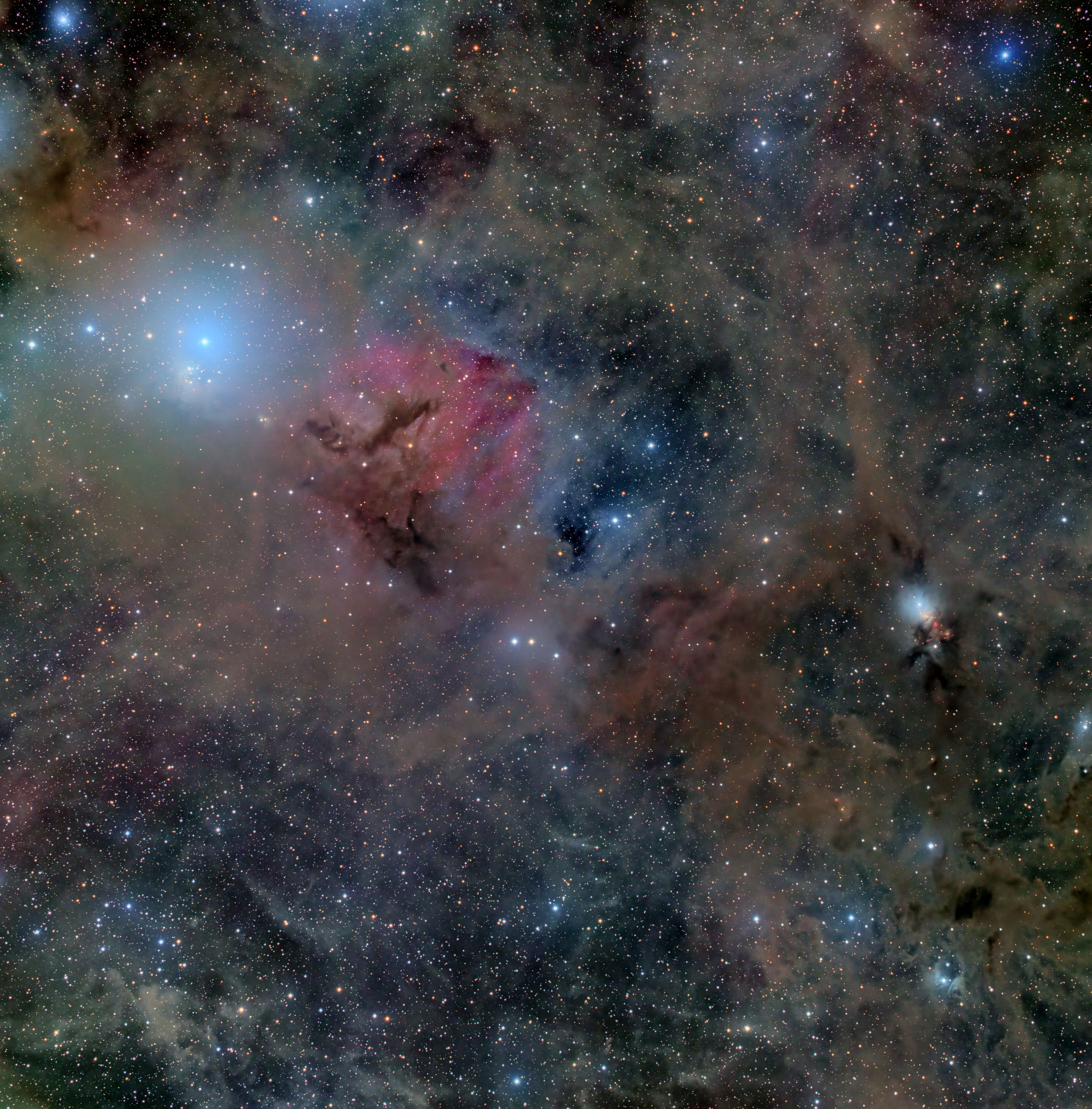
ASTRONOMY - Stardust in Perseus
Image Credit & Copyright: Jack Groves
Explanation: This cosmic expanse of dust, gas, and stars covers some 6 degrees on the sky in the heroic constellation Perseus. At upper left in the gorgeous skyscape is the intriguing young star cluster IC 348 and neighboring Flying Ghost Nebula with clouds of obscuring interstellar dust cataloged as Barnard 3 and 4. At right, another active star forming region NGC 1333 is connected by dark and dusty tendrils on the outskirts of the giant Perseus Molecular Cloud, about 850 light-years away. Other dusty nebulae are scattered around the field of view, along with the faint reddish glow of hydrogen gas. In fact, the cosmic dust tends to hide the newly formed stars and young stellar objects or protostars from prying optical telescopes. Collapsing due to self-gravity, the protostars form from the dense cores embedded in the molecular cloud. At the molecular cloud's estimated distance, this field of view would span over 90 light-years.
11/01/2023
ASTRONOMY - Spiral Aurora over Iceland
2023 January 11
Image Credit & Copyright: Stefano Pellegrini
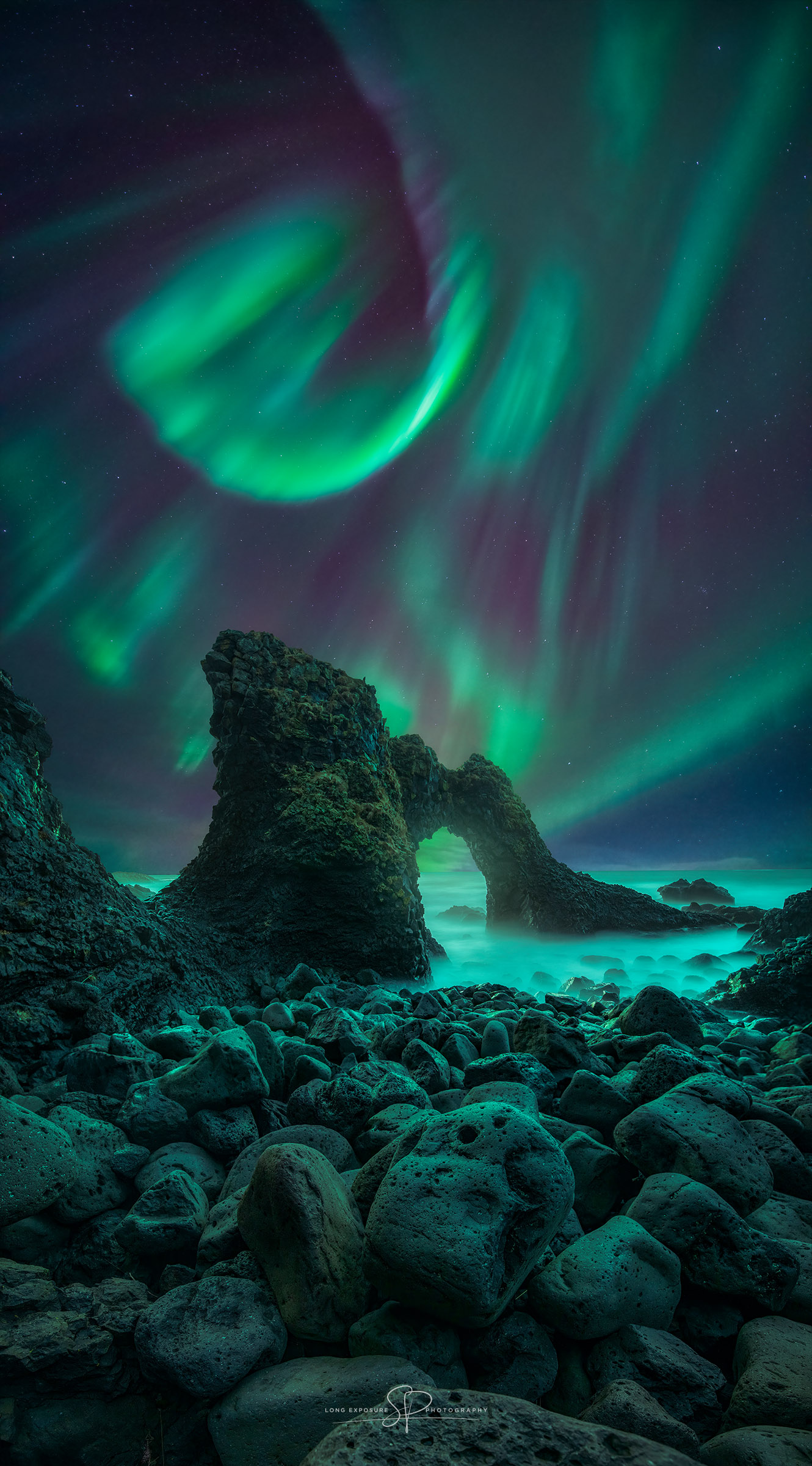
Explanation: The scene may look like a fantasy, but it's really Iceland. The rock arch is named Gatklettur and located on the island's northwest coast. Some of the larger rocks in the foreground span a meter across. The fog over the rocks is really moving waves averaged over long exposures. The featured image is a composite of several foreground and background shots taken with the same camera and from the same location on the same night last November. The location was picked for its picturesque foreground, but the timing was planned for its colorful background: aurora. The spiral aurora, far behind the arch, was one of the brightest seen in the astrophotographer's life. The coiled pattern was fleeting, though, as auroral patterns waved and danced for hours during the cold night. Far in the background were the unchanging stars, with Earth's rotation causing them to appear to slowly circle the sky's northernmost point near Polaris.
08/01/2023
ASTRONOMY - Comet Leonard Closeup from Australia
2022 January 12
Image Credit & Copyright: Blake Estes (itelescope.net)
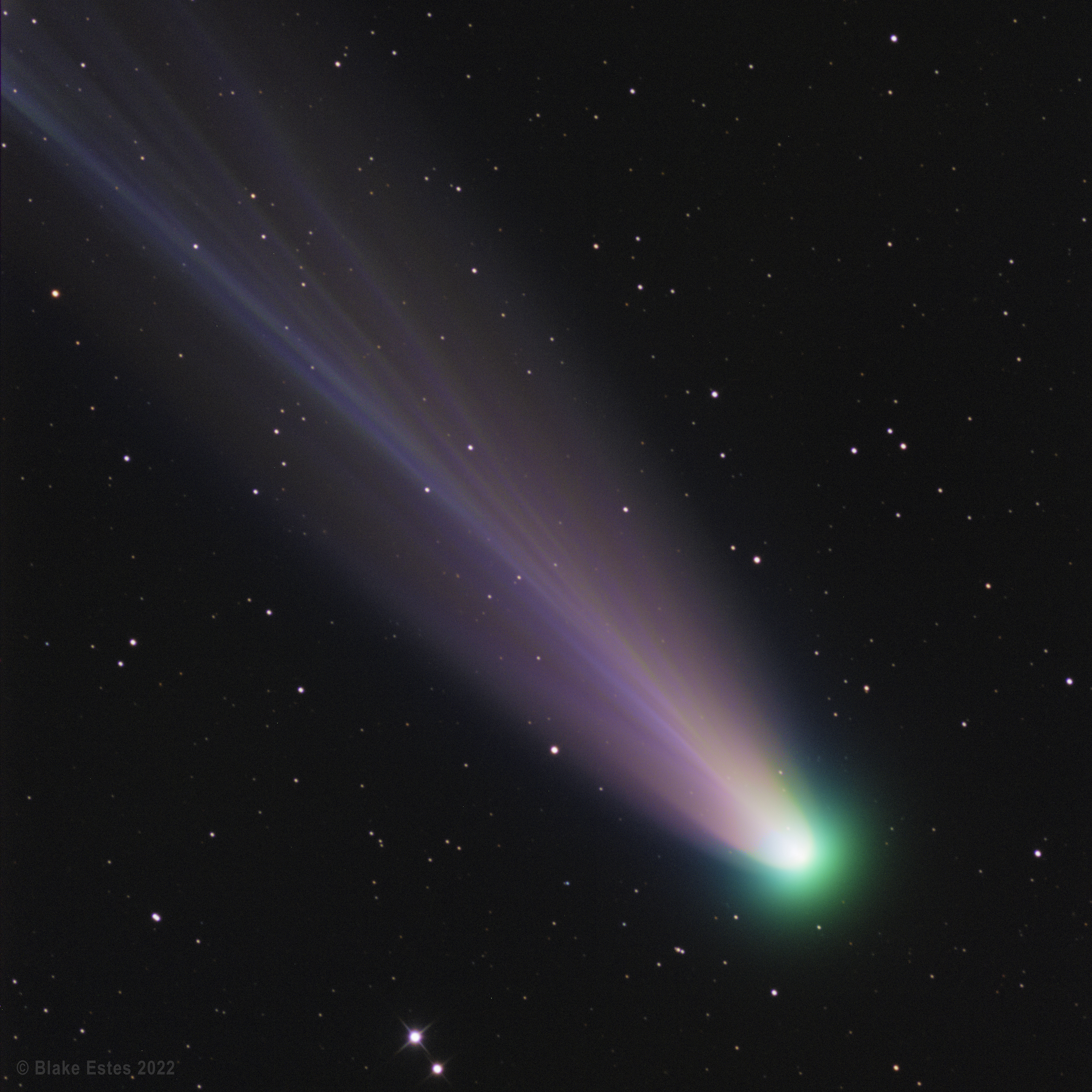
Explanation: What does Comet Leonard look like up close? Although we can't go there, imaging the comet's coma and inner tails through a small telescope gives us a good idea. As the name implies, the ion tail is made of ionized gas -- gas energized by ultraviolet light from the Sun and pushed outward by the solar wind. The solar wind is quite structured and sculpted by the Sun's complex and ever changing magnetic field. The effect of the variable solar wind combined with different gas jets venting from the comet's nucleus accounts for the tail's complex structure. Following the wind, structure in Comet Leonard's tail can be seen to move outward from the Sun even alter its wavy appearance over time. The blue color of the ion tail is dominated by recombining carbon monoxide molecules, while the green color of the coma surrounding the head of the comet is created mostly by a slight amount of recombining diatomic carbon molecules. Diatomic carbon is destroyed by sunlight in about 50 hours -- which is why its green glow does not make it far into the ion tail. The featured image was taken on January 2 from Siding Spring Observatory in Australia. Comet Leonard, presently best viewed from Earth's Southern Hemisphere, has rounded the Sun and is now headed out of the Solar System.
03/01/2023
ASTRONOMY - After Sunset Planet Parade
2023 January 2
Image Credit & Copyright: Tunc Tezel (TWAN)
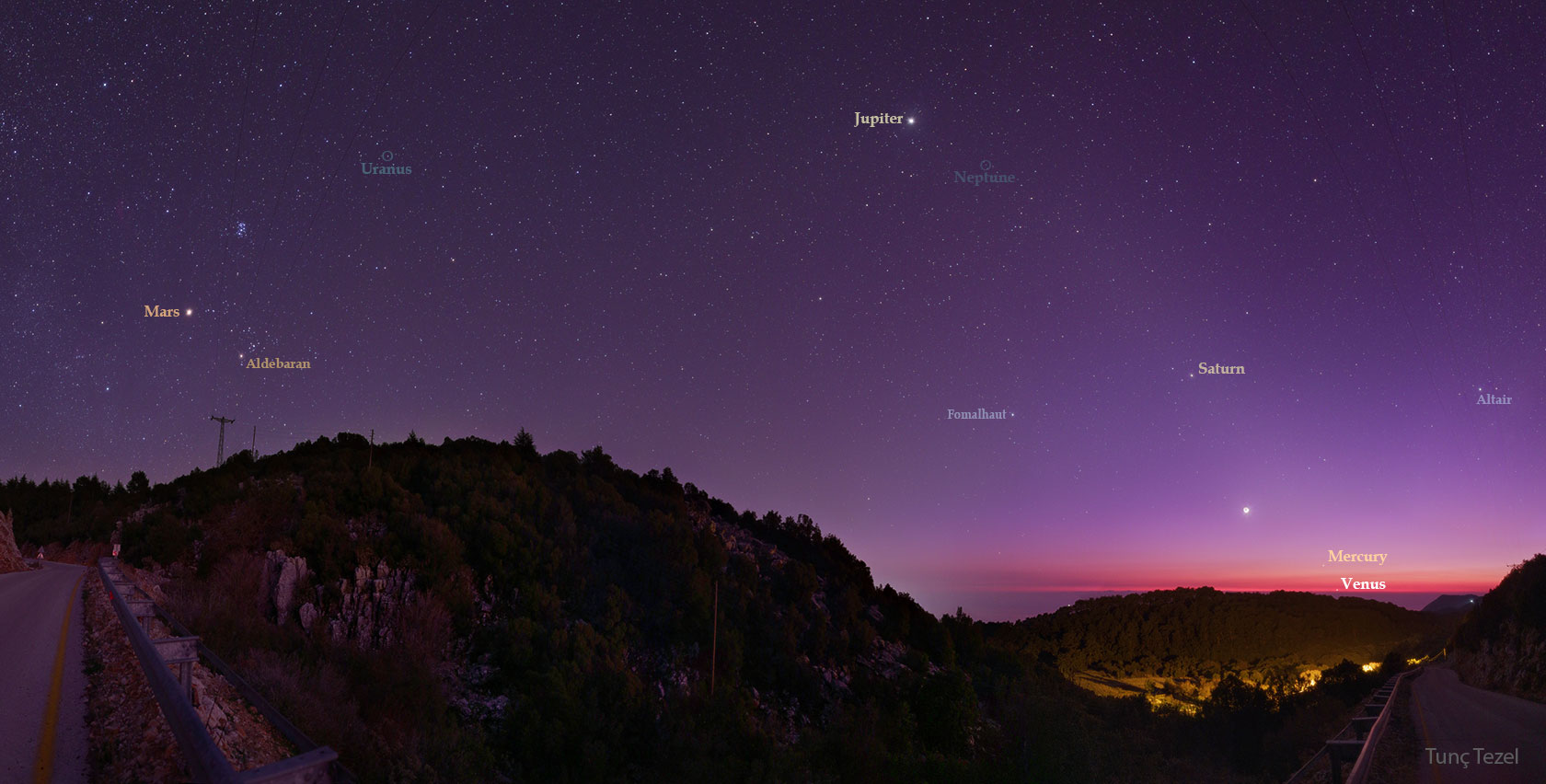
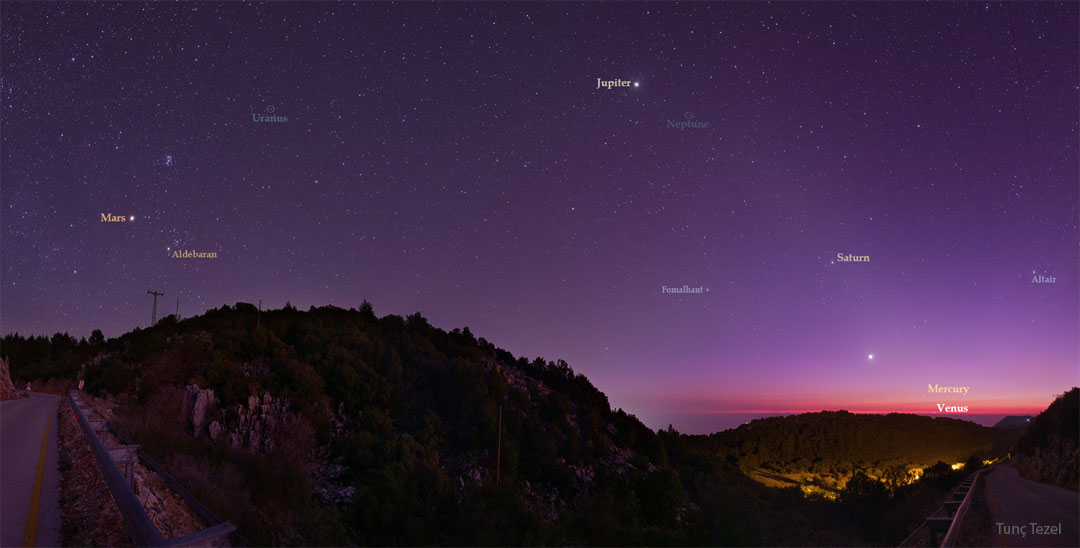
Explanation: Look up tonight and see a whole bunch of planets. Just after sunset, looking west, planets Venus, Saturn, Jupiter and Mars will all be simultaneously visible. Listed west to east, this planetary lineup will have Venus nearest the horizon, but setting shortly after the Sun. It doesn't matter where on Earth you live because this early evening planet parade will be visible through clear skies all around the globe. Taken late last month, the featured image captured all of these planets and more: the Moon and planet Mercury were also simultaneously visible. Below visibility were the planets Neptune and Uranus, making this a nearly all-planet panorama. In the foreground are hills around the small village of Gökçeören, Kaş, Turkey, near the Mediterranean coast. Bright stars Altair, Fomalhaut, and Aldebaran are also prominent, as well as the Pleiades star cluster. Venus will rise higher in the sky at sunset as January continues, but Saturn will descend.
La vie et la mort - Y-A-T-IL UNE VIE APRèS LA MORT ? (3/5)
Sept jours de coma… et une expérience consciente Durant sept jours, le neurochirurgien reste plongé dans un état végétatif. Les examens neur...
-
2026 January 1 Auroral Corona Image Credit & Copyright : Roi Levi Explanation: Cycle 25 solar maximum made 2025 a great year for ...
-
Imaginez un monde où le cancer n’est plus une sentence, mais une simple étape à franchir. Grâce à une découverte révolutionnaire, ce rêve es...