Nombre total de pages vues
29/03/2023
AERONAUTIQUE - Le taxi volant français Atea est prêt à décoller
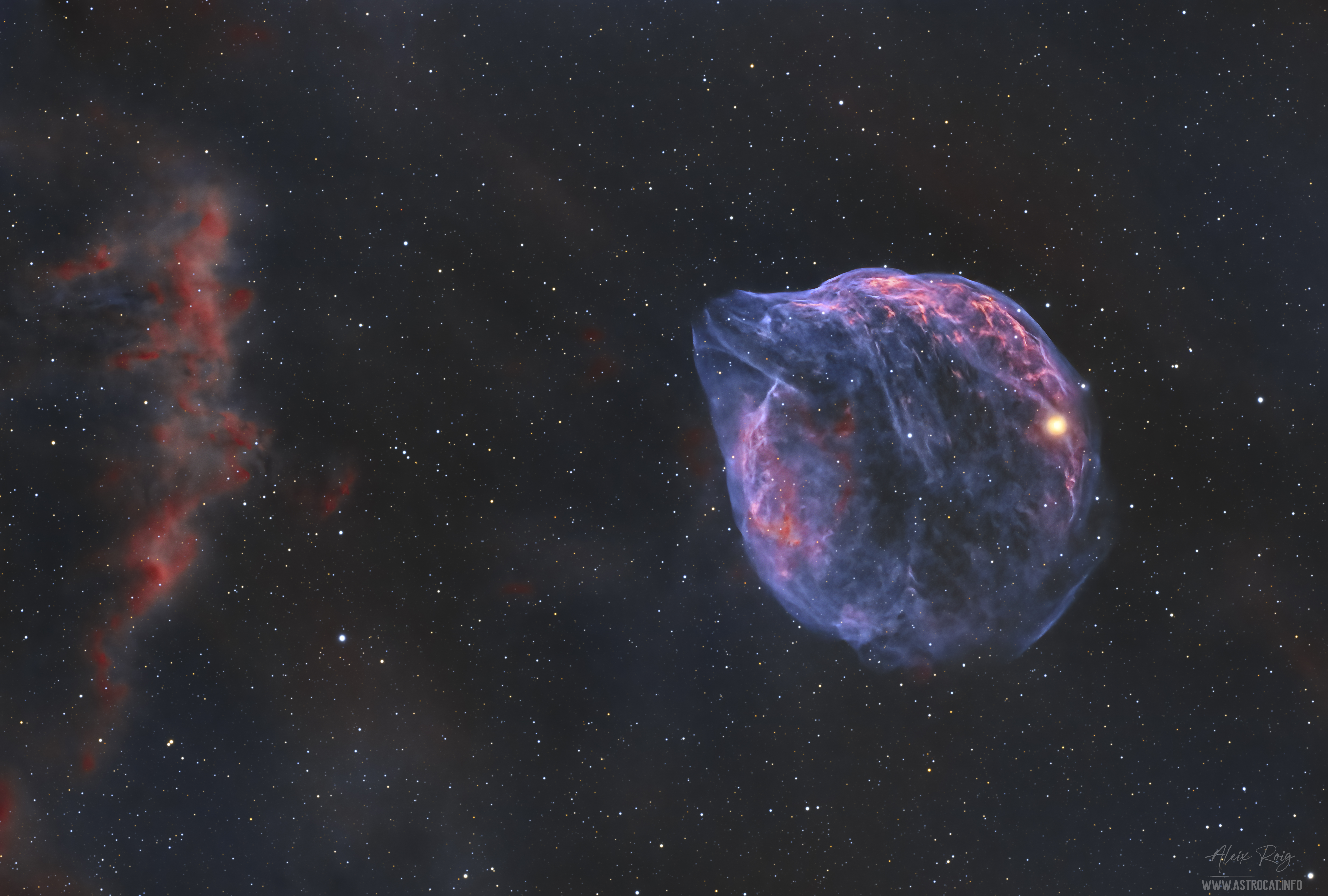
ASTSRONOMY - Sh2-308: A Dolphin Shaped Star Bubble
2023 March 29
Image Credit & Copyright: Aleix Roig (AstroCatInfo)
Explanation: Which star created this bubble? It wasn't the bright star on the bubble's right. And it also wasn't a giant space dolphin. It was the star in the blue nebula's center, a famously energetic Wolf-Rayet star. Wolf-Rayet stars in general have over 20 times the mass of our Sun and expel fast particle winds that can create iconic looking nebulas. In this case, the resulting star bubble spans over 60 light years, is about 70,000 years old, and happens to look like the head of a dolphin. Named Sh2-308 and dubbed the Dolphin-Head Nebula, the gas ball lies about 5,000 light years away and covers as much sky as the full moon -- although it is much dimmer. The nearby red-tinged clouds on the left of the featured image may owe their glow and shape to energetic light emitted from the same Wolf-Rayet star.
28/03/2023
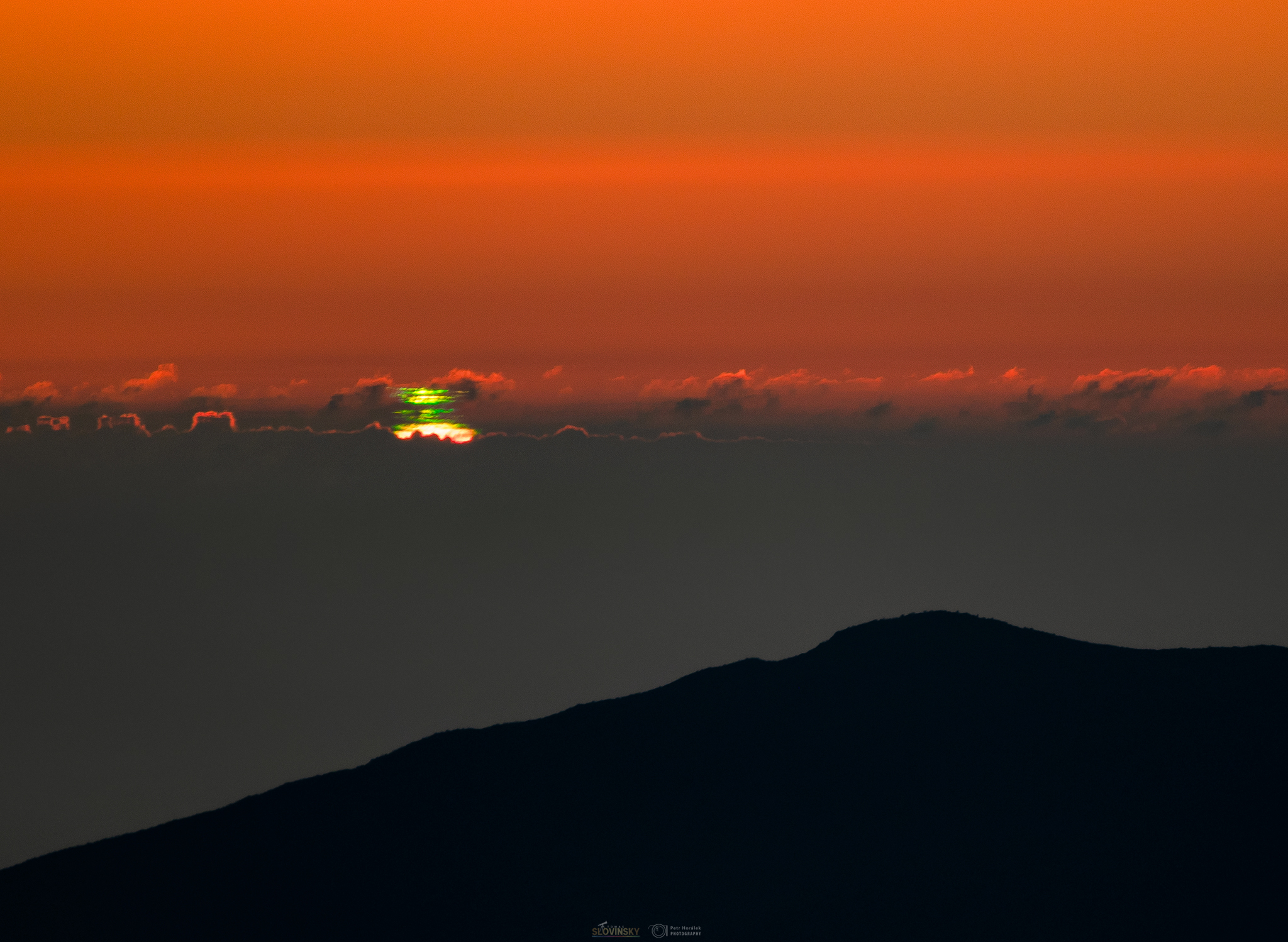
ASTRONOMY - A Multiple Green Flash Sunset
2023 March 28
Image Credit & Copyright: T. Slovinský & P. Horálek (IoP Opava); CTIO, NOIRLab, NSF, AURA
Explanation: Yes, but can your green flash do this? A green flash at sunset is a rare event that many Sun watchers pride themselves on having seen. Once thought to be a myth, a green flash is now understood to occur when the Earth's atmosphere acts like both a prism and a lens. Different atmospheric layers create altitude-variable refraction that takes light from the top of the Sun and disperses its colors, creates two images, and magnifies it in just the right way to make a thin sliver appear green just before it disappears. Pictured, though, is an even more unusual sunset. From the high-altitude Cerro Tololo Inter-American Observatory in Chile one day last April, the Sun was captured setting beyond an atmosphere with multiple distinct thermal layers, creating several mock images of the Sun. This time and from this location, many of those layers produced a green flash simultaneously. Just seconds after this multiple-green-flash event was caught by two well-surprised astrophotographers, the Sun set below the clouds.
27/03/2023
ART FRACTAL - Les somptueuses spirales de Mandelbrot
ASTRONOMY - Aurora Over Arctic Henge
2023 March 27
Image Credit & Copyright: Cari Letelier
Explanation: Reports of powerful solar flares started a seven-hour quest north to capture modern monuments against an aurora-filled sky. The peaks of iconic Arctic Henge in Raufarhöfn in northern Iceland were already aligned with the stars: some are lined up toward the exact north from one side and toward exact south from the other. The featured image, taken after sunset late last month, looks directly south, but since the composite image covers so much of the sky, the north star Polaris is actually visible at the very top of the frame. Also visible are familiar constellations including the Great Bear (Ursa Major) on the left, and the Hunter (Orion) on the lower right. The quest was successful. The sky lit up dramatically with bright and memorable auroras that shimmered with amazing colors including red, pink, yellow, and green -- sometimes several at once.
26/03/2023
ACTIVITE SOLAIRE : Une tempête de très grande amplitude
ASTRONOMY - Wanderers
2023 March 26
Video Credit: Visuals: Erik Wernquist; Music: Christian Sandquist; Words & Voice: Carl Sagan
Explanation: How far out will humanity explore? If this video's fusion of real space imagery and fictional space visualizations is on the right track, then at least the Solar System. Some of the video's wondrous sequences depict future humans drifting through the rings of Saturn, exploring Jupiter from a nearby spacecraft, and jumping off a high cliff in the low gravity of a moon of Uranus. Although no one can know the future, wandering and exploring beyond boundaries -- both physical and intellectual -- is part of the human spirit and has frequently served humanity well in the past.
25/03/2023
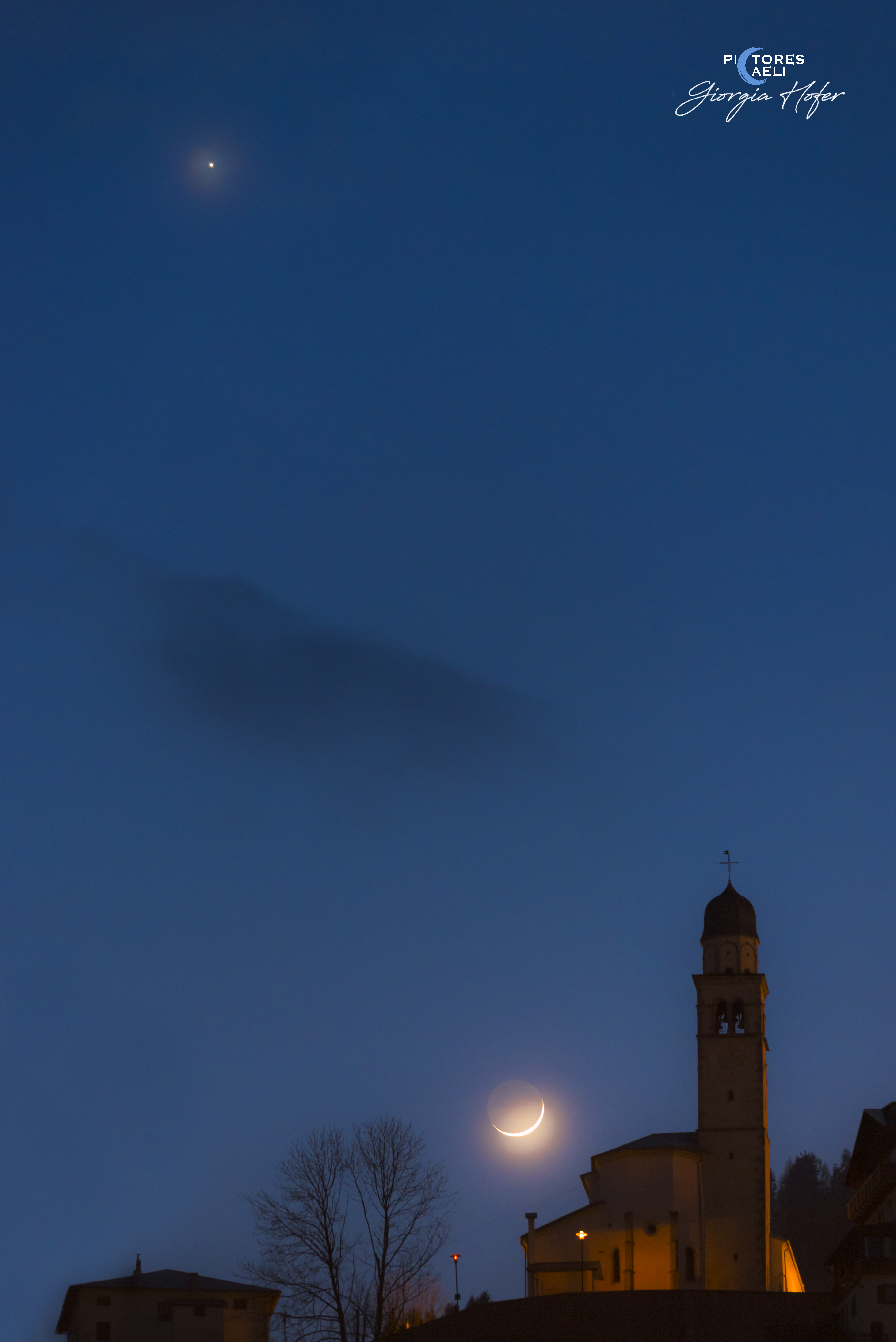
ASTRONOMY - Venus and the Da Vinci Glow
2023 March 25
Image Credit & Copyright: Giorgia Hofer
Explanation: On March 23 early evening skygazers could watch Venus and a young crescent moon, both near the western horizon. On that date Earth's brilliant evening star, faint lunar night side and slender sunlit crescent were captured in this telephoto skyscape posing alongside a church tower from Danta di Cadore, Dolomiti, Italy. Of course the subtle lunar illumination is earthshine, earthlight reflected from the Moon's night side. A description of earthshine, in terms of sunlight reflected by Earth's oceans illuminating the Moon's dark surface, was written over 500 years ago by Leonardo da Vinci. On March 24, from some locations the Moon could be seen to occult or pass in front of Venus. Around the planet tonight, a waxing lunar crescent will appear near the Pleiades star cluster.
21/03/2023
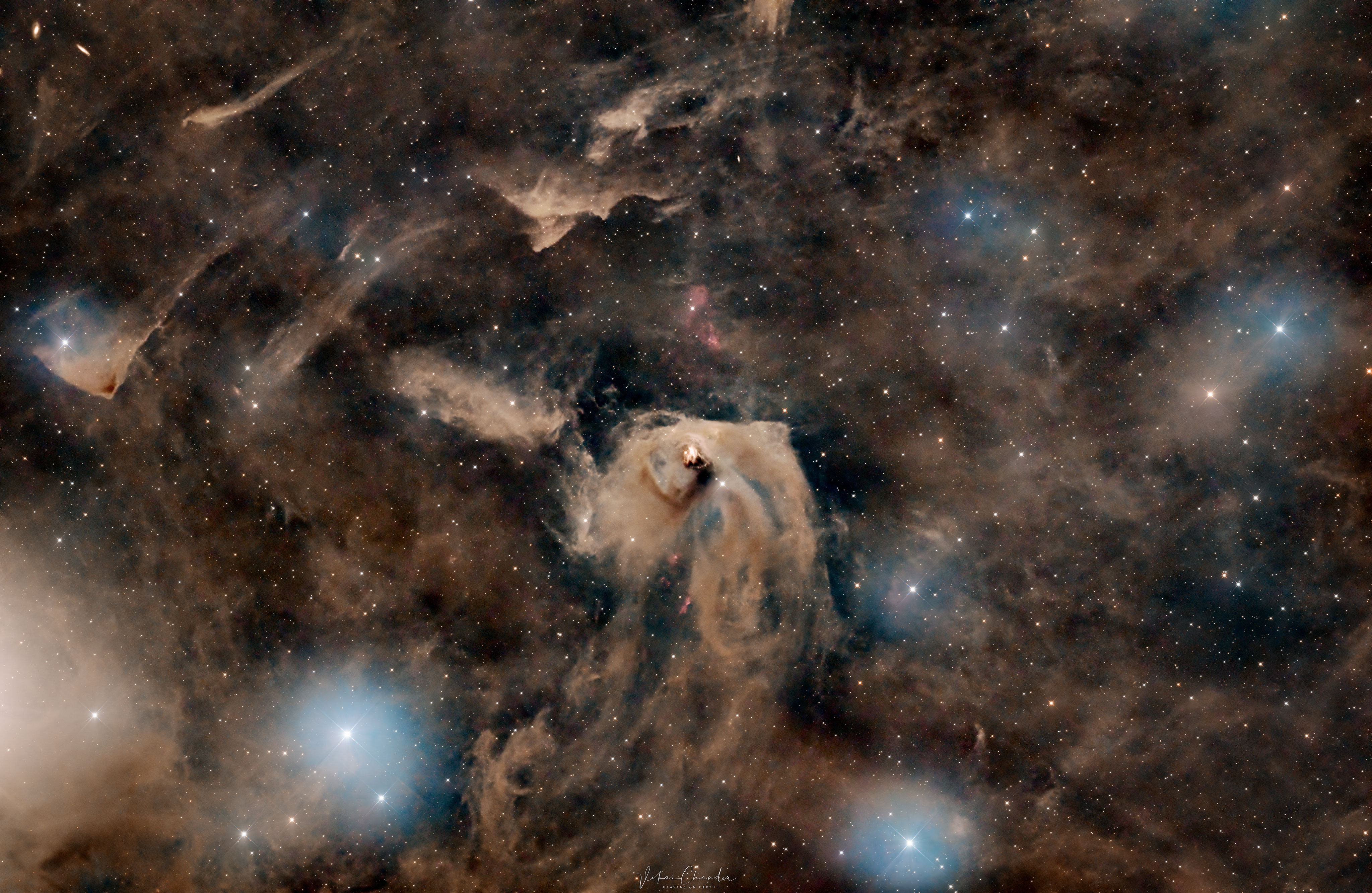
ASTRONOMY - Dark Nebulae and Star Formation in Taurus
2023 March 21
Image Credit & Copyright: Vikas Chander
Explanation: Can dust be beautiful? Yes, and it can also be useful. The Taurus molecular cloud has several bright stars, but it is the dark dust that really draws attention. The pervasive dust has waves and ripples and makes picturesque dust bunnies, but perhaps more importantly, it marks regions where interstellar gas is dense enough to gravitationally contract to form stars. In the image center is a light cloud lit by neighboring stars that is home not only to a famous nebula, but to a very young and massive famous star. Both the star, T Tauri, and the nebula, Hind's Variable Nebula, are seen to vary dramatically in brightness -- but not necessarily at the same time, adding to the mystery of this intriguing region. T Tauri and similar stars are now generally recognized to be Sun-like stars that are less than a few million years old and so still in the early stages of formation. The featured image spans about four degrees not far from the Pleiades star cluster, while the featured dust field lies about 400 light-years away.
20/03/2023
ASTRONOMY - M1: The Expanding Crab Nebula
2023 March 20
Video Credit & Copyright: Detlef Hartmann
Explanation: Are your eyes good enough to see the Crab Nebula expand? The Crab Nebula is cataloged as M1, the first on Charles Messier's famous list of things which are not comets. In fact, the Crab is now known to be a supernova remnant, an expanding cloud of debris from the explosion of a massive star. The violent birth of the Crab was witnessed by astronomers in the year 1054. Roughly 10 light-years across today, the nebula is still expanding at a rate of over 1,000 kilometers per second. Over the past decade, its expansion has been documented in this stunning time-lapse movie. In each year from 2008 to 2022, an image was produced with the same telescope and camera from a remote observatory in Austria. The sharp, processed frames even reveal the dynamic energetic emission surrounding the rapidly spinning pulsar at the center. The Crab Nebula lies about 6,500 light-years away toward the constellation of the Bull (Taurus).
La vie et la mort - Y-A-T-IL UNE VIE APRèS LA MORT ? (3/5)
Sept jours de coma… et une expérience consciente Durant sept jours, le neurochirurgien reste plongé dans un état végétatif. Les examens neur...
-
2026 January 1 Auroral Corona Image Credit & Copyright : Roi Levi Explanation: Cycle 25 solar maximum made 2025 a great year for ...
-
Imaginez un monde où le cancer n’est plus une sentence, mais une simple étape à franchir. Grâce à une découverte révolutionnaire, ce rêve es...