Nombre total de pages vues

26/12/2023


ASTRONOMY - IC 443: The Jellyfish Nebula

 2023 December 26

A complex nebula is shown in front of a dense starfield.
The nebula appears orange. A bright star is seen just to the 
right of the nebula. 
Please see the explanation for more detailed information.

IC 443: The Jellyfish Nebula
Image Credit & Copyright: David Payne

Explanation: Why is this jellyfish swimming in a sea of stars? Drifting near bright star Eta Geminorum, seen at the right, the Jellyfish Nebula extends its tentacles from the bright arcing ridge of emission left of center. In fact, the cosmic jellyfish is part of bubble-shaped supernova remnant IC 443, the expanding debris cloud from a massive star that exploded. Light from the explosion first reached planet Earth over 30,000 years ago. Like its cousin in astronomical waters, the Crab Nebula supernova remnant IC 443 is known to harbor a neutron star -- the remnant of the collapsed stellar core. The Jellyfish Nebula is about 5,000 light-years away. At that distance, the featured image would span about 140 light-years across.

25/12/2023

BIOMIMETISME - Innovations inspirées par la Nature - Les feuilles autonettoyantes du lotus


Le lotus (Nelumbo spp) est une plante aquatique. Pourtant l'eau, ce n'est pas vraiment son truc, surtout sur ses feuilles. En effet, ces dernières sont superhydrophobes, c'est-à-dire que leur surface repousse l'eau, elle glisse littéralement sur les feuilles. Les propriétés superhydrophobes des feuilles de lotus sont dues à une rugosité nanométrique, des petites pointes de l'ordre du nanomètre. Lorsqu'une goutte d'eau tombe sur les petites pointes, elle n'y adhère pas et emporte avec elle les impuretés présentes sur la plante.

Cette propriété physique intéresse bon nombre de domaines et cela depuis sa découverte dans les années 70. Des tissus déperlants, des parois de douche autonettoyantes ou encore des revêtements utilisés en aéronautique sont basés sur la rugosité nanométrique.

© William Thielicke, Wikimedia Commons, CC by-sa 4.0 International, 3.0 Unported, 2.5 Generic, 2.0 Generic and 1.0 Generic license
FuturaSciences

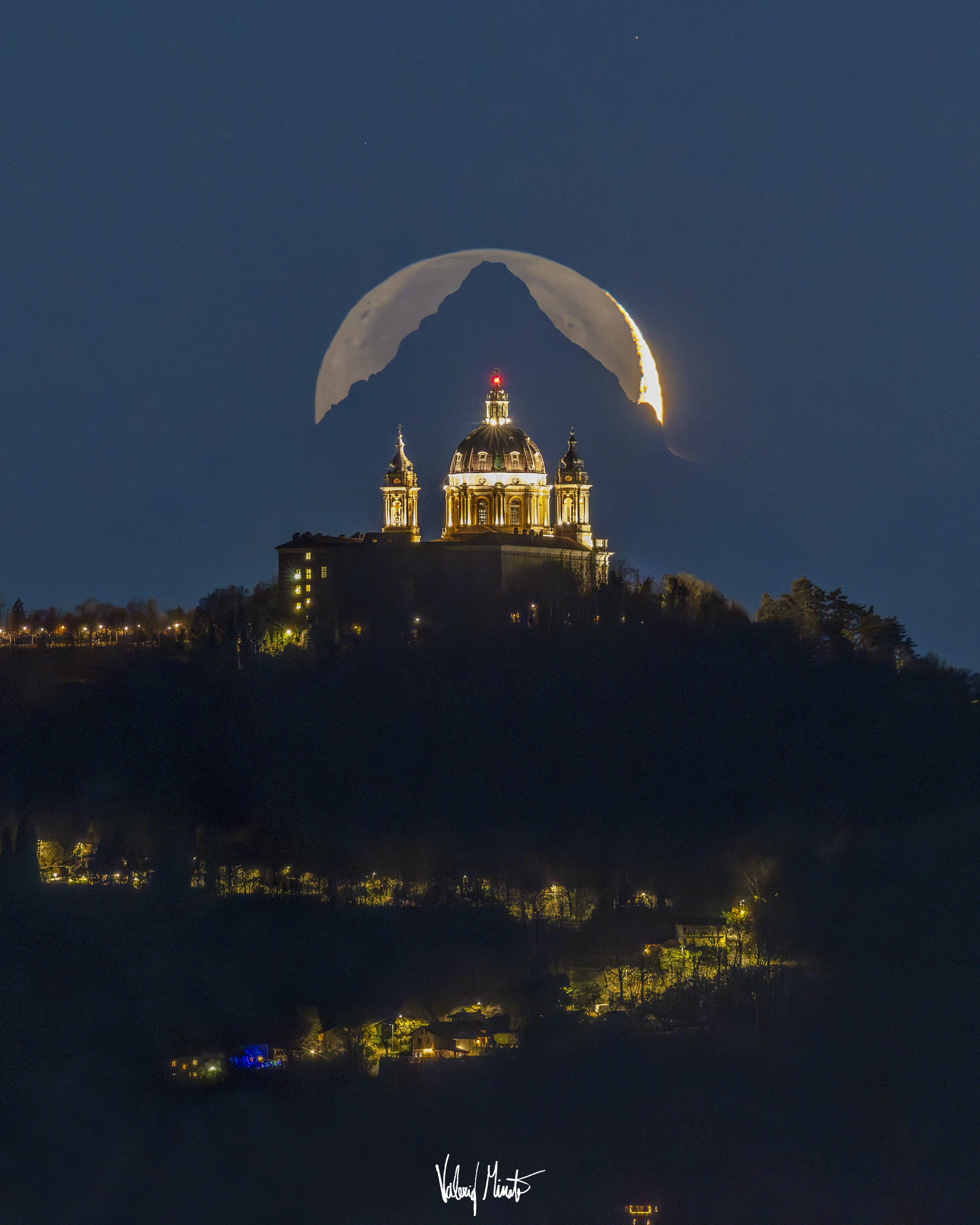
ASTRONOMY - Cathedral - Mountain - Moon

 2023 December 25

A tree-lined hill is shown topped by a majestic
cathedral. Directly behind the cathedral is 
of a triangular-shaped mountain top. Directly behind
the mountain is a crescent moon, although the exposure
is long enough to see the rest of lunar circle. 
Please see the explanation for more detailed information.

Cathedral, Mountain, Moon
Image Credit & Copyright: Valerio Minato

Explanation: Single shots like this require planning. The first step is to realize that such an amazing triple-alignment actually takes place. The second step is to find the best location to photograph it. But it was the third step: being there at exactly the right time -- and when the sky was clear -- that was the hardest. Five times over six years the photographer tried and found bad weather. Finally, just ten days ago, the weather was perfect, and a photographic dream was realized. Taken in PiemonteItaly, the cathedral in the foreground is the Basilica of Superga, the mountain in the middle is Monviso, and, well, you know which moon is in the background. Here, even though the setting Moon was captured in a crescent phase, the exposure was long enough for doubly reflected Earthlight, called the da Vinci glow, to illuminate the entire top of the Moon.

24/12/2023

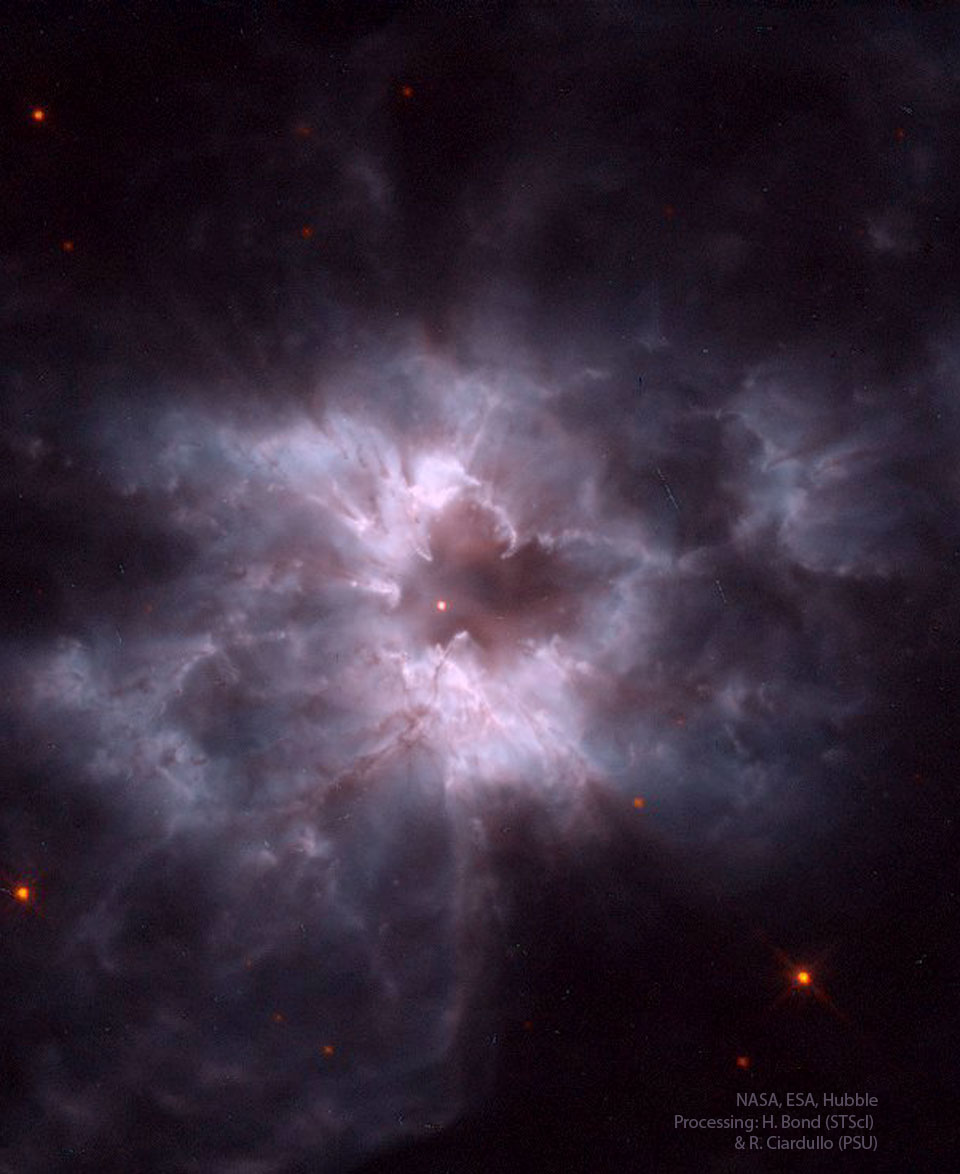
ASTRONOMY - NGC 2440: Cocoon of a New White Dwarf

 2023 December 24

A nebula in purple and pink is shown with dust pillars 
curving around. In the center is a bright orange spot.
Please see the explanation for more detailed information.

NGC 2440: Cocoon of a New White Dwarf
Image Credit: NASAESAHubble; Processing: H. Bond (STScI), R. Ciardullo (PSU), Forrest Hamilton (STScI)

Explanation: What's that in the center? Like a butterfly, a white dwarf star begins its life by casting off a cocoon of gas that enclosed its former self. In this analogy, however, the Sun would be a caterpillar and the ejected shell of gas would become the prettiest cocoon of all. In the featured cocoon, the planetary nebula designated NGC 2440 contains one of the hottest white dwarf stars known. The white dwarf can be seen as the bright orange dot near the image center. Our Sun will eventually become a white dwarf butterfly, but not for another 5 billion years.

23/12/2023

ASTRONOMY - A December Summer Night

 2023 December 23

See Explanation.  Clicking on the picture will download
the highest resolution version available.

A December Summer Night
Image Credit & Copyright: Ian Griffin (Otago Museum)

Explanation: Colours of a serene evening sky are captured in this 8 minute exposure, made near this December's solstice from New Zealand, southern hemisphere, planet Earth. Looking south, star trails form the short concentric arcs around the rotating planet's south celestial pole positioned just off the top of the frame. At top and left of center are trails of the Southern Cross stars and a dark smudge from the Milky Way's Coalsack Nebula. Alpha and Beta Centauri make the brighter yellow and blue tinted trails, reflected below in the waters of Hoopers Inlet in the Pacific coast of the South Island's Otago Peninsula. On that short December summer night, aurora australis also gave luminous, green and reddish hues to the sky above the hills. An upper atmospheric glow distinct from the aurora excited by collisions with energetic particles, pale greenish bands of airglow caused by a cascade of chemical reactions excited by sunlight can be traced in diagonal bands near the top left.

22/12/2023

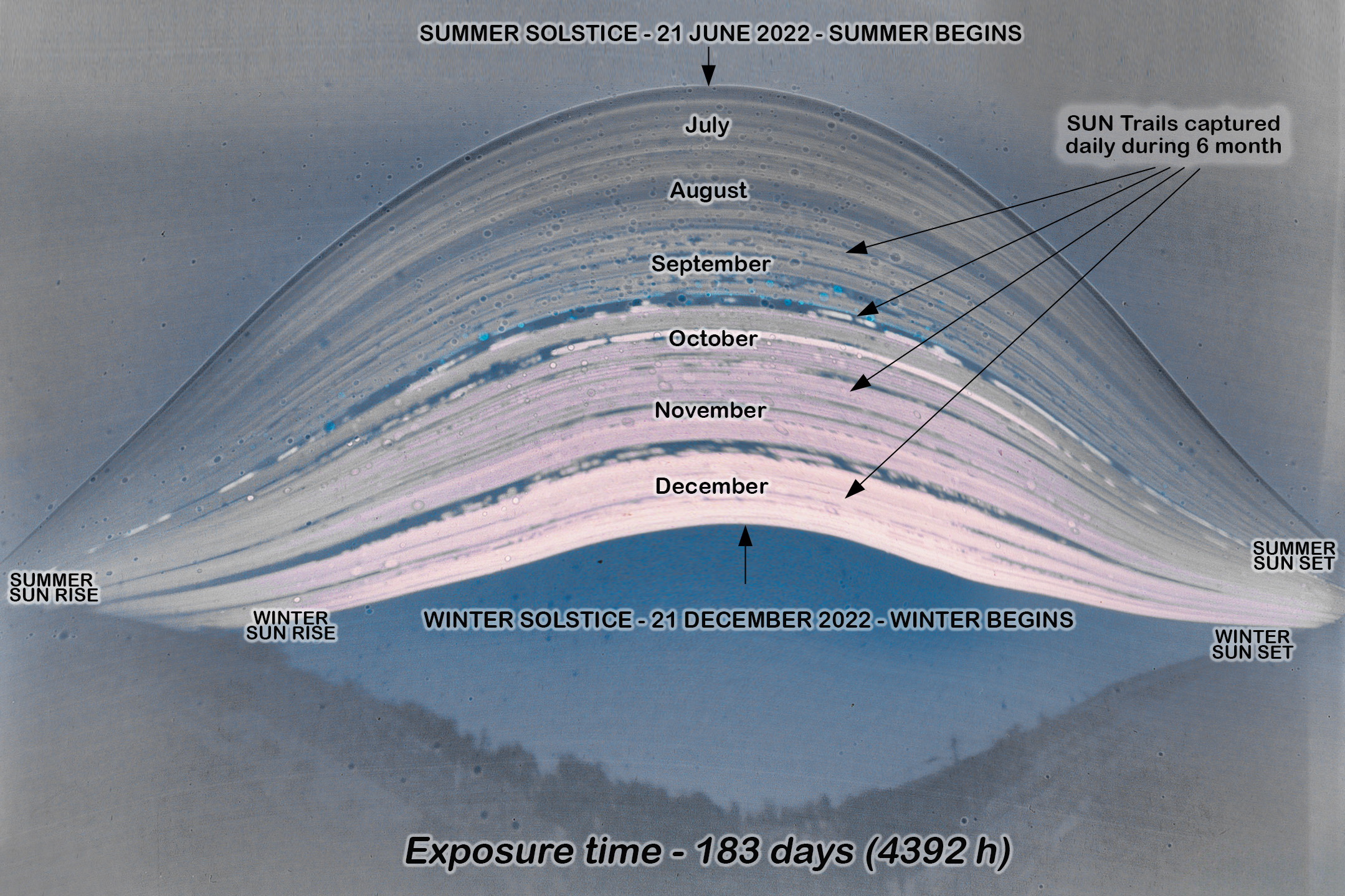
ASTRONOMY - 183 Days in the Sun

 2023 December 22

See Explanation.  Clicking on the picture will download
the highest resolution version available.

183 Days in the Sun
Image Credit & Copyright: José Zarcos Palma

Explanation: A single 183 day exposure with a pinhole camera and photographic paper resulted in this long-duration solargraph. Recorded from solstice to solstice, June 21 to December 21, in 2022, it follows the Sun's daily arcing path through planet Earth's skies from Mertola, Portugal. On June 21, the Sun's highest point and longest arc represents the longest day and the astronomical beginning of summer in the northern hemisphere. The solstice date with the fewest hours of daylight is at the beginning of winter in the north, corresponding to the Sun's shortest and lowest arc in the 2022 solargraph. For 2023, the northern winter solstice was on December 22 at 3:27 UTC. That's December 21 for North America time zones.

17/12/2023

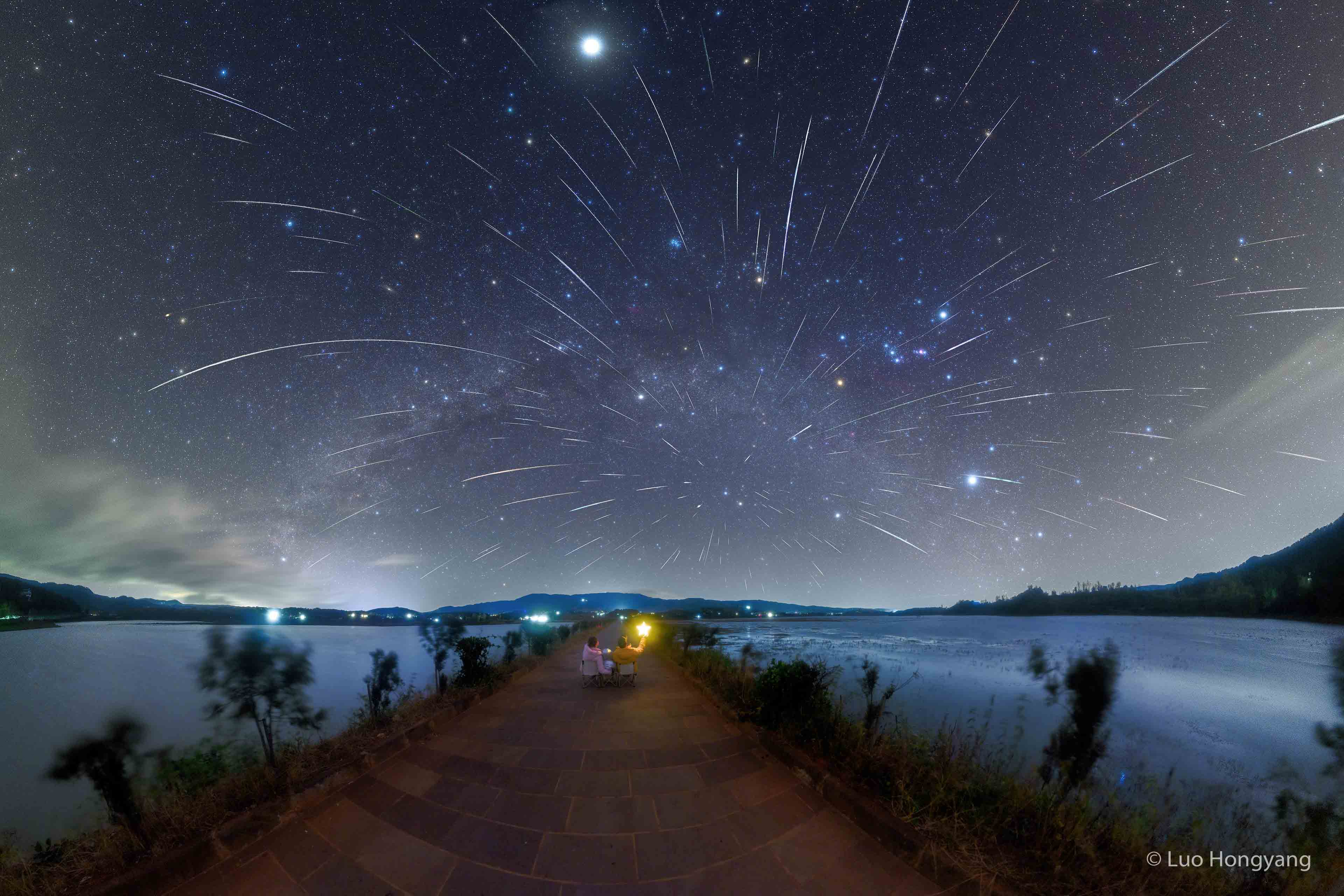
ASTRONOMY - Geminids over China's Nianhu Lake

 2023 December 17

Two people are pictured from the back looking at a dark
star-filled sky. The sky is also filled with numerous streaks
caused by meteors from the Geminids meteor shower.
Please see the explanation for more detailed information.

Geminids over China's Nianhu Lake
Image Credit & Copyright: Hongyang Luo

Explanation: Where are all of these meteors coming from? In terms of direction on the sky, the pointed answer is the constellation of Gemini. That is why the major meteor shower in December is known as the Geminids -- because shower meteors all appear to come from a radiant toward Gemini. Three dimensionally, however, sand-sized debris expelled from the unusual asteroid 3200 Phaethon follows a well-defined orbit about our Sun, and the part of the orbit that approaches Earth is superposed in front of the constellation of Gemini. Therefore, when Earth crosses this orbit, the radiant point of falling debris appears in Gemini. Featured here is a composite of many images taken a few days ago through dark skies from Nianhu Lake in China. Over 100 bright meteor streaks from the Geminids meteor shower are visible.

AERONAUTIQUE - Les plus gros avions du monde - Antonov An-124 (Condor)

D'une capacité de 120 tonnes de fret sur une distance de 5.400 km, l'Antonov An-124 est le plus gros avion de transport civil et militaire du monde produit en série. Surnommé « Condor » à l'OTAN, il permet de transporter des charges hors norme telles que des locomotives, des grues, des satellites, des bateaux... et même un obélisque éthiopien, en 2005. L'armée française y a, elle-même, recours de temps en temps. Conçu dans les années 1980, le quadriréacteur a été modernisé plusieurs fois et peut être chargé par le nez ou par l'arrière avec des rampes de chargement spéciales.

Longueur : 68,9 mètres
Envergure : 73,3 mètres
Premier vol : 1982

FuturaSciences

16/12/2023

LA FRANCE A L'AFFICHE - Place du Capitole - Toulouse


Le capitole, place emblématique de la ville de Toulouse. Egalement la place de l’hôtel de ville, très beau monument tout en longueur.

Doz

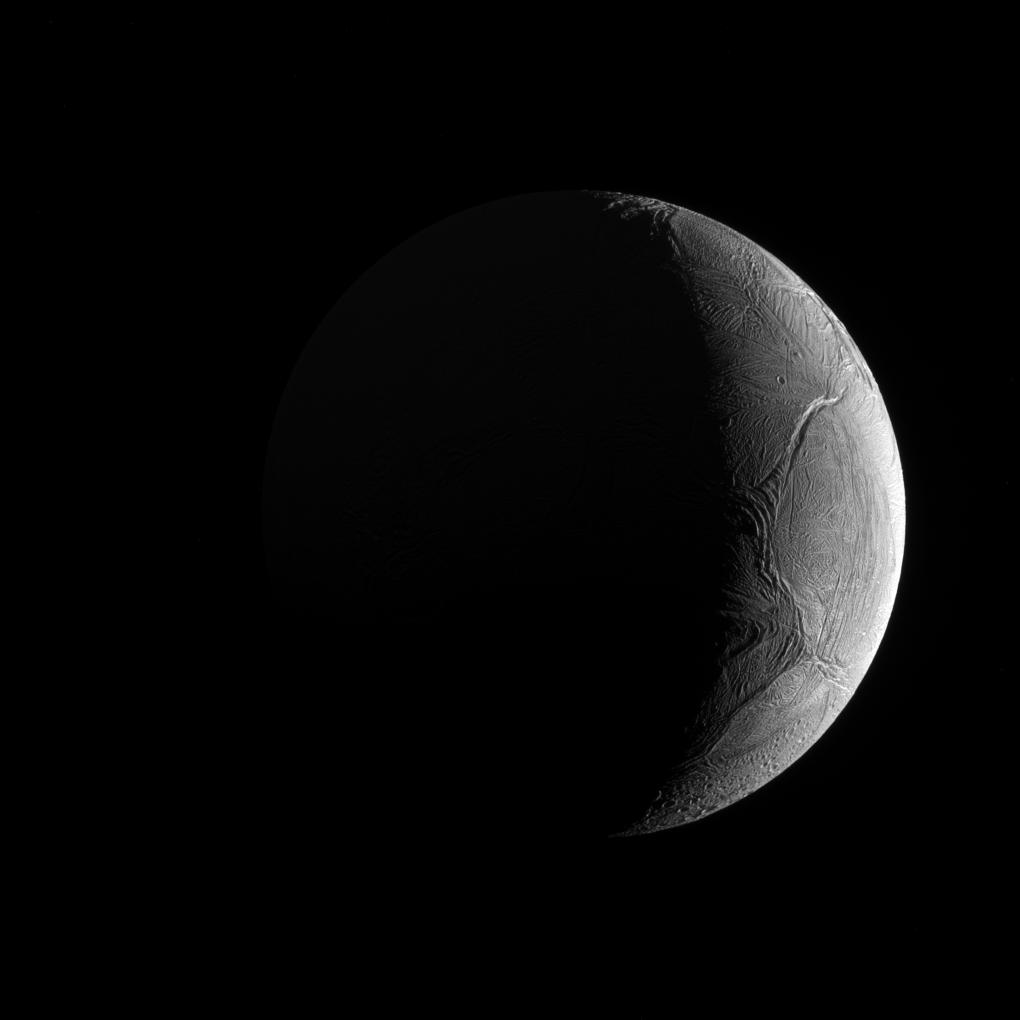
ASTRONOMY - Crescent Enceladus

 2023 December 16

See Explanation.  Clicking on the picture will download
the highest resolution version available.

Crescent Enceladus
Image Credit: Cassini Imaging TeamSSIJPLESANASA

Explanation: Peering from the shadows, the Saturn-facing hemisphere of tantalizing inner moon Enceladus poses in this Cassini spacecraft image. North is up in the dramatic scene captured during November 2016 as Cassini's camera was pointed in a nearly sunward direction about 130,000 kilometers from the moon's bright crescent. In fact, the distant world reflects over 90 percent of the sunlight it receives, giving its surface about the same reflectivity as fresh snow. A mere 500 kilometers in diameter, Enceladus is a surprisingly active moon. Data and images collected during Cassini's flybys have revealed water vapor and ice grains spewing from south polar geysers and evidence of an ocean of liquid water hidden beneath the moon's icy crust.

ASTRONOMY - Mystery: Little Red Dots in the Early Universe

 2025 December 24 Mystery: Little Red Dots in the Early Universe Image Credit:  NASA ,  ESA ,  CSA ,  STScI ,  JWST ;  Dale Kocevski  ( Colb...