Nombre total de pages vues

15/07/2024

ASTRONOMY - The Tadpole Galaxy from Hubble

 2024 July 15

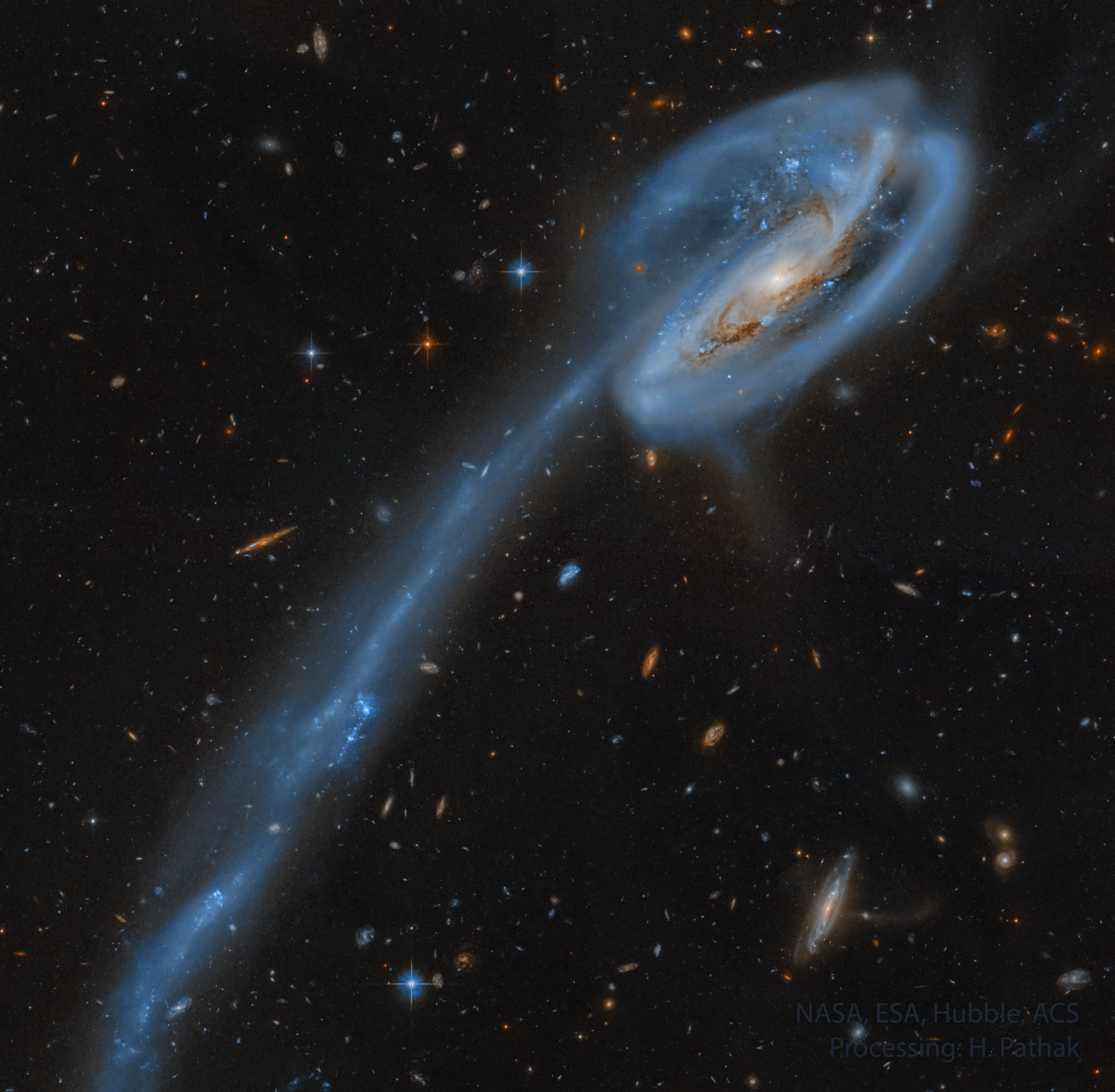
A spiral galaxy is shown on the upper left with a really
long tail of stars and blue-glowing gas trailing to the 
lower left. 
Please see the explanation for more detailed information.

The Tadpole Galaxy from Hubble
Image Credit: Hubble Legacy ArchiveESANASAProcessing: Harshwardhan Pathak

Explanation: Why does this galaxy have such a long tail? In this stunning vista, based on image data from the Hubble Legacy Archive, distant galaxies form a dramatic backdrop for disrupted spiral galaxy Arp 188, the Tadpole Galaxy. The cosmic tadpole is a mere 420 million light-years distant toward the northern constellation of the Dragon (Draco). Its eye-catching tail is about 280 thousand light-years long and features massive, bright blue star clusters. One story goes that a more compact intruder galaxy crossed in front of Arp 188 - from right to left in this view - and was slung around behind the Tadpole by their gravitational attraction. During the close encounter, tidal forces drew out the spiral galaxy's stars, gas, and dust forming the spectacular tail. The intruder galaxy itself, estimated to lie about 300 thousand light-years behind the Tadpole, can be seen through foreground spiral arms at the upper right. Following its terrestrial namesake, the Tadpole Galaxy will likely lose its tail as it grows older, the tail's star clusters forming smaller satellites of the large spiral galaxy.

14/07/2024

ASTRONOMY - Meteor Misses Galaxy

 2024 July 14

A distant spiral galaxy is seen in the image center.
A multi-colored streak runs diagonally across the image
from the upper left to the lower right. Parts of this
streak have gas near it. The background is dark field
filled with stars. 
Please see the explanation for more detailed information.

Meteor Misses Galaxy
Credit & Copyright: Aman Chokshi

Explanation: The galaxy was never in danger. For one thing, the Triangulum galaxy (M33), pictured, is much bigger than the tiny grain of rock at the head of the meteor. For another, the galaxy is much farther away -- in this instance 3 million light years as opposed to only about 0.0003 light seconds. Even so, the meteor's path took it angularly below the galaxy. Also the wind high in Earth's atmosphere blew the meteor's glowing evaporative molecule train away from the galaxy, in angular projection. Still, the astrophotographer was quite lucky to capture both a meteor and a galaxy in a single exposure -- which was subsequently added to two other images of M33 to bring up the spiral galaxy's colors. At the end, the meteor was gone in a second, but the galaxy will last billions of years.

SANTé/MEDECINE - John Dalton et la première description du daltonisme


John Dalton est un physicien et chimiste britannique né le 6 septembre 1766 à Eaglesfield et mort à Manchester le 27 juillet 1844. Il s'intéresse à la météorologie et à la chimie et est connu pour sa théorie atomique. John Dalton s'aperçoit à l'âge adulte qu'il ne perçoit pas certaines couleurs et décrit ce phénomène qui sera appelé « daltonisme ». Son frère souffre du même problème de vision des couleurs.

© Patrick.lynch, CC by-sa 3.0

13/07/2024

ASTRONOMY - Noctilucent Clouds over Florida

 2024 July 9

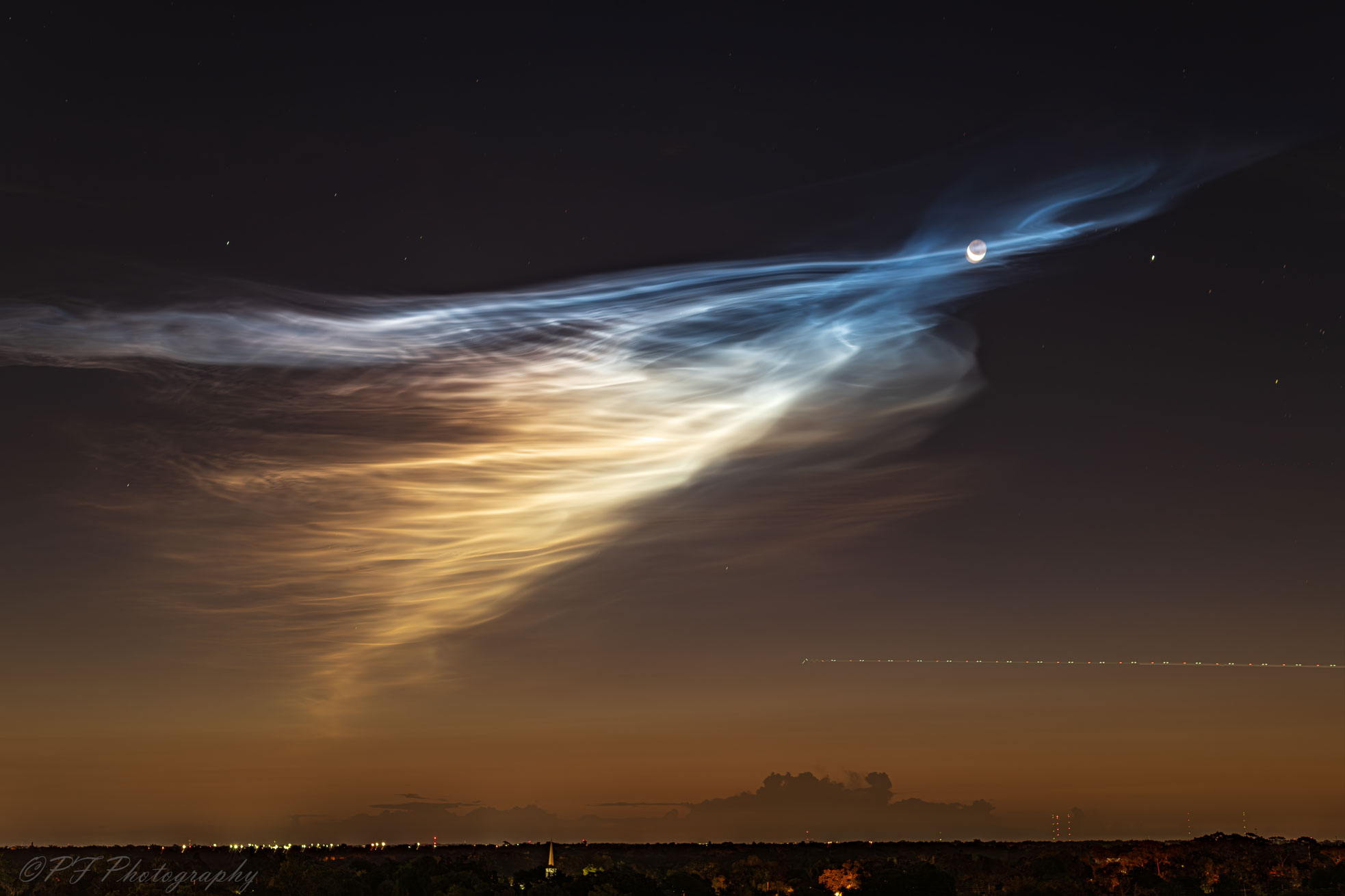
A dawn sky is shown that is black at the top and brown near the 
horizon. Wispy clouds converge on the right turning from a white to a
blue hue. Near the apex of this convergence is a crescent moon. 
Please see the explanation for more detailed information.

Noctilucent Clouds over Florida
Credit & Copyright: Pascal Fouquet

Explanation: These clouds are doubly unusual. First, they are rare noctilucent clouds, meaning that they are visible at night -- but only just before sunrise or just after sunset. Second, the source of these noctilucent clouds is actually known. In this rare case, the source of the sunlight-reflecting ice-crystals in the upper atmosphere can be traced back to the launch of a nearby SpaceX rocket about 30 minutes earlier. Known more formally as polar mesospheric clouds, the vertex of these icy wisps happens to converge just in front of a rising crescent Moon. The featured image -- and accompanying video -- were captured over OrlandoFloridaUSA about a week ago. The bright spot to the right of the Moon is the planet Jupiter, while the dotted lights above the horizon on the right are from an airplane.

11/07/2024

SANTé/MEDECINE - Christiaan Barnard premier chirurgien à greffer un cœur


Christiaan Barnard est né le 8 novembre 1922, à Beaufort West (Afrique du Sud) et décédé le 2 septembre 2001. Il est marqué par la mort d'un de ses frères, à l'âge de 5 ans, d'une maladie cardiaque, ce qui serait à l'origine de sa vocation. Le 3 décembre 1967, il dirige l'équipe qui réalise la première greffe cardiaque au Cap.

© Bryan Brandenburg CC BY-SA 3.0

10/07/2024

SANTé/MEDECINE - Sigmund Freud, fondateur de la psychanalyse


Né le 6 mai 1856 à Freiberg, en Moravie (actuelle République Tchèque), Sigmund Freud obtient son doctorat de médecine en 1881 et s'intéresse à la neurologie. Il suit en France les cours de Charcot, à la Pitié-Salpétrière. De retour à Vienne, en Autriche, il s'installe comme médecin et traite les maladies nerveuses. Il décrit le concept d'inconscient, la notion de refoulement, le complexe d'Œdipe, s'intéresse à la signification des rêves et pose les fondements de la psychanalyse.

© Ferdinand Schmutzer, DP

09/07/2024

NUCLEAIRE - LES DANGERS - Définition des déchets nucléaires


Les déchets nucléaires appelés également déchets radioactifs sont des résidus provenant des centres nucléaires de production d’électricité à chaque cycle de la filière. D’après un documentaire intitulé Déchets, le cauchemar du nucléaire, des détritus provenant des centrales nucléaires sont recyclés en théorie à 10 % alors qu’en réalité seulement 1,5 % des déchets sont recyclés. Le reportage passionnant sur les déchets radioactifs révèle également que 13 % des déchets radioactifs de la France sont stockés en plein air en Sibérie dans une ville interdite d’accès.

Par définition, le déchet nucléaire d’après vive-le-nucleaire-heureux.com est un déchet provenant d’une zone de contrôle radiologique où y sont manipulées des matières radioactives. Pour limiter au maximum les dangers des déchets nucléaires à l’organisme, ils doivent faire l’objet d’un contrôle radiologique important. Si l’examen des déchets radioactifs ne présente pas de risque, ils peuvent être libérés puis être traités de la même manière que les déchets industriels.

CentraleNucléaireInfo

08/07/2024

SANTé/MEDECINE - Luc Montagnier - découvreur du VIH


Né le 18 août 1932 à Chabris, Luc Montagnier est un virologue français. Il est colauréat en 2008, avec Françoise Barré-Sinoussi, du Prix Nobel de physiologie ou médecine, pour leur découverte en 1983 du VIH, le virus responsable du Sida. Il est également membre de l'académie des sciences et de médecine et professeur émérite à l'Institut Pasteur. Il poursuit des recherches en Chine.

© Prolineserver GFDL

ASTRONOMY - Exoplanet Zoo: Other Stars

 2024 July 8

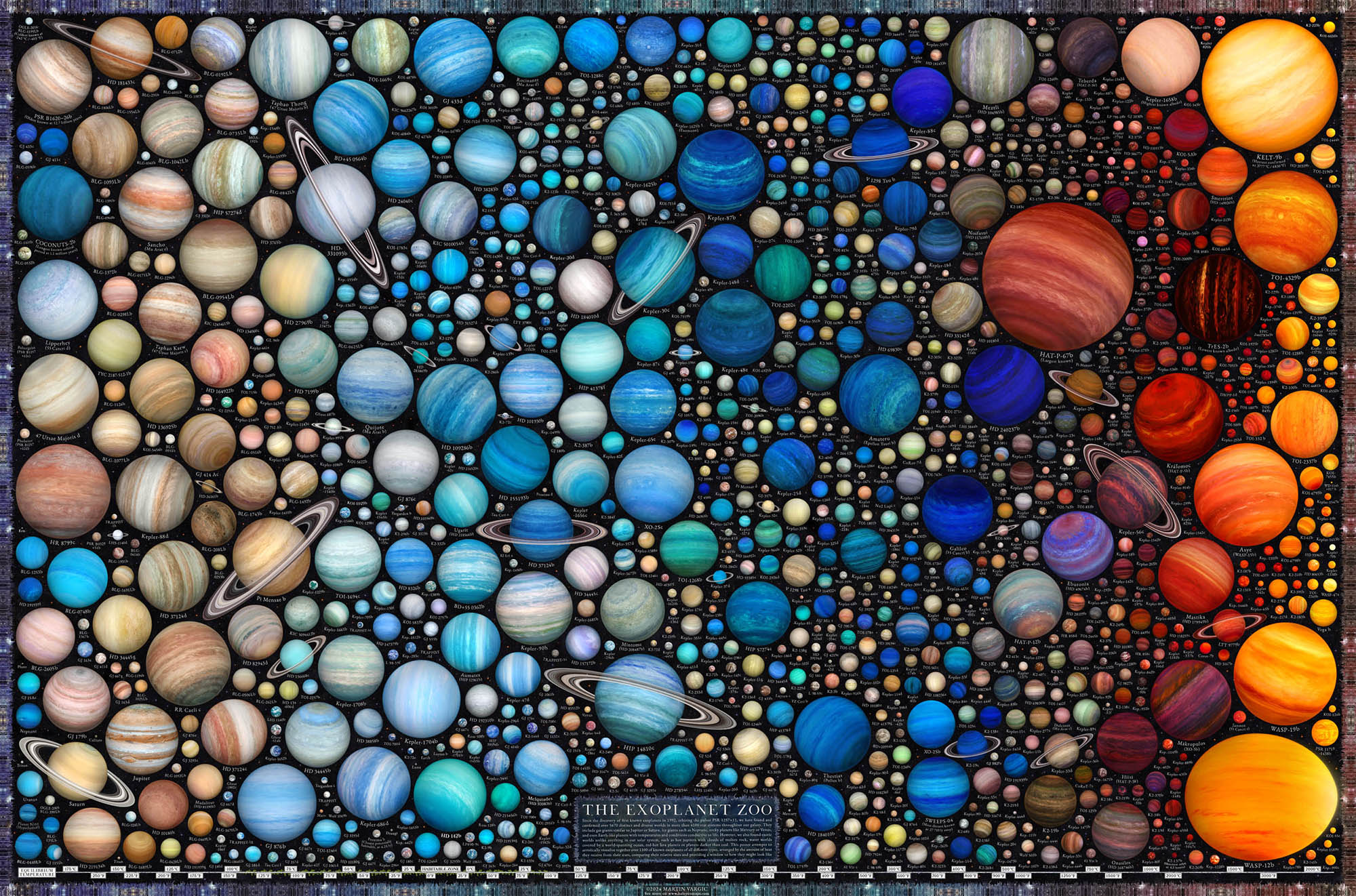
A graphic illustrates hundreds of possible exoplanets,
with blue drawings of planets in the middle, red on the right,
and tan on the left. Some exoplanets are drawn with rings.
Please see the explanation for more detailed information.

Exoplanet Zoo: Other Stars
Illustration Credit & Copyright: Martin Vargic, Halcyon Maps

Explanation: Do other stars have planets like our Sun? Surely they do, and evidence includes slight star wobbles created by the gravity of orbiting exoplanets and slight star dimmings caused by orbiting planets moving in front. In all, there have now been over 5,500 exoplanets discovered, including thousands by NASA's space-based Kepler and TESS missions, and over 100 by ESO's ground-based HARPS instrument. Featured here is an illustrated guess as to what some of these exoplanets might look like. Neptune-type planets occupy the middle and are colored blue because of blue-scattering atmospheric methane they might contain. On the sides of the illustration, Jupiter-type planets are shown, colored tan and red from the scatterings of atmospheric gases that likely include small amounts of carbon. Interspersed are many Earth-type rocky planets of many colors. As more exoplanets are discovered and investigated, humanity is developing a better understanding of how common Earth-like planets are, and how common life might be in the universe.

07/07/2024

ASTRONOMY - Iridescent Clouds over Sweden

 2024 July 7

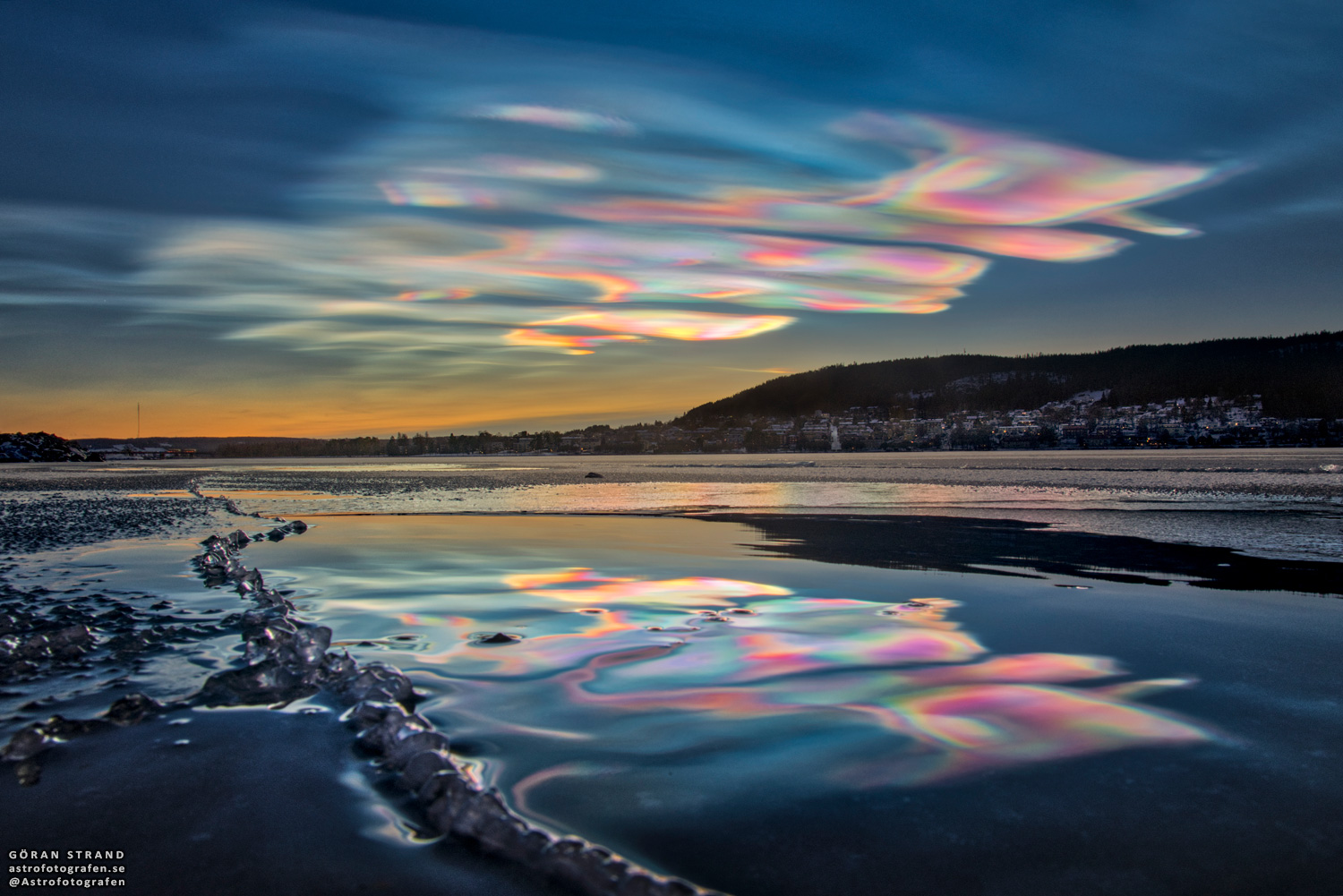
A landscape shows the sky above, shallow water in front,
and hills to the right. The sunset sky is filled with
beautifully multicolored clouds. These clouds are clearly
reflected by the calm water in front. 
Please see the explanation for more detailed information.

Iridescent Clouds over Sweden
Image Credit: Goran Strand

Explanation: Why are these clouds multi-colored? A relatively rare phenomenon in clouds known as iridescence can bring up unusual colors vividly -- or even a whole spectrum of colors simultaneously. These polar stratospheric clouds also, known as nacreous and mother-of-pearl clouds, are formed of small water droplets of nearly uniform size. When the Sun is in the right position and, typically, hidden from direct view, these thin clouds can be seen significantly diffracting sunlight in a nearly coherent manner, with different colors being deflected by different amounts. Therefore, different colors will come to the observer from slightly different directions. Many clouds start with uniform regions that could show iridescence but quickly become too thick, too mixed, or too angularly far from the Sun to exhibit striking colors. The featured image and an accompanying video were taken late in 2019 over OstersundSweden.

Astronomy - MARS MARATHON BY PERSEVERANCE

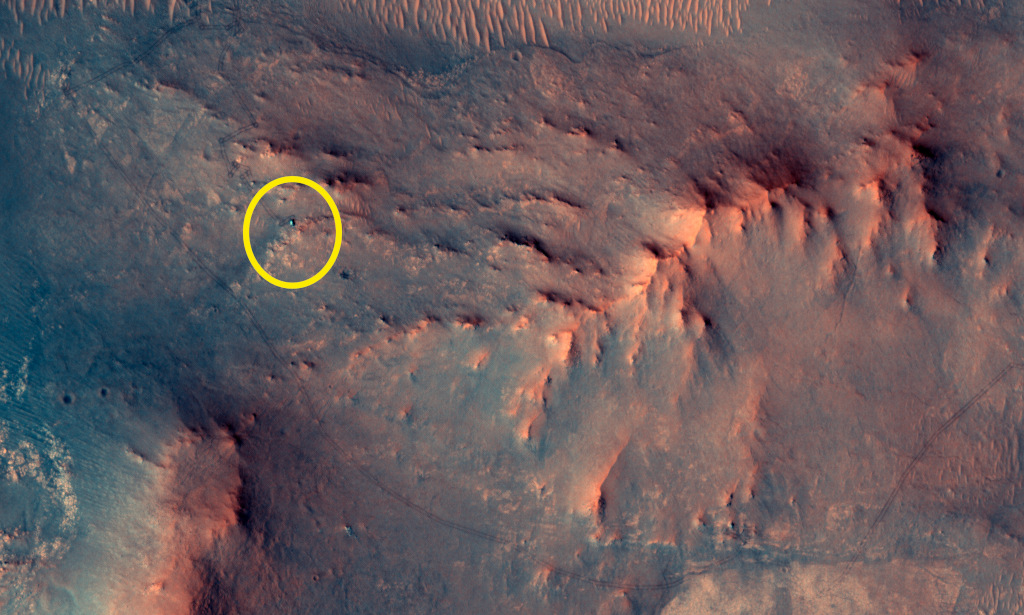
2026 June 27 Mars Marathon by Perseverance Image Credit: NASA , LPL (U. Arizona) , MRO , HiRISE Explanation: In this recent HiRISE view fro...