Nombre total de pages vues

09/06/2025

ASTRONOMY - Between Scylla and Charybdis: A Double Cosmic Discovery

2025 June 9

Between Scylla and Charybdis: A Double Cosmic Discovery
Image Credit: M. Drechsler, Y. Sainty, A. Soto, N. Martino, L. Leroux-Gere, S. Khallouqui, & A. Kaeouach; Text: Ogetay Kayali (Michigan Tech U.)

Explanation: Can you identify this celestial object? Likely not — because this is a discovery image. Massive stars forge heavy elements in their cores and, after a few million years, end their lives in powerful supernova explosions. These remnants cool relatively quickly and fade, making them difficult to detect. To uncover such faint, previously unknown supernova remnants, a dedicated group of amateur astrophotographers searched through sky surveys for possible supernova remnant candidates. The result: the first-ever image of supernova remnant G115.5+9.1 — named Scylla by its discoverers—glowing faintly in the constellation of the mythological King of Aethiopia: Cepheus. Emission from hydrogen atoms in the remnant is shown in red, and faint emission from oxygen is shown in hues of blue. Surprisingly, another discovery lurked to the upper right: a faint, previously unknown planetary nebula candidate. In keeping with mythological tradition, it was named Charybdis (Sai 2) — a nod to the ancient Greek expression "caught between Scylla and Charybdis" from Homer’s Odyssey.

08/06/2025

ASTRONOMY - Facing NGC 3344

 2025 June 8

Grand spiral galaxy NGC 3344 is shown. Spiral arms
with stars, star clusters, and nebula are visible.
Please see the explanation for more detailed information.

Facing NGC 3344
Image Credit: ESA/Hubble & NASA

Explanation: From our vantage point in the Milky Way Galaxy, we see NGC 3344 face-on. Nearly 40,000 light-years across, the big, beautiful spiral galaxy is located just 20 million light-years away in the constellation of Leo Minor. This multi-color Hubble Space Telescope close-up of NGC 3344 includes remarkable details from near infrared to ultraviolet wavelengths. The frame extends some 15,000 light-years across the spiral's central regions. From the core outward, the galaxy's colors change from the yellowish light of old stars in the center to young blue star clusters and reddish star forming regions along the loose, fragmented spiral arms. Of course, the bright stars with a spiky appearance are in front of NGC 3344 and lie well within our own Milky Way.

MUSIC - Johannes Brahms - Lullaby

"Lullaby"

07/06/2025

ASTRONOMY - Perseverance Selfie with Ingenuity

 2025 June 7

See Explanation.  Clicking on the picture will download
the highest resolution version available.

Perseverance Selfie with Ingenuity
Image Credit: NASAJPL-CaltechMSSS

Explanation: On the Mars rover's mission Sol 46 or Earth date April 6, 2021, Perseverance held out a robotic arm to take its first selfie on Mars. The WATSON camera at the end of the arm was designed to take close-ups of Martian rocks and surface details though, and not a quick snap shot of friends and smiling faces. In the end, teamwork and weeks of planning on Mars time was required to program a complex series of exposures and camera motions to include Perseverance and its surroundings. The resulting 62 frames were composed into a detailed mosaic, one of the most complicated Mars rover selfies ever taken. In this version of the selfie, the rover's Mastcam-Z and SuperCam instruments are looking toward WATSON and the end of the rover's outstretched arm. About 4 meters (13 feet) from Perseverance is a robotic companion, the Mars Ingenuity helicopter. Perseverance has now spent over 1,500 sols exploring the surface of the Red Planet. On Earth date January 18, 2024, Ingenuity made its 72nd and final flight through the thin Martian atmosphere.

06/06/2025

ASTRONOMY - NGC 6302: The Butterfly Nebula

2025 June 6
See Explanation.  Clicking on the picture will download
the highest resolution version available.

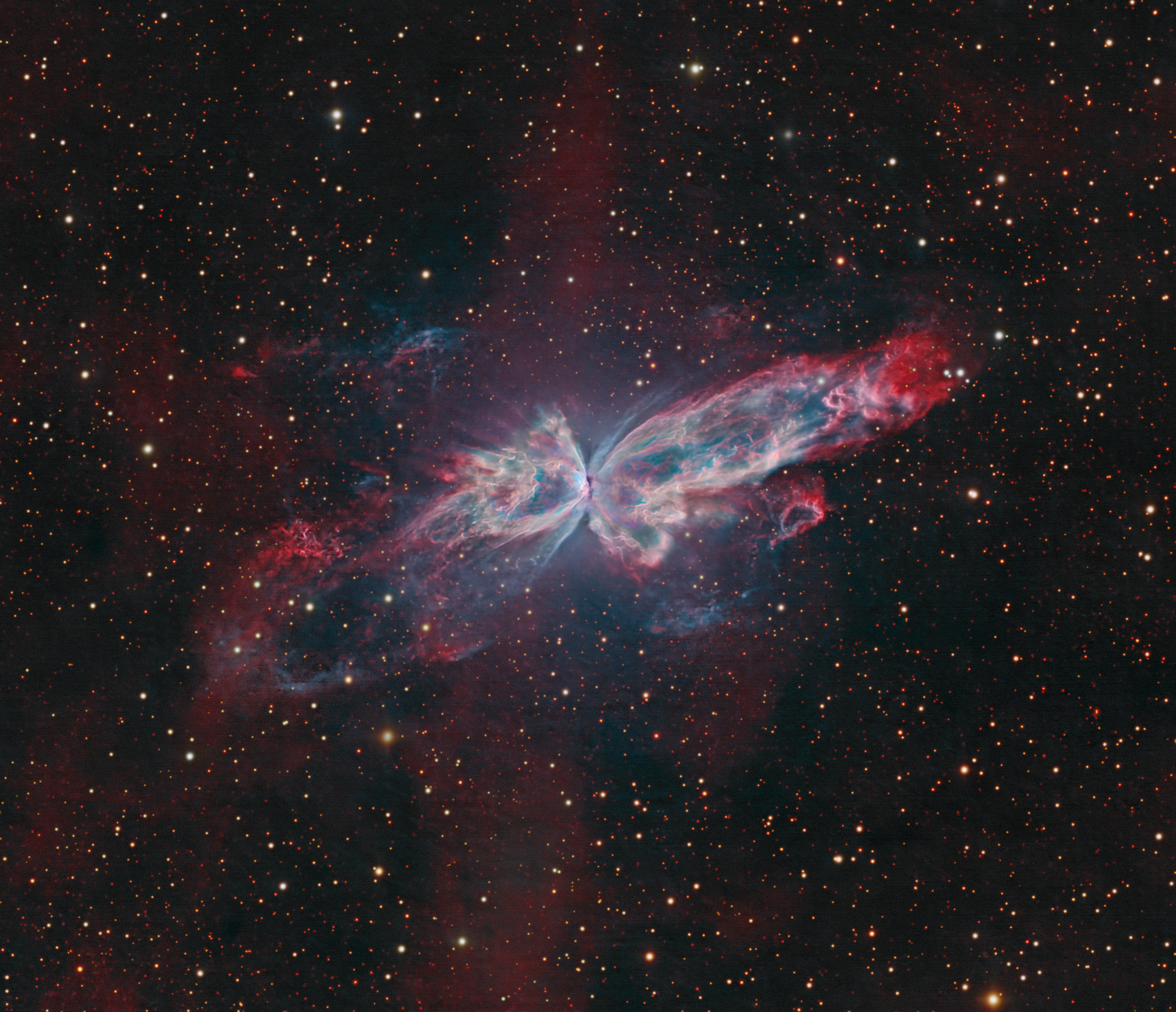
NGC 6302: The Butterfly Nebula
Image Credit & CopyrightMike Selby

Explanation: The bright clusters and nebulae of planet Earth's night sky are often given the names of flowers or insects, and its whopping 3 light-year wingspan, NGC 6302 is no exception. With an estimated surface temperature of about 250,000 degrees C, the central star of the planetary nebula is transforming into a white dwarf star, becoming exceptionally hot, and shining brightly in ultraviolet light. The central star is hidden from direct view by a torus of dust, but its energetic ultraviolet light ionizes atoms in the nebula. In this sharp, telescopic view composed with narrowband image data, the ionized hydrogen and doubly ionized oxygen atoms are shown in their characteristic red and blue-green hues to reveal a stunning complex of knots and filaments within the nebula's wing-like bipolar outflows. NGC 6302 lies about 4,000 light-years away in the arachnologically correct constellation of the Scorpion (Scorpius). 

ASTRONOMIE - Mars et Régulus : suivez leur curieux tandem bicolore !


Depuis son passage au plus près de la Terre en janvier dernier, Mars continue de s’éloigner de la Terre. Son éclat va en diminuant, mais elle est encore brillante : sa magnitude est de 1,4 à la mi-juin. On peut donc facilement la repérer à l’œil nu dans le ciel du soir, même quand la nuit n’est pas encore complète. La planète rouge est à chercher au-dessus de l’horizon ouest, dans la constellation du Lion qui est assez facile à reconnaître.

Du 15 au 19 juin, Mars frôle l’étoile principale du Lion : Régulus. Leur distance angulaire sera de l’ordre du degré, et descendra même à 0°45 le soir du 17 juin. Par coïncidence, les deux astres se trouvent avoir la même luminosité apparente, ce qui donne à cette paire un aspect intrigant. Quant à leurs couleurs respectives, elles sont bien différentes : Régulus est bleutée, tandis que Mars, recouverte d’oxyde de fer, est bel et bien rougeâtre ! Cette différence de couleur est parfaitement visible à l’œil nu. Et si vous possédez des jumelles, n’hésitez pas à les braquer sur le duo : l’éclat des deux astres en sera renforcé et les couleurs vous paraitront encore plus évidentes !

Ce rapprochement est aussi l’occasion d’apprécier le mouvement de Mars dans le ciel : celui-ci est perceptible de jour en jour grâce au repère fourni par Régulus qui, elle, semble immuable. En effet, Mars se trouve à environ 270 millions de kilomètres, ce qui est très peu par rapport à Régulus : cette étoile est située à 79 années-lumière de la Terre, c’est-à-dire presque 3 millions de fois plus loin ! Ceci explique que nous percevions les mouvements de Mars autour du Soleil (combinés à ceux de la Terre), alors que Régulus et les autres étoiles semblent fixes.

Stelvision

05/06/2025

LA TERRE VUE DU CIEL - Chichen Itza


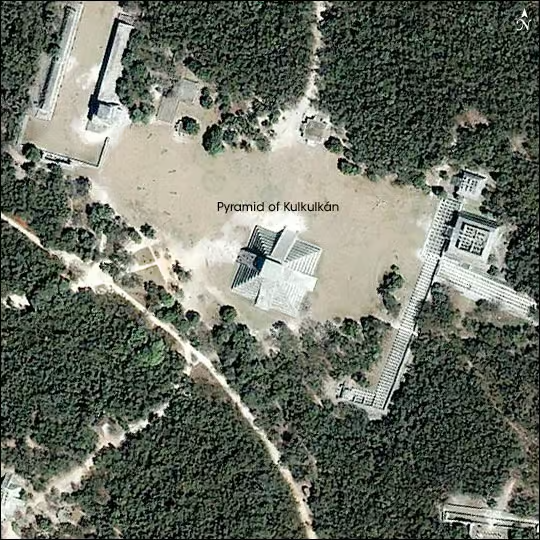
Chichen Itza est la capitale maya de la période classique tardive, elle est la seule cité yucatèque à rester peuplée après les premiers abandons du IXe siècle. La culture maya s'y est mêlée à celle des Toltèques de Tula qui y introduisirent le culte de Quetzalcoalt ou Kukulkan, le Serpent à plumes. La pyramide reste l'élément central de la cité, complétée par le monumental jeu de balle à la fonction religieuse ou l'observatoire.

Crédits : NASA

ASTRONOMY - Savudrija Star Trails

2025 June 5
See Explanation.  Clicking on the picture will download
the highest resolution version available.

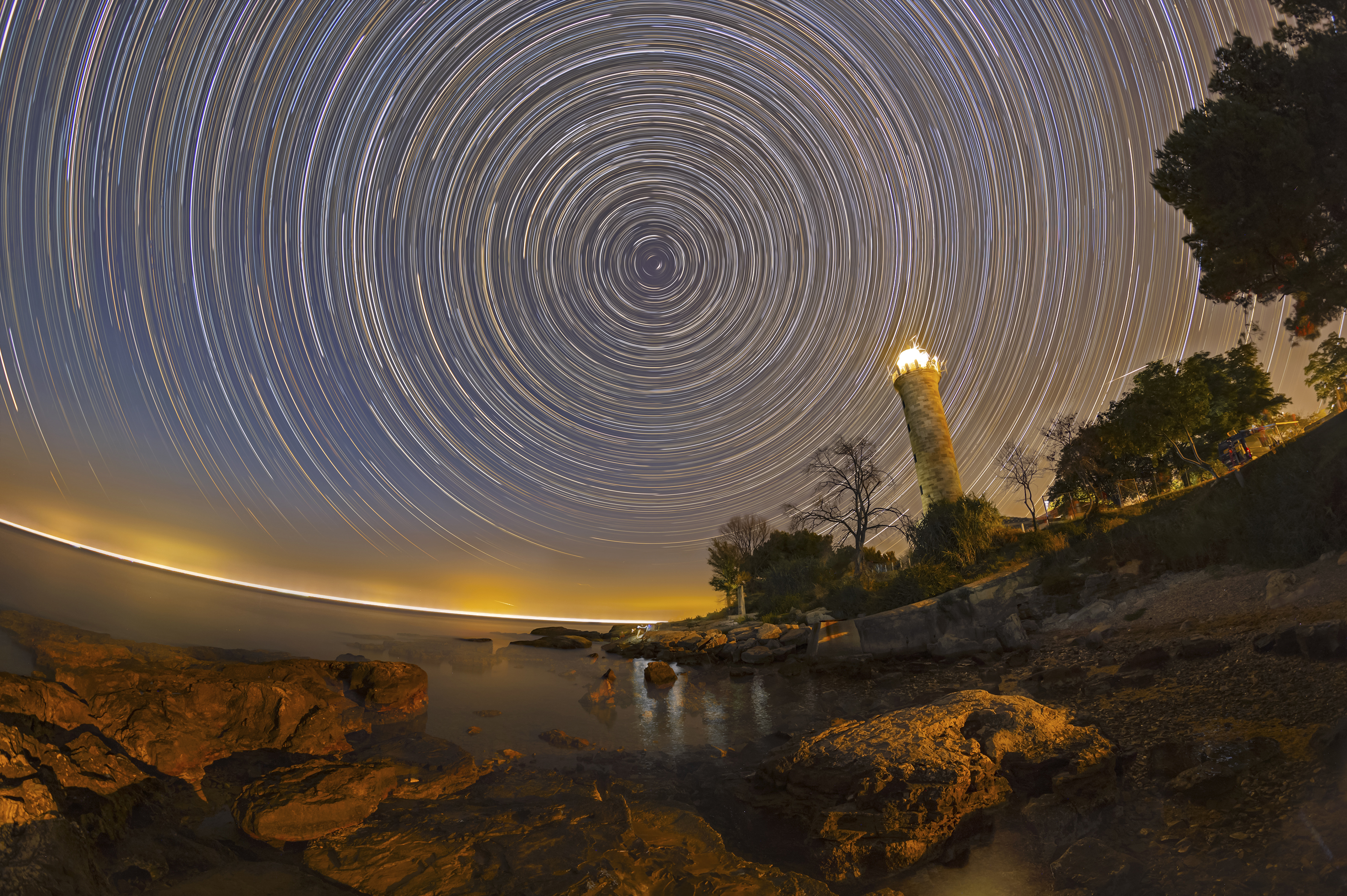
Savudrija Star Trails
Image Credit & CopyrightBranko Nadj

Explanation: Savudrija lighthouse shines along the coast near the northern end of the Istrian peninsula in this well-composed night skyscape. A navigational aid for sailors on the Adriatic Sea, the historic lighthouse was constructed in the early 19th century. But an even older aid to navigation shines in the sky above, Polaris, alpha star of the constellation Ursa Minor and also known as the North Star. In this scene Polaris forms the shortest bright arc near the North Celestial Pole, the extension of Earth's axis of rotation into space. Of course, the North Celestial Pole lies exactly at the center of all the concentric startrails. The composite image is a digital stack of 400 exposures, each 30 seconds long, taken with camera and tripod fixed to a rotating planet.

SANTé/MEDECINE - Cancer - Le système immunitaire contre la maladie

Parce qu'ils espèrent pouvoir un jour traiter des cancers de l'estomac à un stade avancé, des chercheurs américains en bio-ingénierie sont en train de développer une forme améliorée d'immunothérapie activée par la lumière. C'est ce que rapporte le journal de l'Université du Texas à Dallas, à laquelle appartient une partie de l'équipe de scientifiques.

Selon le docteur Girgis Obaid, professeur adjoint à l'Erik Jonsson School of Engineering and Computer Science de l'Université du Texas, cette approche consiste à utiliser des molécules conçues en laboratoire, ainsi qu'une lumière rouge lointaine ou une lumière proche infrarouge, pour «préparer» le système immunitaire et l'aider à attaquer les cellules cancéreuses tenaces. Ces molécules conçues en laboratoire (ou «bêta-organismes») cibleraient alors uniquement les tumeurs, laissant les tissus sains intacts afin de réduire les effets secondaires.

«Lorsqu'elles sont activées par la lumière, nos protéines modifiées capturent l'oxygène et le convertissent en molécules réactives capables de tuer les cellules cancéreuses et d'activer simultanément le système immunitaire», explique Girgis Obaid. Cette approche n'a cependant pas encore été entièrement testée sur des humains.

En collaboration avec le docteur Rolf Brekken, Girgis Obaid a reçu en août une bourse de recherche de presque 250.000 dollars (environ 220.803 euros) du Cancer Prevention & Research Institute of Texas, pour approfondir son travail visant à améliorer le traitement de la carcinose péritonéale gastrique.

Traiter différents types de tumeurs

Plus précisément, Brekken et Obaid ont conçu de nouvelles protéines artificielles qui, une fois injectées dans l'abdomen d'un patient, se lient aux cellules cancéreuses. Une petite fibre-optique applique ensuite une lumière proche infrarouge pour activer les protéines artificielles, bloquer la croissance des cellules cancéreuses et inciter les cellules immunitaires à les détruire.

«Nous combinons l'approche activée par la lumière avec la technologie des protéines artificielles, utilisant les deux voies pour éliminer la tumeur», explique Girgis Obaid. Selon les chercheurs, cette approche pourrait potentiellement fonctionner pour divers types de tumeurs.

Les chercheurs espèrent que leur traitement améliorera le pronostic vital des patients dont le cancer de l'estomac s'est étendu. «Il existe un besoin urgent de traitements pour aider les personnes atteintes d'un cancer de l'estomac avancé à vivre plus longtemps», conclue Girgis Obaid.

Nina Bailly

04/06/2025

ASTRONOMY - A Milky Road to the Rubin Observatory

 2025 June 4

A Milky Road to the Rubin Observatory
Image Credit: NSFDOERubin Obs.Paulo Assunção Lago (Rubin Obs.)

Explanation: Is the sky the same every night? No -- the night sky changes every night in many ways. To better explore how the night sky changes, the USA's NSF and DOE commissioned the Vera C. Rubin Observatory in Cerro PachónChile. In final testing before routine operations, Rubin will begin to explore these nightly changes -- slight differences that can tell us much about our amazing universe and its surprising zoo of objects. With a mirror over 8 meters across, Rubin will continually reimage the entire visible sky every few nights to discover new supernovas, potentially dangerous asteroids, faint comets, and variable stars -- as well as mapping out the visible universe's large-scale structure. Pictured, the distant central band of our Milky Way Galaxy appears to flow out from the newly operational observatory. Taken last month, the featured picture is a composite of 21 images across the night sky, capturing airglow on the horizon and the Small Magellanic Cloud galaxy on the lower left.

Santé/Médecine - LES SYMPTOMES DE LA FIBROMYALGIE: 3. - DES RAIDEURS MATINALES (5/12)

Beaucoup de personnes atteintes de fibromyalgies souffrent de raideurs. Généralement, elles sont plus intenses le matin, au réveil. Mais on ...