"Pachelbel's canon"
26/07/2025

ASTRONOMY - Globular Cluster Omega Centauri
2025 July 26
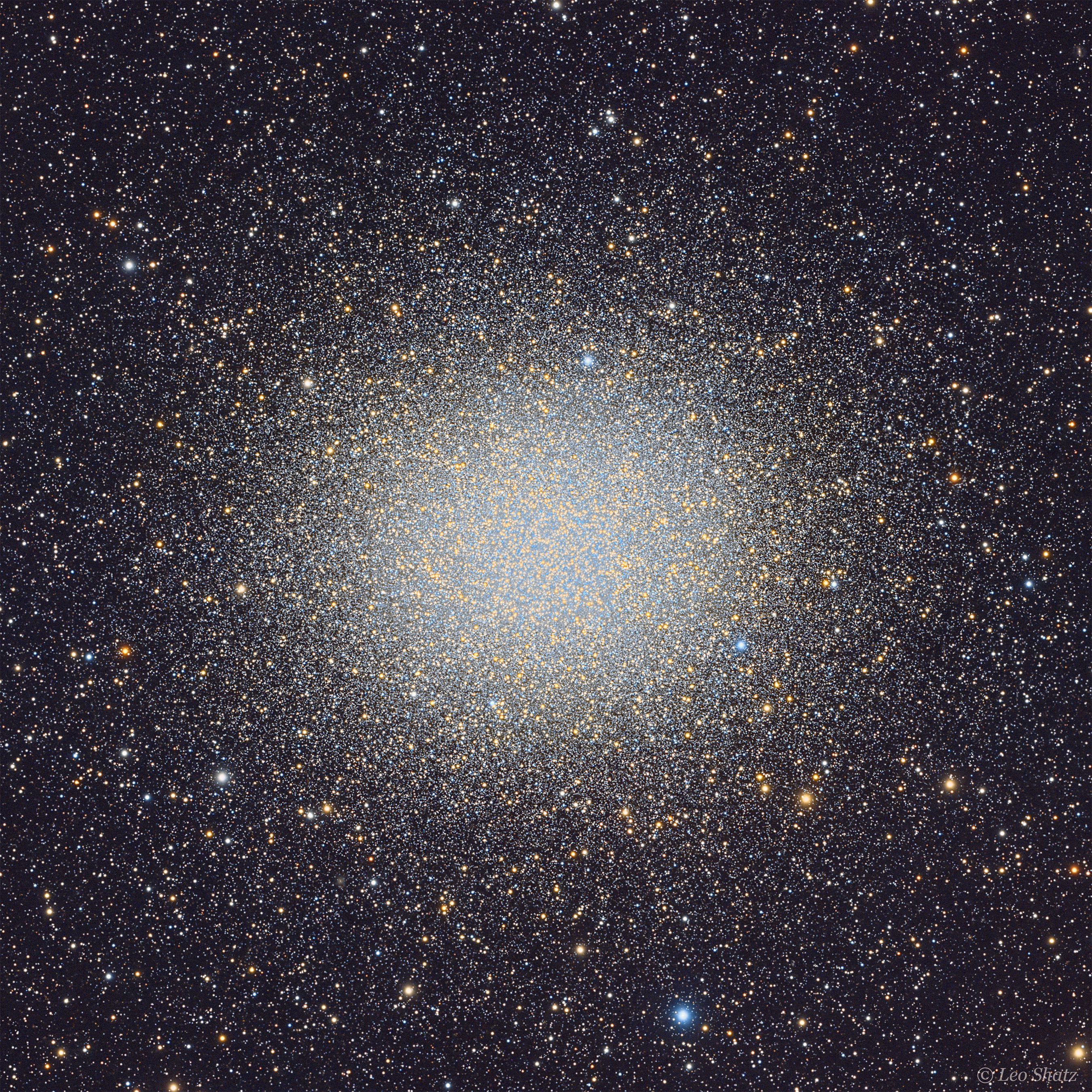
Image Credit & Copyright: Data acquisition - SkyFlux Team, Processing - Leo Shatz
Explanation: Globular star cluster Omega Centauri packs about 10 million stars much older than the Sun into a volume some 150 light-years in diameter. Also known as NGC 5139, at a distance of 15,000 light-years it's the largest and brightest of 200 or so known globular clusters that roam the halo of our Milky Way galaxy. Though most star clusters consist of stars with the same age and composition, the enigmatic Omega Cen exhibits the presence of different stellar populations with a spread of ages and chemical abundances. In fact, Omega Cen may be the remnant core of a small galaxy merging with the Milky Way. With a yellowish hue, Omega Centauri's red giant stars are easy to pick out in this sharp telescopic view. A two-decade-long exploration of the dense star cluster with the Hubble Space Telescope has revealed evidence for a massive black hole near the center of Omega Centauri.
25/07/2025
SANTé/MEDECINE - Les bénéfices de la marche pour le corps

Une révolution douce pour la santé
Si l’on en croit le spécialiste Dr. Manan Vora, la marche quotidienne représente l’un des exercices les plus simples mais aussi les plus efficaces pour améliorer durablement sa santé. Installé à Mumbai, cet orthopédiste et expert en médecine du sport partage régulièrement ses conseils à ses 450 000 abonnés sur Instagram. Récemment, il a détaillé dans une vidéo comment chaque minute passée à marcher transforme notre organisme, cumulant des effets bénéfiques étonnants au fil du temps.
L’effet immédiat de la marche sur le corps
Dès la première minute, le corps réagit : la circulation sanguine s’active, apportant un surplus d’oxygène et de nutriments essentiels vers muscles et organes. Passés cinq minutes, le moral s’améliore nettement grâce à l’afflux d’endorphines – ces fameuses «hormones du bonheur » –, offrant une sensation rapide de bien-être.
À dix minutes, le niveau de cortisol, hormone du stress, commence à chuter, permettant ainsi d’alléger rapidement les tensions accumulées. Quinze minutes suffisent pour que la marche contribue à réguler le glucose sanguin : un atout indéniable dans la gestion du diabète ou la prévention des pics glycémiques après les repas.
Les bénéfices qui s’accumulent avec la durée
Mais l’intérêt ne s’arrête pas là. Selon le Dr Vora, trente minutes de marche enclenchent un processus de combustion des graisses : c’est ici que le corps «commence à puiser dans ses réserves ». Une donnée précieuse pour celles et ceux qui cherchent à perdre du poids ou à améliorer leur composition corporelle. D’ailleurs, une étude menée en 2017 confirmait déjà que marcher modérément renforçait les effets d’un régime hypocalorique sur la perte de masse grasse et l’amélioration des marqueurs de risque cardiovasculaire.
En poursuivant jusqu’à quarante-cinq minutes, il devient possible d’apaiser l’esprit et d’interrompre les ruminations mentales : marcher longtemps calme littéralement le cerveau. Enfin, atteindre soixante minutes offre un dernier cadeau – non négligeable : un pic de dopamine, neurotransmetteur associé au plaisir et à la motivation.
Voici ce que retient le Dr Vora pour résumer ces bienfaits croissants :
・Dès quelques pas, circulation et humeur sont stimulées.
・À partir de 10-15 minutes, gestion du stress et du sucre s’améliore.
・Au-delà d’une demi-heure, perte de poids et équilibre mental deviennent tangibles.
ActusanteNet
ASTRONOMY - Twelve Years of Kappa Cygnids
2025 July 25

Image Credit & Copyright: Petr Horálek, Josef Kujal, Tomáš Slovinský; Acknowledgement: Mahdi Zamani
Explanation: Meteors from the Kappa Cygnid meteor shower are captured in this time-lapse composite skyscape. The minor meteor shower, with a radiant not far from its eponymous star Kappa Cygni, peaks in mid-August, almost at the same time as the much better-known and better-observed Perseid meteor shower. But, seen to have a peak rate of only about 3 meteors per hour, Kappa Cygnids are vastly outnumbered by the more popular, prolific Perseid shower's meteors that emanate from the heroic constellation Perseus. To capture dozens of Kappa Cygnids, this long term astro-imaging project compiled meteors in exposures selected from over 51 August nights during the years 2012 through 2024. Most of the exposures with identified Kappa Cygnid meteors were made in August 2021, a high point of the shower's known 7-year activity cycle. All twelve years worth of Kappa Cygnids are registered against a base sea and night skyscape of the Milky Way above Elafonisi Beach, Crete, Greece, also recorded in August of 2021.
24/07/2025
ASTRONOMY - Titan Shadow Transit
2025 July 24

Image Credit & Copyright: Volodymyr Andrienko
Explanation: Every 15 years or so, Saturn's rings are tilted edge-on to our line of sight. As the bright, beautiful ring system grows narrower and fainter it becomes increasingly difficult to see for denizens of planet Earth. But it does provide the opportunity to watch transits of Saturn's moons and their dark shadows across the ringed gas giant's still bright disk. Of course Saturn's largest moon Titan is the easiest to spot in transit. In this telescopic snapshot from July 18, Titan itself is at the upper left, casting a round dark shadow on Saturn's banded cloudtops above the narrow rings. In fact Titan's transit season is in full swing now with shadow transits every 16 days corresponding to the moon's orbital period. Its final shadow transit will be on October 6, though Titan's pale disk will continue to cross in front of Saturn as seen from telescopes on planet Earth every 16 days through January 25, 2026.
23/07/2025
ASTRONOMY - Fireball over Cape San Blas
2025 July 23
Image Credit & Copyright: Jason Rice
Explanation: Have you ever seen a fireball? In astronomy, a fireball is a very bright meteor -- one at least as bright as Venus and possibly brighter than even a full Moon. Fireballs are rare -- if you see one you are likely to remember it for your whole life. Physically, a fireball is a small rock that originated from an asteroid or comet that typically leaves a fading smoke trail of gas and dust as it shoots through the Earth's atmosphere. It is unlikely that any single large ground strike occurred -- much of the rock likely vaporized as it broke up into many small pieces. The featured picture was captured last week from a deadwood beach in Cape San Blas, Florida, USA.
SANTé/MEDECINE - Cancer du foie : (6/6) Le groupe sanguin AB

Ce n'est pas la première étude à établir un lien entre groupe sanguin et risque de cancer. Le site gouvernemental Santé.fr recense d'autres recherches, notamment une étude réalisée à Shanghai en 2017. Celle-ci montre que "le groupe AB est associé à un risque significativement plus élevé de cancer du foie." Si plusieurs travaux se recoupent sur le sujet, ces résultats sont toutefois à prendre avec des pincettes. Comme le souligne le site gouvernemental : "Il est important de garder à l’esprit que, non seulement ces observations ne sont que des associations statistiques, mais aussi que les augmentations et diminutions du risque de certaines maladies en lien avec les groupes sanguins sont, au plus, de l’ordre de quelques pour cent. Les groupes sanguins ne sont donc pas de bons facteurs de prédiction à l’échelle individuelle. Pour chacun d’entre nous, le groupe sanguin ne protège de ou ne condamne à aucune maladie."
AlineD.
22/07/2025
SANTé/MEDECINE - Cancer du foie : (5/6) Le groupe sanguin le plus susceptible de développer un cancer du foie

Cancer et groupe sanguin. Si un lien a pu être fait par les chercheurs, les raisons de cette corrélation restent encore inexpliquées. C'est pourquoi certains experts appellent à la prudence avant de tirer des conclusions trop hâtives. Selon eux : "Ces essais qui ne ciblent que le groupe sanguin ne tiennent souvent pas compte d’autres facteurs qui augmentent le risque de cancer, comme la consommation d’alcool ou le fait d’être fumeur."
AlineD.
(à suivre)
ASTRONOMY - A Double Detonation Supernova
2025 July 22
Image Credit: ESO, P. Das et al.; Background stars (NASA/Hubble): K. Noll et al.
Explanation: Can some supernovas explode twice? Yes, when the first explosion acts like a detonator for the second. This is a leading hypothesis for the cause of supernova remnant (SNR) 0509-67.5. In this two-star system, gravity causes the larger and fluffier star to give up mass to a smaller and denser white dwarf companion. Eventually the white dwarf's near-surface temperature goes so high that it explodes, creating a shock wave that goes both out and in -- and so triggers a full Type Ia supernova near the center. Recent images of the SNR 0509-67.5 system, like the featured image from the Very Large Telescope in Chile, show two shells with radii and compositions consistent with the double detonation hypothesis. This system, SNR 0509-67.5 is also famous for two standing mysteries: why its bright supernova wasn't noted 400 years ago, and why no visible companion star remains.
21/07/2025
SANTé/MEDECINE - Cancer du foie : Une corrélation entre cancer du foie et groupe sanguin (4/6)

Selon les conclusions, les personnes de "groupes sanguins A, B ou AB ont un risque 55 % plus élevé de développer un cancer de l’estomac par rapport aux personnes de groupe sanguin O". L'étude indique ensuite que "les personnes ayant un groupe sanguin A ont également un risque six fois plus élevé de développer un cancer de l’intestin, (ou colorectal)". Par ailleurs, d’autres recherches menées sur plus de 18 000 adultes ont montré que "les personnes du groupe sanguin AB avaient 45 % de risques supplémentaires de développer un cancer du foie."
AlineD.
(A suivre)
Inscription à :
Articles (Atom)
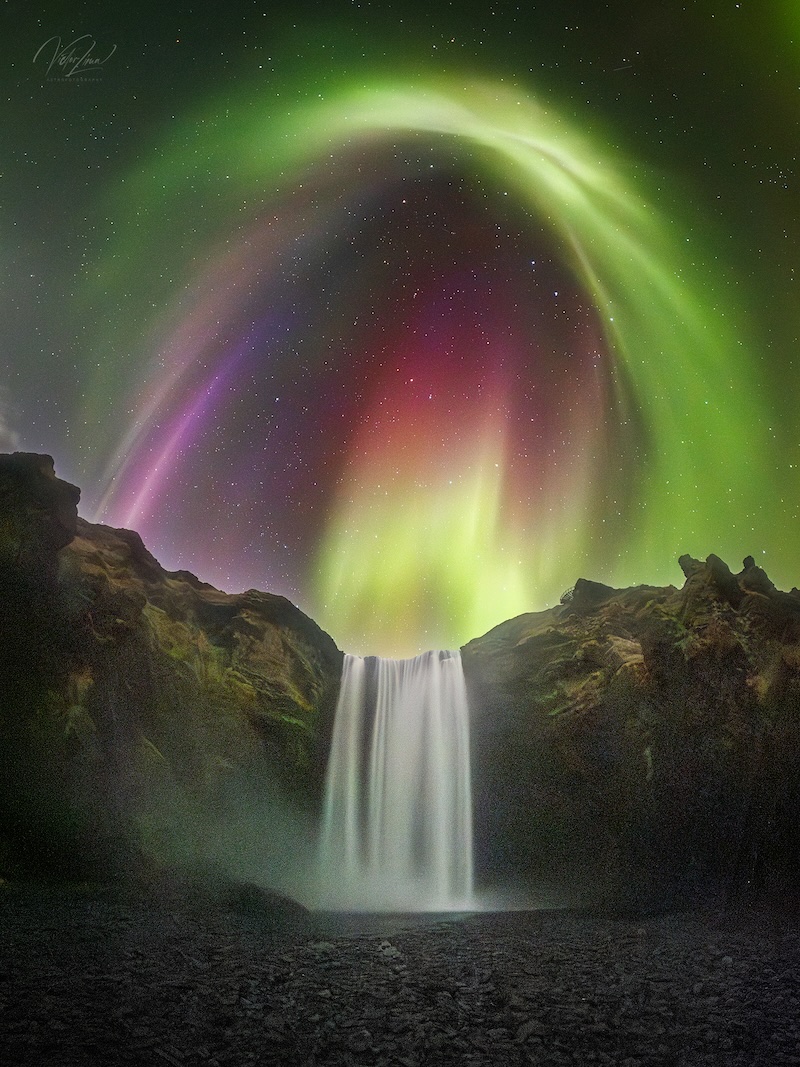
Astronomy - COLORFUL AURORA OVER ICELANDIC WATERFALL
2026 August 27 Colorful Aurora over Icelandic Waterfall Image Credit & Copyright: Victor Lima Text: Cecilia Chirenti ( NASA GSFC , UM...
-
2026 January 2 NanoSail-D2 Image Credit & Copyright : Ralf Vandebergh Explanation: In 2011, on January 20, NASA's NanoSail-D2 ...
-
2026 January 1 Auroral Corona Image Credit & Copyright : Roi Levi Explanation: Cycle 25 solar maximum made 2025 a great year for ...


